Friday, October 11, 2013
Liberia: EPA, UNDP to Launch Climate Change Project
Thursday, June 20, 2013
Japan and UNDP Highlight Need to Build On Adaptation Achievements in Africa
AllAfrica.com
In their opening addresses at the event, Burkina Faso President Blaise Compaoré, Japan's Parliamentary Senior Vice-Minister for Foreign Affairs Masaji Matsuyama and UNDP Administrator Helen Clark said they would like to see progress made under the ...
Wednesday, April 17, 2013
For 11.5% cut UNDP will give you access to project developers and holders of carbon credits in Africa ! Hurry Certificates are limited !
Promoting access to low-carbon development in Africa
"The African continent has historically not benefited much from the CDM," said Christiana Figueres, executive secretary of the United Nations Framework Convention on Climate Change (UNFCCC). "The current state of the market opens the possibility for African nations to increase their participation, in particular via a programmatic approach that caters to smaller projects. The Africa Carbon Forum aims to further improve the access to and spread of the CDM on the continent."
The CDM allows emission reduction projects in developing countries to earn certified emission reductions (CERs), commonly known as carbon credits, each equivalent to one tonne of carbon dioxide. CERs can be traded and sold, and used by industrialized countries to meet a part of their emission reduction targets under the Kyoto Protocol.
Wednesday, February 13, 2013
Tuesday, December 4, 2012
Helping Africa by talking about it with rich Japanese donors ! No one knows the truth behind Administrative overhead that Helen Clark charges to cover her lavish style living at Trump towers in New York.
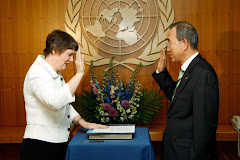
Helen Clark: Keynote Address at the JICA Symposium on The Tokyo International Conference for African Development
30 November 2012Helen Clark, UNDP Administrator
Keynote Address at the JICA Symposium on
The Tokyo International Conference for African Development (TICAD)
United Nations University HQ, Tokyo, Japan
30 November 2012, 5pm (local time)
I am very pleased to be able to attend this symposium hosted by JICA, because of the strong partnership between UNDP and Japan, and our shared commitment to development in Africa. This co-operation takes place under the framework of the Tokyo International Conference on African Development (TICAD), and today we reflect on its two decades of support for Africa.
Monday, November 26, 2012
Are you an American retiree ore veteran? Are you part of 10 Million Americans living in poverty ? ...are you paying too much for your prescription drugs? Is Medicare not helping? The United Nations might help you - why not consider going to Africa ? Drugs are free there for the poor !
Germany funds UNIDO project on local production of essential medicines in Africa
Click here for this story in full @ ReliefWeb: http://reliefweb.int/report/kenya/germany-funds-unido-project-local-production-essential-medicines-africa
VIENNA, 21 November 2012 – The Government of Germany will fund a EUR 1 million project in support of local production of essential generic medicines in Ghana, Kenya and additional countries in Africa. The project will begin in January 2013.
The new funding is expected to accelerate the implementation of the African Union’s Pharmaceutical Manufacturing Plan for Africa (PMPA), a joint endeavor with the African Union Commission.
“Unsatisfactory access to essential drugs is a key limitation that has had an impact on the health of the populations in a range of countries in Africa,” said Kandeh K. Yumkella, UNIDO Director-General.
“Local manufacturers in developing countries could be a source of assured quality drugs, especially for the poor. Certified local production is also a way to combat counterfeit drugs, which endanger human lives.”
It is envisaged that in the future, the project could include more countries: Mozambique, Nigeria, Tanzania, Uganda, and Zimbabwe...
Click here for this story in full @ ReliefWeb: http://reliefweb.int/report/kenya/germany-funds-unido-project-local-production-essential-medicines-africa
Are you wondering where Luiz Inacio Lula da Silva was/is ? Wonder no more : United Nations has engaged his services as best practices to fight hunger in Africa !
UN, African Union and Instituto Lula join forces to fight against African hunger
During a meeting at the African Union’s (AU) headquarters in the Ethiopian capital of Addis Ababa, the heads of the UN Food and Agriculture Organization (FAO), the African Union (AU) and the not-for-profit Instituto Lula agreed to pursue their “shared vision” of a hunger-free Africa through a coordinated campaign against malnutrition and food security, according to an FAO news release announcing the partnership.
“Building a food and nutrition-secure Africa requires better governance, renewed political will and strong commitment to work together through innovative and comprehensive food security and nutrition programmes and strategies involving all concerned stakeholders,” said FAO’s Director-General, José Graziano da Silva.
According to FAO statistics, the number of undernourished people on the African continent has steadily increased since the early 1990s, from 175 million to 239 million today.
Despite the negative trend, the Chairperson of the AU Commission, Nkosazana Dlamini Zuma, underscored Africa’s agricultural potential, noting that 60 per cent of the continent’s arable land was still unutilized.
“This enormous potential can make a real difference to improve our agricultural production and food security,” said Ms. Zuma, adding that the time had come for African farmers to move beyond subsistence agriculture to more expansive methods of agro-industrial production.
Tuesday, November 13, 2012
Helen Clark's rush to institutionalize Carbon Tax - she uses scare tactics - with false statistics !
Click here to read this at Tom Nelson's Blog: http://tomnelson.blogspot.com/2012/11/un-helen-clark-co2-could-cause.html
UN's Helen Clark: CO2 could cause agricultural yields to fall 50% in some African countries by 2050; CO2 may also cause meningitis epidemics
Some African countries could see agricultural yields decrease by fifty per cent by 2050.
...The average price of staple foods is now expected to rise over the long term, with some scenarios suggesting that wheat prices will be locked in at fifteen per cent higher in 2050.
...
The Arctic sea ice has just reached its lowest level in thousands of years.
...
Climate variability and extreme conditions such as floods can trigger epidemics of diseases, such as diarrhoea, malaria, dengue fever, and meningitis. ...The death toll from cyclones in Bangladesh, for example, was reduced from around 500,000 people in 1970 to 3,000 in 2007, thanks in part to improved early warning systems.
...
Recent estimates suggest that our carbon-intensive economies cost the world around US$1.2 trillion a year -or 1.6 per cent of total global GDP.
Click here to read this at Tom Nelson's Blog: http://tomnelson.blogspot.com/2012/11/un-helen-clark-co2-could-cause.html
Friday, October 26, 2012
How much does United Nations' Ban Ki-moon hate Africa? A lot ! He lobbied behind the scenes that the newest Global Green Fund be located in his native South Korea !
Click here to read this in full at allAfrica.com: http://allafrica.com/stories/201210240554.html
NAMIBIA has lost to South Korea in the bidding to host the secretariat of the United Nations Framework Convention on Climate Change (UNFCCC) Green Climate Fund (GCF) in Windhoek.
The 24-member board of the GCF on Saturday selected the South Korean port city of Incheon to house the secretariat.
Environment and Tourism Minister Netumbo Nandi-Ndaitwah said earlier that Namibia deserved to host the secretariat because the country had demonstrated strong leadership and acted as a role model for other developing countries in the area of climate change and environmental management.
Namibia submitted its expression of interest to an interim GCF secretariat on February 15, and its candidature to host the fund was endorsed by the Southern African Development Community (SADC) as well as the African Union (AU)...
Click here to read this in full at allAfrica.com: http://allafrica.com/stories/201210240554.html
Wednesday, October 17, 2012
interesting exchange of Geraldine Moleketi in Twitter about democratic standards required from African countries
Thursday, August 2, 2012
The Telegraph: Aid to despot must stop
Telegraph View: Andrew Mitchell, the Development Secretary, must cancel aid to Rwanda's president Paul Kagame immediately.
How many guest speakers at the Conservative Party conference have been accused of helping an indicted war criminal to lay waste to a swathe of Africa? Step forward President Paul Kagame of Rwanda, a plausible and ruthless autocrat, who was favoured with a special invitation to address the party faithful in 2007. Even at the time, this was an odd decision. Mr Kagame’s subsequent behaviour casts doubt over whether he is fit to have any kind of relationship with Britain.
Andrew Mitchell, the International Development Secretary, has “delayed” a payment of £16 million. Given the gravity of the charges, this inadequate response suggests that Britain is still inhibited by loyalty to the despot and embarrassment over having favoured him for so long. The idea that any leader who promotes murder and plunder should receive funding is abhorrent. Mr Mitchell should cancel aid to Rwanda's government immediately...
Click here to read the full story on the Telegraph
Wednesday, July 18, 2012
Following Helen Clark on Twitter: Is she a UNDP leader or a Socialist International thinker ?
SOCIALIST INTERNATIONAL CAMPAIGNS (Click here)
MAKING THE FIGHT AGAINST POVERTY IN AFRICA AN URGENT PRIORITY
• put in place a programme of collective action in the fight against poverty;
- To involve the IMF and the World Bank- To join efforts with the ONGs
Saturday, October 22, 2011
Tegegnework Gettu:- the man behind the secret deals inside UNDP

Thursday, September 1, 2011
Hiding the Real Africa
Why NGOs prefer bad news

And now for some good news out of Africa. Poverty rates throughout the continent have been falling steadily and much faster than previously thought, according to the National Bureau of Economic Research. The death rate of children under five years of age is dropping, with “clear evidence of accelerating rates of decline,” according to The Lancet. Perhaps most encouragingly, Africa is “among the world’s most rapidly growing economic regions,” according to the McKinsey Quarterly.
Yet US journalism continues to portray a continent of unending horrors. Last June, for example, Time magazine published graphic pictures of a naked woman from Sierra Leone dying in childbirth. Not long after, CNN did a story about two young Kenyan boys whose family is so poor they are forced to work delivering goats to a slaughterhouse for less than a penny per goat. Reinforcing the sense of economic misery, between May and September 2010 the ten most-read US newspapers and magazines carried 245 articles mentioning poverty in Africa, but only five mentioning gross domestic product growth.
Reporters’ attraction to certain kinds of Africa stories has a lot to do with the frames of reference they arrive with. Nineteenth century New York Herald correspondent Henry M. Stanley wrote that he was prepared to find Zanzibar “populated by ignorant blacks, with great thick lips, whose general appearance might be compared to Du Chaillu’s gorillas.” Since the Biafran War, a cause célèbre in the West, helped give rise in the late 1960s to the new field of human rights, Western reporters have closely tracked issues like traditional female circumcision. In the 1980s, a famine in Ethiopia that, in fact, had as much to do with politics as with drought, set a pattern of stories about “starving Africans” that not only hasn’t been abandoned, but continues to grow: according to a 2004 study done by Steven S. Ross, then a Columbia journalism professor, between 1998 and 2002 the number of stories about famine in Africa tripled. In Kenya, where I was a Peace Corps volunteer in the late 1960s and where I returned to live four years ago, The New York Times description of post-election violence in 2007 as a manifestation of “atavistic” tribalism carried echoes of Stanley and other early Western visitors.
But the main reason for the continued dominance of such negative stereotypes, I have come to believe, may well be the influence of Western-based non-governmental organizations (NGOs) and international aid groups like United Nations agencies. These organizations understandably tend to focus not on what has been accomplished but on convincing people how much remains to be done. As a practical matter, they also need to attract funding. Together, these pressures create incentives to present as gloomy a picture of Africa as possible in order to keep attention and money flowing, and to enlist journalists in disseminating that picture.
Africans themselves readily concede that there continues to be terrible conflict and human suffering on the continent. But what’s lacking, say media observers like Sunny Bindra, a Kenyan management consultant, is context and breadth of coverage so that outsiders can see the continent whole—its potential and successes along with its very real challenges. “There are famines; they’re not made up,” Bindra says. “There are arrogant leaders. But most of the journalism that’s done doesn’t challenge anyone’s thinking.”
Over the past thirty years, NGOs have come to play an increasingly important role in aid to Africa. A major reason is that Western donors, worried about government corruption, have channelled more funds through them. In the mid-1970s, less than half a dozen NGOs (like the Red Cross or CARE) might operate in a typical African country, according to Nicolas van de Walle, a professor of government at Cornell, but now the same country will likely have 250.
This explosive NGO growth means increasing competition for funds. And according to the head of a large US-based NGO in Nairobi, “When you’re fundraising you have to prove there is a need. Children starving, mothers dying. If you’re not negative enough, you won’t get funding.” So fierce is the competition that many NGOs don’t want to hear good news. An official of an organization that provides data on Somalia’s food situation says that after reporting a bumper harvest last year, “I was told by several NGOs and UN agencies that the report was too positive.”
Rasna Warah, a Kenyan who worked for UN-Habitat before leaving to pursue a writing career, says that exaggerations of need were not uncommon among aid officials she encountered. “They wanted journalists to say ‘Wow.’ They want them to quote your report,” she says. “That means more money for the next report. It’s really as cynical as that.”
Western journalists, for their part, tend to be far too trusting of aid officials, according to veteran Dutch correspondent Linda Polman. In her book The Crisis Caravan, she cites as one example the willingness of journalists to be guided around NGO-run refugee camps without asking tough questions about possible corruption or the need for such facilities. She writes, “Aid organizations are businesses dressed up like Mother Teresa, but that’s not how reporters see them.”
Pushed and pulled by slashed budgets and increased demands, journalists are growing increasingly reliant on aid groups. Sometimes that involves not just information or a seat on a supply plane, but deep involvement in the entire journalistic process.
In an online essay written in 2009, Kimberly Abbott of the International Crisis Group discussed a 2005 Nightline program on Uganda that her NGO helped to produce and fund. It was hosted by actor Don Cheadle, the star of Hotel Rwanda. Nightline’s Ted Koppel explained in his introduction, as retold by Abbott: “Cheadle wanted his wife and daughters to get a sense of the kind of suffering that is so widespread in Africa. The International Crisis Group wanted publicity for what is happening in Uganda. And we, to put it bluntly, get to bring you a riveting story at a greatly reduced expense.” According to Abbott, “versions of such partnerships are happening now in print and broadcast newsrooms across the country, though many are reluctant to discuss them too openly.”
Daniel Dickinson, a former BBC reporter who is now a communications officer for the European Union in Nairobi, has seen the impact of technology and economics on reporting on Africa first-hand. “The big difference in the past five to ten years is the expansion of the Internet,” he says. “Journalists have got to feed these animals. Add to that the financial crash, and more and more internationals are taking the content we offer them.”
Ben Parker, co-founder and head of IRIN, a news agency that is part of the UN Office for the Coordination of Humanitarian Affairs, admires Dickinson’s success. “He does stories and they’re picked up whole,” Parker says. IRIN itself can point to many similar successes in finding takers for its stories on aid projects. “The Western media won’t reprint us verbatim,” he says. “But some plagiarize.”
Lauren Gelfand, a correspondent for Jane’s Defence Weekly who is based in Nairobi, says most reporters she knows string for three or four news organizations to make ends meet, and can’t afford to do time-consuming stories. She saw the effect when she took a year off from journalism to work for Oxfam. “If reporters were going to cover a development story it had to be easy,” remembers Gelfand, noting that the simplest sell was a celebrity visit to an aid project.
Gelfand says that her Oxfam experience helped her to understand just how much attention ngos put on getting their story told. “All the talking points are carefully worked out…. It’s a huge bureaucracy and there are as many levels of control as in any government,” she says of Oxfam, adding that many NGOs are reluctant to cooperate with media unless they know they’ll be shown in a positive light.
To be fair to the NGOs, Gelfand says, “It’s easier to sell a famine than to effect real, common-sense policy change.” And, she says, she continues to believe that most aid workers do what they do because they want to make a difference. Nonetheless, “A lot of what Oxfam does is to sustain Oxfam.”
Stories featuring aid projects often rely on dubious numbers provided by the organizations. Take Kibera, a poor neighborhood in Nairobi. A Nexis search of major world publications found Kibera described as the “biggest” or “largest” slum in Africa at least thirty-four times in 2004; in the first ten months of 2010 the claim appeared eighty-three times. Many of those stories focused on the work of one of the estimated 6,000 or more local and international NGOs working there, and cited population figures that ranged as high as one million residents. Recently, however, the results of Kenya’s 2009 census were released: according to the official tally, Kibera has just 194,269 residents. In 2010, Rasna Warah wrote in the Daily Nation, a Kenyan paper, that while working for the Worldwatch Institute, an NGO, she had published inflated population estimates using UN-Habitat data, despite knowing there was no consensus on the numbers among her former colleagues at the organization. Sometime after 2004, she wrote, population estimates for Kibera started to rise, and “Before we knew it, the figure spread like a virus.” She added, “The inflated figures were not challenged, perhaps because they were useful to various actors…. They were particularly useful to NGOs, which used them to ‘shock’ charities and other do-gooders into donating more money to their projects in Kibera.”Questionable figures of another sort are to be found in reports on the United Nations Millennium Development Goals, a series of targets on poverty reduction and other measures of well-being. UN and NGO officials routinely describe Africa as failing to meet the goals, and the press routinely writes up this failure.
But some experts, among them Jan Vandemoortele, one of the architects of the MDGS, have expressed concern that the goals are being misused. He wrote in 2009 that the MDGS were intended as global targets, but have been improperly applied to individual countries and regions. “It is a real tragedy when respectable progress in Africa is reported as a failure by international organizations and external observers,” Vandemoortele wrote, voicing the suspicion that particular measurements have been selected “so as to present Africa as a failure, solely to gain support for a particular agenda, strategy, or argument.”
Nonetheless, when the UN met in September, The Associated Press quoted UN Secretary-General Ban Ki-moon as saying, “Many countries are falling short, especially in Africa,” while the Los Angeles Times quoted an Oxfam report as saying, “Unless an urgent rescue package is developed to accelerate fulfillment of all the MDGS, we are likely to witness the greatest collective failure in history.”
The consequences of skewed or incomplete reporting on Africa are not just a disservice to readers but also have the potential to influence policy. “The welfare model [of Africa] is still dominant on the Hill and in Hillary Clinton’s world,” according to van de Walle. Among corporate officials, says Catherine Duggan, an assistant professor at Harvard Business School, the perception is still that “Africa is where you put your money once you’ve made it somewhere else.” Moreover, such reporting is demoralizing to Africans working for change. Martin Dawes, a unicef regional chief of communication for West and Central Africa, says that when there is a disaster, journalists “come to us as aid workers but often don’t talk to the government, which is often what we’re working through. It means that the chances for Africans to show an engaged response is limited. They are written out of their own story.”
Even with shrinking resources, journalists can do better than this. For a start, they can stop depending so heavily, and uncritically, on aid organizations for statistics, subjects, stories, and sources. They can also educate themselves on how to find and interpret data available from independent sources. And they can actively seek out stories that deviate from existing story lines.
But in the end, it will probably take sustained economic progress to break the current mold. Sunny Bindra, the Kenyan management consultant, recalls that in the 1980s, “Japan got attention because it was whacking the US. It’s the same with India and China now.” Until that happens, a sick African woman in labor will continue to be treated as poverty porn, and most Africans will have to starve in order to make it onto the evening news.
This article was adapted from a paper (pdf) written for Harvard’s Joan Shorenstein Center on the Press, Politics and Public Policy.
Friday, August 19, 2011
U2 Singer Bono says: "west is doing nothing for poor Africa"
Hey Bono - if you want others to pay, why not put 50% of your FB CASH to fund Horn of africa crisis? So people can actually trust you?
CLICK HERE FOR THIS STORY
Sunday, January 30, 2011
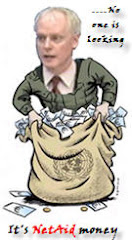
Where is NETAID money? Maybe Harry Belafonte and Danny Glover know smth about ?!
By Colum Lynch and Paul Farhi
Washington Post Staff Writers

The concerts will be carried live on MTV, VH-1, the BBC and other broadcasters to 60 countries; radio broadcasts will reach 120 nations, potentially making these the widest heard musical performances in history. The shows will promote NetAid's Web site, which will serve as a kind of clearinghouse for donors and organizations dedicated to relieving hunger and eradicating poverty.
But even before the first chords are struck, the novel charitable alliance is caught up in controversy, deflecting charges of self-interest and self-dealing. Harry Belafonte, the actor and musician who helped organize the event, said he and actor Danny Glover were quitting in disgust. The event, he said, had "been reduced to a trade show" promoting the U.N. bureaucracy and a corporate sponsor, Cisco Systems Inc.
U.N. sources said that in his letter of resignation, Belafonte also complained that proceeds would be funneled back into the U.N. Development Program and Cisco before money reached the world's poor.
"When you deal with the flesh and the blood that makes up the hungry and disenfranchised of this world, you must play in a field of trust," Belafonte said in an interview. "I find that sacred ground. There shouldn't be any cynicism or agendas."
NetAid is the brainchild of a Cisco executive, Diane Merrick, who last year began considering ideas for an attention-getting stunt for her company, based in San Jose, Calif. To promote Cisco, which makes the routing and switching equipment that is the Internet's plumbing, Merrick considered staging an event that would be accessible to millions online.
Among other ideas, she thought about using the Internet to "stream" live video of a fashion show or the worldwide premiere of a Steven Spielberg film. The company particularly wanted to generate attention during Telecom '99, a huge trade show being held this week in Geneva (one of the NetAid concerts will emanate from Geneva, with an audience specially invited by Cisco).
"We were really looking for a way to demonstrate the power of the Internet outside the business realm," Merrick said. "Business has already embraced the Internet. What we wanted to do was give everyone else a glimpse of the future."
Casting about for a more populist vehicle, Cisco eventually contacted music promoter Ken Kragen, who had organized the Hands Across America event in 1986 and the "We Are the World" benefit for famine relief in 1985. By coincidence, Kragen had received a call a week earlier from Belafonte, who wanted Kragen's help in producing an event to mark the United Nations' World Poverty Week, also scheduled at the same time as Telecom '99.
"It was just serendipity," said Kragen. "There was something magical about" the coincidental timing of the U.N. event and the business conference. The company and Belafonte soon began discussion to merge their events.
Belafonte, who was active in the civil rights movement, was asked last year by the United Nations to harness the drawing power of the pop music and film elite in the cause of fighting global poverty. Backed by Cisco's initial commitment of $3 million, he recruited Glover, former South African President Nelson Mandela and U2's Bono, who has advocated that wealthy nations forgive the debts of impoverished countries.
But by August, less than two months before the concerts, Belafonte began privately criticizing the organizing effort. Specifically, he is upset about the makeup of the board overseeing the NetAid foundation, which is dominated by U.N. officials and corporate executives. He is also critical of an arrangement whereby Cisco will be reimbursed about $5 million from NetAid concert-ticket receipts and broadcast rights fees. The company made cash advances to reserve Giants Stadium in New Jersey and Wembley Stadium in London for the shows.
Cisco also has donated $10 million to the NetAid Foundation and contributed roughly $10 million to $12 million more in services, time and equipment. The company says that none of this will be reimbursed.
U.N. officials and NetAid organizers said the reimbursement arrangement is standard practice. They characterized the dispute as driven by oversized egos and a conflict over leadership of the event, not financial impropriety. They said Belafonte lashed out because he could not exercise absolute control over a project that grew dramatically in scope and political importance since its inception.
Organizers also noted that NetAid has continued to attract endorsements and involvement from political figures and celebrities. In September, President Clinton, British Prime Minister Tony Blair and Nelson Mandela were the first to log on to the NetAid Web site (www.netaid.org). The event has also had no trouble attracting performers such as Sheryl Crow, George Michael and Mary J. Blige.
The departures, nevertheless, could prove embarrassing for the United Nations, which has gingerly begun to seek alliances with corporate sponsors to help fill the funding gap caused by shrinking contributions from wealthy governments. NetAid represents the first major collaboration between the United Nations and a private corporation to tackle a specific global problem.
In addition to Cisco, the consulting firm KMPG and the computer company Akamai Technologies have been involved in setting up the Internet site. Several of the aid organizations have links on the NetAid site, which also carries links to the homes pages of Cisco, Akamai and KMPG.
"The point is not to raise money from the concerts; the point is to build a constituency of activists for development" through the Internet, said Mark Malloch Brown, UNDP director.
The NetAid Web site also attempts to dramatize the gulf between industrialized nations and the developing world. It offers implicit and sometimes overt critiques of Western lifestyles. Visitors to the site are likely to learn that "the richest 20 per cent of the world's people eat 11 times as much meat and seven times as much fish as the poorest 20 percent" as well as the following: "In the minute it will take you to read this, 13 children will have died in the world's poorest countries. Each day, the rich West gets $35 million in debt repayments from the poorest nations in Africa. . . . Debt can kill."
The site avoids much discussion of corruption, waste, ethnic warfare, governmental oppression, political strife or cultural practices that impede progress in developing countries.
Cisco says the NetAid Web site will be the most powerful in the world, capable of handling 60 million "hits" every hour or up to 125,000 simultaneous video "streams" of the concert.
Both U.N. Secretary General Kofi Annan and Malloch Brown have met with Belafonte to try to address his concerns.
According to the sponsors, the net proceeds from sales of concert tickets – which cost from $30 to $75 – will go to poverty relief programs in Africa, Kosovo and elsewhere. Additional funds collected from private donations made over the Internet will go to a variety of programs, including hunger-relief projects and refugee resettlement programs, officials said.
Malloch Brown said Belafonte had proposed to distribute the money throughout the U.N. system. Malloch Brown argued in favor of creating a nine-member panel, composed of representatives of the U.N., various charities, corporate sponsors and entertainers.
Belafonte said he was asked last year by the head of the U.N. Food and Agricultural Organization, Jacques Douf, to "please use whatever creative resources [were] at my disposal in the name of ending hunger."
He said he approached an acquaintance, Djibril Diallo, the communications director of the UNDP. But he says UNDP and Cisco Systems quickly seized control of the project.
"They co-opted the ownership of the Web site and the logo," Belafonte said. "I then decided I could not stay with the project and give it the grace of my presence, for whatever that was worth
Thursday, August 12, 2010
Former Africa minister Malloch-Brown advises oil firm on African expansion

- Rajeev Syal and Solomon Hughes
- guardian.co.uk,
- Article history

Just 12 months after resigning from the government, Lord Malloch-Brown, the former Foreign Office minister for Africa, has become an adviser to an oil firm that is expanding its interests on the continent.
Vitol, the Swiss-based oil firm, has previously been fined for paying kickbacks to Saddam Hussain's regime. It recently entered talks to take over oil businesses in 19 African countries.
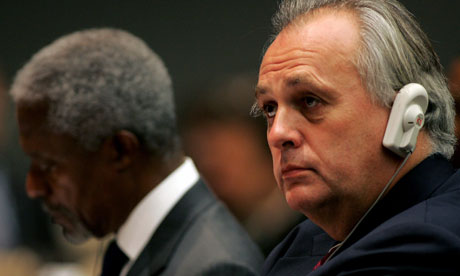
The disclosure about the talks and that Malloch-Brown, the Labour peer and former UN deputy secretary general, is a consultant to the firm, has raised concerns among Labour MPs over former ministers who have left government and gone into lucrative, private-sector, jobs closely related to their ministerial roles.
Sir Peter Soulsby, a Labour member of the Commons' political and constitutional reform committee, said: "There ought to be much tougher rules on the jobs that ministers take when they leave office. Taking this particular job at the very least shows an unfortunate lack of judgment."
Malloch-Brown, 57, joined Gordon Brown in July 2007 as part of the former prime minister's "government of all the talents". Her was also made a life peer. He stood down from office in July last year, for "personal and family reasons".
His new role has been approved by the advisory committee on business appointments, which advises ex-ministers on jobs taken within two years of leaving office.
Vitol is in negotiations with Shell Oil Products Africa for the potential acquisition of their businesses in several countries, including Egypt, Togo Senegal, Kenya, Uganda, Tanzania, Botswana and Namibia. It already has interests in Ghana and Cameroon.
In 2007, the firm admitted paying illegal kickbacks under the UN oil-for-food programme and agreed to pay $17.5m in restitution and fines.
The oil-for-food scheme was designed to use proceeds from Iraq's sales to buy food, medicine and other humanitarian aid, to alleviate the impact of international sanctions.
In 2006, when Malloch-Brown was chief of staff to the UN secretary general, Kofi Annan, he defended the organisation's oil-for-food programme from claims of fraud by telling the security council that "not a penny was lost from the organisation".
Malloch-Brown, who is also a consultant to Southwest Energy, an Ethiopian oil firm, defended his new role and dismissed claims of a potential conflict of interest. "My knowledge of Africa was not gained as a British minister. Rather I was recruited into government because I had worked extensively on African and international issues throughout my career. My activities today continue to reflect that," he said, adding that he had never been in contact with Vitol during his time at the UN, nor had any dealings with the company when he was a minister.
When in government, Malloch-Brown quickly gained a reputation for making colourful comments. The then foreign secretary at the time, David Miliband, who is 11 years his Malloch-Brown's junior, was said to have been upset when he the latter told a newspaper: "It's fine for me to be, for the first time in my life, the older figure, the wise eminence behind the young foreign secretary." He also raised eyebrows when he said that Tony Blair and George W Bush were "joined at the hip".
Other ministers who worked under Gordon Brown and who have taken up private-sector jobs include Lady Vadera, a former business minister who is now advising the authorities in Dubai, and Lord Carter of Barnes, the former head of strategy at No 10, now marketing chief for Alcatel-Lucent telecoms group. Ruth Kelly, the former education secretary, was appointed as senior strategic manager for HSBC. John Hutton, the former energy minister and defence secretary, has become an adviser to Eversheds, the law firm, and is joining the board of the US firm Hyperion Power Generation, which sells nuclear reactors.
Malloch-Brown, who is also a consultant to correctSouthwest Energy, an Ethiopian oil company, defended his new role this week and dismissed any allegations of a potential conflict of interest. "My knowledge of Africa was not gained as a British minister. Rather I was recruited into government because I had worked extensively on African and international issues throughout my career. My activities today continue to reflect that," he said.
He added that he had never been in contact with Vitol during his time at the UN, nor had any dealings with the the company when he was a minister.
"As part of my due diligence prior to starting my consulting appointment, I have discussed the oil-for-food issue and reviewed the steps that have been taken by Vitol to ensure that the necessary lessons have been learnt and the right compliance programme put in place," he said. He declined to say how much he would be paid for the role.
A spokesman for Vitol said the timing of Malloch-Brown's recruitment, and the decision to negotiate to take over parts of Shell's operations in Africa, was a coincidence. "This type of expansion activity is something that Vitol has been looking at for some time."
A statement added that the peer's new consulting agreement began last month and had been properly disclosed on the Lords website. "Lord Malloch-Brown provides consulting services on geo-political issues of importance to the Vitol group, including current and potential future business in Africa," it read.

iginio gagliardone
Geraldine Moleketi
Helen Clark
undpwatch