Click here to read this in full @: http://www.undp.org/content/undp/en/home/ourperspective/ourperspectivearticles/2013/01/10/the-internet-gender-gap-magdy-martinez-soliman.html
The role of ICTs as development enablers is more widely understood
today as access to new technologies, particularly mobile phones, has
grown exponentially. Mobile phone subscriptions exceeded six billion by
the end of 2012, three-quarters of which were in the developing world.
However, women are at a disadvantage: they are 21% less likely to own a
mobile phone than men, according to the latest Broadband Commission Report (PDF, 2.4Mb).
Development presents an opportunity to effectively address this and
other gender gaps. I am speaking here about sustainable human
development, about the ability to make choices and lead a healthy, long
and educated life with all that we value.
Showing posts with label internet. Show all posts
Showing posts with label internet. Show all posts
Wednesday, February 13, 2013


Friday, October 26, 2012
UN Seeking Global Internet Surveillance for Terror, Propaganda
Click here to read this in full at The New American: http://www.thenewamerican.com/tech/computers/item/13335-un-seeking-global-internet-surveillance-for-terror-propaganda
The United Nations and a broad coalition of its totalitarian-minded member governments are increasingly demanding that a global regulatory regime be imposed over the Internet, with supposed concerns about “terrorism” becoming just the most recent argument advanced to support the controversial scheme. In a massive report released this week, the UN claimed a planetary agreement on surveillance, data retention, and more would be needed for “terror” purposes.
Click here to read this in full at The New American: http://www.thenewamerican.com/tech/computers/item/13335-un-seeking-global-internet-surveillance-for-terror-propaganda
The United Nations and a broad coalition of its totalitarian-minded member governments are increasingly demanding that a global regulatory regime be imposed over the Internet, with supposed concerns about “terrorism” becoming just the most recent argument advanced to support the controversial scheme. In a massive report released this week, the UN claimed a planetary agreement on surveillance, data retention, and more would be needed for “terror” purposes.
Click here to read this in full at The New American: http://www.thenewamerican.com/tech/computers/item/13335-un-seeking-global-internet-surveillance-for-terror-propaganda
Sunday, January 30, 2011
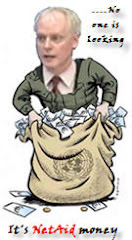
Where is NETAID money? Maybe Harry Belafonte and Danny Glover know smth about ?!
NetAid Weaves a Complicated Web

By Colum Lynch and Paul Farhi
Washington Post Staff Writers
By Colum Lynch and Paul Farhi
Washington Post Staff Writers

Actor Danny Glover has also withdrawn his support
from NetAid. (Michael Lutzky — The Washington Post)
The concerts will be carried live on MTV, VH-1, the BBC and other broadcasters to 60 countries; radio broadcasts will reach 120 nations, potentially making these the widest heard musical performances in history. The shows will promote NetAid's Web site, which will serve as a kind of clearinghouse for donors and organizations dedicated to relieving hunger and eradicating poverty.
But even before the first chords are struck, the novel charitable alliance is caught up in controversy, deflecting charges of self-interest and self-dealing. Harry Belafonte, the actor and musician who helped organize the event, said he and actor Danny Glover were quitting in disgust. The event, he said, had "been reduced to a trade show" promoting the U.N. bureaucracy and a corporate sponsor, Cisco Systems Inc.
U.N. sources said that in his letter of resignation, Belafonte also complained that proceeds would be funneled back into the U.N. Development Program and Cisco before money reached the world's poor.
"When you deal with the flesh and the blood that makes up the hungry and disenfranchised of this world, you must play in a field of trust," Belafonte said in an interview. "I find that sacred ground. There shouldn't be any cynicism or agendas."
NetAid is the brainchild of a Cisco executive, Diane Merrick, who last year began considering ideas for an attention-getting stunt for her company, based in San Jose, Calif. To promote Cisco, which makes the routing and switching equipment that is the Internet's plumbing, Merrick considered staging an event that would be accessible to millions online.
Among other ideas, she thought about using the Internet to "stream" live video of a fashion show or the worldwide premiere of a Steven Spielberg film. The company particularly wanted to generate attention during Telecom '99, a huge trade show being held this week in Geneva (one of the NetAid concerts will emanate from Geneva, with an audience specially invited by Cisco).
"We were really looking for a way to demonstrate the power of the Internet outside the business realm," Merrick said. "Business has already embraced the Internet. What we wanted to do was give everyone else a glimpse of the future."
Casting about for a more populist vehicle, Cisco eventually contacted music promoter Ken Kragen, who had organized the Hands Across America event in 1986 and the "We Are the World" benefit for famine relief in 1985. By coincidence, Kragen had received a call a week earlier from Belafonte, who wanted Kragen's help in producing an event to mark the United Nations' World Poverty Week, also scheduled at the same time as Telecom '99.
"It was just serendipity," said Kragen. "There was something magical about" the coincidental timing of the U.N. event and the business conference. The company and Belafonte soon began discussion to merge their events.
Belafonte, who was active in the civil rights movement, was asked last year by the United Nations to harness the drawing power of the pop music and film elite in the cause of fighting global poverty. Backed by Cisco's initial commitment of $3 million, he recruited Glover, former South African President Nelson Mandela and U2's Bono, who has advocated that wealthy nations forgive the debts of impoverished countries.
But by August, less than two months before the concerts, Belafonte began privately criticizing the organizing effort. Specifically, he is upset about the makeup of the board overseeing the NetAid foundation, which is dominated by U.N. officials and corporate executives. He is also critical of an arrangement whereby Cisco will be reimbursed about $5 million from NetAid concert-ticket receipts and broadcast rights fees. The company made cash advances to reserve Giants Stadium in New Jersey and Wembley Stadium in London for the shows.
Cisco also has donated $10 million to the NetAid Foundation and contributed roughly $10 million to $12 million more in services, time and equipment. The company says that none of this will be reimbursed.
U.N. officials and NetAid organizers said the reimbursement arrangement is standard practice. They characterized the dispute as driven by oversized egos and a conflict over leadership of the event, not financial impropriety. They said Belafonte lashed out because he could not exercise absolute control over a project that grew dramatically in scope and political importance since its inception.
Organizers also noted that NetAid has continued to attract endorsements and involvement from political figures and celebrities. In September, President Clinton, British Prime Minister Tony Blair and Nelson Mandela were the first to log on to the NetAid Web site (www.netaid.org). The event has also had no trouble attracting performers such as Sheryl Crow, George Michael and Mary J. Blige.
The departures, nevertheless, could prove embarrassing for the United Nations, which has gingerly begun to seek alliances with corporate sponsors to help fill the funding gap caused by shrinking contributions from wealthy governments. NetAid represents the first major collaboration between the United Nations and a private corporation to tackle a specific global problem.
In addition to Cisco, the consulting firm KMPG and the computer company Akamai Technologies have been involved in setting up the Internet site. Several of the aid organizations have links on the NetAid site, which also carries links to the homes pages of Cisco, Akamai and KMPG.
"The point is not to raise money from the concerts; the point is to build a constituency of activists for development" through the Internet, said Mark Malloch Brown, UNDP director.
The NetAid Web site also attempts to dramatize the gulf between industrialized nations and the developing world. It offers implicit and sometimes overt critiques of Western lifestyles. Visitors to the site are likely to learn that "the richest 20 per cent of the world's people eat 11 times as much meat and seven times as much fish as the poorest 20 percent" as well as the following: "In the minute it will take you to read this, 13 children will have died in the world's poorest countries. Each day, the rich West gets $35 million in debt repayments from the poorest nations in Africa. . . . Debt can kill."
The site avoids much discussion of corruption, waste, ethnic warfare, governmental oppression, political strife or cultural practices that impede progress in developing countries.
Cisco says the NetAid Web site will be the most powerful in the world, capable of handling 60 million "hits" every hour or up to 125,000 simultaneous video "streams" of the concert.
Both U.N. Secretary General Kofi Annan and Malloch Brown have met with Belafonte to try to address his concerns.
According to the sponsors, the net proceeds from sales of concert tickets – which cost from $30 to $75 – will go to poverty relief programs in Africa, Kosovo and elsewhere. Additional funds collected from private donations made over the Internet will go to a variety of programs, including hunger-relief projects and refugee resettlement programs, officials said.
Malloch Brown said Belafonte had proposed to distribute the money throughout the U.N. system. Malloch Brown argued in favor of creating a nine-member panel, composed of representatives of the U.N., various charities, corporate sponsors and entertainers.
Belafonte said he was asked last year by the head of the U.N. Food and Agricultural Organization, Jacques Douf, to "please use whatever creative resources [were] at my disposal in the name of ending hunger."
He said he approached an acquaintance, Djibril Diallo, the communications director of the UNDP. But he says UNDP and Cisco Systems quickly seized control of the project.
"They co-opted the ownership of the Web site and the logo," Belafonte said. "I then decided I could not stay with the project and give it the grace of my presence, for whatever that was worth
Wednesday, March 10, 2010
Google, ITU Address Policies Of Global Internet Freedom
By Kaitlin Mara @ 10:03 pm
A representative of Google and of the United Nations International Telecommunication Union today spoke of internet freedom in repressive regimes and censorship in Western democracies.
The same tools that allow democratic participation and the opportunity to bear witness to atrocity can be used for spam or surveillance, such as the tracking of Iranian dissidents through cell phones, said Robert Boorstin, director of public policy at Google.
Boorstin and Alexander Ntoko, head of corporate strategy at the ITU, spoke today at the 8-9 March Geneva Summit for Human Rights, Tolerance and Democracy.
The Geneva Summit today announced a “Declaration on Internet Freedom” whichcan be read here.
Censorship in Western Democracies
Those worried about human rights should be careful about focussing too much on the censorship of “ugly regimes” said Boorstin, as in doing so they can be blinded to other worrying developments. The Open Net Initiative, he added, demonstrates the range of different forms of censorship taking place online.
One such development was the recent sentencing of three Italian Google officials for violating privacy laws, he said. The charge followed the posting to Google video of a clip of an autistic teenager being abused by several other teens. Google was alerted to the video two months after it had been posted and then took “about two and a half hours to take it down,” Boorstin said.
“No one would defend the content of that video,” he said, “but if you are criminally responsible for anything that appears on your website, that is going to have a chilling effect on what people are allowed to put up. And it’s going to encourage repressive regimes” that might want to criminalise or censor certain behaviour online. There are also practical considerations, as “every minute 20 hours of video is uploaded to YouTube.”
One promising development is that the United States Treasury on Monday lifted a long-time ban on companies licensing certain kinds of software to countries such as Iran and Sudan, he said.
“This is a great accomplishment, this is something that human rights groups and companies argued for together,” said Boorstin, saying it was a “small step down a long road ahead.”
Internet Freedom where Speech is Not Free
“While there are no borders in cyberspace, global culture does not exist yet,” said Ntoko. “Global companies need to take into account that the internet will not from one day to the next” make value, government, and religious differences disappear.
This means companies have to decide how they will act when faced with censorship.
Speaking of the censored Google.cn that the company runs in China, Boorstin said: “if and when we pull out of China, I feel we will be taking away from the Chinese people a tool they have come to value because it is not Baidu [the Chinese government-run search engine] and because we do not censor as much as Baidu does,” said Boorstin.
But, he said, in China the company does not offer services such as Gmail or Blogger that would have required them to store data in servers on Chinese soil, as this would have left them vulnerable to demands that they share personal information of users.
In Thailand, YouTube was blocked for a time following the posting of a video about the Thai king that violated the nation’s lèste majesté laws. Eventually, Google agreed to take down the offending videos so that the site would be unblocked, seeing it better to take that action than to have nothing there, said Boorstin.
A recently launched Global Network Initiative, a collaboration between Google and Microsoft and Yahoo, is trying to draw up a “code of conduct on how internet tech companies should operate in repressive regimes,” Boorstin said.
Everything Is Mobile
Internet freedom cannot be discussed without recognising the importance of mobile phone technology, especially in developing countries.
Mobile phones have been the fastest spread of a technology in human history, said Boorstin. About two-thirds of the world’s population has access to mobile phones (and this probably underestimates real access as one phone can be used by an entire village) and 80 percent of mobile phone queries on Google come from outside the United States, said Boorstin.
Ntoko encouraged African policy makers in particular to work on creating an enabling environment for business, saying “speaking as an African… we can no longer continue to expect Africa to develop by waiting for handouts… Africa has to put in place the necessary environment to attract business. When that happens, there will be development.” Google currently has bases in South Africa and Kenya, said Boorstin, and said that the company has scouts evaluating other countries for potential projects.
When Is Censorship Appropriate?
Telecommunications networks are bombarded with complaints over what is in the networks, said Ntoko.
Reasons for wanting to censor content online include: technical reasons; the content is illegal within a particular country (and online censorship is an extension of offline censorship); social, cultural or religious reasons (promoting or protecting existing values); the prohibition of politically sensitive material, such as that which critiques the government; and national security reasons. National security, said Ntoko, is recently the most oft-cited reason for censorship, said Ntoko.
It is difficult to prosecute a crime when the criminal, the victim, and the weapon are in three different locations, said Ntoko. UN agencies are working on common laws across countries.
What happened to Google in Italy will most likely not happen elsewhere, said Ntoko. But a better understanding is needed of the liabilities for online content across different countries.
Ntoko said in terms of treatment of content on the internet, the ITU has been working with its members to come up with a common understanding among their national differences. “We need to see if there is any common element,” he said, so that a global company can know what to expect in different countries.
The ITU started with child pornography, and protecting children online, as a focal point as every country can understand it, and it has a unifying element as likely all countries will agree on its negativity.
But “anybody who attempts to find a universal declaration, vision of what should not be allowed on the internet is doomed to failure outside of a very small number of topics,” such as child pornography and hate speech, said Boorstin. Though he also said that he thought instructions for committing suicide or building bombs should not be online though he was not sure how they could be removed.
William New contributed to this story.
Kaitlin Mara may be reached at kmara@ip-watch.ch.
Subscribe to:
Posts (Atom)