Showing posts with label Mark Malloch Brown. Show all posts

Wednesday, October 19, 2011

Transparency: Why is UNDP not willing to make public all activities and expenditures related to this Commission?

UNDP's Commission on the Private sector & Development


CO-CHAIRS
The Right Honourable Paul Martin
21st Prime Minister, Canada

Ernesto Zedillo
Director, Yale Center for the Study of Globalization
Former President, Mexico
MEMBERS
Eduardo Aninat (Chile)
Former Deputy Managing Director,
International Monetary Fund


Jorge CastaƱeda (Mexico)
Former Minister of Foreign Affairs, Mexico
Distinguished Professor of Politics &
Latin American Studies, New York University


Luisa Diogo (Mozambique)
Minister of Planning and Finance, Mozambique

Carleton Fiorina (United States)
President and CEO, Hewlett-Packard Company

Rajat Gupta (India)
Senior Partner Worldwide,
McKinsey & Company


Anne Lauvergeon (France)
Chairman of the Executive Board, Areva Group
President and CEO, Cogema


Jannik Lindbaek (Norway)
Chairman, Statoil ASA

Peter McPherson (United States)
President, Michigan State University
Alan Patricof (United States)
Vice-Chairman and Founder, Apax Partners

Kwame Pianim (Ghana)
CEO, New World Investments

C.K. Prahalad (United States)
Harvey C. Fruehauf Professor of Business
Administration, University of Michigan Business
School


Robert Rubin (United States)
Director and Chairman,
Executive Committee, Citigroup
Former Secretary of the Treasury, United States


Miko Rwayitare (South Africa)
President and Executive Chairman,
Telecel International
Owner Mont Rochelle Winery


Juan Somavia (Chile)
Director-General,
International Labour Organization


Hernando de Soto (Peru)
President, Institute for Liberty
and Democracy, Peru
EX-OFFICIO MEMBERS
Maurice Strong (Canada)
Special Adviser to the Commission

Mark Malloch Brown (United Kingdom)
Administrator, United Nations Development Programme
ALTERNATES
Debra Dunn for Carleton Fiorina (United States)
Senior Vice President of Corporate Affairs, Hewlett-Packard Company

Michael Froman for Robert Rubin (United States)
President and CEO, CitiInsurance
SECRETARIAT
Nissim Ezekiel
Executive Director

Jan Krutzinna, Naheed Nenshi, Yann Risz, Sahba Sobhani
Core Team

Thursday, February 24, 2011

Mark Malloch Brown outraged of UNDP's decision to nominate Aicha Gaddafi as its Goodwill Ambassador


“I hope she's not a UNDP Ambassador,” ...“I don't think it's UNDP. I was surprised when I saw that... she was an Ambassador to any part of the UN system.”

Sunday, January 30, 2011

Where is NETAID money? Maybe Harry Belafonte and Danny Glover know smth about ?!


NetAid Weaves a Complicated Web

By Colum Lynch and Paul Farhi
Washington Post Staff Writers


Danny Glover
Actor Danny Glover has also withdrawn his support
from NetAid. (Michael Lutzky — The Washington Post)


UNITED NATIONS – It is supposed to be the feel-good event of the fall, a melding of music, technology and anti-poverty activism. Tomorrow, millions around the world will watch pop-music stars such as David Bowie, Bono and Puff Daddy perform in London, Geneva and New Jersey for NetAid, a U.N.-sponsored effort to engage wealthy westerners in the hardships of the developing world.

The concerts will be carried live on MTV, VH-1, the BBC and other broadcasters to 60 countries; radio broadcasts will reach 120 nations, potentially making these the widest heard musical performances in history. The shows will promote NetAid's Web site, which will serve as a kind of clearinghouse for donors and organizations dedicated to relieving hunger and eradicating poverty.

But even before the first chords are struck, the novel charitable alliance is caught up in controversy, deflecting charges of self-interest and self-dealing. Harry Belafonte, the actor and musician who helped organize the event, said he and actor Danny Glover were quitting in disgust. The event, he said, had "been reduced to a trade show" promoting the U.N. bureaucracy and a corporate sponsor, Cisco Systems Inc.

U.N. sources said that in his letter of resignation, Belafonte also complained that proceeds would be funneled back into the U.N. Development Program and Cisco before money reached the world's poor.

"When you deal with the flesh and the blood that makes up the hungry and disenfranchised of this world, you must play in a field of trust," Belafonte said in an interview. "I find that sacred ground. There shouldn't be any cynicism or agendas."

NetAid is the brainchild of a Cisco executive, Diane Merrick, who last year began considering ideas for an attention-getting stunt for her company, based in San Jose, Calif. To promote Cisco, which makes the routing and switching equipment that is the Internet's plumbing, Merrick considered staging an event that would be accessible to millions online.

Among other ideas, she thought about using the Internet to "stream" live video of a fashion show or the worldwide premiere of a Steven Spielberg film. The company particularly wanted to generate attention during Telecom '99, a huge trade show being held this week in Geneva (one of the NetAid concerts will emanate from Geneva, with an audience specially invited by Cisco).

"We were really looking for a way to demonstrate the power of the Internet outside the business realm," Merrick said. "Business has already embraced the Internet. What we wanted to do was give everyone else a glimpse of the future."

Casting about for a more populist vehicle, Cisco eventually contacted music promoter Ken Kragen, who had organized the Hands Across America event in 1986 and the "We Are the World" benefit for famine relief in 1985. By coincidence, Kragen had received a call a week earlier from Belafonte, who wanted Kragen's help in producing an event to mark the United Nations' World Poverty Week, also scheduled at the same time as Telecom '99.

"It was just serendipity," said Kragen. "There was something magical about" the coincidental timing of the U.N. event and the business conference. The company and Belafonte soon began discussion to merge their events.

Belafonte, who was active in the civil rights movement, was asked last year by the United Nations to harness the drawing power of the pop music and film elite in the cause of fighting global poverty. Backed by Cisco's initial commitment of $3 million, he recruited Glover, former South African President Nelson Mandela and U2's Bono, who has advocated that wealthy nations forgive the debts of impoverished countries.

But by August, less than two months before the concerts, Belafonte began privately criticizing the organizing effort. Specifically, he is upset about the makeup of the board overseeing the NetAid foundation, which is dominated by U.N. officials and corporate executives. He is also critical of an arrangement whereby Cisco will be reimbursed about $5 million from NetAid concert-ticket receipts and broadcast rights fees. The company made cash advances to reserve Giants Stadium in New Jersey and Wembley Stadium in London for the shows.

Cisco also has donated $10 million to the NetAid Foundation and contributed roughly $10 million to $12 million more in services, time and equipment. The company says that none of this will be reimbursed.

U.N. officials and NetAid organizers said the reimbursement arrangement is standard practice. They characterized the dispute as driven by oversized egos and a conflict over leadership of the event, not financial impropriety. They said Belafonte lashed out because he could not exercise absolute control over a project that grew dramatically in scope and political importance since its inception.

Organizers also noted that NetAid has continued to attract endorsements and involvement from political figures and celebrities. In September, President Clinton, British Prime Minister Tony Blair and Nelson Mandela were the first to log on to the NetAid Web site (www.netaid.org). The event has also had no trouble attracting performers such as Sheryl Crow, George Michael and Mary J. Blige.

The departures, nevertheless, could prove embarrassing for the United Nations, which has gingerly begun to seek alliances with corporate sponsors to help fill the funding gap caused by shrinking contributions from wealthy governments. NetAid represents the first major collaboration between the United Nations and a private corporation to tackle a specific global problem.

In addition to Cisco, the consulting firm KMPG and the computer company Akamai Technologies have been involved in setting up the Internet site. Several of the aid organizations have links on the NetAid site, which also carries links to the homes pages of Cisco, Akamai and KMPG.

"The point is not to raise money from the concerts; the point is to build a constituency of activists for development" through the Internet, said Mark Malloch Brown, UNDP director.

The NetAid Web site also attempts to dramatize the gulf between industrialized nations and the developing world. It offers implicit and sometimes overt critiques of Western lifestyles. Visitors to the site are likely to learn that "the richest 20 per cent of the world's people eat 11 times as much meat and seven times as much fish as the poorest 20 percent" as well as the following: "In the minute it will take you to read this, 13 children will have died in the world's poorest countries. Each day, the rich West gets $35 million in debt repayments from the poorest nations in Africa. . . . Debt can kill."

The site avoids much discussion of corruption, waste, ethnic warfare, governmental oppression, political strife or cultural practices that impede progress in developing countries.

Cisco says the NetAid Web site will be the most powerful in the world, capable of handling 60 million "hits" every hour or up to 125,000 simultaneous video "streams" of the concert.

Both U.N. Secretary General Kofi Annan and Malloch Brown have met with Belafonte to try to address his concerns.

According to the sponsors, the net proceeds from sales of concert tickets – which cost from $30 to $75 – will go to poverty relief programs in Africa, Kosovo and elsewhere. Additional funds collected from private donations made over the Internet will go to a variety of programs, including hunger-relief projects and refugee resettlement programs, officials said.

Malloch Brown said Belafonte had proposed to distribute the money throughout the U.N. system. Malloch Brown argued in favor of creating a nine-member panel, composed of representatives of the U.N., various charities, corporate sponsors and entertainers.

Belafonte said he was asked last year by the head of the U.N. Food and Agricultural Organization, Jacques Douf, to "please use whatever creative resources [were] at my disposal in the name of ending hunger."

He said he approached an acquaintance, Djibril Diallo, the communications director of the UNDP. But he says UNDP and Cisco Systems quickly seized control of the project.

"They co-opted the ownership of the Web site and the logo," Belafonte said. "I then decided I could not stay with the project and give it the grace of my presence, for whatever that was worth

Friday, January 7, 2011

A Bloated U.N. Bureaucracy Causes Bewilderment

click here for story

GENEVA — When Bolivia wanted a list of standards drawn up for the trade in llama and alpaca meat, it turned to an unlikely source: the U.N. Economic Commission for Europe.

This little-known body, based in Geneva, published a 44-page report in 2008 offering global norms for the fat thickness and trimming of llama cuts, and the means of avoiding “ragged edges” and ensuring that “cross-sectional surfaces” form approximate right angles with the skin surface.

It also offered a color gauge for in-shell walnuts and walnut kernels, and recently a glossy 75-page brochure on red and green peppers, highlighting product characteristics for food traders to avoid, like mold or discoloration.

The United Nations is widely known for functions like peacekeeping, health programs, refugee support and the International Court of Justice. But those are just a part of its bureaucracy, whose size and structure still bewilder many of its own employees.

There are five big centers — New York, Geneva, Rome, Vienna and Nairobi — and numerous smaller ones. In Geneva alone, the United Nations held 10,000 meetings in 2009, offered 632 training workshops and translated 220,000 pages of documents for its yearbooks, reports, and working papers.

But in these difficult economic times, as many countries reduce their own services, critics are asking whether there is a case for putting this army of civil servants to work in a smarter, more streamlined manner.

“There’s huge redundancy and lack of efficiency,” said Mark Malloch Brown, deputy in 2006 to the secretary general at the time, Kofi Annan, “but it’s entirely the making of the member states, who want to pass certain resolutions and demand certain papers.”

There appears little prospect of genuine overhaul soon, given its size, the competing interests of its 192 member states, and the fact that the worst of the financial crisis may be over.

The frustration is often most pointed among those with exposure to the private sector, like Jean-Pierre Lehmann, professor of international political economy at the I.M.D. business school in Lausanne, Switzerland.

“Generally, the U.N. has been a terrible disappointment compared to the ideals with which it was established” after World War II, he said. “It serves as a gravy train for a very bloated employment system, and, yes, there is huge overlap between the agencies.”

In food standards, for example, the U.N. Economic Commission for Europe is far from alone, often examining the same issues as other U.N. bodies like the World Health Organization and the Food and Agriculture Organization. Its mandate also overlaps with national or regional agencies like the U.S. Food and Drug Administration and the European Food Safety Authority.

The United Nations itself is broadly divided into six parts, the best known of which are the secretariat, headed by the secretary general, Ban Ki-moon; the General Assembly; the Security Council; and the International Court of Justice. The other two are the Economic and Social Council and a Trusteeship Council.

Latest U.N. figures show it employs about 75,000 people, including those in related agencies, under a $5 billion annual budget. This excludes its 16 peacekeeping operations and the cost of several agencies financed by voluntary contributions from member states. Mr. Malloch Brown, chairman of global affairs at F.T.I. Consulting in London, estimates the real annual budget is about $20 billion when all funds and programs are included. That budget is “utterly opaque, untransparent and completely in the shadow” and would benefit from being consolidated and audited from the outside, he said.

The secretariat and related agencies comprise 16 specialized bodies, including theInternational Monetary Fund; four related organizations, including the World Trade Organization and the International Atomic Energy Agency; two trust funds; and three convention secretariats, including the one on climate change.

Under the General Assembly, there are eight committees and a plethora of boards, councils, working groups and panels. There are also 11 “programs,” including Unicefand the U.N. High Commissioner for Refugees.

Below the Security Council sit a dozen “subsidiary bodies,” including peacekeeping operations.

The Economic and Social Council has five regional commissions, including the Economic Commission for Europe; nine functional commissions; three standing committees; and expert, ad-hoc and related bodies.

“We need to reform the institutions rather than abolish them, en principe,” Mr. Lehmann said, “but it is a Herculean task and so far, I think, all attempts have failed.”

During the late 1990s, Mr. Annan initiated what he called a “quiet revolution” by reducing staff, cutting the administrative budget and trying to weed out patronage. Staff numbers are down.

Mr. Malloch Brown said Mr. Annan was “fairly” successful, mainly because he had previously held a number of top positions inside the United Nations and had “understood the levers.” But political constraints make change almost impossible at the central secretariat, he said.

Jan Kubis of Slovakia, executive secretary of the U.N. Economic Commission for Europe, defended his organization’s role during an interview at his office overlooking the lake in Geneva.

“We do our standard setting, we do our norm setting, we do our reports and it is so technical and so diverse and so apolitical that we are below the line of visibility,” said Mr. Kubis, a respected veteran of European diplomacy and bureaucracy. “Very often you hear about this or that development, but rarely are we mentioned.”

The commission has 220 employees, and its 2010 budget, most of which went on staff, was almost $50 million. Mr. Kubis said the squeeze is on. “We are asked to do more but the resources are basically the same,” he said.

For some, certain issues have become even more acute under the current leadership. Inga-Britt Ahlenius, the former under secretary general for the United Nations internal oversight office, submitted a damning end-of assignment report in July to the secretary general, which was subsequently leaked.

It described a pervasive culture of secrecy, notably surrounding Mr. Ban. She said that he appeared more concerned with preventing news leaks than with releasing possible criminal evidence to prosecutors. She also said Mr. Ban’s office had blocked attempts to improve transparency despite commitments to the contrary.

At the time, the U.N. said that it regretted the leak but that the memo’s “frank thinking and advice” would be reviewed as an important tool for improving management. Farhan Haq, a spokesman for the United Nations in New York, declined to comment on the accusations, saying the issues were “raised long ago and were responded to in detail then.”

More broadly, he said that Mr. Ban “feels he has made progress in internal reforms,” notably revamping the internal justice system to handle disputes more transparently; by encouraging senior officials to comply with financial disclosure rules; by strengthening whistle-blower protection; and by expanding the role of the U.N. Ethics Office.

Back in Geneva, Mr. Kubis argues that reform can occur only “step by step.”

“You are surprised what is coming from New York sometimes,” he said. “It’s simply sometimes impossible.”

The work of the U.N. Economic Commission for Europe is “a never ending story,” he said. A current priority is developing standards to allow people with impaired vision to detect electric cars. “We’re working on it,” he said. “We are unique.”

Tuesday, November 9, 2010

UNAT Judgement No. 1485: UNDP Kenya Case


The Applicant joined the United Nations Development Programme (“UNDP”) Office at Nairobi, Kenya, on 9 December 1986, as a secretary at the GS-6 level, on a three-month fixed-term appointment. Her appointment was extended several times, on a short-term basis. On 1 May 1991, the Applicant was granted a permanent appointment. Effective January 1992, the Applicant was promoted to the post of Junior Administrative Assistant, and effective July 1999, she was promoted to the post of Administrative Assistant in Personnel. As a result of a classification exercise, the Applicant was classified as a Human Resources Associate from 1 December 2001. The Applicant retired from service effective 31 March 2005.

The Applicant was placed on sick leave with full pay from 5 May 2003 until 11 February 2004. Upon exhaustion of the Applicant’s sick leave entitlements to full pay, she was placed on sick leave with half pay, combined with annual leave from 12 February to 17 November 2004. Having exhausted all of her sick leave entitlements and accrued annual leave, the Applicant was granted special leave with full pay (“SLWFP”) from 18 November 2004 until her retirement on 31 March 2005.

On 5 October 2005, the Applicant requested the Resident Representative, UNDP Kenya, to place her retroactively on special leave with full pay from 23 March 2004, stating that she had been “medically cleared” and had been “willing and able” to return to work in March 2004. The Applicant also requested that the attendance records and leave balance at the date of separation be adjusted accordingly.

On 11 November 2005, the Resident Representative, UNDP Kenya, replied to the Applicant’s request, confirming her administrative status on extended sick leave in March 2004. On 22 December 2005, the Applicant replied to the Resident Representative’s letter, and on 3 January 2006, the Applicant requested an administrative review of the decision of the Resident Representative, UNDP Kenya, not to place her on SLWFP from March 2004.

On 9 March 2006, the Assistant Administrator and Director of the Bureau of Management confirmed the Resident Representative’s decision. In his letter to the Applicant, the Assistant Administrator stated that, despite the Applicant’s claim that she is requesting the review of an administrative decision taken by the Resident Representative on 11 November 2005, it should be noted that the Resident Representative’s 11 2

AT/DEC/1485

November 2005 letter is only an explanatory note of the Applicant’s administrative status since March 2004. The Assistant Administrator also stated that the Applicant’s claim that she was “medically cleared to return to work” on 23 March 2004 was not substantiated with medical evidence. However, the Assistant Administrator pointed out that, even if it was assumed that the Applicant had been medically cleared on 23 March 2004, the Applicant’s request for review should have been made within two months from 23 March 2004. The Assistant Administrator, therefore, concluded that the Applicant’s request for review was time-barred.

On 12 April 2006, the Applicant filed an appeal with the Joint Appeals Board (“JAB”). The JAB adopted its report on 26 December 2006. Its considerations and recommendation read, in part, as follows:

“1. The Appellant is contesting the administrative decision to not place her [SLWFP] from 23 March to 17 November 2004. The Appellant argues that, upon submission of her medical documentation dated 5 April 2004, she should have been removed from sick leave with half pay and placed on SLWFP.

2. The Panel, in its executive session of 7 December 2006, noted that the Appellant first made her request in a letter dated 5 October 2005 to UNDP, 18 months after the date of Appellant’s alleged medical clearance, and six months after the Appellant’s effective date of separation on retirement. The Resident Representative, UNDP, responded on 11 November 2005, reiterating the Organization’s original decision. The Appellant requested on 3 January 2006 review of the response. The Director, Bureau of Management, UNDP, provided administrative review in a memorandum dated 9 March 2006, raising time-bar among other issues.

3. The Panel finds that the appeal is not receivable, as the Appellant failed to meet the requirement in staff rule 111.2(a) to submit a request for review within two months of receipt of notification of the contested decision, embodied here in the notification of March 2004 salary payment. The Panel observed that the medical documentation of 5 April 2004 was only received by the UN Joint Medical Services in March 2005, and contradicted earlier medical reports of the Appellant’s treating physician. Noting that the Appellant was a Human Resources Assistant, the Panel, while taking into account her illness, found no exceptional circumstances as required by staff rule 111.2(f) for waiving the time-limit.

4. Therefore, the Panel recommends that the Secretary-General find this appeal time-barred and not receivable.”

On 16 May 2007, the Under-Secretary-General for Management submitted a copy of the report to the Applicant and informed her that the Secretary-General accepted the JAB’s findings and conclusions and accordingly decided to take no further action in her case.

On 26 November 2007, the Applicant filed the above-referenced Application with the Tribunal.
Whereas the Applicant’s principal contentions are:

1. The JAB misdirected itself when it found that the applicable administrative decision was that contained in the March 2004 salary payment. The applicable administrative decision was that contained in the Resident Representative’s letter of 11 November 2005.
3
AT/DEC/1485

2. The Applicant complied with the provisions of staff rule 111.2 and therefore her request for review is receivable.

3. The Applicant has been seriously injured by defamation, character assassination, and by flagrant and undeniable administrative injustice which warrants compensation.

Whereas the Respondent’s principal contentions are:

1. The Applicant’s claim is time-barred. No exceptional circumstances existed that could warrant a waiver of the time limits.

2. The Applicant’s claim relating to defamation and character assassination was not before the JAB and is therefore not receivable.

Thursday, August 12, 2010

Former Africa minister Malloch-Brown advises oil firm on African expansion

Lord Malloch-Brown

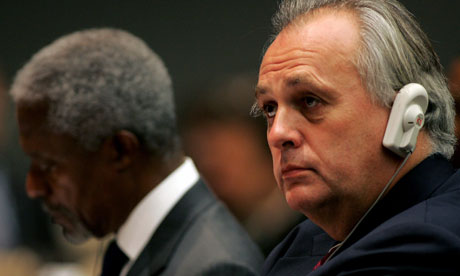
Lord Malloch Brown pictured in 2005 at a UN oil-for-food programme meeting in New York. Photograph: Jeff Zelevansky/REUTERS

Just 12 months after resigning from the government, Lord Malloch-Brown, the former Foreign Office minister for Africa, has become an adviser to an oil firm that is expanding its interests on the continent.

Vitol, the Swiss-based oil firm, has previously been fined for paying kickbacks to Saddam Hussain's regime. It recently entered talks to take over oil businesses in 19 African countries.

The disclosure about the talks and that Malloch-Brown, the Labour peer and former UN deputy secretary general, is a consultant to the firm, has raised concerns among Labour MPs over former ministers who have left government and gone into lucrative, private-sector, jobs closely related to their ministerial roles.

Sir Peter Soulsby, a Labour member of the Commons' political and constitutional reform committee, said: "There ought to be much tougher rules on the jobs that ministers take when they leave office. Taking this particular job at the very least shows an unfortunate lack of judgment."

Malloch-Brown, 57, joined Gordon Brown in July 2007 as part of the former prime minister's "government of all the talents". Her was also made a life peer. He stood down from office in July last year, for "personal and family reasons".

His new role has been approved by the advisory committee on business appointments, which advises ex-ministers on jobs taken within two years of leaving office.

Vitol is in negotiations with Shell Oil Products Africa for the potential acquisition of their businesses in several countries, including Egypt, Togo Senegal, Kenya, Uganda, Tanzania, Botswana and Namibia. It already has interests in Ghana and Cameroon.

In 2007, the firm admitted paying illegal kickbacks under the UN oil-for-food programme and agreed to pay $17.5m in restitution and fines.

The oil-for-food scheme was designed to use proceeds from Iraq's sales to buy food, medicine and other humanitarian aid, to alleviate the impact of international sanctions.

In 2006, when Malloch-Brown was chief of staff to the UN secretary general, Kofi Annan, he defended the organisation's oil-for-food programme from claims of fraud by telling the security council that "not a penny was lost from the organisation".

Malloch-Brown, who is also a consultant to Southwest Energy, an Ethiopian oil firm, defended his new role and dismissed claims of a potential conflict of interest. "My knowledge of Africa was not gained as a British minister. Rather I was recruited into government because I had worked extensively on African and international issues throughout my career. My activities today continue to reflect that," he said, adding that he had never been in contact with Vitol during his time at the UN, nor had any dealings with the company when he was a minister.

When in government, Malloch-Brown quickly gained a reputation for making colourful comments. The then foreign secretary at the time, David Miliband, who is 11 years his Malloch-Brown's junior, was said to have been upset when he the latter told a newspaper: "It's fine for me to be, for the first time in my life, the older figure, the wise eminence behind the young foreign secretary." He also raised eyebrows when he said that Tony Blair and George W Bush were "joined at the hip".

Other ministers who worked under Gordon Brown and who have taken up private-sector jobs include Lady Vadera, a former business minister who is now advising the authorities in Dubai, and Lord Carter of Barnes, the former head of strategy at No 10, now marketing chief for Alcatel-Lucent telecoms group. Ruth Kelly, the former education secretary, was appointed as senior strategic manager for HSBC. John Hutton, the former energy minister and defence secretary, has become an adviser to Eversheds, the law firm, and is joining the board of the US firm Hyperion Power Generation, which sells nuclear reactors.

Malloch-Brown, who is also a consultant to correctSouthwest Energy, an Ethiopian oil company, defended his new role this week and dismissed any allegations of a potential conflict of interest. "My knowledge of Africa was not gained as a British minister. Rather I was recruited into government because I had worked extensively on African and international issues throughout my career. My activities today continue to reflect that," he said.

He added that he had never been in contact with Vitol during his time at the UN, nor had any dealings with the the company when he was a minister.

"As part of my due diligence prior to starting my consulting appointment, I have discussed the oil-for-food issue and reviewed the steps that have been taken by Vitol to ensure that the necessary lessons have been learnt and the right compliance programme put in place," he said. He declined to say how much he would be paid for the role.

A spokesman for Vitol said the timing of Malloch-Brown's recruitment, and the decision to negotiate to take over parts of Shell's operations in Africa, was a coincidence. "This type of expansion activity is something that Vitol has been looking at for some time."

A statement added that the peer's new consulting agreement began last month and had been properly disclosed on the Lords website. "Lord Malloch-Brown provides consulting services on geo-political issues of importance to the Vitol group, including current and potential future business in Africa," it read.

Thursday, October 1, 2009

U.N. Auditors Find Development Program Broke Rules in Offering Aid to North Korea

By George Russell

FC1


Did the United Nations Development Program, the U.N.’s multibillion-dollar development flagship, break its own rules in offering assistance to the dictatorship of Kim Jong Il?

The long awaited answer, offered up by the U.N.’s own Board of Auditors, is a clear "Yes" — though UNDP itself quickly spun the answer as a vindication.

The long-awaited and controversial audit of United Nations operations in North Korea has concluded that, in line with accusations first raised by a senior U.S. diplomat, the United Nations Development Program and other agencies contravened their own regulations in hiring local staff nominated by the dictatorial North Korean government, and in making unauthorized hard currency payments to the Kim Jong Il regime.

The auditors, who stressed that their work was only a preliminary investigation, also declared they were unable to determine the total amount of unorthodox payments that had made. They lacked access to documentation from the U.N.’s offices in North Korea, a frequent observation throughout their report, and even lacked access to the cashed checks involved in the transactions. The auditors also were refused access to North Korea by the Kim Jong Il regime, which refused to cooperate in the investigation.

Paradoxically, the results of the audit immediately were hailed as a vindication by the UNDP, the United Nations’ flagship development organization, which has been largely responsible for running U.N. operations in North Korea.

The UNDP claim was that the report did not specifically support all the charges originally raised last January by U.S. Ambassador to the U.N. Mark Wallace, citing unpublished previous U.N. audits, that tens of millions of dollars in UNDP spending might have been misappropriated by the Kim Jong Il government as a result of the UN’s unorthodox policies in North Korea. Among other things, Wallace declared that it was “impossible” for the U.N. aid agency to verify whether its funds “have actually been used for bona fide development purposes or if the DPRK [North Korea] has converted such funds for its own illicit purposes.”

According to UNDP spokesman David Morrison, the latest audit findings are still under review by the U.N. development organization, which plans to file a formal response. But Morrison declared that the latest audit findings explicitly ruled out the possibility that there had been any diversion of UN funds to North Korea’s nuclear weapons program, and, contrary to U.S. Ambassador Wallace’s January assertions, said that UNDP officials had in most cases been able to visit UN development projects in North Korea to determine that money had been properly spent. “the money went where it was intended,” he said.. Moreover, he claimed, the audit confirmed that there were only “modest” levels of funding involved.

In fact, the specific language of the audit did not necessarily support Morrison’s assertion, especially insofar as the auditors declared they had not even had access to the checks used to pay North Korean staffers or other bills. Morrison’s arguments about the “modest” size of UNDP payments were also immediately contested by a U.S. official, speaking on background, who pointed out that the report tallied more than $72 million in spending by various U.N. agencies in North Korea from 2002 to 2006, and the list of agencies was far from inclusive. (The latest audit specifies thaht UNDP processed payments on behalf of all the mentioned agencies.) During that period, UNDP and one of its subordinate agencies operated anywhere from 28 to 41 projects in North Korea.

The same official pointed out that the audit report said only that visits to projects “only occurred in a coordinated way with the authorization and supervision of DPRK authorities.” (Nor did the report specify whether locally hired UNDP staffers, who continued to work for the Kim Jong Il government, were the ones actually carrying out the visits.)

For his part, Secretary-General Ban Ki-Moon was more cautious in drawing conclusions about the audit findings. A statement issued by his official spokesman, Michelle Montas, noted that the report “does not indicate that large-scale UN funding has been systematically diverted, as has been alleged” -- an unsurprising conclusion, as the report specifically declared that it was unable to judge the amount of funds involved in hard currency payments, without access to documentation in North Korea. But the spokesman’s statement also declares that the auditors’ document “identifies practices not in keeping with how the UN operates elsewhere in the world.”

Ban’s spokeman said that the Secretary General would ask for a further continuation of the auditing process, including a visit by auditors to North Korea, without mentioning the fact that North Korea already has rejected any such cooperation.

In one sense, the entire debate over diversion of UNDP money in North Korea became moot two months ago. At that time, even while declaring it had done no wrong, UNDP revised its policies to prevent further North Korean selection and control of local staff, and banning any payments in hard currency in that country. North Korea refused to accept the new rules, and all UNDP staff have subsequently left the country. A variety of other U.N. agencies, however, including the World Food Program and UNICEF, continue to operate there.

Even while declaring that it lacked access to documents that would have revealed the full extent of hard currency payments to North Korea, the latest audit makes clear that North Korean input into UNDP operations in the country was extensive and pervasive. Of 31 UNDP staff in North Korea in February, 22 were described as local hires, meaning North Korean government nominees, who, the report notes. These included four of UNDP’s program officers, the Information Technology officer who managed local computer networks, and the finance officer.

According to the report, these local hires were “seconded” to the UN agencies from the North Korean government, meaning that they were still government employees, and in general considered to be immune to U.N. rules and regulations governing staff conduct.

The report also noted, as Ambassador Wallace had done in his original complaint, that the unorthodox hiring and foreign exchange practices of the UNDP in North Korea had been exposed in previous audits dating back to 2001.

In his original complaint, Wallace noted that audits had uncovered the practices dating back to 1994; his point was that nothing was done as a result. In a brief on-the-record comment after the latest audit report was released, Wallace declared that the document “vindicated certainly some of our concerns.”

The UNDP’s current argument, on the other hand, is that members of the 36-nation Executive Board supervising UNDP activity (which includes both the U.S.and North Korea) were aware of those practices through the previous audits, and tacitly accepted them. UNDP spokesman Morrison indicated his agency’s view that there were no restrictions, for example, on the type of currency to be used in local economies.

The audit report itself noted that the UN’s current chief representative in North Korea, known as the Resident Representative, viewed the paying of North Koreans in hard currency to be an “established practise” in place when he first arrived in July 2005.

The latest audit report, on the other hand, while noting a lack of basic documentation on payment practices in North Korea, specifically mentioned that hard currency payments were made in violation of specific sections of a basic operating agreement covering UNDP operations in North Korea.

The latest audit report added a further mystery of its own. It was signed not by the auditors who carried out the investigation, but by senior officials in the member countries who had provided the experts under U.N. auspices. UNDP spokesman Morrison was unable to say why the auditors themselves did not sign the document, but it is known that one member of the three-man team who carried out the work, Pierre Brodeur of France, abruptly resigned from the group before the audit was made public. Brodeur was contacted prior to the audit’s publication by FOX News, but refused to make any statements.

There has been widespread speculation that Brodeur resigned due to disagreements with the audit’s conclusions, or the lack of access to documents required for a more definitive report.

Friday, January 23, 2009

PROFIT MAFIA IN UNDP


According to U.N. Chief Procurement Officer Akiko Yuge, the contract for PRO-FIT was approved after a "competitive bidding process" in 1998. The contract was approved under an arrangement known as a Reimbursable Loan Agreement, which allows UNDP to pay outside companies for the services of temporary employees, and does not, Yuge says, require further competitive bidding. "UNDP believes that to date it has received value for money from PRO-FIT," she added.


That is a stunning statement from a Chief Procurement Officer, a red herring, no doubt.


RLAs are rarely used, and if so, only to obtain the very specific services/expertise of an individual or a small group (say, a research institution).


The agreement will typically be for a limited period of time (some months, maybe a year).


RLAs are not intended for temp agency services.


Yuge is lying (what's new). A contract for temp services should always be awarded competitively. If this agency has had an ongoing contract for 10 years (or even more) simply for temp services of clerical nature (data entry they claim...) it is a sweetheart deal of the worst kind.


For one, temp services should by nature not end up as a 10 year + contract - that is self-contradictory.


The constant use of temps also constrict career opportunity and development for regular staff, and is in some cases used as intimidation ('If you guys don't behave and do my bidding, we'll outsource what you do!')UNDP needs major house cleaning. Problem is that top management is the big problem.


The Executive Board must step up before this spins further out of control.

Sunday, October 19, 2008

Lord Malloch Brown's running of UN unit damned over Congo ‘murder’

Graham Duffill
http://www.timesonline.co.uk/tol/news/politics/article4968978.ece

The widow of a British engineer found hanged in a Congo hotel room while on a dangerous mission for the United Nations has been awarded a £143,000 payout in a ruling that is highly critical of a department then run by Lord Malloch Brown, now a Foreign Office minister.

The body of Joe Comerford, 41, a Cambridge-educated engineer, showed signs of being strangled with a belt and a pathologist’s report suggested he had been murdered. However, his family was denied a proper payment by the UN’s insurers after the agency presented a biased report implying his death could have been suicide.

The UN’s administrative tribunal severely criticised the department last week responsible for its “callous” treatment of his wife and said that the case was “seriously mishandled”.

Mark Malloch Brown, who was the UN’s deputy secretary-general and head of UNDP until Gordon Brown invited him to join the government last year, said: “There was no way I felt I could personally resolve the matter and I decided it had to be referred to the UN justice system.”

Dutch-born Deborah Comerford-Verzuu launched the action after her husband died working for the UN Development Programme (UNDP) in the Democratic Republic of the Congo in August 2000. She has fought an eight-year legal battle with help from Andrew Granger of Taylor Wessing, a London-based law firm, who took her case pro bono.

Comerford had been sent to Congo ahead of 5,000 UN peacekeeping troops to assess structural damage caused by an occupying force of soldiers backed by neighbouring Rwanda. His report could have led to sanctions against Rwanda.

The troops, who controlled the Kisangani mining region, were robbing the country of diamonds, cobalt and ivory.

Comerford, from Bury in Lancashire, had left three children under the age of five with his wife at their home near the UN’s head office in Geneva, where she also worked for the UNDP. Over the previous 10 years he had been on similar UN missions, including supporting refugee camps for victims of genocide in Rwanda.

On August 16 he checked in to the Palm Beach hotel in Kisangani, which was also being used by the rebel troops for processing their illegal money and diamonds. Comerford had no protection even though the area was ranked a high security risk. Two days later his body was found in his hotel room, suspended from the window bars by a belt.

A Kenyan government pathologist concluded from severe bruises to the groin and broken bones in the neck that Comerford appeared to have been murdered. A report commissioned by the UNDP, quoting a pathologist from Guy’s hospital in London who saw pictures from the scene, said it could also have been suicide.

The tribunal awarded Comerford-Verzuu compensation “in light of the reckless and callous treatment” she received.

Comerford-Verzuu, who still works for the UN, said last week: “I never wanted a battle with the UN. All I ever wanted was to try and find out what really happened to Joe and to achieve a measure of justice.”

The UNDP said: “We regret the time it took to resolve these claims”, adding that it would pay the compensation “without delay”.

Tuesday, September 2, 2008

Mark `Moloch' Brown:The Empire's Coup Man in Georgia

Executive Intelligence Review
Aug. 12, 2008 (EIRNS)

—There is good reason for the British Empire's silence about the attack by Mikhail Saakashvili's Georgia on South Ossetia on Aug. 7, an attack that brought the world to the brink of World War III. Saakashvili was put in power by the duo of British agents—billionaire speculator and Nazi collaborator, George Soros, and Lord Mark Malloch Brown, now the United Kingdom's Minister for Africa, Asia and the United Nations for the British Foreign and Commonwealth Office (FCO). And, by tracking the records of the UN Development Program (UNDP) which Malloch Brown administered, and Soros's Open Society Institute and its offshoots, the proverbial check stubs will be found.

Lord Malloch Brown has been in the business of overthrowing governments since 1986, when he left the London Economist for the international section of an agressive political consulting firm in the U.S. called Sawyer Miller, and from there advised the Presidential campaign of Corazon Aquino in the Philippines. He stuck with Aquino through the overthrow of President Ferdinand Marcos in 1986, a role about which he boasts. In 1990, he represented the Presidential campaign of Peruvian fascist novelist Mario Varga Llosa, a drug legalization advocate, who lost the election after proposing a vicious austerity program to cut the living standards of Peru's lower classes. Sawyer Miller also helped promote the Dalai Lama against China.

From Sawyer Miller, Malloch Brown spent the next 18 years at the World Bank and the United Nations, forming a deep, but secretive relationship with Soros.

He is also secretive about his finances—he lists only his government salary of about $160,000 on financial disclosure forms. Prior to taking the Ministry job, he served as the Vice Chairman of George Soros's hedge fund, the Quantum Fund in 2007. For a bit of comparison, note that Soros earned billions of dollars heading the Quantum Fund in recent years!

Malloch Brown enhances his meager government salary, however, with a government-subsidized home in London called "The Admiralty House," which is valued at about 7.76 million pounds sterling, according to the British government. Both the Spectator and the Times of London have written exposes of Malloch Brown for this sweetheart deal, where the rent is over $300,000 per year, and for which he "leapfrogged" over 20 higher-ranking cabinet members to get the perk. The price Malloch Brown demanded, to leave Soros's Quantum Fund was a fat portfolio covering the entire world, a peerage (he is now a British Lord), the right to attend Cabinet meetings, and the luxurious home.

The subsidized home deal is identical to the arrangement which Malloch Brown had for about five years when he headed the UN Development Program, and then became Deputy Secretary General of the UN, and lived in New York. There he was a tenant at the five acre estate owned by George Soros in Katonah, New York, which the UN paid for, at $120,000 a year, to Soros. It was about 20% below the market price, but when asked about this house by a reporter, Malloch Brown stormed out of the interview, exclaiming, "I am doing God's work!"

Malloch Brown and Soros have been co-conspirators in a global plot against the nation state since at least 1993, when Malloch Brown joined a group organized by Soros that travelled to Serbia and Bosnia, to advise him on how to best spend a $50 million grant to "rebuild" Bosnia, after the British orchestrated war had destroyed it. In the 1990s, Soros had also funded the street thug apparatus OTPOR, that boasts of toppling Serbian President Slobodan Milosevic in 2000. Soros's network later used the experienced Serbian mob-controllers to create the "democracy shocktroops" for the "Rose Revolution" in Georgia that put Saakashvili into power.

Throughout his time at the UN, Malloch Brown and Soros were a duo. They held a joint press conference in Monterrey, Mexico in 2002, to announce plans on how use UN funds, integrated with private funding from Soros and his ilk, to control the economies and policies of Third World countries. Soros was not there as a philanthropist—he was there as President and Chairman of the Soros Management Fund, a notorious hedge fund.

The Rose Revolution

There would be no Saakashvili regime today without George Soros and Malloch Brown. Even in 2001, Saakashvili was a Soros-financed operative. In January, 2004, at the annual meeting in Davos, Switzerland, Soros, Malloch Brown, and Mikhail Saakashvili gave a joint press conference where Saakashvili got $1.5 million—two-thirds from Soros's Open Society Institute and one-third from the UN Development Program. The funds were to be for a "Governance Reform Program" for Georgia, of which the main project was payoffs—a "Salary Supplement Fund," for which Malloch Brown arranged millions more.

Malloch Brown's UNDP bluntly describe how he and Soros would, in effect, not only give money, but would stack the Georgia government with the "skilled professionals" they would pick. The UNDP report says that,

Georgia "lacked the skilled professionals needed to design and execute sweeping reforms.... The state lacked the resources to pay salaries" that might lure the kind of globalist operatives that Soros and Malloch Brown wanted there.

So, continues the UNDP Report, "Working in close partnership with billionaire philanthropist George Soros, UNDP moved swiftly.... Speed was recognized as crucial to success. Even before Mr. Saakashvili was sworn into office, UNDP and Mr. Soros's Open Society Institute (OSI) had agreed upon the creation of a new initiative to help the new administration secure the staff and expertise it needed." The initiative—to pay a supplemental salary to Saakashvili and top government officials—went on for three years, and Saakashvili himself admitted its importance at a Washington, D.C. press conference in early 2004, when asked about his financial dependence on Soros.

Saakashvili said: "Now regarding George Soros's contribution, this is primarily UNDP Fund: United Nations Development Program Fund to fund capacity building for Georgian government, and George Soros will not be the only contributor. We said we expect, as we already have pledges from a number of other contributions. We only have at this moment, two million dollars contributed by UNDP and Soros, but we have some other pledges, we need at least eight million dollars already this year and we will need some more for the next year.... Soros played good role in bolstering democratic processes in Georgia. He was very instrumental for many NGOs in their development and I think there is nothing bad about that, wrong about that."

Malloch Brown's UNDP report even boasted that this funding had provoked "Russian President Vladimir Putin ... to chide Mr. Saakashvili that he was on Mr. Soros's payroll." By 2006, the salary supplements were over $1 million per month, says the UNDP report.

These are the funds that go to a large contingent of Soros agents who are the government of Georgia: head of the National Security Council, Alexander Lomaia; Gigi Bokeria, Deputy Foreign Minister (who had been one of the early trainees of the Serbian Otpor for street demonstrations); Chairman of Georgia Parliament's Committee for Eurointegration: David Darchiashvili, to name a few.

Nazi Collaborator Soros, British Lord Behind Phony `Democracy' Movements


by Michele Steinberg
Download article in PDF

August 16, 2008 (LPAC)—The following article will appear in the next upcoming issue of Executive Intelligence Review:

In the days following the Aug. 7 invasion of South Ossetia by Mikhail Saakashvili's Georgia, which brought the world to the brink of World War III, the silence was deafening from the ruling circles of the British Empire, most notably the newly minted Baron Malloch-Brown, of St. Leonard's Forest in the County of West Sussex, otherwise known as Mark Malloch Brown, Britain's State Minister for Africa, Asia, and the United Nations in the Foreign and Commonwealth Office (FCO).

There was good reason for the silence: Saakashvili is a wholly owned test-tube baby of the British Empire, created in 2004 by the duo of billionaire speculator and Nazi collaborator George Soros, and Malloch Brown, And, by tracking the records of the UN Development Programme (UNDP) which Malloch Brown administered, and Soros's Open Society Institute and its offshoots, the proverbial check stubs that created the phony ``Democracy Revolution'' will be found.

On Aug. 9, Lyndon LaRouche condemned Soros for the Georgia operation, and warned: ``If you want a preview of what the United States would be like under a President Obama, just look at Georgia's recent actions. Georgian President Saakashvili, like Barack Obama, is owned by the same British godfather--George Soros.'' LaRouche asked: ``Would Soros's man Obama be another Dick Cheney if he got into office?''

LaRouche was more than right--Malloch Brown is the liaison between 10 Downing Street and Obama, courtesy of Soros (see following article).

Malloch Brown, a life-long British plant at the United Nations, is not only a ``collaborator'' of Soros; he was Soros's business partner: vice chairman of the Quantum Fund hedge fund, and vice president of Soros' global empire, the Open Society Institute, immediately before coming home in mid-2007 to his British mother.

- `Moloch' Brown: The Empire's Coup Man -

Like Soros, Malloch Brown is the enemy of the very concept of the sovereign nation-state; he has been in the business of overthrowing governments since 1986, when he became the head of the international section of an aggressive, and controversial, U.S. political consulting firm, Sawyer Miller, from where he advised the Presidential campaign of Corazon Aquino in the Philippines. He boasts that he helped Aquino unseat President Ferdinand Marcos, who was overthrown in 1986. In 1990, he represented the Presidential campaign of Peruvian fascist, ``his old friend,'' novelist Mario Varga Llosa, a drug legalization advocate and Soros favorite, who lost the 1990 election after proposing a vicious austerity program to cut the living standards of Peru's lower classes. Sawyer Miller also helped promote the Dalai Lama against China.

After Sawyer Miller, Malloch Brown spent the next 17 years at the World Bank and the United Nations, forming a deep, but secretive relationship with Soros.

In April 2007, the Financial Times reported that ``Sir Mark will also serve as vice-chairman of the billionaire philanthropist's Open Society Institute, which promotes democracy and human rights, particularly in eastern Europe and the former Soviet Union.''

The Financial Times added, in a May 1, 2007 article, that, ``In a letter to shareholders in his Quantum hedge funds, Mr. Soros said Sir Mark would provide advice on a variety of issues to him and his two sons, who now run the company on a day-to-day basis. With his extensive international contacts, Malloch Brown will help create opportunities for [Soros Fund Management] and the fund around the world....''

Malloch Brown is secretive about his finances--he lists only his government salary of about $160,000 on financial disclosure forms. For a bit of comparison, note that Soros gained billions of dollars heading the Quantum Fund in recent years. How much Malloch Brown made in partnership with Soros is not something he will talk about.

Malloch Brown enhances his meager government salary, however, with a government-subsidized home in London known as the ``Admiralty House,'' which is valued at about 7.76 million British pounds, according to the British government. Both the Spectator and the Times of London have written exposes on Malloch Brown's sweetheart deal, where the rent is over $300,000 per year, and for which he ``leapfrogged'' over 20 higher-ranking Cabinet members to get the perk. The price Malloch Brown demanded, to leave Soros's Quantum Fund was a fat portfolio covering the entire world, a peerage (he is now a British Lord), the right to attend Cabinet meetings, and the luxurious home.

The subsidized home deal is identical to the arrangement which Malloch Brown enjoyed during his years as head of the UNDP (1999-2005); in 2006, he became Deputy Secretary General of the UN, and lived in New York. There he was a tenant on Soros's five-acre estate in Katonah, for which the UN paid $120,000 a year--about 20% below the previous tenant's rent. When questioned about the deal by a reporter, Malloch Brown stormed out of the interview, exclaiming, ``I am doing God's work!'' He also accused reporters of having a secret agenda when they tried to raise other questions about his financial relationship with Soros.

For the first time, EIR has pieced together the decades-long operations of the duo. Like H.G. Wells's ``Open Conspiracy,'' the British Empire's use of these two has been hidden in plain view. But it was not until the flight-forward by their golem, Saakashvili, that the scope of their operations came into focus.

- Godfathers of the `Rose Revolution' - From early on, provocations against Russia, and destabilization of the Balkans and Central Eurasia have been their joint focus. In 1993, Malloch Brown joined a group organized by Soros that travelled to Serbia and Bosnia, to advise the billionaire on how to best spend a $50 million grant to ``rebuild'' the country, after the British-orchestrated war had destroyed it. In the late 1990s, Soros had funded the street thug apparatus Otpor, that boasts of having toppled Serbian President Slobodan Milosevic in 2000. Soros's network later used the experienced Serbian mob-controllers to create the ``democracy shocktroops'' for the ``Rose Revolution'' in Georgia that put Saakashvili into power, and the ``Orange Revolution'' in Ukraine.

Malloch Brown and Soros held a joint press conference in Monterrey, Mexico in 2002, under the auspieces of a conference on globalism, to announce plans on how use UN funds, integrated with private funding from Soros and company, to control the economies and policies of Third World countries. Soros was not there as a philanthropist--his usual cover--he was there as president and chairman of the Soros Management Fund, another notorious hedge fund.

There would be no Saakashvili regime today without George Soros and Malloch Brown. Even in 2001, Saakashvili was a Soros-financed operative. In January 2004, at the annual economic summit in Davos, Switzerland, Soros, Malloch Brown, and Saakashvili gave a press conference where they announced a $1.5 million gift to Saakashvili--two-thirds from Soros's Open Society Institute, and one-third from the UNDP. The funds were to be for a ``Governance Reform Program'' for Georgia, of which the main project was payoffs--a ``Salary Supplement Fund,'' for which Malloch Brown arranged millions more.

Malloch Brown's UNDP bluntly described how he and Soros would, in effect, not only give money, but would stack the Georgia government with the ``skilled professionals'' they would pick. The UNDP report says that Georgia ``lacked the skilled professionals needed to design and execute sweeping reforms ... the state lacked the resources to pay salaries'' that might lure the kind of globalist operatives that Soros and Malloch Brown wanted there.

So, continued the UNDP report, ``Working in close partnership with billionaire philanthropist George Soros, UNDP moved swiftly.... Speed was recognized as crucial to success. Even before Mr. Saakashvili was sworn into office, UNDP and Mr. Soros' Open Society Institute (OSI) had agreed upon the creation of a new initiative to help the new administration secure the staff and expertise it needed.'' The payment of supplemental salaries to Saakashvili and top government officials--continued for three years, and Saakashvili himself admitted its importance at a Washington, D.C., press conference in early 2004, when asked about his financial dependence on Soros.

Saakashvili said: ``Now regarding George Soros's contribution, this is primarily UNDP Fund: United Nations Development Program Fund to fund capacity building for Georgian government, and George Soros will not be the only contributor. We said we expect, as we already have pledges from a number of other contributions. We only have at this moment, two million dollars contributed by UNDP and Soros, but we have some other pledges, we need at least eight million dollars already this year and we will need some more for the next year.... Soros played a good role in bolstering democratic processes in Georgia. He was very instrumental for many NGOs in their development, and I think there is nothing bad about that, wrong about that.''

Malloch Brown's UNDP report even boasted that this funding had provoked ``Russian President Vladimir Putin ... to chide Mr. Saakashvili that he was on Mr. Soros' payroll.'' By 2006, the UNDP reports, the salary supplements were over $1 million per month.

With these funds, Soros and Malloch Brown stacked the Saakashvili regime with British agents. Ongoing research by EIR has thus far identified the following British and Soros stooges in the current government of Georgia:

* Prime Minister Vladimer ``Lado'' Gurgenidze, a British empire banker, citizen of the United Kingdom. Born 1970 in Tbilisi, he began work in 1997 for the Anglo-Dutch giant bank ABN AMRO, living in London 1998-2003. In 1997-98 he directed the bank's corporate finance operations in Russia and neighboring countries. Among the ABN AMRO conquests was its ``twinning project'' ensnaring the Bank of Georgia, which had been privatized in 1994-95. From 1998-2000, Gurgenidze was ABN AMRO's director and head of mergers and acquisitions in the emerging European markets. After the Soros/UNDP project, he was hired for the Georgia government, bringing in a management team from ABN AMRO and other British-connected banks. He was appointed prime minister and head of the government in November 2007.

* Head of the National Security Council Alexander Lomaia, a longtime top executive of Soros operations in Georgia, now overseeing the country's military operations. He was executive director of the Open Society Georgia Foundation in 2003-04, where he ``directed the foundation's operational grant-making and administrative activities, and fulfillment of its annual overall budget of more than $2,500,000.'' During the same time he was regional director for the former Soviet Union for the Open Society Institute's ``Democracy Coalition Project.'' This operation aims to turn the former countries of the Soviet Union against Russia.

* Chairman of Georgia Parliament's Committee for Eurointegration, David Darchiashvili, is the former executive director of the Open Society Georgia Foundation. He had worked for the Soros-dominated NGO networks since 1992, primarily in the Caucasus Institute for Peace, Democracy and Development, a ``partner institution'' to the Soros Open Society Institute. Darchiashvili was executive director of the Open Society Georgia Foundation in the period (approximately) 2006-07, when Saakashvili ``won'' his second election, amidst accusations of repression and dirty tricks against his opposition.

- Soros Thugs on the Streets of Tblisi -

From 1994 to 2004, Soros's various projects and sub-projects of the Open Society Institute, including the Central Eurasian Project (CEP) and the Open Society Georgia Foundation, spent about $40 million to topple former Georgia President Eduard Shevardnadze.

But installing the Saakashvili-British government didn't reach fruition until early in 2003, when Soros began a full operation to activate the ``democracy'' shock troops. The Canadian daily Globe and Mail provided a vivid account in November 2003:

``Dateline Tbilisi--It was back in February that billionaire financier George Soros began laying the brickwork for the toppling of Georgian President Eduard Shevardnadze.

``That month, funds from his Open Society Institute sent a 31-year-old Tbilisi activist named Giga Bokeria to Serbia to meet with members of the Otpor (Resistance) movement and learn how they used street demonstrations to topple dictator Slobodan Milosevic. Then, in the summer, Mr. Soros's foundation paid for a return trip to Georgia by Otpor activists, who ran three-day courses teaching more than 1,000 students how to stage a peaceful revolution.

``Last weekend, the Liberty Institute that Mr. Bokeria helped found was instrumental in organizing the street protests that eventually forced Mr. Shevardnadze to sign his resignation papers.'' Bokeria says it was in Belgrade that he learned his Jacobin trade.

But EIR had revealed that Saakashvili was already a Soros agent in 2001. In November 2003, right after Shevardnaze was toppled, EIR reported, in an article by Roman Bessonov, entitled, ``Georgia: Soros, Stalin, and a Gallon of Wine'':

``On Sept. 18, 2001, Justice Minister Michael Saakashvili arrived at the Parliament of Georgia with a pack of photos, depicting luxurious mansions owned by top police officials. Meanwhile, mass media reported that his flat was visited by `unidentified persons,' who tried to steal some documentation. This added heat to the media scandal, portraying the ambitious minister as a target of organized crime and corruption, and initiating his ascent to the exceptional popularity he enjoys today.

``The engineers of his career had studied the psychology and moods of the Georgians--and not only Georgians. In a similar way, `anti-corruption careers' were made in other transitional or Third World countries, from Mexico to the Philippines. The Georgian brew was cooked to a recipe tested many times before, especially where luxury and misery live side by side, and the physical economy is ruined....

``Saakashvili resigned as Justice Minister, with complaints that the state leadership (to which he owed his party and government career), was impeding implementation of his demagogic National Anti-Corruption Plan. This project had received ample attention from megaspeculator George Soros, who promised assistance in the effort to cleanse the Georgian establishment. Soros appreciated the earlier reform of the law enforcement bodies, whereby the Penitentiary Authority was transferred from the Internal Affairs Ministry to the Ministry of Justice....

``But that was not enough for the megaspeculator: The next step was supposed to be a sound whipping of the Georgian police, replacing its top cadres with `decent persons' selected by him and Saakashvili.''

Soros's role in the ``new'' police force, continued Bessonov, ``may explain the unexpectedly easy surrender of the police to the crowd under the Crusaders' banners, on Nov. 21 [2003]. For the whole period from September 2001 till November 2003, Saakashvili was under ardent tutelage from George Soros. The latter's Open Society Georgia Foundation co-founded the Liberty Institute of Georgia, and launched a `youth assistance program.' Its young disciples were promptly organized into a movement entitled Kmara! (Enough!), which took lessons in organizing protest actions from professionals in former Yugoslavia and Ukraine.

``The broad-shouldered young guys in leather jackets, who mounted the tribune of the Parliament on Saturday, Nov. 22, smashing tables and chairs, belonged to Kmara! As the BBC's correspondent said, these persons `hissed out' the elected President from the Parliament building. The social-populist phraseology of Saakashvili and the choice of Gori as launch-place for the decisive move into Tbilisi, represent nothing new in this sort of `regime change' operation. Anywhere George Soros appeared in the post-Soviet area, he would mimic the character of the local protest mood. In Lviv, Ukraine, his magazine Derzhavnist (Statehood) introduced the idea of ``Ukraine as the Fourth Rome,'' and published an article saying that the execution of Jews in Babiy Yar, near Kiev, in 1941, was actually an execution of Ukrainian patriots by Jewish commissars. The local Jewish community was shocked ... but such details have never bothered Soros....

``It was St. George's day on Sunday, Nov. 23, [2003] when Shevardnadze resigned. George Soros' day was celebrated with gallons of wine in the central squares of Tbilisi.''

Soros's shock troops also ran the streets in the Ukraine ``Orange Revolution,'' and he tried the same scenario, unsuccessfully, throughout the Commonwealth of Independent States. It is high time that all Soros operations in these countries were shut down, in the interest of defending sovereignty.