Showing posts with label georgia. Show all posts

Tuesday, November 13, 2012

In Georgia: - UNDP wants the prisoners to "effectively monitor their human rights inside jails - and report on abuses"


Click here for this in full @ The Messenger online: http://www.messenger.com.ge/issues/2734_november_12_2012/2734_eto.html


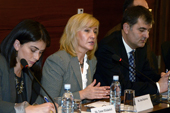
On Friday, the Ministry of Corrections and Legal Assistance of Georgia, with assistance from the United Nations Development Programme (UNDP), launched a discussion on effective mechanisms for monitoring the human rights situation in Georgian prisons. The public defender of Georgia has been the only institution since 2007 to implement public oversight over the prisons. Alternative monitoring can ensure more effective protection of human rights and prevent torture and ill-treatment.

The meeting brought together representatives of the government, civil society and international organizations at the Radisson Blu Iveria Hotel.

The discussion was opened by Minister Sozar Subari who has emphasized the necessity of public monitoring in the penitentiary systems and welcomed all interested organizations who want to make their contribution in making the system healthier.

Click here for this in full @ The Messenger online: http://www.messenger.com.ge/issues/2734_november_12_2012/2734_eto.html

Monday, November 5, 2012

UNDP Adaptation Bulletin Showcases Initiatives in Armenia and Albania


Click here for this in full at Climate Change Policy : http://climate-l.iisd.org/news/undp-adaptation-bulletin-showcases-initiatives-in-armenia-and-albania/165181/
November 2012: The October issue of the UN Development Programme’s (UNDP) quarterly Adaptation Bulletin features articles on: supporting climate change adaptation in Armenia and Albania; and training Asian government officials to internalize the economics of adaptation into national investment and planning decisions.
In addition to the Armenian and Albanian projects, the Bulletin highlights UNDP support for similar adaptation initiatives in Azerbaijan, Georgia, Tajikistan and Turkmenistan.
The Bulletin notes that the UNDP adaptation initiative in Armenia’s mountain forest ecosystems integrated climate change risk management into biodiversity and forest management practices to address forest degradation and fragmentation, invasive species and wildfires. It indicates that the initiative recently introduced early warning systems and forest health monitoring tools to mainstream climate change risks into forest management planning. According to the Bulletin, the project has made significant progress in improving wildfire management through, inter alia, building disaster risk resilience, enhancing cross-institutional coordination and promoting national ownership.
In Albania, the Bulletin describes how local communities in the Drini-Mati River Delta identified biodiversity and species loss, pressure on dunes and groundwater systems and threats to agriculture, infrastructure and tourism as key concerns, during a UNDP-facilitated climate risk assessment, prioritization and adaptation process. The communities proposed preventing coastal erosion and flood protection through traditional materials use and increasing connectivity of coastal protected areas through bio-corridors. Government officials are now evaluating these proposed coastal adaptation measures for policy adoption and integration.
The Bulletin further describes a collaborative UNDP and the US Agency for International Development’s (USAID) ADAPT Asia-Pacific capacity building programme is training technical government officers on the economics of adaptation, including how adaptation relates to medium and long-term national, sub-national and sectoral development plans and budgets. The programme also trains officers to use cost-benefit tools to evaluate adaptation investment projects for financing by different funds, including the Adaptation Fund (AF), Green Climate Fund (GCF), Least Developed Countries Fund (LDCF) and Special Climate Change Fund (SCCF).
The Bulletin also includes sections on resources, announcements and portfolio information. The Bulletin is produced by UNDP-Global Environmental Facility’s (GEF) Environment and Energy Group. [UNDP Adaptation Bulletin]

Click here for this in full at Climate Change Policy : http://climate-l.iisd.org/news/undp-adaptation-bulletin-showcases-initiatives-in-armenia-and-albania/165181/

Thursday, October 23, 2008

UNDP's Dervis Admits Paying Saakashvili Unwise, Dodges on Congo Security and Kosovo Fees

Byline: Matthew Russell Lee of Inner City Press at the UN: News Analysis

UNITED NATIONS, October 22 -- After the UN Development Program had defended paying salary to Georgian President Mikheil Saakashvili since Inner City Press exclusively reported on it, on Wednesday UNDP Administrator Kemal Dervis belatedly acknowledged that payments to such high officials "raises questions" and "may not be desirable." 

  Under the rubric of UNDP's lack of impartiality, and as limited by UNDP to post-conflict situations, Inner City Press asked Dervis about the Georgia program, about UNDP paying or processing the salary of an ex-UN employee who now works for the Kosovo government, and about a judgment against UNDP in favor of the widow of a UNDP consultant sent without security to Eastern Congo and killed. On this last, Dervis read an apology from notes, whilemistakenly locating the murder, and UNDP's negligence, as having been in Kenya. Video here, from Minute 28:15.

   After Inner City Press had reported on UNDP's Georgia program, in which it funneled money from George Soros' Open Society Institute to President Saakashvili and his inner circle, Russian Foreign Minister Sergey Lavrov denounced the program as a "privatization of the UN." Wednesday Inner City Press asked Dervis to respond to the criticism. 

   While quickly saying, "I fully agree with the Russian foreign minister," Dervis did not step away from processing such money for OSI or other -- apparently any other -- private foundation. UNDP takes a fee in such deals, although in recently months UNDP's spokesman has repeatedly declined to provide information about the fees UNDP charges. Ironic in light of this stonewalling, Dervis three times said that programs like that in Georgia "must be transparent."


UNDP's Dervis on Oct. 22, 2008, Kosovo and security answers not shown

  Regarding the verdict against UNDP of 143,000 pounds, Dervis said that UNDP now has the ability, through the freedom of so-called ex gratia payments, to provide support in such circumstances. Given the now-admitted inadvisability of UNDP's program to pay Georgia's president, it is doubtful that giving UNDP less oversight in payments is advisable. But what Dervis did not address -- along with the Kosovo question, which he did not answer at all -- was the lack of security that UNDP provided to Joe Comerford when they sent him to the Congo, where he got killed. Click here for more on the case.

   This seems to be a pattern with UNDP, which was criticized in the UN's recent reports about the December 2007 bombing of UN premises in Algiers Yet Dervis has yet to take any questions on UNDP's actions before the Algiers bombing, and his spokesman declined to comment on or even confirm UNDP's vacature of its premises in Amman, Jordan, despite the UN's head of security confirming it to Inner City Press. Transparency, indeed...

Watch this site, and this Oct. 2 debate, on UN, bailout, MDGs

and this October 17 debate, on Security Council and Obama and the UN.

Tuesday, September 30, 2008

Russia Accuses UNDP of Funding Georgian President - Lavrov says: UNDP is out of control


By BENNY AVNI, Staff Reporter of the Sun | September 30, 2008

UNITED NATIONS — Russia's confrontation with the West is escalating, with Foreign Minister Sergei Lavrov accusing the U.N. Development Program of collaborating with the financierGeorge Soros to fund Mikheil Saakashvili's rise to the Georgian presidency.


Rick Gershon/Getty

President Saakashvili of Georgia shakes hands with U.N. Secretary-General Ban at the United Nations on September 24.

Russia has long accused Mr. Soros of financing the 2003 Rose Revolution, and Mr. Saakashvili in particular. Yesterday, Mr. Lavrov called for an examination of the ties between Mr. Soros and the UNDP. "At the time, George Soros was sponsoring members of the Georgian government," Mr. Lavrov told reporters, adding that UNDP "funds and finances" were also used to support Georgian officials.

"We should clearly check and establish clear rules for controlling the spending by international organizations," he said. "We should not allow that such organizations be privatized."

The Columbia University-educated Mr. Saakashvili swept into power in a January 2004 election that resulted from the Rose Revolution, ousting a Russian ally, Eduard Shevardnadze, as president.

Russia's war with Georgia over the independence claims of two breakaway Georgian regions, which began in early August, has ratcheted up tensions between America and Russia. Also, Prime Minster Putin reportedly has declined for weeks to take calls from Secretary-General Ban, whose statements on Georgia were seen in Moscow as one-sided.

American officials have raised questions about the relationship between Mr. Soros's Open Society Institute and the UNDP in the past. And as The New York Sun first reported in June 2006, a former UNDP administrator, Mark Malloch Brown, rented a house adjacent to Mr. Soros's estate in Katonah, N.Y., paying the financier what real estate agents in the area characterized as below market rate rent.

Since the breakup of the Soviet Union, Mr. Soros's OSI has concentrated much of its pro-democracy activities in former Soviet republics striving to break with their totalitarian past, with local leaders and their nationalist supporters pledging to sever ties with Moscow.

Information about the UNDP's activities in Georgia is available to all the members of the agency's board, including Russia, a spokesman for the agency, Stéphane Dujarric, told the Sun yesterday. Launched in January 2004, the program in Georgia included "salary top-ups for leading officials," he said, and was designed "to enable the government to recruit the staff it needed, and also to help remove incentives for corruption."

The Georgian president, prime minister, and speaker of the Parliament received monthly salary supplements of $1,500 each; ministers received $1,200 a month, and deputy ministers $700, Mr. Dujarric said.

The program was funded initially by Mr. Soros's OSI, which gave $1 million, while the UNDP gave $500,000. A Swedish government agency later added another $1 million. An "exit strategy" was built into the program, Mr. Dujarric said, and the Georgian government assumed responsibility for the salaries after three years.

Mr. Lavrov's contention that the UNDP must avoid being "privatized" came at the end of a week in which Russia significantly sharpened its rhetoric against America.

At a press conference yesterday and in his speech before the U.N. General Assembly on Saturday, Mr. Lavrov repeatedly denounced Washington's disruption of the existing world order by invading Iraq. "The solidarity of the international community fostered on the wave of struggle against terrorism turned out to be somehow privatized," he said in his assembly speech, referring to the Iraq invasion.

Separately, Mr. Lavrov declined yesterday to provide new details about his country's resumption of military cooperation with Syria, amid reports that the Russian navy sent several ships to the Mediterranean port of Tartus. "This cooperation is conducted in the framework of the international law and does not endanger anyone's security," Mr. Lavrov said.

Friday, September 12, 2008

ООН приплачивала Михаилу Саакашвили


Грузинский президент Михаил Саакашвили получал на протяжении 2004 года в дополнение к своей официальной зарплате полторы тысячи долларов в месяц от Программы развития ООН (ПРООН). Об этом сообщила американская информационная служба Inner City Press.

Со ссылкой на ПРООН она пишет, что целью этих выплат, субсидировавшихся, помимо ООН, шведским правительством и американским финансистом Джорджем Соросом, было дать возможность грузинскому правительству "принять на работу нужных ему сотрудников, а также помочь снять побудительные стимулы к коррупции".

Как отмечается в официальном разъяснении ПРООН, которое цитирует Inner City Press, ежемесячные выплаты в размере 1500 долларов президенту, премьер-министру, председателю парламента страны, а также министрам (1200 долларов) и их заместителям (700 долларов), осуществлялись в рамках Программы реформы управления в Грузии.

С этой целью был создан Фонд надбавок к зарплате, который финансировался соросовским Институтом "Открытое общество", внесшим 1 млн долларов, ПРООН (500 тыс. долларов) и шведским правительственным агентством сотрудничества в целях международного развития (1 млн долларов).

"Этот фонд предназначался для того, чтобы обеспечить ведущих госслужащих жалованьем, которое, будучи скромным по международным меркам, было достаточным для Грузии", - подчеркивается в заявлении ПРООН.

Взамен на финансовую подпитку Саакашвили пообещал повысить собираемость налогов в Грузии с тем, чтобы в дальнейшем финансировать надбавки к жалованью из средств госбюджета.

Если верить ПРООН, эта задача была выполнена досрочно - вместо трех отпускавшихся на нее лет, за один год.

Помимо этого грузинские власти пообещали ООН сократить существующий бюрократический аппарат, заменив его хорошо оплачиваемой и хорошо организованной гражданской службой. Как Саакашвили справился с этой задачей, ПРООН не сообщила.

Как передает ИТАР-ТАСС, дипломаты в ООН задаются вопросом: для чего понадобилось соросовскому институту "Открытое общество", который совместно с другими американскими НПО финансировал в 2003 году "революцию роз", приведшую к власти нынешний режим в Грузии, использовать ООН, чтобы "поднять" зарплаты Саакашвили и ряду других членов грузинского руководства?

В каких еще странах ПРООН выполняет схожие функции? Из каких других источников поступали деньги на подкормку нынешнего грузинского режима?

UNDP's Funding of Saakashvili Causes Russian Uproar, For-Ex Stonewalling Continues

By Matthew Lee (http://www.InnercityPress.Com)
UNITED NATIONS, September 11 -- As the UN Executive Board lurched through the fourth of its five day meeting, with UNDP management having stoked its its ostensible overseers into demanding it re-open the flow of money to Kim Jong Il's North Korea, one of UNDP's equally dubious programs on the other side of the political spectrum fell under fire. It involves UNDP having paid salary to Georgian president Saakashvili, with its own funds and those of George Soros' Open Society Institute. Inner City Press first reported on the program in December 2006, then again on August 25, 2008, click here for that story. This was picked up by Russia's Ambassador to the UN Vitaly Churkin and by Russian media. See examples here, here and here.
The question to be answered is, are the members of UNDP's Executive Board really informed by UNDP management what type of programs are going on?

Meanwhile, despite the Executive Board president's gushing on September 10 that no member disagreed with the head-long rush to return to Pyongyang, even in the face of uncertainty if Kim Jong Il is on his death bed or dead, possibly toppled by even harder-line generals who have restarted that country's nuclear program, in front of the Security Council Inner City Press asked U.S. Ambassador Khalilzad for the U.S. Mission position, video here at Minute 6:43:

Inner City Press: UNDP has been meeting this week. The US position seems to be that the UNDP should go back to North Korea. Do you feel--

Ambassador Khalilzad: We have been under the view that there is a need for steps to make sure that some of the problems that have been listed will not take place again. Thank you.

But when Inner City Press asked UNDP's spokesman early on September 11 for a copy of Regional Director Ajay Chhibber's so-called "roadmap" to return to North Korea, which even the Executive Board president said should be distributed and made transparent, it was not provided.


UNDP's Dervis, thinking of funding to Saakashvili, roadmap and Russian response not shown

Also in front of the Security Council on September 11, Inner City Press asked Ban Ki-moon's envoy to Myanmar Ibrahim Gambari to explain the UN system's silence while it was losing 20% of aid funds to the Than Shwe regime. "Matthew, I hope you raise that with [OCHA's] John Holmes and with UNDP." Video here, from Minute 7:19.

Well, Inner City Press has had currency exchange loss questions pending with UNDP for weeks and weeks, and has repeated sent reminded, still with no response. This did not impinge on the self-congratulatory dream world of some Executive Board delegates cooking up rubber stamp resolutions in Conference Room C in the UN's basement on the night of September 11. Nor did it stop once and future UNDP-er Jan Mattsson for patting himself on the back for finally getting an audit of the UN Office for Project Services after seven years, and moving to pay off a blatant cost overrun for Afghan elections in 2005. It all cuminates, he told the Board on September 11, in a new UNOPS web site, in three languages: English, French and Spanish. Maybe that's why Russia didn't know about the funding to Saakashvili...

Meanwhile, UNDP has not provided answers as simple as the volume of fees it collects as a conduit for funding for prisons and military barracks all over the world, and to pay an ex-UN Kosovo Mission staffer to work for Kosovo's government. Not only could this dubious middle-man role raise more Russian questions about UNDP -- more generally, it is for reasons like these that many believe that UNDP is an opaque, unaccountable and even corrupt organization.

Tuesday, September 2, 2008

Nazi Collaborator Soros, British Lord Behind Phony `Democracy' Movements


by Michele Steinberg
Download article in PDF

August 16, 2008 (LPAC)—The following article will appear in the next upcoming issue of Executive Intelligence Review:

In the days following the Aug. 7 invasion of South Ossetia by Mikhail Saakashvili's Georgia, which brought the world to the brink of World War III, the silence was deafening from the ruling circles of the British Empire, most notably the newly minted Baron Malloch-Brown, of St. Leonard's Forest in the County of West Sussex, otherwise known as Mark Malloch Brown, Britain's State Minister for Africa, Asia, and the United Nations in the Foreign and Commonwealth Office (FCO).

There was good reason for the silence: Saakashvili is a wholly owned test-tube baby of the British Empire, created in 2004 by the duo of billionaire speculator and Nazi collaborator George Soros, and Malloch Brown, And, by tracking the records of the UN Development Programme (UNDP) which Malloch Brown administered, and Soros's Open Society Institute and its offshoots, the proverbial check stubs that created the phony ``Democracy Revolution'' will be found.

On Aug. 9, Lyndon LaRouche condemned Soros for the Georgia operation, and warned: ``If you want a preview of what the United States would be like under a President Obama, just look at Georgia's recent actions. Georgian President Saakashvili, like Barack Obama, is owned by the same British godfather--George Soros.'' LaRouche asked: ``Would Soros's man Obama be another Dick Cheney if he got into office?''

LaRouche was more than right--Malloch Brown is the liaison between 10 Downing Street and Obama, courtesy of Soros (see following article).

Malloch Brown, a life-long British plant at the United Nations, is not only a ``collaborator'' of Soros; he was Soros's business partner: vice chairman of the Quantum Fund hedge fund, and vice president of Soros' global empire, the Open Society Institute, immediately before coming home in mid-2007 to his British mother.

- `Moloch' Brown: The Empire's Coup Man -

Like Soros, Malloch Brown is the enemy of the very concept of the sovereign nation-state; he has been in the business of overthrowing governments since 1986, when he became the head of the international section of an aggressive, and controversial, U.S. political consulting firm, Sawyer Miller, from where he advised the Presidential campaign of Corazon Aquino in the Philippines. He boasts that he helped Aquino unseat President Ferdinand Marcos, who was overthrown in 1986. In 1990, he represented the Presidential campaign of Peruvian fascist, ``his old friend,'' novelist Mario Varga Llosa, a drug legalization advocate and Soros favorite, who lost the 1990 election after proposing a vicious austerity program to cut the living standards of Peru's lower classes. Sawyer Miller also helped promote the Dalai Lama against China.

After Sawyer Miller, Malloch Brown spent the next 17 years at the World Bank and the United Nations, forming a deep, but secretive relationship with Soros.

In April 2007, the Financial Times reported that ``Sir Mark will also serve as vice-chairman of the billionaire philanthropist's Open Society Institute, which promotes democracy and human rights, particularly in eastern Europe and the former Soviet Union.''

The Financial Times added, in a May 1, 2007 article, that, ``In a letter to shareholders in his Quantum hedge funds, Mr. Soros said Sir Mark would provide advice on a variety of issues to him and his two sons, who now run the company on a day-to-day basis. With his extensive international contacts, Malloch Brown will help create opportunities for [Soros Fund Management] and the fund around the world....''

Malloch Brown is secretive about his finances--he lists only his government salary of about $160,000 on financial disclosure forms. For a bit of comparison, note that Soros gained billions of dollars heading the Quantum Fund in recent years. How much Malloch Brown made in partnership with Soros is not something he will talk about.

Malloch Brown enhances his meager government salary, however, with a government-subsidized home in London known as the ``Admiralty House,'' which is valued at about 7.76 million British pounds, according to the British government. Both the Spectator and the Times of London have written exposes on Malloch Brown's sweetheart deal, where the rent is over $300,000 per year, and for which he ``leapfrogged'' over 20 higher-ranking Cabinet members to get the perk. The price Malloch Brown demanded, to leave Soros's Quantum Fund was a fat portfolio covering the entire world, a peerage (he is now a British Lord), the right to attend Cabinet meetings, and the luxurious home.

The subsidized home deal is identical to the arrangement which Malloch Brown enjoyed during his years as head of the UNDP (1999-2005); in 2006, he became Deputy Secretary General of the UN, and lived in New York. There he was a tenant on Soros's five-acre estate in Katonah, for which the UN paid $120,000 a year--about 20% below the previous tenant's rent. When questioned about the deal by a reporter, Malloch Brown stormed out of the interview, exclaiming, ``I am doing God's work!'' He also accused reporters of having a secret agenda when they tried to raise other questions about his financial relationship with Soros.

For the first time, EIR has pieced together the decades-long operations of the duo. Like H.G. Wells's ``Open Conspiracy,'' the British Empire's use of these two has been hidden in plain view. But it was not until the flight-forward by their golem, Saakashvili, that the scope of their operations came into focus.

- Godfathers of the `Rose Revolution' - From early on, provocations against Russia, and destabilization of the Balkans and Central Eurasia have been their joint focus. In 1993, Malloch Brown joined a group organized by Soros that travelled to Serbia and Bosnia, to advise the billionaire on how to best spend a $50 million grant to ``rebuild'' the country, after the British-orchestrated war had destroyed it. In the late 1990s, Soros had funded the street thug apparatus Otpor, that boasts of having toppled Serbian President Slobodan Milosevic in 2000. Soros's network later used the experienced Serbian mob-controllers to create the ``democracy shocktroops'' for the ``Rose Revolution'' in Georgia that put Saakashvili into power, and the ``Orange Revolution'' in Ukraine.

Malloch Brown and Soros held a joint press conference in Monterrey, Mexico in 2002, under the auspieces of a conference on globalism, to announce plans on how use UN funds, integrated with private funding from Soros and company, to control the economies and policies of Third World countries. Soros was not there as a philanthropist--his usual cover--he was there as president and chairman of the Soros Management Fund, another notorious hedge fund.

There would be no Saakashvili regime today without George Soros and Malloch Brown. Even in 2001, Saakashvili was a Soros-financed operative. In January 2004, at the annual economic summit in Davos, Switzerland, Soros, Malloch Brown, and Saakashvili gave a press conference where they announced a $1.5 million gift to Saakashvili--two-thirds from Soros's Open Society Institute, and one-third from the UNDP. The funds were to be for a ``Governance Reform Program'' for Georgia, of which the main project was payoffs--a ``Salary Supplement Fund,'' for which Malloch Brown arranged millions more.

Malloch Brown's UNDP bluntly described how he and Soros would, in effect, not only give money, but would stack the Georgia government with the ``skilled professionals'' they would pick. The UNDP report says that Georgia ``lacked the skilled professionals needed to design and execute sweeping reforms ... the state lacked the resources to pay salaries'' that might lure the kind of globalist operatives that Soros and Malloch Brown wanted there.

So, continued the UNDP report, ``Working in close partnership with billionaire philanthropist George Soros, UNDP moved swiftly.... Speed was recognized as crucial to success. Even before Mr. Saakashvili was sworn into office, UNDP and Mr. Soros' Open Society Institute (OSI) had agreed upon the creation of a new initiative to help the new administration secure the staff and expertise it needed.'' The payment of supplemental salaries to Saakashvili and top government officials--continued for three years, and Saakashvili himself admitted its importance at a Washington, D.C., press conference in early 2004, when asked about his financial dependence on Soros.

Saakashvili said: ``Now regarding George Soros's contribution, this is primarily UNDP Fund: United Nations Development Program Fund to fund capacity building for Georgian government, and George Soros will not be the only contributor. We said we expect, as we already have pledges from a number of other contributions. We only have at this moment, two million dollars contributed by UNDP and Soros, but we have some other pledges, we need at least eight million dollars already this year and we will need some more for the next year.... Soros played a good role in bolstering democratic processes in Georgia. He was very instrumental for many NGOs in their development, and I think there is nothing bad about that, wrong about that.''

Malloch Brown's UNDP report even boasted that this funding had provoked ``Russian President Vladimir Putin ... to chide Mr. Saakashvili that he was on Mr. Soros' payroll.'' By 2006, the UNDP reports, the salary supplements were over $1 million per month.

With these funds, Soros and Malloch Brown stacked the Saakashvili regime with British agents. Ongoing research by EIR has thus far identified the following British and Soros stooges in the current government of Georgia:

* Prime Minister Vladimer ``Lado'' Gurgenidze, a British empire banker, citizen of the United Kingdom. Born 1970 in Tbilisi, he began work in 1997 for the Anglo-Dutch giant bank ABN AMRO, living in London 1998-2003. In 1997-98 he directed the bank's corporate finance operations in Russia and neighboring countries. Among the ABN AMRO conquests was its ``twinning project'' ensnaring the Bank of Georgia, which had been privatized in 1994-95. From 1998-2000, Gurgenidze was ABN AMRO's director and head of mergers and acquisitions in the emerging European markets. After the Soros/UNDP project, he was hired for the Georgia government, bringing in a management team from ABN AMRO and other British-connected banks. He was appointed prime minister and head of the government in November 2007.

* Head of the National Security Council Alexander Lomaia, a longtime top executive of Soros operations in Georgia, now overseeing the country's military operations. He was executive director of the Open Society Georgia Foundation in 2003-04, where he ``directed the foundation's operational grant-making and administrative activities, and fulfillment of its annual overall budget of more than $2,500,000.'' During the same time he was regional director for the former Soviet Union for the Open Society Institute's ``Democracy Coalition Project.'' This operation aims to turn the former countries of the Soviet Union against Russia.

* Chairman of Georgia Parliament's Committee for Eurointegration, David Darchiashvili, is the former executive director of the Open Society Georgia Foundation. He had worked for the Soros-dominated NGO networks since 1992, primarily in the Caucasus Institute for Peace, Democracy and Development, a ``partner institution'' to the Soros Open Society Institute. Darchiashvili was executive director of the Open Society Georgia Foundation in the period (approximately) 2006-07, when Saakashvili ``won'' his second election, amidst accusations of repression and dirty tricks against his opposition.

- Soros Thugs on the Streets of Tblisi -

From 1994 to 2004, Soros's various projects and sub-projects of the Open Society Institute, including the Central Eurasian Project (CEP) and the Open Society Georgia Foundation, spent about $40 million to topple former Georgia President Eduard Shevardnadze.

But installing the Saakashvili-British government didn't reach fruition until early in 2003, when Soros began a full operation to activate the ``democracy'' shock troops. The Canadian daily Globe and Mail provided a vivid account in November 2003:

``Dateline Tbilisi--It was back in February that billionaire financier George Soros began laying the brickwork for the toppling of Georgian President Eduard Shevardnadze.

``That month, funds from his Open Society Institute sent a 31-year-old Tbilisi activist named Giga Bokeria to Serbia to meet with members of the Otpor (Resistance) movement and learn how they used street demonstrations to topple dictator Slobodan Milosevic. Then, in the summer, Mr. Soros's foundation paid for a return trip to Georgia by Otpor activists, who ran three-day courses teaching more than 1,000 students how to stage a peaceful revolution.

``Last weekend, the Liberty Institute that Mr. Bokeria helped found was instrumental in organizing the street protests that eventually forced Mr. Shevardnadze to sign his resignation papers.'' Bokeria says it was in Belgrade that he learned his Jacobin trade.

But EIR had revealed that Saakashvili was already a Soros agent in 2001. In November 2003, right after Shevardnaze was toppled, EIR reported, in an article by Roman Bessonov, entitled, ``Georgia: Soros, Stalin, and a Gallon of Wine'':

``On Sept. 18, 2001, Justice Minister Michael Saakashvili arrived at the Parliament of Georgia with a pack of photos, depicting luxurious mansions owned by top police officials. Meanwhile, mass media reported that his flat was visited by `unidentified persons,' who tried to steal some documentation. This added heat to the media scandal, portraying the ambitious minister as a target of organized crime and corruption, and initiating his ascent to the exceptional popularity he enjoys today.

``The engineers of his career had studied the psychology and moods of the Georgians--and not only Georgians. In a similar way, `anti-corruption careers' were made in other transitional or Third World countries, from Mexico to the Philippines. The Georgian brew was cooked to a recipe tested many times before, especially where luxury and misery live side by side, and the physical economy is ruined....

``Saakashvili resigned as Justice Minister, with complaints that the state leadership (to which he owed his party and government career), was impeding implementation of his demagogic National Anti-Corruption Plan. This project had received ample attention from megaspeculator George Soros, who promised assistance in the effort to cleanse the Georgian establishment. Soros appreciated the earlier reform of the law enforcement bodies, whereby the Penitentiary Authority was transferred from the Internal Affairs Ministry to the Ministry of Justice....

``But that was not enough for the megaspeculator: The next step was supposed to be a sound whipping of the Georgian police, replacing its top cadres with `decent persons' selected by him and Saakashvili.''

Soros's role in the ``new'' police force, continued Bessonov, ``may explain the unexpectedly easy surrender of the police to the crowd under the Crusaders' banners, on Nov. 21 [2003]. For the whole period from September 2001 till November 2003, Saakashvili was under ardent tutelage from George Soros. The latter's Open Society Georgia Foundation co-founded the Liberty Institute of Georgia, and launched a `youth assistance program.' Its young disciples were promptly organized into a movement entitled Kmara! (Enough!), which took lessons in organizing protest actions from professionals in former Yugoslavia and Ukraine.

``The broad-shouldered young guys in leather jackets, who mounted the tribune of the Parliament on Saturday, Nov. 22, smashing tables and chairs, belonged to Kmara! As the BBC's correspondent said, these persons `hissed out' the elected President from the Parliament building. The social-populist phraseology of Saakashvili and the choice of Gori as launch-place for the decisive move into Tbilisi, represent nothing new in this sort of `regime change' operation. Anywhere George Soros appeared in the post-Soviet area, he would mimic the character of the local protest mood. In Lviv, Ukraine, his magazine Derzhavnist (Statehood) introduced the idea of ``Ukraine as the Fourth Rome,'' and published an article saying that the execution of Jews in Babiy Yar, near Kiev, in 1941, was actually an execution of Ukrainian patriots by Jewish commissars. The local Jewish community was shocked ... but such details have never bothered Soros....

``It was St. George's day on Sunday, Nov. 23, [2003] when Shevardnadze resigned. George Soros' day was celebrated with gallons of wine in the central squares of Tbilisi.''

Soros's shock troops also ran the streets in the Ukraine ``Orange Revolution,'' and he tried the same scenario, unsuccessfully, throughout the Commonwealth of Independent States. It is high time that all Soros operations in these countries were shut down, in the interest of defending sovereignty.