Byline: Matthew Russell Lee of Inner City Press at the UN: News Analysis
UNITED NATIONS, June 30 -- Belated describing to the Press his report on the bombing of the UN in Algiers back in December, Lakhdar Brahimi on Monday acknowledged that the UN takes into consideration governments' desire to downplay security threats. "It's a sensitive issue," he said, because when the UN raises threat levels, "investors stop going there... The UN takes that into consideration." Video here, from Minute 9:39.
Since the UN, particularly through its UN Development Program, operates on the premise that the only road to development is by building the capacity and strengths of governments, this runs counter to prioritizing the safety of staff. In this case, there were other conflicts of interest. UK Ambassador to the UN John Sawers told the Press on Monday morning that he is "not sure if the choice of an Algerian" like Brahimi "to investigate a bombing in Algeria was the right way to go. Inner City Press asked Brahimi about the comment. Brahimi replied that he didn't think he was assigned the investigation because he is Algerian, and that Algeria didn't feel it controlled the investigation. Judge me on my work, Brahimi said.
But his report dodged the obvious question, of holding anyone accountable. That task has been assigned to yet another panel, this one headed by Ralph Zacklin, who the UN Staff Union on Monday called "an insider who has served as legal counsel... with repsonsible for some sensitive political issues including the Oil for Food program, where he assisted in some procurement decision criticized by [Paul] Volcker." They question if this is a person who will objectively mete out responsibility.
Lakhdar Brahimi at UN on June 30, concern about investors and accountability not shown
So far, only David Veness has resigned. Ambassador Sawers sung Veness' praises on Monday, saying he will be hard to replace. Inner City Press is told that Jack Straw sold Veness on the job by saying it could take him to retirement. Who now will wants this hot potato? While word on the street is Russian, it may be Poland's time, we'll see.
Counter-Terrorism Changes Still Fall Short: Following a string of court decisions criticizing the UN's Al Qaeda and Taliban sanctions as violating the due process rights of those put on the lists, the UN Security Council on Monday extended the sanctions with some changes, including committing to review all names on the lists within the next two years. Inner City Press asked UK Ambassador to the UN John Sawers if the reforms in Resolution 1822 are retroactive, and thus might be used to try for better outcomes in the court decisions questioning the sanction. They are not retroactive, Sawers answered, but they will help going forward. Video here, from Minute 2:10. Costa Rica later said that it is not strong enough in providing due process in the listing and delisting of those subject to sanctions. But Costa Rica voted for the resolution, and as Sawers has noted, few reporters cover the sanctions anyway. UN Counter-Terrorism czar Michael Smith has yet to brief the press. Ah, accountability....
Showing posts with label bombing. Show all posts
Showing posts with label bombing. Show all posts
Tuesday, July 1, 2008


Tuesday, April 8, 2008
UNDP: Advancing Socialism and Communism in the world

United Nations flagship agency - UNDP is working hard to:
Support the Venezuelan Government in reorganizing and realigning its taxation
system with the best socialist model of state and institutions.
UNDP Watch is pblishing today in esclusive the portion of Objectives and targets of the UNDP Venezuela project: Nr.# 58054:

Monday, April 7, 2008
Did Hugo Chavez hand terrorists access to Venezuela's huge state oil earnings?

Terrorism: Did Hugo Chavez hand terrorists access to Venezuela's huge state oil earnings?
A FARC computer captured by Colombian forces shows just that — and it amounts to state support of terror.Colombian officials on Tuesday reported yet another hideous finding from the laptop computer of dead FARC terrorist Raul Reyes, who was blown away in a Colombian military raid last Saturday.
Turns out the FARC had a friend called "Angel" who was none other than Chavez, the oil-rich Venezuelan dictator whose ties to the FARC go back at least 15 years. The new revelations showed that he was using state oil company cash to finance terrorists.
Last December, Chavez, using the pretense of mediating a hostage release with FARC operative Ivan Marquez, secretly organized a diversion of $300 million in Venezuelan state oil earnings to the FARC.The FARC has waged a war of atrocities against Colombia since 1966, killing, maiming and displacing tens of thousands. It rivals al-Qaida in depravity, and its atrocities put it on every internationally recognized list of global terror groups.Colombia's high commissioner for peace, Luis Restrepo, reported that Marquez said Chavez would hand FARC a "stake in oil companies" to funnel $300 million in financial support. "We already have the first 50 million and he has a schedule to complete 200 during the year," Marquez wrote. "The friend suggested working the package through the black market, to avoid problems."
So Chavez didn't just hand them cash in a black bag. More ingeniously, he "offered us a chance of a business in which we will receive a portion of oil to sell abroad, leaving us a juicy profit," the terrorist gushed. "We will receive ($300 million) to create a for-profit company for investments in Venezuela. It's likely that we will get government contracts."
In other words, Chavez was offering the FARC seed capital to ensure that its cash continued permanently — along with its efforts to topple Colombia's democracy. In light of its previously unknown bid to acquire 50 kilograms of enriched uranium for a dirty bomb, and Chavez's growing alliance with Iran, this signals big plans to expand terrorism on a global scale.Chavez's scam is actionable as state sponsorship of terrorism and should be stopped immediately. Taking him to court is one thing, but as evidence piles up, we probably ought to start thinking about taking him out.
The U.S. took out drugged-up Panamanian dictator Manuel Noriega in 1989 for much less.Chavez's actions are more disturbing because the terror cash ultimately comes from his biggest customer, the U.S. consumer. In his Caracas palace, fuming at President Bush, the dictator must have been pleased to know that cash from unwitting U.S. motorists at Citgo pumps funded not only FARC's bombings and cocaine traffic, but also hostage-taking that included three innocent Americans.
Chavez sells about 1.3 million barrels of oil a day to the U.S., amounting to 60% of Venezuelan state oil company production. At $100 a barrel, that's a $130-million-a-day outlay that U.S. officials ought to rethink.On Tuesday, Bush voiced strong support for Colombia and urged Congress to think about the real choice here: an ally that's just foiled an international terrorist plot to acquire uranium for nuclear bombs or a dictatorship actively seeking to topple the U.S. through its sponsorship of terror.Rarely have we seen terror financing so brazen. Maybe it's time to seriously consider doing without Venezuelan oil as long as Hugo Chavez is in power.
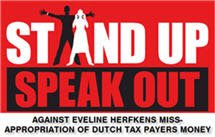
Bergenaar wil geld Herfkens vorderen
 05 apr 2008, 07:08 - BERGEN OP ZOOM;BERGEN OP ZOOM - Als het ministerie van Buitenlandse Zaken het niet aandurft, wil de Bergse advocaar Roger van Dijk het wel proberen.
Hij is ervan overtuigd dat het juridisch haalbaar is de kwart miljoen dollar die de Nederlandse VN-medewerkster Eveline Herfkens ten onrechte ontving, terug te eisen. "Desnoods wil ik die vordering wel voor 5000 euro overkopen van het ministerie."
Oud-minister Herfkens (PvdA) kwam begin dit jaar in opspraak omdat bleek dat de 250.000 dollar huurvergoeding die zij van het ministerie van Buitenlandse Zaken ontving voor haar appartement in New York, in strijd was met de interne regels van de VN. Die stellen dat medewerkers geen vergoedingen van overheden mogen ontvangen. Herfkens, die voor de ontwikkelingsorganisatie UNDP werkt, weigert tot nu toe het geld terug te betalen. Ze zegt dat ze niet van de regels op de hoogte was.
Een meerderheid van de Tweede Kamer vindt dat de ex-minister het geld, ze kreeg 7000 dollar per maand voor haar appartement, wél moet terugbetalen. Volgens minister Maxime Verhagen van Buitenlandse Zaken is het ministerie echter kansloos het geld via een juridische procedure terug te vorderen.
"Volgens mij is hard te maken dat Herfkens het wel wist. Ze heeft de rules en regulations van de VN ondertekend. Dan kun je als overheid gewoon een 'onverschuldigde betaling' terughalen", zegt Van Dijk. Dergelijke vorderingen kunnen ook worden verhandeld. "Ik durf daar wel 5000 euro voor te bieden." Het gaat Van Dijk naar eigen zeggen niet om de mogelijke opbrengst van 250.000 dollar, maar om het principe. "In Nederland moet een uitkeringstrekker al voor de rechter komen als hij voor 500 euro fraudeert. Dan is dit helemaal schandelijk." door Cyril Rosman
cyril.rosman@bndestem.nl
Als het ministerie van Buitenlandse Zaken het niet aandurft, wil de Bergse advocaar Roger van Dijk het wel proberen. Hij is ervan overtuigd dat het juridisch haalbaar is de kwart miljoen dollar die de Nederlandse VN-medewerkster Eveline Herfkens ten onrechte ontving, terug te eisen. "Desnoods wil ik die vordering wel voor 5000 euro overkopen van het ministerie."
Oud-minister Herfkens (PvdA) kwam begin dit jaar in opspraak omdat bleek dat de 250.000 dollar huurvergoeding die zij van het ministerie van Buitenlandse Zaken ontving voor haar appartement in New York, in strijd was met de interne regels van de VN. Die stellen dat medewerkers geen vergoedingen van overheden mogen ontvangen. Herfkens, die voor de ontwikkelingsorganisatie UNDP werkt, weigert tot nu toe het geld terug te betalen. Ze zegt dat ze niet van de regels op de hoogte was.
Een meerderheid van de Tweede Kamer vindt dat de ex-minister het geld, ze kreeg 7000 dollar per maand voor haar appartement, wél moet terugbetalen. Volgens minister Maxime Verhagen van Buitenlandse Zaken is het ministerie echter kansloos het geld via een juridische procedure terug te vorderen.
"Volgens mij is hard te maken dat Herfkens het wel wist. Ze heeft de rules en regulations van de VN ondertekend. Dan kun je als overheid gewoon een 'onverschuldigde betaling' terughalen", zegt Van Dijk. Dergelijke vorderingen kunnen ook worden verhandeld. "Ik durf daar wel 5000 euro voor te bieden." Het gaat Van Dijk naar eigen zeggen niet om de mogelijke opbrengst van 250.000 dollar, maar om het principe. "In Nederland moet een uitkeringstrekker al voor de rechter komen als hij voor 500 euro fraudeert. Dan is dit helemaal schandelijk.
Tuesday, April 1, 2008
U.N. had warning of terror attack
By Betsy Pisik
Washington Times
NEW YORK — U.N. and Algerian officials were warned in advance of a December terrorist attack in Algiers that killed 17 U.N. staffers but they failed to boost security measures at the U.N. compound, a preliminary report says.
"The hostile intent against the U.N. in Algeria was present and well-known before the attack," David Veness, U.N. undersecretary general for safety and security, wrote in a 20-page preliminary report, a copy of which was obtained by The Washington Times.
Six months before the attack, "the media branch for [al Qaeda in the Maghreb] issued a direct threat against the U.N.," Mr. Veness wrote.
Beginning in April, the U.N. security coordinator for the Algerian compound sent a series of urgent messages to headquarters in New York, warning that the likelihood of an attack on the compound housing seven U.N. agencies was "high" and that damage would be "severe."
In subsequent warnings, Babacar Ndiaye of Senegal, the U.N. security coordinator, sought barriers to protect the compound and other measures.
Despite the warnings, the compound remained at "Phase 1" of a five-level security system used by the United Nations — a level considered safe enough for U.N. staffers to bring their families to live overseas.
Mr. Ndiaye died in the Dec. 11 attack that killed 17 and injured at least 40.
Shortly afterward, al Qaeda claimed credit for the bombing, boasting that it used nearly a ton of explosives against "the den of international apostasy."
Local press reports shortly after the attack quote Algerian Interior Minister Noureddine Yazid Zerhouni as saying that the government had reason to expect an attack because in April, authorities had arrested a man with surveillance video of the site on his cell phone.
That man, an al Qaeda associate, was wanted in connection with an April 11 attack on the presidential palace in Algeria and a nearby police station.
It was the deadliest attack on the United Nations since the August 2003 Baghdad bombing that killed 22, and forced the organization to leave Iraq for more than a year.
Islamist turmoil has plagued Algeria for years. Up to 200,000 people were killed in a civil war that began in 1992 after the army canceled elections that a now-banned Islamist party was poised to win.
The war ended a decade later, but an Islamist insurgency continued.
By 1996, however, the situation was calmer and the Algerian government began complaining to U.N. Secretary-General Kofi Annan that security precautions stigmatized Algeria with "an undeserved bad image abroad to the extent that it kept out foreign investment," according to the Veness report.
The U.N. subsequently lowered the threat level in stages, ultimately to its lowest level.
Mr. Veness also wrote that the Algerian government was slow to respond to repeated requests for additional security.
He said "care has been taken not to apportion blame or responsibility."
The warnings were received at the U.N. headquarters in New York, but it is not clear from the Veness report how the U.N. responded.
The U.N. Staff Union, a New York-based organization that represents many but not all U.N. employees, has called for a full investigation to find out why better protections were not in place.
The group has publicly questioned why the formal risk assessment for that duty station was so relaxed, given the threats and attacks on foreigners and government buildings.
Just two weeks ago, the United Nations announced the formation of a seven-member panel to review U.N. security arrangements around the world.
Though the review is in response to the Dec. 11 attack, it will not focus on how so many red flags were missed in Algiers, said senior U.N. official Lakhdar Brahimi, who is in charge of the project.
Mr. Brahimi told a press conference last month that the blue and white U.N. flag was no longer a symbol of neutrality and protection, but in fact a target.
Monday, March 31, 2008
Letter to UNDP Watch on Algeria bombing
 It has been 3 months now since the last posting to UNDP Watch to air the blood soaked laundry of UNDP and its negligence in Algeria which cost the lives of 13 of our colleagues and the gross mismanagement of the Security Unit for UNDP. 3 months to take action to prevent another Algeria. 3 months to make the changes in the Security Unit to make sure that rules and regulations are followed in hiring and that the falsely titled deputy chief is removed. But what has happened?
UNDP executive board has given over 30 million dollars to the Security Unit to provide for our safety after Algeria. Of course Mr. Jab Swart has been placed in charge of managing this fund again, even following his inability to give funds to Algeria when it was needed most. Each region was asked to prioritize the needs for using these funds. each responsible regional security unit focal point reviewed and approved these requests. The security unit budgeting manager reviewed and validated these requests.The Administrator and Associate Administrator have reminded everyone that security is the highest priority and that the funding is available to help protect us. But what has happened in this 3 months? NOTHING.
Mr.Jab Swart sits on his deputy chief's throne and 'manages' this fund. If you ask anyone they refer to this fund as "Jab's fund". Funds for some moving of UNDP offices have been proposed but not a penny has been issued. Almost every UNDP country office where you and I work every day far from Mr. Jab Swart in his private ofice in New York have asked for funds. What have we received NOTHING.
Mr. Jab Swart was keen to use "his" fund last year to give funds to projects he personally endorsed such as thousands for countries in Europe where his friends worked. Many thousands for other countries where there was a lesser threat than in Algeria, where again Mr. Jab Swart's friends worked or where he had worked himself. But Algeria was given funds for only some radios. How did Mr. Jab Swart think that a few radios would help against a bomb? In Mr. Jab Swart's management of security it is more important to but an armoured truck for his friends in Somalia where the staff worked from a safe hotel most of the time. For Algeria Mr. Jab Swart did virtually NOTHING.
With the blood of 13 UN colleages on his hands it could be expected that Mr. Jab Swart would be eager to make right and do for us what he refused to do for Algeria. But he has done NOTHING.
In Africa we have a saying: Rain beats a leopard's skin, but it does not wash out the spots. The rain of our colleagues' blood was not enough even to wash out Mr. Jab Swart's spots of incompetence. His background is not security and he is an incompetent manager and UNDP administration has not seen fit to remove him. Again my friends, what has been done NOTHING.
Perhaps Mr. Brahimi and his investigating team will see the truth behind Mr. Jab Swart's spots. But I and many others expect the usual NOTHING.
Subscribe to:
Posts (Atom)