Thursday, October 22, 2009

U.N. Injustice

Forbes.com

Claudia Rosett, 10.22.09, 12:01 AM ET

Founded "to save succeeding generations from the scourge of war," today's United Nations is instead laying the groundwork for war galore. In the name of "justice," the U.N. handicaps democracies trying to defend themselves against tyrants and terrorists. That's the bottom line of the so-called Goldstone report, the 575-page product of the U.N.'s "fact-finding mission" on the war this past winter between Gaza and Israel.

Led by former South African judge Richard Goldstone, this U.N. mission set out to explore, as Goldstone summed it up, "All violations of International Human Rights Law and International Humanitarian Law that might have been committed at any time in the context of military operations that were conducted in Gaza from 27 December 2008 - 18 January 2009 whether before during or after."

From this exercise Goldstone emerged to accuse Israel of "reprisals" and "collective punishments" and "war crimes." He also criticized "armed groups" in Gaza (where the major "armed group"--terrorist Hamas--runs the enclave). But in the U.N. universe, that is a nod to the appearance of impartiality, of no real relevance to action. Last week the U.N. Human Rights Council adopted Goldstone's report, with a resolution slamming Israel and omitting any mention of Hamas. Goldstone duly expressed his "sadness" over this predictable action by the same Geneva-based Human Rights Council that earlier this year hosted Iranian President Mahmoud Ahmadinejad as a star speaker at its anti-Israel Durban Review conference.

In a process weirdly akin to the enrichment of uranium into weapons grade material, the Human Rights Council's anti-Israel distillation of Goldstone's anti-Israel report is now wending its way toward debates at U.N. headquarters in New York. This process is fraught with threats that Israelis will face prosecution by the International Criminal Court, if Israel does not preempt that possibility by conducting its own public investigations and prosecutions as prescribed by Goldstone's mission.

Hamas has welcomed all this. The Israeli government has rejected it, and the U.S. government--from its new seat on the U.N. Human Rights Council, has voted against it. Plenty has been written already on the specifics of the Goldstone mission, report and ensuing resolution.

Troubling though each step of this has been, there's a deeper problem underlying this entire scene. That problem is the idea that the U.N. is in any way equipped to dispense "justice." It is not.

Unless the U.N. secretly reports to the divine (and its record of corrupt and self-serving abuses, from Oil-for-Food to current complicity in Congo atrocities strongly suggests it does not), the only over-arching authority operating here is the U.N. itself. The U.N. is not a system of justice; it more closely resembles an extremely well-funded and plushly appointed kangaroo court.

The U.N.'s 192-state membership is stacked with manipulative despotic governments, ringed with immunities, and has been engaged for decades now in the process of turning the democratic state of Israel into a pariah. Israel, as we all know, has been condemned over the years more often than any other U.N. member state. Israel is unwelcome to serve among the 10 rotating members of a U.N. Security Council, which in recent years has seated such tyrannies as Syria and Libya.

Nonetheless, this entire exercise in crucifying Israel is taking place in the name of "justice." Never mind that Israel pulled out of Gaza in 2005 in hope of peace, and was rewarded with the takeover of Gaza by the terrorist group, Hamas--dedicated to the destruction of Israel. Having suffered thousands of terrorist rocket and mortar attacks launched out of Gaza, Israel finally fought a brief war to defend itself.

The U.N. responded by dispatching Goldstone, who at lightning speed (by U.N. standards) produced a report stuffed with hundreds of mentions of justice, law and accountability. In a statement on Sept. 29 to the Human Rights Council, presenting his final report, he said "it is accountability above all that is called for in the aftermath of the regrettable violence that has caused so much misery for so many."

But to whom is Goldstone himself accountable? He reports to the U.N. Human Rights Council, which in turn reports to the U.N. General Assembly. Which in turn reports to ... itself. And what is that General Assembly? It is a conclave dominated by the 130-member G-77, chaired this year by Sudan, which overlaps with the Organization of the Islamic Conference. This is the same General Assembly, which, in its own version of global "justice," gave more than equal time on its main stage last month not only to representatives of free nations, but to Libya's Muammar al-Qaddafi, Iran's Ahmadinejad and Venezuela's Hugo Chavez.

It can happen from time to time that the U.N. does dispense justice--if only through the accidents of Brownian motion. But in this system, as a general rule, the advantage goes to those least wedded to law and most willing to wallow in impunity. Brazen rule-breaking trumps justice.

Why? Because states built around decent frameworks of law have internal drivers to hold them to account. By contrast, states piloted by despots, tyrannical dynasties or thug juntas have no such internal checks and balances.

Nor are U.N. "inquiries" and "fact-finding missions" required to conform to any particular over-arching, impartial and accountable standard of justice. U.N. missions by and large make up their own rules as they go along, subject to mandates, which member states have themselves devised to suit their own aims.

Thus do we see the Goldstone mission completed with blinding speed, mandated, launched, signed, sealed and adopted within eight months of the conflict it purports to have explored. Meanwhile, the U.N. investigation launched in 2005 into Syria's role in political assassinations in Lebanon is now dragging into its fourth year, with no clear results yet.

U.N. missions also tend to be highly selective in focus--and not in the interest of justice. For Israel, the grave menace right now is the growing influence in the region of Iran, which has threatened to destroy Israel, and is clearly pursuing the makings and know-how for nuclear weapons. Iran has been training and arming not only Hamas, but other terrorist groups such as Lebanon-based Hezbollah, which has made a tradition of stockpiling forbidden munitions under the gaze of U.N. peacekeepers, and in 2006 launched a war against Israel by kidnapping two soldiers from Israeli territory.

In Goldstone's report, so devoted to "justice," Iran is mentioned only twice: once in a footnote on page 455, in a list of munitions "held by Palestinian armed groups," which includes the 220 millimeter Fadjr-3 rocket, described as "Iranian-designed" and "thought to be smuggled into Gaza." And in an annex on the last page, listing groups which replied to calls for submissions, there is one mention of the Iranian Islamic Human Rights Commission, based in Tehran.

The real force for civilized order in the world is not the fiction of U.N. global "justice" but the requirements of decency imposed at the margin by a global top cop, when one steps forward. That was the role played by the U.S. as the U.N.-deplored lone superpower. Now America is relinquishing that role. President Barack Obama, who has just proclaimed Oct. 24 "United Nations Day," likes to describe the U.N. as "indispensable, if imperfect." The U.N. is much worse than imperfect; it is misleading and dangerous. Far too much of what it does is not only dispensable, but damaging. What's indispensable--though largely missing from the current debate--is a public understanding that the U.N. system has plenty to do with licensing the interests of its most ruthless member states, and almost nothing to do with "justice."

Claudia Rosett, a journalist-in-residence with the Foundation for Defense of Democracies, writes a weekly column on foreign affairs for Forbes.

Read more Forbes Opinions here.

NKorea poses threat to peace

Capital News


BY AGENCE FRANCE PRESSE
Update 10 minutes ago

SEOUL, Oct 22 - US Defense Secretary Robert Gates Thursday labelled North Korea a grave threat to international peace and promised to continue protecting Washington's allies in the region under a nuclear umbrella.

Speaking at annual security talks with his South Korean counterpart, Gates pledged to employ the full array of US military might as a deterrent to the North's nuclear and missile programmes.

"North Korea continues to pose a threat to South Korea, to the region and to others," Gates said.

"And, as such, I want to reaffirm the unwavering commitment of the United States to the alliance and to the defence of the Republic of Korea (South Korea)," he said at the start of the annual Security Consultative Meeting.

"The United States will continue to provide extended deterrence, using the full range of military capabilities -- including the nuclear umbrella -- to ensure ROK security."

The US stations 28,500 troops to bolster South Korea's 655,000-strong armed forces against the North's 1.2 million-member military. It also guarantees a "nuclear umbrella" over its long-time ally in case of atomic attack.

South Korean Defence Minister Kim Tae-Young said the North's policy had not changed despite recent diplomatic overtures.

Although "there are signs of some change from North Korea, including its recent willingness to talk, in reality the unstable situation such as the nuclear programme and a military-first policy continues unchanged," Kim said.

In a toughly worded statement Gates and Kim said the missile and nuclear tests in April and May, along with recent short-range missile tests, clearly violate United Nations Security Council resolutions.......

Click here to read the article

Monday, October 19, 2009

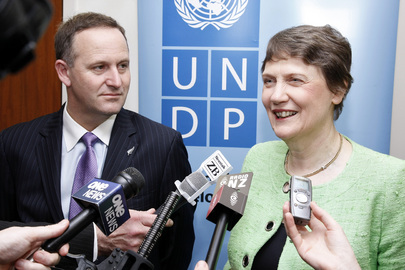
Administrator of UNDP Helen Clark to visit Finland


Helen Clark, the Administrator of the United Nations Development Programme, UNDP, will visit Finland on 19-20 October at the invitation of Minister for Foreign Trade and Development Paavo Väyrynen.

The topics of discussion will include Finland’s initiative for closer development policy dialogue between the United States and the EU, issues related to climate change, and the importance of democracy and good governance for sustainable economic development.

In the UN system, the UN Development Programme is the key actor providing financing for and implementing development aid programmes. The focus of UNDP activities lies primarily in the development of democracy and good governance, prevention of environmental threats, as well as conflict prevention and post-conflict rehabilitation.

The UNDP Headquarters is located in New York and the agency has operations in almost all developing countries. UNDP is one of Finland’s main cooperation partners in multilateral development co-operation. This year, Finland’s general aid contribution to the UNDP budget is EUR 19 million.

Helen Clark has been the head of UNDP since April this year. She is the former Prime Minister of New Zealand and is now visiting Finland for the first time since her appointment to her current position. During her visit to Finland, Clark will also meet Prime Minister Matti Vanhanen, MP Pekka Haavisto and representatives of NGOs.

National's 'gloss' will wear off - Goff

The New Zealand Herald

Labour leader Phil Goff says National is still enjoying a honeymoon with the public after a new poll showed it had double the support of his party.

TV3's poll of 1000 voters last night put the National Government's support at an exceptionally high 59.9 per cent compared to Labour's 27.2 per cent.

Mr Goff said the poll covered a recess period when it was hard for Labour to get publicity and before recent controversies over rugby broadcasting and ACC.

"This is a new government, it's in its first year of government, they still have the appearance of being fresh, of being people-friendly. We know from experience that the gloss wears off," Mr Goff told Radio New Zealand.

"It's a difficult stage of the political cycle for the Labour Party, we don't get exuberant about high polls we don't get deeply depressed about low polls.

"We want to be doing better, we are working hard to do better in those polls, but we will stand by the values we think are important to New Zealanders."

In other findings the poll put Green Party support at 6.9 per cent, the Maori Party 2.4 per cent and ACT 1.7 per cent.

In the preferred Prime Minister stakes on 4.7 per cent support Mr Goff languished behind John Key on 55.8 per cent support.

Former PM Helen Clark, who now heads the United Nations Development Programme in New York, scored 8.2 per cent.

New Zealand First leader Winston Peters, whose party is not even in Parliament, got 3 per cent support. His party got 1 per cent.

The poll questioned how down to earth people thought the leaders were. Mr Key scored 80 per cent and Mr Goff 37 per cent. It also asked if people thought the leaders had personality, Mr Key scored 72 per cent and Mr Goff 26 per cent.

- NZPA

Conference Told of N.Korea Abuse of Food Aid

The ninth International Conference on North Korean Human Rights and Refugees in Melbourne on Friday accused North Korea of grave abuses and discussed ways to improve the situation. The conference was organized jointly by the South Korean Citizens' Alliance for North Korean Human Rights and the Australian Committee for Human Rights in North Korea under the joint sponsorship of the Australian Institute of International Affairs, the U.S. National Endowment for Democracy, and the Chosun Ilbo.

One participant pointed out that international humanitarian aid to the North has not been properly distributed to the North Korean residents, children in particular. Joanna Hosaniak, the senior program officer for international cooperation for CANKHR, interviewed 40 North Korean children and juveniles and 10 adults in the South between 2001 and 2008 and heard that none of them had received rice sent by South Korea or the international community during this period. They said they had instead seen grain sacks marked "Republic of Korea," "UN," or "Red Cross" sold on the market.

They said food supplied by South Korea is given to the military on a priority basis and the rest sold to moneyed military officers or Party members in the market. Only a small amount of food is distributed to the general public at slightly lower than the market price.

Some 2.55 million tons of rice and 200,000 tons of corn were delivered to the North during the Kim Dae-jung and Roh Moo-hyun administrations.

None of the 50 said they had either received or seen meat or canned fish, which the UN had supplied to the North for children and pregnant women, between 2001 and 2007.

(englishnews@chosun.com )

Sunday, October 18, 2009

For Nepotism, Dial U-N-J-O-B-$-$


by CLaudia Rosett at PajamasMedia

Over at United Nations, lynchpin of America’s new Nobel-prize-winning multilateralism, it’s shaping up as the Year of Nepotism — again. Inner-City Press reports that the new president of the General Assembly, Libya’s Ali Treki, has his daughter, Amal Ali Treki, working in his UN office.

As Inner-City further notes, this follows the previous president of the UN General Assembly, Nicaragua’s Miguel d’Escoto Brockman, hiring a niece and nephew (Michael Clark, who likes the idea of a world without money) during his 2008-2009 stint presiding over the Parliament of Man.

This comes on top of the UN Development Program biting-and-nepotism ruckus earlier this year; while Inner-City’s questions about the ascent at the UN of Ban Ki-Moon’s son-in-law apparently remain lost in the labyrinth.

Meanwhile, the U.S. Mission to the UN has been promising to bring to America’s dealings with the UN — have you heard this before? — “high expectations for its performance and accountability,” including “financial accountability, transparency, ethics and internal oversight“…etc…. etc…. etc. Maybe the Obama adminstration should think smaller, and start simply by assembling, and releasing for the perusal of U.S. taxpayers, a directory of all family relationships in the UN system.

Saturday, October 17, 2009

UNDP Reports on Clark's Kiwi Concerns, Doss Probe In Limbo, Ryan on Sri Lanka

By Matthew Russell Lee

UNITED NATIONS, October 15 -- The no longer so new Administrator of the UN Development Program, Helen Clark of New Zealand, has still not done a UN press conference. On Thursday one of her duputies, Jordan Ryan of the Bureau for Crisis Prevention and Recovery, was announced as the guest at the noon briefing, with no topic listed. [Inner City Press previously covered Ryan's work in Vietnam, click here.]

Once Ryan arrived on Thursday, the scope of the briefing was limited to UNDP's work in Tonga and Samoa. Inner City Press asked if this had anything to do with the interest ofHelen Clark's native New Zealand in these two. Why not a briefing on the Philippines and Indonesia? Mr. Ryan did not directly answer. He described three big waves.

Since UNDP never comes to the UN briefing room anymore, Inner City Press asked Mr. Ryan a few outstanding UNDP questions. Is it true that UNDP was the agency charged with relocating the World Food Program in Islamabad to a common premises in the diplomatic zone, before the recent bombing? When will UNDP's internal investigation of Alan Doss' written request that he be shown "leeway" -- that rules be broken -- and a UNDP job given to his daughter? Ryan said there is an investigation. But it's been months.

As the moderator tried to cut off questions, Inner City Press returned Tonga and Samoa -- how much notice was given? half an hour -- then Guinea and Sri Lanka. Ryan, who has visited Sri Lanka, talked about building housing. Inner City Press asked about the view of some Tamils that the rehousing may involve changing the ethnic make up in Northern Sri Lanka. Video here.


Helen Clark and New Zealand PM and press, Tonga and 226 briefing not shown

Ryan said that not what he saw during his visit, but acknowledged that in some cases in Sri Lanka, people are moved to places other than where they came from. This could be done in the name of safety. But it could having intentions and / or effects.

Afterwards, several other UN correspondents marveled that Helen Clark, the UN system's third highest officials, has yet to come do a press conference at the UN. Watch this site.

* * *

Is Ban Ki-moon responsible for "Crimes Against Humanity" committed by Kim Jong-il and North Korean Regime ?


Currently North Korea runs six prison camps with almost 154,000 political prisoners. These data come from a recent South Korean government report.

Last week for the first time - a representative of the GNP ruling party in South Korea said that: - "These 154,000 - who are held in separate prisons from common criminals - are forced to work more than 10 hours a day on only 200g (7oz) of food, and are denied medical care".

Mr. Yooo Sang-hyun of the Grand National Party was quoted saying that: - "North Korea perpetrates various crimes against humanity, including public executions, tortures or rapes, against those who try to escape".

Many experts now are saying that previous governments, when Ban Ki-Moon was Minister of Foreign Affairs, have failed to highlight the evidence of the human rights abuses in North Korea, and that somehow with the Sunshine policy and CASH support from Ministry of Reunification for Kim Jong-il might have been an supportive element for the perpetration of these Crimes Against Humanity committed in the North by the Communist Regime.

Ban Ki-moon has continued to remain silent about North Korean human rights abuses not only throughout his tenure as Minister of Foreign Affairs of South Korea but also when he came to the helm of the United Nations since January 2007. Although the UN keeps an official presence in Pyongyang, with UNDP (United Nations Development Programme), Ban Ki-moon seem to intentionally fail to address these issues and affront the Regime on the matter.


Thursday, October 8, 2009

Helen Clark and UNDP sycophancy


If there is one thing that keeps me in the UK and which frustrates and angers me the most about the idea of returning to New Zealand (or even to Australia), it is how journalism almost does not exist in the mainstream media. At least with the Times, the Observer, the Telegraph, FT or even (cough) the Guardian, there are journalists – people not afraid to research a topic and ask hard questions, to be a devil’s advocate for the opposing point of view. Sadly, it appears that metaphorically sticking your tongue up the arse of your subject is de rigueur among New Zealand reporters

The most recent example is the sycophancy dressed as journalism being trotted out by Tracy Watkins in the Dominion Post, who has written two articles profiling how Helen Clark is getting on leading the UN Development Programme. Watkins could just as well have been working for the Labour Party to produce such inane twaddle. The first article would be better seen in the NZ Woman's Weekly or the like. I do love how the talk of scandals was brushed to one side though, "disgruntled staff" you see. Because, presumably, you only listen to disgruntled staff when they work for the private sector, not the altruistic people loving United Nations.

You can of course read the latest instalment here, which goes on about five crisis that have ravaged the world in the past year (food, financial, fuel, swine flu and climate change), though you might ask some hard questions about how many of these are real and how many still exist (food and fuel disappeared as financial came).

Watkins could have asked what have been the achievements of the UNDP, how many countries it has weaned off of aid since it was formed in 1965? The answer of course is none.

Watkins could have talked to critics of aid, especially UN based aid operations. Funnily enough she didn’t.

Watkins could have asked how much of the NZ$5 billion budget of the UNDP goes on administration, how much the average UNDP employee receives in income (tax free) and the UNDP’s travel budget? In other words she could have discussed why UN employees are some of the best paid (and least hard working) “public sector” workers in the world.

So the article is essentially an interview with Clark. Nice for Watkins to get her jaunt to New York of course, but that could have been done over the phone. Watkins could instead have used her trip to meet with different groups who have differing views of the UNDP or the UN, but that might have upset Clark – and you can’t do that can you?

She finishes with a so-called “factbox”, which says precious little.

It talks about New Zealand’s aid, ignoring aid raised through private charities and distributed through such charities, like World Vision (who I do NOT endorse). For example, talk about the aid given by the US ignores that around 80% again is given and distributed privately. In short, aid doesn’t have to involve force.

So what could Watkins have done? Well maybe she could have looked at the long list of scandals involving the UNDP and asked Clark what she’d be doing about it on her NZ$500,000 tax free salary. Scandals? You mean the New Zealand MSM hasn’t been doing its job to find out what the UNDP is about? You betcha! Watch this space.

Helen sends UNDP back into North Korea


Despite a major report outlining questionable UNDP practices in North Korea before (such as hiring North Korean staff selected by the regime for sensitive job positions), the UNDP is back.

UNDP Watch notes:

The regime employees filled such critical jobs as UNDP finance officer; program officer slots that helped to design and oversee UNDP projects in the country; technology officer, who maintained all of UNDP’s internal and external communications and servers; and even the assistant to the head of the UNDP office, who presumably was in a position to see much, if not all, of the boss’ paperwork.

The staff were paid in US$, and the capacity for fraud and diversion of aid for political purposes was enormous. $9.13 million was paid directly from UNDP to North Korean government agencies for projects approved by UNDP.

Who says the UNDP is back? Well the Korean Central News Agency. All other reports rely on that coverage. So who knows how true it is.

The Heritage Foundation is outraged for a very good reason. In a totalitarian state, any aid given is approved by the regime and benefits it. The regime's top priorities are:
- The tightly knit senior leadership surrounding Kim Jong Il and his non-estranged family;
- The military and secret police; and
- High ranking party members.

By NO means can money or aid going to North Korea that is used by its own government agencies ever be verified as having delivered assistance to those in need. It would be like funding Concentration Camp commanders to assist their captives.

So how is Helen Clark justifying this? Or is it just plus ça change... ?

I'm sure the New Zealand mainstream media are working hard to investigate this one, like they did before entered the role.

Thursday, October 1, 2009

Helen Clark/UNDP: -We're back in North Korea because they are changing and is a change we can believe in

Heritage Foundation: - The UN Development Program Rewards North Korea

Brett Schaeffer

The era of engaging the world’s worst actors continues apace with the recent announcement that the United Nations Development Program has formally returned to North Korea and restarted its program there on Wednesday September 30, 2009. For those who don’t know the history, information provided by whistleblowers to the U.S. Mission to the United Nations led the U.S. to question UNDP about its practices and activities in North Korea. Based on the information it received, the U.S. initiated an investigation that revealed numerous UNDP violations of U.N. rules and regulations and led the UNDP executive board to suspend its activities in North Korea in March 2007. According to a FoxNews summary of an independent audit commissioned by UNDP and released in May 2008, UNDP “routinely, and systematically… disregarded U.N. regulations on how it conducted itself in Kim Jong-Il’s brutal dictatorship, passing on millions of dollars to the regime in the process.”

In light of North Korea’s actions over the past year and its disdain for the U.N. Security Council’s resolutions regarding its nuclear-weapons and ballistic-missiles programs, the decision to return is baffling. The barbaric indifference of the North Korean government to the suffering of its own people should lead the U.N. to pull out of North Korea all together. In other repressive regimes, the U.N. and NGOs can sometimes work around the government to help the people directly. In these cases, there is some justification for continuing U.N. humanitarian activities. There is little basis for this approach in North Korea. The regime controls virtually all international humanitarian activities. Despite the best efforts of the U.N. and other providers of humanitarian assistance, aid to North Korea is only permitted if it benefits the regime. UNDP’s return to North Korea — and the continued present of other U.N. agencies like WFP and UNICEF — rewards the reprehensible government of Kim Jong-Il.