Showing posts with label North Korea. Show all posts

Friday, September 6, 2013

United Nations in North Korea hit hard by Syria conflict - - no one wants to give money for Kim Jong-un

The World Food Programme (WFP) has revealed that food support for North Korea hit a two-year low during the month of August. According to WFP, cited by Radio Free Asia (RFA), food aid to North Korea this year has shown a declining trend since February: more than 3000 tons in January; 6000t in February; 4000t in March and April; 3000t in May and June; 2900t in July; and 2050t in August, the lowest amount of food aid given since 200t in August of 2011.

Click here for this story in full at: http://www.dailynk.com/english/read.php?cataId=nk00100&num=10929

Wednesday, July 3, 2013

U.N. agencies and UNDP in North Korea carrying in cash to keep operations afloat


Read this in full at UNDP: http://www.foxnews.com/world/2013/06/27/un-agencies-in-north-korea-carrying-in-cash-to-keep-operations-afloat/#ixzz2Y1NsIwvc

  • North Korea Korean Wa_Cham.jpg
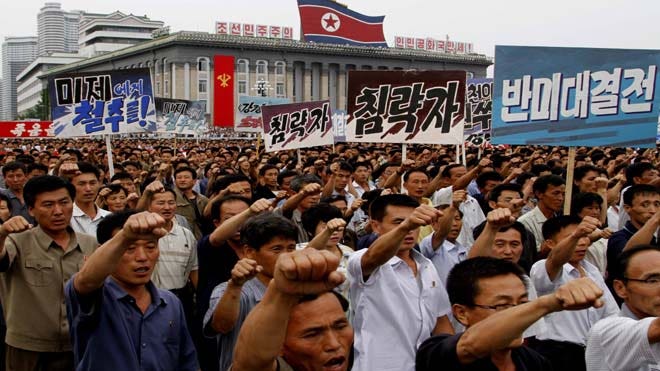
    North Koreans march on Kim Il Sung Square in Pyongyang, North Korea as they hold an anti-U.S. demonstration on Tuesday, the 63rd anniversary of the outbreak of the three-year Korean War, from 1950 to 1953. (AP Photo/KIm Kwang Hyon)
United Nations agencies working in North Korea, which is under harsh Western sanctions, are facing a financial crisis of their own, leading at least some of them to carry in cash from neighboring China to keep their struggling operations afloat.


Read more: http://www.foxnews.com/world/2013/06/27/un-agencies-in-north-korea-carrying-in-cash-to-keep-operations-afloat/#ixzz2Y1NsIwvc

Wednesday, November 7, 2012

ICPN-2012-05-DPRK International Individual Consultant for the “Technical Design Optimization” of locally made Small Wind Energy Systems in the DPR of Korea


(re-advertisement)..
Procurement Process :RFP - Request for proposal
Office :DPR of Korea - KOREA (DEMOCRATIC PEOPLE'S REPUBLIC OF)
Deadline :25-Nov-12
Posted on :05-Nov-12
Development Area :CONSULTANTSCONSULTANTS
Reference Number :10128
Documents :
ICPN-2012-05-DPRK
P11 form
Overview : Individual Consultant Procurement Notice Reference: ICPN-2012-05-DPRK (re-advertisement) Deadline to submit your offer: before 11:59 pm on November 25, 2012. Post title: International Individual Consultant for the “Technical Design Optimization” of locally made Small Wind Energy Systems in the DPR of Korea. Project: Small Wind Energy Development and Promotion in Rural Areas (SWEDPRA) Location and duration: Home based (approximately 30-45 working days), including one-week mission in DPRK. From December 2012 to January 2013. First mission expected in December. Invitation to: International individual consultants. Please send your proposal/offer in electronic format (pdf, tiff, etc.) to the e-mail address operations.dprk@undp.org with the following subject: Offer ICPN-2012-05-DPRK, or alternatively, you can send your offer duly signed in a sealed envelope to the following address: United Nations Development Programme (UNDP). DPRK country office. Procurement Unit. P.O. Box 27. 21 Munsudong, Daedonggang District, Pyongyang, Democratic People’s Republic of Korea. Please mark in envelope the reference number: ICPN-2012-05-DPRK Any question or comments regarding this Request for Quotation shall be sent to the e-mail address operations.dprk@undp.org or to the address shown above, not later than November 19, 2012. The answers to the questions or any modification to the Terms of Reference will be sent to the DPRK email list “DPRK Phonebook”, not later than November 20, 2012.

Thursday, September 27, 2012

UN Sanctions Committee letter to Francis Gurry ( S/AC.60/2012/OC.42 )

Click here to read the letter in full


Click here to read the letter in full
http://wipo.int/export/sites/www/about-wipo/en/oversight/pdf/sanctions_committee_iran.pdf

Ban Ki-moon's major cover up on WIPO scandal continues - Sanction Committee says they "never prohibited" Iran and/or North Korea to receive high tech equipments

Click here to read this @ http://www.ag-ip-news.com/news.aspx?id=28445&lang=en

Decision of UN Sanctions Committee on WIPO’s Technical Assistance to Iran

26-Sep-2012 | Source : AG-IP News | Visits : 173
 
GENEVA - The United Nations (UN) committee charged with overseeing implementation of Security Council resolutions relating to the Islamic Republic of Iran has confirmed that World Intellectual Property Organization (WIPO) technical assistance to the Islamic Republic of Iran does not violate United Nations resolutions, a press release by the organization stated.

In a letter to WIPO Director General Francis Gurry, the Chairman of the Committee Néstor Osorio, said “I wish to convey the Committee’s understanding that nothing in Security Council resolutions 1696 (2006), 1737 (2006), 1747 (2007), 1803 (2008) and 1929 (2010) prohibit the proposed project as described in your letter aimed at assisting Iran in developing technical capacity for intellectual property rights protection.”

The letter also advises early consultation with the Committee. WIPO has already put in place measures to ensure that all managers must refer to WIPO’s Office of the Legal Counsel (OLC) for guidance and clearance any activity proposed in a country subject to UN sanctions. OLC will, wherever necessary, consult the appropriate UN sanctions committee.

This letter follows a similar communication from the committee overseeing implementation of Security Council resolutions relating to the Democratic People’s Republic of Korea (DPRK) which also said that WIPO assistance to DPRK does not violate UN resolutions.
 

Saturday, September 15, 2012

Heritage: U.N. Review of Tech Transfers to Iran, North Korea Underscores Need for U.S. Action

Click here to read this on Heritage: http://blog.heritage.org/2012/09/13/u-n-review-of-tech-transfers-to-iran-north-korea-underscores-need-for-u-s-action/

By Brett Schaefer

As reported by Fox News earlier this year, the World Intellectual Property Organization (WIPO) approved the transfer of computers and other equipment to Iran and North Korea—both of which are under sanction by the U.S. and the United Nations—without notifying WIPO member states or the U.N. sanctions committees.
In response, WIPO director general Francis Gurry announced that the organization would establish an “Independent External Review” to investigate and submit its report to WIPO. While director general Gurry clearly sought to minimize the potential for embarrassment by circumscribing the review through its “terms of reference,” the two individuals conducting the review (Stig Edqvist and John P. Barker) went well beyond this guidance. Their findings, published in a report this week, are damning:
  • The report concludes that the transfers could have violated U.N. sanctions, depending on how the language adopted by the Security Council was interpreted. The final determination will be made by the U.N. Sanctions Committees.
  • While noting that WIPO has implemented procedures as of May 1, 2012, to “require a review of programs for countries subject to UN sanctions,” the experts harshly criticized WIPO’s previous disregard for such procedures and saw “no justification for the previous lack of a policy to check Sanctions Committee Compliance on a systematic basis.”
  • Moreover, the report states that much of the transferred equipment is subject to U.S. jurisdiction under U.S. Export Administration Regulations and would have triggered the need for an export license. As a result, the report unambiguously concludes that North Korea and Iran “could not have purchased much of this equipment directly from third-party vendors. These countries could only have gained access to the specific items delivered through an organization that invoked the privileges and immunities protections such as WIPO.”
  • WIPO asserts that, as an international organization, it is not subject to national laws. However, the report observes, “Other international organizations have the same privileges and immunities, yet often will take into account national laws on technology transfers to sensitive countries, end-users, and end-uses out of respect for the views of their Member States.”
The experts were clearly astounded by WIPO’s actions:
[W]e simply cannot fathom how WIPO could have convinced itself that most Member States would support the delivery of equipment to countries whose behavior was so egregious it forces the international community to impose embargoes and where the deliveries, if initiated by the recipient countries, would violate a Member State’s laws.… The UN itself declared that Iran and [North Korea] should fall into a heightened category of diligence and review because of their threats to world peace and stability. WIPO, as a UN agency, shares the obligation to support the work of other UN bodies, including the Sanctions Committees.
Based on the review, WIPO’s actions are indefensible, and WIPO should be held accountable. To do this, the U.S. needs to make its own assessment of how these transfers were approved and who is responsible. According to House Committee on Foreign Affairs chairwoman Ileana Ros-Lehtinen (R–FL) and ranking member Howard Berman (D–CA), director general Gurry and WIPO legal counsel Edward Kwakwa have impeded congressional testimony by WIPO witnesses. The U.S. should insist that the witnesses requested by Congress be allowed to testify without restriction.
Moreover, the U.S. should not let stand WIPO’s assertion that U.S. sanctions can be ignored with impunity. The report correctly notes that only the U.S. can “make the determination of whether the UN privileges and immunities ultimately would exempt WIPO from enforcement of U.S. export control laws” and whether those immunities extend to third-party contractors.
A failure by the U.S. to vigorously insist that its export control laws apply to the U.N. and its contractors would, in effect, render them meaningless.

Posted in American Leadership
 
Click here to read this on Heritage: http://blog.heritage.org/2012/09/13/u-n-review-of-tech-transfers-to-iran-north-korea-underscores-need-for-u-s-action/ 

Friday, September 14, 2012

U.N. shipment of high-tech to North Korea, Iran unjustified and unfathomable, say investigators

By George Russell @ Fox News

Read more: http://www.foxnews.com/world/2012/09/13/un-shipment-high-tech-to-north-korea-iran-unjustified-and-unfathomable-say/#ixzz26PVr5r3z

EXCLUSIVE: The controversial shipments of U.S.-made computer equipment to North Korea  and Iran by the United Nations’ World Intellectual Property Organization was not only “unjustified” but something “we simply cannot fathom,” according to an independent investigative report, commissioned by WIPO itself.

The report puts new pressure on the Obama Administration to decide what to do next. The same report makes it clear that WIPO, a U.N.  agency  that considers itself beyond the reach of any nation’s laws, clearly violated U.S. export control  legislation in the process—and that the transgressions were worse than previously known.

North Korea and Iran are also under U.N. sanctions for their illegal nuclear weapons programs, and neither could have legally obtained such  goods anywhere on their own, the report says, pointing the finger directly at WIPO for making possible the sensitive shipments, otherwise clearly forbidden  under U.S. rules.

The high-tech shipments  to two of the world’s most dangerous governments were initially made public last April by Fox News, which reported that WIPO’s method for carrying  out the transaction in North Korea seemed designed to bypass safeguards set up in 2008 after  a similar scandal involving another U.N. agency, the United Nations Development Program.

In the newest case involving  North Korea, the WIPO goods, ostensibly part of a routine technology upgrade for that country’s  patent retrieval system, included along with ordinary laptop computers and other goods  a “very capable” hardware firewall and network security system  that is subject to “a very high level of U.S. licensing requirements” for so-called “dual-use” items, which have a number of non-civilian applications.

“The equipment is subject to national security, anti-terrorism and encryption controls under U.S. law,” the report declared.

For its part, WIPO not only considers itself above the laws of nation states, but also seems to consider itself as an entity apart from any coordinated such U.N. efforts as sanctions, even though numerous U.N. Security Council resolutions call on U.N. bodies to cooperate in the sanctions efforts.
A 1974 agreement between the U.N. and WIPO, in Article 2, expressly says that WIPO “agrees to co-operate in whatever measures may be necessary to make co-ordination of the policies and activities of the United Nations and those of the organs and agencies within the United Nations system fully effective. The Organization agrees further to participate in the work of any United Nations bodies which have been established or may be established for the purpose of facilitating such co-operation and co-ordination.”

The same agreement, in Article 8, says that WIPO will “cooperate” with the U.N. “by rendering such assistance to it, as the United Nations may request.”

Click here to view the agreement.

Even so, how WIPO could deliver such equipment “to countries whose behavior was so egregious it
Even so, how WIPO could deliver such equipment “to countries whose behavior was so egregious it forced the international community to impose embargoes,”  was beyond the investigators’ .
The WIPO report throws the issue of what to do next about the high-tech transgression back to the Obama Administration. The report declares that “only the U.S.  can make the determination of whether the U.N. privileges and immunities ultimately would exempt WIPO from the enforcement of U.S . export control laws”—a legal possibility not often expressed at U.N. organizations.
The report says it is also a U.S. decision whether those same privileges and immunities  extend to the non-U.N. contractors that actually carried out the procurement and shipping of the sensitive U.N.’s bidding—something that the report noted has in the past not always been automatic.

Click here to view the full report.

Whether the U.S. will actually come up with such a tough response is another question.
A State Department official, in response to questions from Fox News, declared that “we agree with the inquiry team that  regardless of whether WIPO violated U.N. sanctions, this issue raises serious questions about management and transparency at WIPO, as well as coordination with member states and the United Nations Security Council sanctions committees. We will continue our ongoing efforts with member states and WIPO to pursue measures to improve its oversight, transparency and accountability mechanisms.”

Meantime, the report does not rule out the possibility that U.N. sanctions committees themselves might still declare the WIPO actions to be illegal, although it judges that possibility to be faint. The report lays out a  “broad” case that the WIPO transactions are illegal in U.N. terms, a view held by a number of well-credentialed international legal experts as well as a “narrow” case that they are not, before deferring to U.N. sanctions committees, which have not yet made a judgment.

But while clarifying the gravity of the offense against international peace and stability—not to mention the sovereign rule of law-- the 77-page report, written by a two-person panel commissioned by WIPO itself in August, only added to the mystery of why the obscure agency, headed by Director General Francis Gurry, decided to take such an explosive action in the first place.

One reason for the continuing lack of clarity was the short time frame and limited budget granted to the inquiry by Gurry himself.  The issue of the shipments came up among WIPO member states only in March, after a whistle-blowing staff member brought them to the attention of the Geneva diplomatic corps.

A number of countries, including the U.S., began  demanding explanations from Gurry behind closed doors , asking among other things why United Nations sanctions committees which monitor restrictions against North Korea and Iran were not informed in advance of the transactions.
After a couple of months Gurry hastily announced that WIPO would make no more technology shipments to any country in the future, and assembled his investigative panel in August, giving it only three weeks to come to its conclusions.

The investigators were given relatively narrow terms of reference, which included whether the controversial shipments conformed to the programs initially passed by WIPO’s 185 member states, and whether the actions were in compliance with U.N. sanctions.

The report, a joint effort by a Swedish police official named Stig Edqvist and U.S. attorney John Barker, a former senior State Department official and export controls expert, goes considerably beyond that, however—especially when they focus on the demands of U.S. law.

Their report underlines that although many of the goods involved in the WIPO shipments were ordinary laptops and other conventional computer gear, some of them definitely weren’t.

In some cases, which included the network security device, the technology was  sensitive enough to require higher-level  U.S. export controls  even for  countries far less dangerous than the belligerent  rogue states, which are under  U.N. sanctions for their illegal nuclear weapons programs.

The only way the two  countries could get their hands on such things, the report declared, was by using an international organization that claimed diplomatic  privileges and immunities putting it above national laws—an organization, in other words, like WIPO.

The report addresses an allegation that surfaced immediately after the discovery of the sensitive shipments—that Gurry had arranged the transfer of the goods, especially in the case of North Korea, as a quid pro quo for the country’s support for his election as Director General.

The investigators asked Gurry himself and he “unequivocally denied there was any link, express or implied,” between his election and the shipment, the report states.

On the other hand, the document says, “we asked to speak with DPRK [Democratic People’s Republic of Korea] and Iranian mission representatives to obtain their views, but not surprisingly, they would not speak with us.”

The investigators then note that Gurry personally signed a diplomatic communication to the North Korean mission in June, 2011, to confirm plans for the equipment, which was only delivered in early 2012.

Beyond the narrow issues of who did what, and when, the report also takes a look at how WIPO actually communicated the details of the transfers to its  185 member states in the program and budget documents they approve, and declared that there was nothing there that would have tipped the exact nature of the transfers.

Those documents, typical for U.N. organizations, are enormously lengthy but short on important detail.

“In the broadest sense,” the report observes, “member states approved the overall technical assistance programs because these programs were included in the program and budget docs. Unless a member state  asked in advance of a shipment, however, the member state could not tell from the program and budget documents which countries would receive computers and equipment.”

In other words, member states usually do not know what they are approving.
Moreover, WIPO staffers themselves were not always helpful. While  noting that WIPO has “no procedure requiring a separate review of programs for countries subject to UN sanctions,” the investigators also observe that “WIPO staff did not provide us with a basis for why they sought review of some shipments, but not others.”
In general, however, “WIPO’s provision of technical assistance for DPRK was handled in the same manner as it would have been for countries not subject to U.N sanctions,” a function of their general view that WIPO stood apart from national law, and even apart from what other parts of the U.N. were saying and doing about their client countries.
The WIPO report offered a sharp rebuttal of that attitude, arguing that WIPO staff, “shares the obligation to support the work of other U.N. bodies, including the sanctions committees.”
It also suggests the common-sense idea that WIPO could get out of the business of facilitating otherwise illegal acts if it made“a deliberate policy decision, as other international organizations have done, not to deliver technology  and equipment  to a country if that [country] could not legally obtain such technology  and equipment on its own.”
An additional way to do that, it suggests, would be to make the contractors who actually procure and ship such equipment at the U.N.’s behest to obtain export licenses from the manufacturer nations—such as the U.S.—in advance of shipment.
For its part, WIPO told Fox News that “At the moment, WIPO is reviewing the report and considering its recommendations.”
Most of the solutions it was proposing, the WIPO report said, had already been suggested four years earlier—in the wake of the previous scandal involving the transfer of hard currency and dual-use technology to North Korea by the United Nations Development Program.
That scandal ended with a 353-page report, compiled after an eight-month investigation, which found similar and even more extensive abuses on the part of UNDP, and which suggested a number of changes to UNDP procedures for dealing with such sensitive items in Pyongyang.
“We have drawn heavily from this report on the UNDP recommendations (in some cases verbatim),” the WIPO report notes drily, as well as those from other U.N. agencies that actually had developed better practices and procedures for dealing with sanctioned countries.
If those older UNDP-related recommendations had been in place in WIPO’s case, the latest report noted, “It is unlikely that WIPO would have proceeded as it has in this case.”
Or maybe not. The WIPO report notes that despite UNDP’s previous extended brush with the consequences of shipping touchy materials to suspect places, it was also involved in the latest scandal, because “WIPO sought the assistance of the UNDP to handle the actual delivery of the shipment” from China to North Korea., under a 1978 agreement between the two agencies.
Says the report, in carefully muffled prose: “WIPO staff members informed us that they were not aware of, and we could not  confirm that, WIPO staff sought confirmation from UNDP regarding whether the UNDP had checked to determine whether the deliveries were consistent with the U.N. sanctions requirements  or were consistent with the license requirements under U.S. law for the equipment with U.S. origin content.”
In other words, WIPO staffers couldn’t say whether UNDP itself had checked on the propriety of the shipments.
The report does not follow up with UNDP. Fox News, however, did, citing the report’s own wording.
UNDP's reply: “UNDP is currently analyzing the report and we will get back after this review is concluded.”  

Thursday, September 6, 2012

UNDP subsidizes energy in North Korea: pays $12,000 per year cooking and hot water energy for only 20 families

 SCANDAL

In DPR Korea, UNDP pays

$12,000 (KGS 600,000) = Cooking/hot water x 1 year x 20 families 

= $600 x Family/year = $50 x Family/month

= 5 times salary of a North Korean worker
(a North Korean earns less than $10 per month)

click here for this story on 24.kg

The first modern biogas unit from Kyrgyzstan to go to North Korea

06/09-2012 12:10, Bishkek – 24.kg news agency , by Ivan MARCHENKO
The first modern biogas unit from Kyrgyzstan will go to North Korea. The head of Fluid Public Fund, Alexey Vedenev, reported to 24.kg news agency.
According to him, PF’s experts designed and produced BEM-50 biogas unit for a rural cooperative in North Korea. It will process up to three tons of manure per day and earn up to 120 cubic meters of biogas during the same time period. The unit will provide up to 20 families with the energy necessary for cooking and hot water supply, as well for domestic heating. There will be another product of processing – biological fertilizers capable of enhancing crop yields by 2-3 times.
As noted, the UNDP supported the export of biogas unit to North Korea. Its cost is KGS 600-700 thousand.
URL: http://eng.24.kg/community/2012/09/06/25558.html

Friday, August 31, 2012

SCANDAL: UNDP management played a key role in securing Iran and North Korea's votes for Francis Gurry of WIPO (it allowed internal cover up of shipments thru its China Office)


GENEVA | Thu Aug 30, 2012 11:06am EDT
 
(Reuters) - Four months after a U.N. agency's decision to send computer equipment to Iran and North Korea first stirred controversy, a feud has erupted between the body's director general and a suspended senior manager over misconduct allegations.

In a suit filed with a U.N. tribunal, the manager accuses Francis Gurry, the Australian head of the Geneva-based World Intellectual Property Organization, of pledging the equipment to the two sanctioned countries in exchange for their votes.

The suit also alleges Gurry earmarked posts for member states who backed him in his 2008 election and those whose votes he is trying to secure as part of his 2014 re-election bid.

WIPO is the U.N.'s richest body and is almost entirely self funded with annual revenues of over $300 million, mostly earned from patent application fees. It was created in the 1970s to promote intellectual property rights, particularly in the developing world, to further economic progress.

"The evidence suggests that the Director General has a track record of manipulating appointments to WIPO professional posts in exchange for votes," said the complainant's brief to the International Labour Organization's Administrative Tribunal (ILOAT) filed on August 20.

The lawsuit was filed by Swiss-based lawyer Matthew Parish, partner at Holman Fenwick Willan, on behalf of a senior WIPO employee, Christopher Mason. Mason contends he was unjustly suspended for corruption in May 2011, wrongly accused of an improper relationship with a contractor at a firm bidding for a WIPO contract.

Gurry denied the allegations, saying he made no deals with any country in exchange for its support. He said a document cited by the claimant, which appears to list political appointments, was fabricated.

"No job pledges were made in exchange for political support, and no such document was ever created or approved by me. I believe that any document purporting to list pledges must be a work of fabrication," he said in an emailed statement last week.

Mason's lawyer Parish said: "The commitments document has been widely circulated throughout the diplomatic community for many months and is an open secret in WIPO."

An International Labour Organization official declined to comment on the proceedings which she said were confidential.

SEEKING REVENGE OR JUSTICE?

Some diplomatic sources in New York, where the United Nations has its headquarters, dismissed Mason's suit as a publicity ploy by an employee intent on embarrassing his former boss. They said they considered it unlikely the equipment in question would breach U.N. sanctions, which are less stringent than those imposed by the United States and European Union.

U.N. sanctions primarily target Iran and North Korea's nuclear and missile programs. They also include a ban on arms exports and, in the case of North Korea, a ban on exports of luxury goods.
One diplomatic source familiar with the case said Mason may be motivated by a desire for revenge after his suspension.

Mason asked the WIPO Appeal Board to review his suspension in August 2011. The board found that the decision to suspend Mason from duty was "flawed" and recommended re-instatement and a moral injuries payment, a document of their conclusions dated March 2012 showed. Mason remains suspended, however.

Although the suit alleges that the transfers to Iran and North Korea were promised in return for their votes in Gurry's 2008 election, it contained no proof to support this claim.

The allegations of vote buying could not be independently verified by Reuters. WIPO records show that Iran and North Korea were among 83 countries on the WIPO committee that selected the director general in 2008 in a secret ballot. The Iranian and North Korean diplomatic missions in Geneva did not respond to repeated requests for comment.

Nevertheless, Mr. Mason's supporters maintain that the suit's claims are credible. These supporters include some inside the organization who declined to be named because they are not authorized to speak to the press and said they feared management retribution.

Mason's sympathizers say further that the case offers a rare glimpse into what critics say is a widespread system of political patronage within the United Nations and raises broader questions about accountability at the world body.

For instance, the head of WIPO's staff council Moncef Kateb has complained of political appointments "that contravene the most basic principles of international public service, particularly that of its independence", according to a statement in 2010 before WIPO's Coordination Committee, a body that advises the director general.

Kateb declined to comment for this story because he is not authorized to speak to the press.
"It's totally unacceptable to have this type of deals and it corrupts the system," said Hillel Neuer of U.N. Watch, a non-governmental group that monitors the United Nations. "Regrettably, it is common. Governments jostle for their own interests and a lot of unsavory dealings occur."

Officials at the U.N. press office in New York did not respond to repeated email requests for comment.

The equipment in question, including servers, firewalls and computers worth roughly $200,000, was sent to Iran and North Korea, without the knowledge of other member states, according to a statement by Esther Brimmer, U.S. assistant secretary of state, earlier this month.

The 185-member agency says the transfers were legal and form part of a technical assistance program involving more than 80 countries to help them develop their patent offices.

U.S. SCRUTINY

The transfers of equipment by WIPO to Iran and North Korea are the subject of two U.S. government probes to establish whether they represented a breach of U.N. and U.S. sanctions aimed at curbing the development of nuclear technology.

The U.S. State Department said in July it was reviewing WIPO's dealings with countries that are under sanctions after media released documents showing WIPO had been involved in shipments to Iran and North Korea. The Department's initial conclusion is that there was no breach of U.N. sanctions because the items in question did not appear to be subject to a ban. The review is ongoing.
A U.N. Security Council diplomat said it was unlikely that its sanctions committees would take any action regarding the WIPO transfers of technology to Iran and North Korea for the same reason.
The U.N. panel of experts on North Korean sanctions said in its latest annual report that it was continuing to collect information on the WIPO case in relation to North Korea.

The House of Representatives Committee on Foreign Affairs is not yet convinced the transfers were legal, suspecting they may have involved banned items, a senior Congressional official involved in the investigation said. It is also reviewing a possible breach of the United States' own sanctions as some of the equipment may have been produced by U.S. computer maker Hewlett Packard Co, the official added.

The company did not respond to a request for comment.

Lawmakers on the bi-partisan House Committee raised concern about possible WIPO retaliation against whistleblowers in a letter to U.S. Secretary of State Hillary Clinton on July 12 and in a letter to Francis Gurry on July 16, both seen by Reuters.

"I can't think of any action that has been taken against any whistleblower," Gurry told Reuters in July.
Email correspondence dated July 20 from Gurry to WIPO senior staff member James Pooley, seen by Reuters, indicated that the director general denied him permission to give evidence to the House Committee. Pooley declined to comment for this story because he is not authorized to speak to the press.

Members of the Committee said a second senior WIPO staff member was prevented from testifying at the committee hearing in a letter to Gurry dated August 1, forcing the cancellation of the session.
Asked in July about claims that witnesses were being blocked, Gurry said he would allow any "properly competent person" on the Iran and North Korea projects to testify.

Gurry said in a statement on the WIPO website on July 19 that supplies to sanctioned countries would in future need to be referred to legal counsel, which would consult the U.N. Sanctions Committee where necessary. WIPO has also commissioned an external enquiry to review the projects with Iran and North Korea, led by a Swedish police official and a U.S. attorney.

(Additional reporting by Louis Charbonneau in New York; editing by Will Waterman and Janet McBride)

CLICK HERE TO READ THIS ARTICLE ON REUTERS 

Friday, August 24, 2012

Fox News EXCLUSIVE: U.N. investigation of computer shipment to North Korea and Iran looks to be much less than thorough

by George Russell at Fox News

The United Nations agency that shipped American-made computers and sophisticated servers to North Korea is now attempting to avoid a thorough investigation that includes why the goods were shipped without either notifying United Nations sanctions committees that are trying to block the country’s nuclear weapons program, or the U.S. government.

The  probe, announced on Aug. 9 by the Geneva-based World Intellectual Property Organization, or WIPO, was advertised at the time as a “full independent external inquiry” to determine whether WIPO acted in violation of U.N. sanctions against North Korea, which continues to ignore worldwide demands that it curtail its quest for a deliverable nuclear bomb. The shipment by WIPO of Hewlett Packard computers and servers to North Korea was first reported by Fox News.

The U.S. government, in particular, says it wants to know how it happened that neither U.N. sanctions committees nor other member-states of WIPO – including the U.S. -- were informed in advance of the shipment of U.S.-manufactured equipment, which was sent from China to Pyongyang by the United Nations Development Program.

Monday, August 6, 2012

Anoid by UNDP's failures to "deliver" in North Korea - Obama Administration wants UNDP's TUMEN River project turned into a Bank (North Asian Development Bank)

Northeast Asian Development Bank revisited


Click here to read this on KoreaTimes


By Ahn Choong-yong,
Foreign Investment Ombudsman

A high note at the International Track II Meeting for Northeast Cooperation I recently attended in Tokyo was a shared enthusiasm for Northeast Asian development and necessary funding architecture. I was privileged to serve as one of the speakers from six nations _ China, Japan, Russia, South Korea, Mongolia and the U.S. ― and we shared the view that Northeast Asian countries could develop a peaceful and prosperous community once properly linked through harmonized intra-regional infrastructures.

Geographically speaking, Northeast Asia encompasses China, Japan, South and North Koreas, the Russian Far East and Mongolia. In 1992, American political scientist Robert A. Scalapino called the region an extended “natural economic territory,” emphasizing sub-regional connectivity in the Tumen River Basin area – an area directly and indirectly bordered by the nations – to exploit its growth potential. Though politically separated by borders, the United Nations Development Programme (UNDP) three decades ago conceived the Tumen River Development Area, calling for cross-border connectivity to realize their intra-regional complementarity and the growth momentum inherent in truly diverse factor endowments. Despite rounds of UNDP meetings attended by key regional stakeholders, the long-heralded UNDP project has yet to materialize due to political and historical legacies.

Recently, the Asian Development Bank forecasted that key SOC projects to deepen essential connectivity in Asia may require about $8.3 trillion by 2020. Given the development potential and funding requirements in Northeast Asia, the creation of a Northeast Asian Development Bank, as observed in the African and Inter-American Development Bank, has long been proposed by experts in the region while the Asian Development Bank may concentrate on funding large-scale infrastructure projects for Southwest Asian nations. An ASEAN infrastructure fund has already been established to finance a number of its development projects.

Rapidly rising China, with its 1.3 billion consumers, has become an important pillar of the world economy. Recently, China revealed an ambitious Changchun-Jilin development corridor to enhance its link with the East Sea route. Eastern Siberia has the world’s largest deposits of natural gas and other mineral resources. President Vladimir Putin of Russia, which is preparing to host its first APEC summit in September, recently emphasized Eastern Siberian development through his “look east policy” along with Russia’s recent accession to the World Trade Organization. As for Japan and Korea, though technologically advanced and capable of supplying significant amount of capital, they are still heavily dependent on imported energy from the Middle East and have been looking for alternative energy supply sources.

Despite the great potential for common prosperity, Northeast Asia has the bane of North Korea’s isolationism and ongoing nuclear ambitions. If North Korea were to peacefully transition toward an open-door regime, Northeast Asia could grow into a genuine and natural economic territory by enhancing cross-border connectivity through railways, gas pipelines, roads and seaports across the Korean Peninsula, the northeastern three provinces of China, the Russian Far East, northern Japan and Mongolia to diversify energy supply sources beyond the Middle East and reduce transport costs.

The possibilities for enhancing SOC connectivity in Northeast Asia are many. To lay out one concrete example, the regional supply and demand equation for natural gas could be further stabilized by extending the East Siberian gas pipeline to the Korean Peninsula, China and Japan. If North Korea were to join this venture, the regional gas supply system would be more robust and stable. Perhaps the gas pipeline passing through North Korean territory could be constructed by a multinational equity fund, for which Russia might serve as the largest shareholder and possess the managerial right while allowing North Korea to collect transmission fees and gas for their own use.

If we could establish multilateral funding architecture in the form of a regional development bank and construct a “cross-border investment community,” Northeast Asia could be transformed from a region with a Cold War legacy to a new growth pillar of the world.

The writer is also a distinguished professor at Chung-Ang University.

Saturday, August 4, 2012

Obama's State Department doesn't trust the U.S. Congress -- instead opts for a UN "independent probe" onto UN's own dealings in North Korea/Iran

EXCLUSIVE: While Congress protests, US helps UN agency with 'independent' probe into high-tech shipments to North Korea


Amid protests from congressional leaders from both parties, the Obama administration is helping an obscure United Nations agency create an investigation into whether it shipped computers and sophisticated servers to North Korea, in violation of the U.N.’s own sanctions against the communist regime.

The Geneva-based World Intellectual Property Organization, or WIPO, told Fox News on Friday that a “full independent external inquiry” into the murky issue would start next week. The “modalities and terms of reference of this inquiry,” a WIPO spokesman declared, “have been completed in close consultation with the U.S. Department of State.”

A State Department spokesman subsequently told Fox News that “we are aware” of the inquiry and that it was being conducted by a “very credible investigator.”

The same spokesman underlined that the State Department “has taken this issue very seriously since it came to our attention in March” and that “we have been working with WIPO to get to the bottom of this,” a process that has involved “asking and pressuring” the U.N. organization for answers. Nonetheless, the spokesman did not bring up the existence of the inquiry until Fox News asked about it.

The WIPO announcement came after a briefing by senior State Department officials yesterday to the House Foreign Affairs Committee, held behind closed doors.

After that session, committee aides complained that legislators “on both sides of the aisle” remain frustrated by the muffled approach that the Obama Administration is taking to the controversial transfer of technology the nuclear-ambitious regime in North Korea, despite U.N. and U.S. sanctions against the communist government, and said the lawmakers were told nothing that they could not have heard in open session.

“They’re deliberately being reticent,” an aide told Fox News, speaking on condition of anonymity. “They have yet to commit to appear before us in open session, or to provide documents to us,” he added, using the excuse that the crucial paperwork had not yet been received.

Nor, according to the aide, did the State Department officials agree in response to committee demands to help pressure WIPO to send two of its senior officials to testify in Washington, a course of action demanded by the committee and rejected by WIPO early last week.

The hearing and the complaints came only a day after the chairman of the House committee, Ileana Ros-Lehtinen, a Florida Republican, and ranking member Howard Berman, a California Democrat, sent a letter to the head of WIPO, Francis Gurry, accusing him of failing to provide “full cooperation” to U.S. legislators, “in default of your commitments and in default of your responsibilities as an official of an international organization.”

The committee members repeated a previous demand that WIPO allow WIPO deputy director general James Pooley and senior advisor Miranda Brown be allowed from testifying in Washington. WIPO has blocked both from appearing, saying that they “did not have any involvement in or direct knowledge of this assistance program.”

Click to read the committee letter.

For its part, WIPO told Fox News that it “continues to respond promptly and in good faith to all the requests for information and documentation received from the U.S. government,” before revealing that imminent startup of the “independent external inquiry” with State Department collaboration. The inquiry, WIPO said, expects to report its findings on September 10.

According to the U.S. legislative aides, Foreign Affairs Committee members learned little in their meeting that they did not already know about the puzzling transfer of computers by WIPO, ostensibly part of a program to modernize North Korea’s ability to access the U.N. organization’s global archive of patents.

Among other things, the committee aides said, Administration officials claimed that they had not yet received the documentation that the committee demanded to see about the controversial shipment, which was revealed by Fox News last April.

The staffers were venting their frustration after a session with Assistant Secretary of State for International Organizational Affairs Esther Brimmer, whose bureau handles U.N. matters in Washington. Brimmer was backed up through a video link with Betty King, the U.S. Ambassador to U.N. organizations in Geneva.

Neither the U.S. nor the U.N. sanctions committees concerned with the issue were informed in advance of the shipment, which took place either late last year or early in 2012. The equipment was sent to Pyongyang by the United Nations Development Program (UNDP), via its China office, a method that appeared designed to avoid heightened oversight over UNDP activities in North Korea following an earlier controversy involving the transfer of sensitive equipment and cash to the communist regime.

That incident also culminated in the formation of an “independent external “ panel of investigators, who were chosen by UNDP.

Even though WIPO had not yet announced that an “independent external inquiry” was about to begin shortly, a State Department spokesman had already declared last week that it “doesn’t appear” that WIPO’s actions -- which involved sending the equipment and paying for it via China, to avoid heightened U.N. oversight -- amounted to a U.N. sanctions violation, though WIPO had asked a U.N. sanctions committee to rule—retroactively—on the issue.

When it comes to whether stricter U.S. sanctions against North Korea have been violated, the State Department spokesman who spoke to Fox News today underlined that the determination ultimately would be made by the U.S. Commerce Department, after State had gotten the requisite information from WIPO. Getting that information, the spokesman said, was “much like a dialogue,” in which WIPO has been “forthcoming.”

Nonetheless, the spokesman added, “This is not simple stuff. It’s complicated. The answers aren’t there yet.”

Adding to the confusion and apparent disarray surrounding the handling of the issue, a second State Department spokesperson separately emailed Fox News a one –sentence reply to a number of questions sent yesterday about the controversial shipment and the Foreign Affairs Committee hearing.
That statement, in full, declared: “We share the Committee’s concerns and are continuing our own inquiry into the facts surrounding this issue.”

Friday, August 3, 2012

Jerome Sauvage of UNDP calls the North Korean' system "the REGIME" !! Will Ban Ki-moon accept this term ?

Click here to read this and listen to Audio of Jerome Sauvage (@RADIO AUSTRALIA)

The full extent of the latest flood disaster in North Korea is still not clear, even after representatives from aid agencies and the UN Development Programme met government officials in Pyongyang.
Several regions have been badly affected by torrential rain and flooding, and tens of thousands of people are believed to have been forced to leave their homes.

But Jerome Sauvage, the UN Development Program's resident coordinator in Pyongyang says they won't know for sure what they are dealing with until they've completed their own on-site assessments.

Presenter: Richard Ewart
Speaker: Jérome Sauvage, UN Development Program's Resident Coordinator in North Korea

SAUVAGE: On the whole it's like a series of events. The first one only was the Khanun typhoon, after that we've had a succession of very heavy rains. What we're seeing is several provinces quite severely affected, and it is possible that a number of villages have been swept away by flash floods. All this will need to be verified. The inter-agency team made of UN agencies, Red Cross and European NGOs are going to be travelling on inter-agency assessment and see what they can. That'll be our first rapid assessment. In terms of numbers what we're getting from the government, and I repeat from the government, so it's not independently verified, is 88 dead and 66-thousand displaced people.
 
EWART: The fact that as you say the information that you have is still to be independently verified, how much of a difficulty does that therefore pose in dealing with the problems that need to be dealt with, reaching the people that need help?
 
SAUVAGE: Based on the early information we're able to provide immediate relief through our pre-positioned stocks of emergency health kits and also sanitation kits. We will also be able to release some food from pre-positioned stocks, but any kind of more important intervention that requires a more detailed assessment.
 
EWART: And presumably also requires the cooperation of the North Korean government?
 
SAUVAGE: Absolutely, it requires the cooperation and so far we are receiving it. And also making sure if you will that the extent of the damage is attributable to the floods. The infrastructure of the country is really not in good shape, the health system is broken, agriculture is not able at present to provide enough food for everybody. And pumping systems, sanitation systems are in very bad shape. So we want to be careful about whatever disaster we are able to assess is not if you will attributable unfortunately to what was there before.
 
EWART: Could you see a situation where the new North Korean regime would be prepared to ask for help from outside from other countries?
 
SAUVAGE: I went to the Ministry of Foreign Affairs where I was officially received, and the government asked for our usual assistance in terms of the agencies that are resident in DPRK. So we will provide aid from our pre-positioned stocks. For the time being there is no reason to expect a larger appeal, such as was done last year for the food emergency.
 
EWART: But as someone who is perhaps more familiar than most in dealing with North Korean politics, do you sense that there is a change of mood, that they are perhaps more approachable than they were under the previous leader?
 
SAUVAGE: I find it very early to tell, even when we are resident in the country we do not get to see very closely the changes at the political level. Just like you we follow the same radio stories and read the same websites, but in fact we don't see very much ourselves. My assessment is it's too early to tell whether they'll be fundamental or deep changes into the regime.
 
EWART: Do you think though that the way that this current crisis as a result of the rains and the floods that have come with it, the way this crisis is handled will be an indicator of how the regime is moving?
 
SAUVAGE: I think the government is used unfortunately to be faced with floods, it's a country which is prone to natural disasters. And in a country where the infrastructure is so fragile, it's in such bad shape, it doesn't take much for a natural disaster to become a very serious natural disaster. The country has systems and they have ways to respond to this crisis, and they have activated them, and that's what we're seeing taking place for the moment.
 
EWART: Now you said that the information that you're in possession of is yet to be independently verified. Do you fear that the situation therefore could be much worse, or do you believe the figures you have are as accurate as you might expect at this stage?
 
SAUVAGE: Even the government told us that these were very preliminary data that they could gather from their national Red Cross and from the country level. Their data doesn't move very well around the country in normal times, so I fully expect that the data will need to be very much adjusted during our assessment this morning and over the following days. It could go either way, it could turn out that it's not as bad as we were fearing, or it could turn out that it is worse than we were fearing.
 

Ban ki-moon lies about North Korea's "emergency" - is contradicted by his guy in Pyongyang - Jerome Sauvage says: " the overall scale of the disaster is smaller than first thought". (Audio of Jerome Sauvage)

click here to read this on http://www.radioaustralia.net.au

A clearer picture of the latest flood disaster to hit North Korea is slowly starting to emerge, as aid agencies continue their assessments of the worst affected areas.
Flooding has been most severe in the provinces of north and south Hamgyong, Kangwon, and South Pyongan.

Early reports suggest 88 people have been killed in the floods, and almost 63,000 people have been forced to leave their homes.

Many roads and bridges have been badly damaged and vast tracts of farmland inundated.
The UN Development Program's resident coordinator in Pyongyang, Jerome Sauvage, says the overall scale of the disaster is smaller than first thought.

"There is no major problem of stagnant water as in a typical flood. Of course the accumulative effect of a hurricane and the heavy rains that followed hurricane Khanun has added to quite a bit of destruction," Mr Savage told Radio Australia's Connect Asia program.

"The water supply system is damaged and for the next month or more people will be resorting to using alternative water sources because there's a high potential risk that the water is or could become contaminated and lead to an outbreak of diseases.

"The immediate situation is not as alarming as initially feared, but they will require assistance and intervention in some sectors. We're thinking of water and sanitation, health and some food assistance."

Mr Sauvage says North Korea is not expected to call for international assistance beyond the agencies already working in the country such as the United Nations and Red Cross.

He says the UN hopes to have a clearer picture of the flood damage in remote parts of the country in the next three to four days.

Tuesday, July 31, 2012

UNDP sets record straight on WIPO transaction - Fox News updates its story

UNDP Version on For-The-Record

27 July 2012
Click here to read this on For-the-record

UNDP has not ``financed’’ the shipment of computers to the Democratic People's Republic of Korea or Iran on behalf of the World Intellectual Property Organization (WIPO), as has been erroneously reported in a few media outlets recently.  As a service, UNDP occasionally makes payments on behalf of other UN agencies.

In November 2011, WIPO requested UNDP China to place an order to a computer supplier and to make a payment on its behalf. This transaction was blocked by the US Office of Foreign Assets Control due to possible concerns over sanctions. UNDP refunded the money to WIPO and has had no further involvement in this matter. 
 

Fox News Update

UPDATE: A day after this story was published, the United Nations Development Program contacted Fox News to  declare that  the computer shipments to North Korea were not “financed through the Beijing offices of the United Nations Development Program (UNDP),” as the story stated. UNDP noted, correctly,  that “this transaction was blocked by the U.S. Office of Foreign Assets Control due to possible concerns over sanctions”—as also noted in Fox News’ original story on the affair.

In fact, as a document attached to that April 3, 2012, story shows, in addition to attempting to finance the transaction, UNDP was responsible for shipping the controversial computers to Pyongyang from the U.N.’s Beijing offices, a procedure which Fox News noted was “apparently designed to bypass safeguards specifically created by U.N. authorities to prevent a repeat of previous U.N. scandals involving shipments to North Korea.”

Read more: http://www.foxnews.com/world/2012/07/26/legal-proliferation-experts-charge-un-high-tech-shipment-to-north-korea/#ixzz229ALUncH
 

Friday, July 27, 2012

FoxNews EXCLUSIVE: Experts charge UN high-tech shipment to North Korea violates UN sanctions; State Department waffles

Read more: http://www.foxnews.com/world/2012/07/26/legal-proliferation-experts-charge-un-high-tech-shipment-to-north-korea/#ixzz21rPstrHe

The obscure branch of the United Nations that shipped sophisticated computers and other high-tech equipment to North Korea violated the U.N.’s own sanctions against that regime, according to a prominent international legal scholar, who echoed congressional investigators in calling for an “independent, external commission” to probe the incident.

John Yoo, a national security expert during the first Bush administration and now a  University of California, Berkeley, professor who specializes in international and U.S. constitutional law, says that the equipment shipped by the Geneva-based World Intellectual Property Organization, or WIPO, “would allow North Korea to carry out simulations necessary to design highly sophisticated nuclear warheads…without the need for testing.” North Korea set off illegal nuclear blasts in 2006 and 2009, which led to the Security Council sanctions.

Yoo’s charge is at odds with the preliminary conclusion of the U.S. State Department on the same issue. A State Department spokesman said Wednesday that it “doesn’t appear” that WIPO’s actions -- which involved sending the equipment and paying for it via China, to avoid heightened U.N. oversight -- amounted to a violation.

Yoo’s opinion was echoed by other proliferation experts, including former U.S. Ambassador to the U.N. John Bolton and a former top-level expert at the State Department who now heads an important anti-proliferation center in Britain.

Any conclusion that WIPO’s actions did not violate repeated U.N. Security Council sanctions against the insular communist regime, Yoo said, “would assume that the agencies of the United Nations have a mandate to violate the very measures necessary to protect international peace and security -- as determined by the Security Council, the only arm of the United Nations empowered to take steps to prevent such threats.”

For its part, the State Department declared that its own judgment was a “preliminary assessment,” and that it would await a ruling by relevant U.N. sanctions committees looking into the issue. Those committees were not consulted by WIPO’s director general, Francis Gurry, before the controversial equipment was shipped to the North Korean capital, Pyongyang.

The very notion that even fully informed U.N. sanctions committees -- which were unsuccessful in halting the notorious Oil for Food scandal involving former Iraqi dictator Saddam Hussein -- will turn up much is questionable, according to Bolton, who previously headed the Bush administration’s successful effort, known as the Proliferation Security Initiative. (Bolton is also a Fox News contributor).

“Unfortunately, these committees have been where sanctions go to die,” Bolton told Fox News. “It is a complete abdication of responsibility, not to mention a signal of embarrassing weakness, for the United States to defer to the Security Council sanctions committees. The U.S. government should first decide its own position on sanctions violations, including the possibility of violations of U.S. sanctions, and then present that view in the sanctions committees.”

In an Op-Ed piece in The Wall Street Journal, Bolton also warned that, “By evading sanctions within the U.N. temple itself, these nuclear proliferators show how to defeat even broadly supported sanctions regimes through death by a thousand cuts.”

For his part, Yoo was emphatic that the WIPO shipments, which took place in late 2011 or early 2012, and were revealed by Fox News last April, were in violation of  even stiffer U.S. sanctions that ban all computer exports to North Korea due to its role as proliferators of nuclear weapons technology and ballistic missile know-how.

The State Department, however, is also shying away from that conclusion, as spokesman Victoria Nuland said yesterday. State, she declared, is “seeking more information from WIPO so that we can conclude  our own work on whether there was any violation of U.S. law, but we don’t yet have everything that we need in order to make that assessment.”

Whether the U.S. will ever pry all the facts out of  WIPO is questionable. After earlier declaring that it viewed the issue with “utmost seriousness,” and announcing that it would not make such shipments in the future, Gurry blocked the appearance of two senior WIPO staffers before the House Foreign Affairs Committee, leading to cancellation of a briefing session on the shipments.

State Department spokesperson Nuland sidestepped a question at the daily briefing yesterday as to whether the small U.N. agency was providing “enough cooperation.”

Nuland’s reply:  “Well, we are continuing to work with them and that is a conversation that is ongoing.” She cited a number of “positive steps” taken by the agency in the wake of the cash-for-computers revelations -- but only on future projects, not those that have already taken place. One of those steps is a “commission that will have an external and independent auditing ability’’ to vet projects -- but  only in the future.

The under-the-radar shipments of Hewlett-Packard computers and servers by WIPO shipments took place in late 2011 or early 2012, and were financed through the Beijing offices of the United Nations Development Program (UNDP). They were revealed by Fox News last April. The U.S. was not informed of the shipments even though the goods were of U.S. manufacture.

Hewlett-Packard has declared that the shipments of laptops, printers and servers violated the company’s strict ban on exports of its high-tech equipment to such rogue regimes.

When the State Department began investigating the North Korea incident, it learned that WIPO and UNDP had also made a similar shipment of 20 less-sophisticated computers to Iran.
According to Yoo, the equipment transfer gives the regime of fledgling leader Kim Jong Un a significant boost in hardware and software “that could quite conceivably contribute” to North Korea’s nuclear-related programs

That alone, he argues, is enough to cross the threshold of the first U.N. sanctions resolution against North Korea (known in UN-speak as DPRK, for Democratic People’s Republic of Korea), enacted in 2006. That resolution urges U.N. member states to prevent the “direct or indirect” supply of goods and technology “which could contribute to DPRK’s  nuclear-related, ballistic missile-related or other weapons of mass destruction-related programs.”

Yoo emphasizes the world “could,” which, he says, means that the U.N. sanctions resolutions were intended to “cover a broad, non-exhaustive list of items and circumstances.” He also noted that other Security Council resolutions explicitly called on “relevant United Nations bodies and other interested parties,” as well as nation-states, to cooperate “fully” in the sanctions efforts.

Yoo offered his legal opinion jointly with another Berkeley law professor, Laurent Mayali, at the behest of a WIPO whistle-blower who first brought the issue to public attention by alerting the U.S. mission in Geneva, among others, to the agency’s actions.

Click here to view the legal memorandum. 

Their contentions were backed up by a sanctions expert who is not involved in the whistle-blower imbroglio: Mark Fitzpatrick, head of the Non-proliferation and Disarmament program at Britain’s prestigious International Institute for Strategic Studies, or IISS, and a former long-time top-level proliferation specialist at the U.S. State Department in the Bush and Clinton administrations.

“Dr. Yoo's argument is correct,” Fitzpatrick emailed in response to questions from Fox News based on the Berkeley professors’ arguments. “Regardless of whether or not the computers in question could allow North Korea to conduct simulations that would enable the development of smaller weapons, it seems unquestionable to me that the computers could aid the program.”

The fact that North Korea -- not to mention Iran -- is looking for ways and means to boost its nuclear capability also seems unquestionable. Immediately prior to the initial WIPO revelations, the Kim regime shocked the world -- and embarrassed the Obama administration -- by announcing that it was about to undertake a rocket-powered satellite launch that Washington considered a cover for work on missile-ready weapons programs.

The administration quickly canceled a freshly-minted deal to ship  some 264,000 tons of food aid to the poverty-stricken rogue country. The satellite launch subsequently did not take place.
For its part, Iran earlier this month launched a variety of ballistic missiles, including a longer-range version, as the U.S. and Europe ratcheted up sanctions intended to stop the Islamic Republic’s increasingly overt nuclear programs, which Iran claims are peaceful. So far, the regime does not seem deterred.

Read more: http://www.foxnews.com/world/2012/07/26/legal-proliferation-experts-charge-un-high-tech-shipment-to-north-korea/#ixzz21rPstrHe

Monday, July 23, 2012

WIPO’s Gurry Discusses Iran/North Korea; Denies Whistleblower Retaliation

By , Click here to read this at Intellectual Property Watch

World Intellectual Property Organization Director General Francis Gurry today said the UN agency has cut off its programme of providing computer equipment to countries in order to eliminate doubts in “certain countries” about the programme as it relates to Iran and North Korea, and said he is moving swiftly to establish an independent review. He also said that he would authorise any WIPO official with competence for the programme to testify about it if asked, and denied any retaliation against whistleblowers.


At issue is a longstanding technical assistance programme of providing hardware to about 80 countries with the aim of helping them to access and participate in the international intellectual property system.

WIPO maintains that it did not do anything wrong. Its activities will be reviewed by the UN sanctions committees for Iran and North Korea, sources said. Both countries are members of WIPO.
Yesterday, WIPO announced it would discontinue sending computers to all countries and would conduct a review (IPW, WIPO, 19 July 2012).

“There’s a relatively small number of countries who benefit from hardware as opposed to our complete software package,” Gurry said. “And since certain member states perceive that there is some ambiguity in the use of standard IT equipment – printers, cartridges, PCs and servers – we think the only complete answer we can give because of their perception of ambiguity is to say, we no longer do that.”

“We can argue for hours and hours and hours about the legal interpretation, that it’s only a few PCs, and so on,” he said. “But if there’s lingering doubt, let’s eliminate it.”
Gurry is working to identify someone to carry out a review of WIPO technical assistance to UN-sanctioned countries. “We’re considering who is best placed to do this,” he said, “as far as I’m concerned as soon as possible.” Timing will depend on the person or agency that does the review, who he will appoint, he said.

“We are taking time to find an appropriately neutral and independent, an unassailable person,” he said.

US Pressure

The US House of Representatives Committee on Foreign Affairs sent a strongly worded letter to Gurry this week expressing “grave concern” about WIPO’s decision to ship the computers, but also countering assertions by WIPO that it has not engaged in wrongdoing. The letter, signed by the Republican and Democratic committee leaders, accused Gurry of “ongoing attempts to keep these technology transfers a secret within your organization.”

The 16 July letter from the House committee available here [pdf], also said: “Even more troubling are allegations that your primary focus on this issue has not been full disclosure of all relevant information on these projects in Iran and North Korea, but rather discovering and punishing whistleblowers who initially alerted outside bodies about these transactions.”

Gurry flatly denied any retaliation against whistleblowers. “I don’t know of any action that has been taken against any whistleblower related to DPRK and Iran. None.” North Korea is the Democratic People’s Republic of Korea.

According to a March letter to the House committee posted here, the person who called attention to the issue was WIPO Staff Council President Moncef Kateb, who wrote on behalf of the Council to the chair of the UN Joint Inspection Unit.

Gurry said that despite the 16 July date of the House letter, he just received it after midnight last night, and that he “has had absolutely no contact with them.” He did say he feels he has a political obligation to answer them.

The House letter seemed to imply they had contact with him. “With regard to your claim to confidentiality in documents provided to us, the information they contain is exactly what WIPO, as a governmental agency, should be providing to all its stakeholders,” it said.

The House committee is planning to hold a hearing on the issue soon, according to sources. Gurry said that he would allow an appropriate WIPO staffperson to testify if asked. A “properly competent person who was related to these activities in an official and authorised manner, who I am confident knows about the activities in question, will be authorised,” he said.

He pointed to the WIPO organisational chart published on the website that specifies areas of responsibility for every person. Responsibility for this area, after Gurry himself, might also include a deputy director general, assistant director general or the legal counsel.

Given the highly politicised environment in the United States just months before the presidential election, questions may be asked about why a committee controlled by the opposition party to President Obama is jumping on this issue so vigorously. They may also ask whether within WIPO there is a mounting effort to tarnish the image of the director who will face re-election in two years.
But for now it is the congressional committee that is asking the questions. “On the face of it,” the letter said, “the documentary record, coupled with your public statements, shows a shocking and intolerable lack of judgment, together with an inclination to disregard the legitimate concerns of Member States and to retaliate against your staff who are simply trying to tell the truth.”

By the Numbers

The House committee has suggested that the US suspend its funding for WIPO. But while members of Congress may be accustomed to this working in environments, where, based the size of its economy, the US can throw its financial weight around, at WIPO, the United States only provides a very small portion of the budget. Some 93 percent of WIPO’s budget comes from fees for its services (including many US lawyers and businesses).

The US government is one of five top government contributors to WIPO (along with France, Japan, Germany and the United Kingdom), giving about US$ 1.1 million per year.

Click here to read this at Intellectual Property Watch

Thursday, July 19, 2012

As Iran Elected to UN Arms Control Post, Ros-Lehtinen Reiterates Call for Structural UN Reform to Prevent 'Inmates Running Asylum'

US House Committee on Foreign Affairs

(WASHINGTON) – U.S. Rep. Ileana Ros-Lehtinen (R-FL), Chairman of the House Foreign Affairs Committee, released the following statement regarding Iran’s recent election to the bureau of the ongoing United Nations conference negotiating an Arms Trade Treaty: “Even as the Iranian regime funnels weapons to Assad and his thugs to butcher the Syrian people, the UN did nothing to block Iran from being elected to negotiate an Arms Trade Treaty. “Every week, it seems the UN finds a new way to hit bottom. Coming on the heels of the discovery that a UN agency supplied Iran and North Korea with sensitive technology, the election of Iran for this conference again shows whose agenda the UN is enabling. “Last year, North Korea and Cuba served consecutive terms as President of the UN Commission on Disarmament. How much longer can the UN’s apologists make excuses for these outrages? How many more good U.S. taxpayer dollars will the Administration keep throwing after the bad? “It’s time to end unconditional, no-strings attached funding to a UN that lets the inmates run the asylum. We need to leverage our contributions at the UN to achieve real reforms, which include ensuring that rogue regimes are not elevated to positions of power.” NOTE: Ros-Lehtinen is the author of H.R. 2829, the United Nations Transparency, Accountability, and Reform Act of 2011, which requires the United Nations to switch its funding mechanism from an assessed basis to a voluntary basis. This shift will empower the U.S. and other member-states to use their strongest leverage at the UN – their monetary contributions – to press for badly needed reform. This legislation enjoys the support of more than 140 cosponsors, and was marked up and reported favorably by the House Foreign Affairs Committee last year. For more information, please click here.

Wednesday, July 18, 2012

WallStreetJournal: What America Gets for Its U.N. Blank Check

Bureaucrats give 'technical assistance' to Iran and North Korea.

Leave it to a small, little-known agency to prove just how out of control the United Nations can get.
We learned last month that the World Intellectual Property Organization (WIPO), which oversees multilateral treaties involving patents, trademarks and copyrights, has been delivering computer hardware and "technical assistance" to none other than Iran and North Korea. The U.N. body's actions are in blatant disregard of Security Council sanctions on Tehran and Pyongyang, prompting House Foreign Affairs Committee Chairwoman Ileana Ros-Lehtinen to call last week for freezing U.S. contributions to the organization.

WIPO says it is merely fulfilling its responsibilities, in this ...

Click here to read the full article on Wall Street Journal