Wednesday, August 20, 2008

How Much Discretion? U.N.'s Anti-Poverty Program Wants Unlimited Spending Power

FOXNEWS

The United Nations Development Program, the U.N.’s anti-poverty agency, which systematically ignored its own financial rules and regulations while funneling millions of dollars to North Korea, wants to give its chief operating officer the right to make out discretionary checks of unlimited amounts, without normal budgetary approval.

That’s up from the current limit of $50,000 which can be dispersed without regulatory oversight.

UNDP argues that the new ability to write such checks without normal authorization would only bring its discretionary powers into line with those currently exercised by other U.N. programs, like UNICEF and the World Food Program (WFP).

The problem is that at the Rome-based WFP, the use of the same unlimited discretionary authority to pay off job-eliminated contract employees was condemned just last year as a $90 million abuse of authority and a violation both of U.N. payment rules for contractors, and of fairness to longer-term employees.

The condemnation was issued by the only budget oversight committee that includes the entire membership of the U.N. It was ignored both by WFP bureaucrats and by the WFP’s 36-nation governing executive board.

UNDP’s desire to have the same unlimited discretionary power for its No. 2 bureaucrat, Associate Administrator Ad Melkert, is contained in support documents for the next meeting of its own, similarly-sized executive board, which meets in New York City from September 8 to 12.

The discretionary money is known in technical parlance as “ex gratia” funds, which UNDP describes as “payments which are made where there is no legal liability to UNDP, but the moral obligation justifies making such payments, which are in the interest of UNDP.” The question of what defines that interest is left to top administrators to decide.

• Click here to see the UNDP submission on ex gratia payments.

The case UNDP cites in asking for the approval for sweeping new check-writing powers is humanitarian: payments to families of staffers killed in the bombing of the U.N.’s headquarters in Algiers last December. In all, 17 U.N. employees were killed in the blast, including seven affiliated with UNDP.

According to the submission, UNDP says it was unable to make “ex gratia” payments to some of the Algiers victims’ families due to the current $50,000 limit. “UNDP should be able to show compassion when addressing such cases,” the submission argues.

(Although UNDP does not say so in the papers it has presented to its executive board, the organization’s insurance policy provides only $180,000 in death benefits for full time staffers and $80,000 for local consultants.)

Few would disagree with the impulse to compensate victims of such a tragedy. But the UNDP document does not state why an unlimited spending power is appropriate, even under those circumstances.

Nor does it state that the same discretionary spending power could also be used in a wide variety of other circumstances. Among them: settling lawsuits by aggrieved contractors or employees without resorting to U.N. arbitration, or a variety of other legal cases where misdeeds or mismanagement might be attributed, rightly or wrongly, to management, and where management might prefer to avoid seeing the claim become public.

The possibility of just such liabilities was revealed in a confidential UNDP draft audit of its own procurement operations, obtained by FOX News last May, which described the operation as awash in shoddy paperwork and faulty bidding processes, and lacking the expertise to evaluate its most expensive technology purchases, while procurement ballooned to more than $2.6 billion.

The same document described the organization as afflicted with “apparent conflict of interest” at the top procurement levels, where the people charged with vetting the process for flaws were also members of the procurement staff.

• Click here to see the draft audit.

Another circumstance where ex gratia payments can be used, apparently, is the funding of unauthorized severance packages to contract U.N. employees who are not entitled to such payments under U.N. rules and regulations.

Just such payments were examined and condemned at length little more than a year ago, in documents submitted to the World Food Program’s executive board by the U.N.’s Advisory Committee on Administrative and Budgetary Questions (ACABQ), a body made up of representatives of all U.N. nation states.

The ACABQ offers opinions on U.N. financial matters on behalf of the entire General Assembly, while each U.N. program’s executive board is made up of a much smaller number of nations.

In a scathing review of one aspect of the World Food Program’s ex gratia spending, the ACABQ noted that the emergency food aid provider had used its discretionary power to make unauthorized severance payments to 417 contract employees, at sites ranging from Bangkok to Johannesburg to Panama.

The payments totaled “in the range of $90 million,” but the amount could have been larger; the ACABQ noted that the World Food Program itself had provided the numbers as estimates, but without “the benefit of actuarial evaluation,” meaning an outside cross-check.

Short-term U.N. employee contracts do not provide for severance or other benefits when they expire, the advisory committee noted. It observed that WFP management appeared to be using the “inappropriate” severance payments to compensate employees where short-term contracts had been repeatedly renewed to avoid handing out the security of longer-term arrangements.

The ACABQ noted that the unauthorized ex gratia payment practice “has significant system-wide implications” — meaning that other U.N. agencies or programs might imitate WFP’s alleged abuse of the ex gratia check-writing power.

The U.N. advisory committee urged that WFP’s executive board should “urgently” take up the issue of unauthorized ex gratia termination payments, and also look at WFP’s staffing policies.

Click here to see the ACABQ report.

That didn’t happen. Instead, the executive board “took note” of the advisory committee’s report and recommendations, a course of action that did not require doing anything the ACABQ suggested. It also “took note” of WFP management’s explanation that the huge unauthorized severance deal was part of a downsizing of the organization that was expected to end in 2009.

Whether the downsizing is still considered a good idea is an open question. In May, 2008, WFP suddenly declared that a “silent tsunami” of rising food prices had placed an additional 100 million people around the world at risk of starvation. WFP has since boosted its biennial budget request from donor nations to more than $6 billion.

The WFP severance debacle has already created one important precedent for the sprawling U.N. system of funds, programs and agencies: the argument that unlimited ex gratia spending power should exist for other parts of the U.N. system too.

That is the core argument in UNDP’s submission for its upcoming executive board meeting: “With the proposed amendment [to its rules], UNDP seeks to harmonize its approach with those of the other Funds and Programmes,” the organization declares.

UNDP also notes that yet another U.N. organization, the United Nations Population Fund — which shares an executive board with UNDP — is asking the same unlimited authority.

In its submission, UNDP refrains from saying that it will disclose the purposes to which it puts the ex gratia money it intends to spend. Instead, the organization says that it will put the 12-month total in its budget statement.

At the same time, UNDP assures its board that the cost of the change, though potentially unlimited, will be small. “UNDP does not expect the proposed change to result in a significant financial impact for UNDP over a period of time, given the low number of such payments that UNDP has had to address to date,” it says.

Why, then, is UNDP seeking an unlimited ceiling on the payments?

FOX News asked UNDP that question, among others, in a detailed query about the ex gratia request on August 12. UNDP acknowledged receipt of the questions but had provided no answers by the time this article was published.

FOX News also asked UNDP about another change in its rules surrounding the ex gratia payments, which has the effect of removing Secretary General Ban Ki-moon’s office from any role in the process.

Under UNDP’s previous rules, an opinion regarding the lack of a legal liability for any ex gratia payment was required of the Secretary General’s Office of Legal Affairs before the payment could be made. Under new rules, that authority will be transferred to UNDP’s Legal Support Office — which reports to the top executives who will hold the newly unlimited check-writing power.

Neither Ban’s office nor UNDP replied to FOX News' questions about the possibilities for conflict of interest in this arrangement, and about the possible loss of centralized oversight over the U.N. in the process.

In its submission, UNDP argues that the involvement of Ban’s lawyers in the ex gratia procedure is a “remnant” of days prior to 2000, when the UNDP’s legal support office didn’t exist.

But in 2004, UNDP got a $10,000 increase in its ex gratia limit without requesting removal of the “remnant” of outside involvement.

UNDP’s other argument for using its own hand-picked lawyers is — once again — that the World Food Program is already doing it.

Despite its frequent references to WFP, the UNDP submission contains no reference to the food program’s $90 million ex gratia boondoggle, which in the opinion of the General Assembly’s financial overseers had involved an abuse of that authority to paper over a major distortion of its hiring and firing practices.

And in fact, the ACABQ itself is making no reference to its previous dismay over WFP’s ex gratia caper. In its own submission to UNDP’s executive board, the ACABQ notes that UNDP’s internal and external auditors have raised no objection, and recommends that the board adopt UNDP’s unlimited funding request at its upcoming session.

George Russell is executive editor of FOX News.

Sunday, August 10, 2008

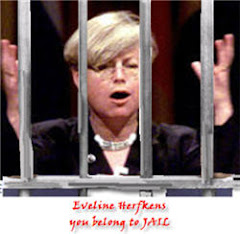
Eveline Herfkens: UNDP in desperation publish fake documents, contradicts itself

Today UNDP's spin machine continue to publish in their official blog ("for-the-record") , which is suppose to provide official responses to innacurate press reports related to the work of UNDP.

Eventhough UNDP desperation makes them to publish fake documentation, which is made post Herfkens story, the stupidity of UNDP's spokesperson to suck Dervis's and Melkert's ass goes this far. But it doesn't matter let's analyze it in detail and take it for granted that these are originals and UNDP is presenting them as truth.

  • UNDP FOR THE RECORD
    25 February, 2008 - On the housing subsidy received by Eveline Herfkens

    Press reports continue to circulate that Eveline Herfkens, Executive Coordinator of the Millennium Campaign, was paid $225,000 per year by the UN for part-time work. In fact, Ms. Herfken' signed a contract in November 2002 for a net annual salary of $134,331. She signed a new contract in November 2006 for a net annual salary of $144,968.01. In both cases the net annual salary was to be pro-rated in the case of part time work (meaning she would receive less than the figures indicated). To view Ms. Herfken's contracts please click here (
    2002 - 06) (2006 - 07).

The above shows how the ignorant UNDP's spokesperson and 14 other Public and Media Relation advisors are - Thanks to UNDP the attachment provided in the 2002-06 period shows that:

1.


  • UNDP STATEMENT: In fact, Ms. Herfken' signed a contract in November 2002 for a net annual salary of $134,331. She signed a new contract in November 2006 for a net annual salary of $144,968.01. In both cases the net annual salary was to be pro-rated in the case of part time work (meaning she would receive less than the figures indicated).

  • FACTS CONTRADICTING UNDP: In same document UNDP claim is original, the documents contradicts what UNDP states about pro-rating her salarry. If the salary was pro-rated, how come Herfkens was granted same full 30 days leave in 2002, 2003, 2004, 2005?? :

2.


  • UNDP STATEMENT: 9 January 2008 - Eveline Herfkens:

  • She worked on this contract for three years full time. In her fourth year (1 November 2005 – 31 October 2006), at her own request, she worked at 75 percent of full time, and her salary was pro-rated accordingly.
    Ms. Herfkens reached the maximum number of years allowed under an ALD contract (four years) on 1 November 2006. Upon completion of this contract, and on the basis of her performance record, the UNDP Office of Human Resources issued Ms. Herfkens what is called a “200 series fixed term appointment” at the equivalent level (L-7 step 6), for a period of one year, effective 1 November 2006. The contract was again pro-rated at Ms. Herfken’s request, this time at 90 percent of full time.

  • FACTS CONTRADICTING UNDP:

  • While UNDP on 9th of January declared that Eveline's contract was prorated at 75% of full time (2005-06) and 90% of full time (2006-07), the document that UNDP published today say that Eveline Herfkens contract was of at 80% of full time for 2002-2006. Who should we believe???


3.


  • UNDP STATEMENT: UNDP's David Morrison as well as Eveline Herfkens have always maintained that she was never aware of the UNDP's rules on housing subsidy.

  • FACTS CONTRADICTING UNDP: In same document published by David Morrison, for 2002-2006, UNDP explicitely had an agreement with Eveline Herfkens on Housing.


4.

  • UNDP STATEMENT: Morrison has stated that Eveline Herfkens was a A5/4 (mid-level officer) during 2002-2006, and that on November 2006 she became L7/6 (senior director level). See both document published by UNDP.

  • FACTS CONTRADICTING UNDP: (a) how can an A5/4 (mid level officer) be nominated Assistant Secretary General ? (b) let's assume she was an A5/4 how did she made it to L7/6 working on a part-time basis ? Regular staff would have required 13.5 years to make it from A5/4 to L7/6. But this UNDP document produced and posted in UNDP Procurement Unit when they approved Herfkens contract in Sept 2007, totally contradicts all the above statements:


5.


  • UNDP STATEMENT: 9 January 2008 - As with all UN staff at the Assistant Secretary-General level, the appointment included business class travel and a UN gold grounds pass. A gold pass facilitates visual recognition of the bearer as senior staff, and allows the individual to enter the UN Secretariat by the Delegates Entrance.

  • FACTS CONTRADICTING UNDP: How can UNDP claim she was an ASG when the contract UNDP published today for the period 2002-2006 was at A5/4 (mid level officer)? In no where in the that contracts is written that Herfkens is an ASG. Who issued the GOLD pass to Herfkens with a contract that states she is an A5/4?


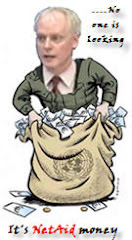
Where is NETAID money David Morrison - or did you transfer them at UNCDF?

Congrats' David Morrison - are you gone do the same with UNCDF as you did with NetAid? Go for it David - its all microfinance, is easy-money, is what you do best.

How can you be the public face of UNCDF Mr. Morrison ?

Your gross-miss management, leadership ignorance and corrupt behaviour has led to UNDP loosing 45 Million dollars in tax-payers funds for this MEGA-FAILURE called NetAid.

How many poor people did NetAid help to come out of poverty under your leadership ? How many will UNCDF get out of poverty under your leadership Mr. Morrison?

And now you are a D2 ? Since when ? Have you seen Personnel Form ? One thing is sure Mr. Morrison, you know where the skeletons are burried in UNDP/NetAid. That's gives you an edge in negotiating upwards your salary and positions.

America Should Withdraw From The United Nations and Let It Collapse

by Robert W. Tracinski

If its handling of Iraq was a test of the United Nations, as President Bush has indicated, then the United Nations has clearly failed. But this should be no surprise, because yet another test of the United Nations--like yet another resolution giving Saddam Hussein "one more chance"--was completely unnecessary.

It is not that the United Nations has failed to show resolve or to live up to its charter. The problem is that the foundation of the United Nations is hopelessly corrupt.

By its very nature, the United Nations is directed by a consensus drawn upon a nonjudgmental mix of the good, the bad, and the ugly. The United Nations' Security Council, whose judgment on Iraq was supposed to bind the United States, is composed of America and a few brave allies--pitted against cynical France, resentful Russia, hostile China, indifferent Mexico, and such enlightened powers as Angola, Cameroon, and Guinea. And the Security Council is just a microcosm of the United Nations itself, which contains a few civilized nations, a few big dictatorships, and a teeming rabble of corrupt and oppressive Third World regimes.

The U.N. charter declares that any "peace-loving" nation is eligible for membership. Yet its founding members included the largest dictatorship of the time: the Soviet Union--a nation at war with its own people and in the process of subjugating half of Europe. In the half-century since, the United Nations' membership criteria have not gotten any more selective.

Yet the defenders of the United Nations tell us that cooperation with this unsavory crowd is essential for America's well-being. In 2001, Madeline Albright declared, "The role of the United Nations is ... vital, because no other institution combines a comprehensive mandate with *near universal representation*." Which means: the United Nations is valuable precisely because it fails to exclude the world's worst regimes. Kofi Annan recently offered his pitch for the importance of the United Nations: "Let us all recognize ... that the global interest is our national interest." Which means: the interests of Russia, France, and China are identical with America's interests. Tom Friedman of the *New York Times*, who has spent recent weeks hyperventilating about America going it alone, tells us: "the key to managing this complex, dangerous world ... is our ability to stand united and with others." Which means: we are doomed unless we are propped up by the support of Angola and Cameroon.

All of the arguments for why we need a coalition of hostile powers and tin-pot dictatorships make no sense. Instead, they are the reflection of a deeper philosophical premise that the U.N.'s apologists refuse to question. The real basis of the United Nations is global collectivism--the belief that America's judgment and interests must be subordinated to the collective opinion of the "world community." When the Times's Friedman, for example, calls the attack on Iraq a "war of choice" that should not be waged without a vast international consensus, what he means is that the choice of how America defends itself ought to made by France, Russia, Cameroon, Chile--by anyone and everyone *except* the United States.

Yes, there is a value to cooperating with other nations--but only with free nations who share a commitment to standing up against the threats of terrorism and dictatorship. Any time free nations agree to subordinate themselves to a collective consensus with hostile dictatorships, it is only the free nations that lose--and it is only the dictatorships that gain. Indeed, the dictatorships run the United Nations. Within weeks of September 11, terrorist-sponsor Syria was invited to chair the United Nations' Security Council. Iraq and Iran are scheduled to trade chairmanship of its disarmament committee, while Libya is set to chair its human rights commission.

This is the same pattern Ayn Rand identified decades ago, when she compared the United Nations to "a crime-fighting committee whose board of directors include[s] the leading gangsters of the community." Yet the only thing that can give such a commission any pretense at legitimacy is the participation of the city's upstanding citizens. Similarly, the only thing that gives the United Nations any legitimacy is America's cooperation: our might, our money, and our moral sanction.

America should not defy the United Nations on Iraq--we should do much more: we should withdraw from the United Nations altogether, letting that organization complete its collapse into a Third World debating society.

This would accomplish more than ending the latest round of diplomatic obstructionism. It would permanently unshackle U.S. foreign policy from the debilitating consensus of the corrupt collection of regimes who run the United Nations.

Obama's Global Poverty Act

by Edward Cline 

I rarely write commentary from anger, preferring a properly objective, psuedo-dispassionate approach to a subject deserving my attention. But news of the details, nature and scope of pending legislation in the U.S. Senate has caused me to make an exception to that rule.

As though Americans were not already burdened with:

• Extortionate and confiscatory taxes wherever they turn on virtually everything they earn, purchase, or do, from the local level on up to the federal level;
• Myriad regulations, controls and arbitrary rules that hamper or obstruct their productivity and their lives;
• Footing the endless bills of earmarked pork barrel projects at home in the amount of billions;
• Footing the bill in the amount of the billions for bottomless altruist and "humanitarian" pork barrel projects abroad;
• Footing the bill for an ever-expanding and ever more costly welfare state to subsidize the ill, the retired, the aged, the young, etc.
• Being held hostage by, say, Saudi Arabia, Venezuela, and other hostile "oil-producing" countries, because our government has decided that snail darters, sea cows, and caribou have a greater right to live than have human beings;
• Paying more for food because mandated ethanol, which reports prove costs more in oil to produce than it "saves," in the gas they buy is taking more crop acreage out of production;


Congress is proposing, in Barack Obama's Global Poverty Act (S.2433, based on H.R. 1302, passed by the House September 25, 2007), that Americans be delivered into a state of indentured servitude as laborers for the United Nations. Perhaps "indentured servitude" is too kind a term, for as horrendous a condition as it is, there is usually a time limit to such servitude. Slavery would be the more accurate term in this instance, for what Congress is considering is servitude by Americans in perpetuity, in exchange for nothing but the privilege of laboring to "save" the world without thanks or reward, of filling the alleged needs of others, of performing unlimited "community service" for the offense of merely existing.

The not-so-peculiar and odd thing about H.R. 1302 was that it passed the House by voice vote. This is a stratagem adopted by legislators who fear that a bill is so outrageous that it is better that no record be kept of those who endorsed it. S.2433 was passed from the Senate Foreign Relations Committee in the same manner - by voice vote, without public hearings, to protect the identities of the guilty. It will probably be introduced to the Senate for a similar, anonymous voice vote -- by Harry Reid.

There is a double irony in this behavior. First, S.2433 is a bipartisan-sponsored bill. This underscores the fact that there is no fundamental difference between the Democratic and Republican Parties. Second, it is a piece of legislation which, given the altruist, collectivist premises behind it, one would have thought its creators should have trumpeted boastfully. But it is being handled by corrupt, guilty, fearful sneaks who haven't the courage of their own malice.

It reminds one of the scene in Atlas Shrugged, when James Taggart pulls down a window blind to obliterate the sight of the Washington Monument, just as he and government officials decide to decree a moratorium on brains. The proper American response to this evil and to its sponsors and supporters, in Congress and in the U.N., should be Dagny Taggart's when she learns of it: "I won't work as a slave or as a slave-driver." The bill's co-sponsor is Republican Senator Richard Lugar of Indiana, who sits on the Foreign Relations Committee. Its other co-sponsors are Senators Joseph Biden, Maria Cantwell, Chris Dodd, Dick Durbin, Russ Feingold, Dianne Feinstein, Charles Hagel, and Robert Mendez, all Democrats.

The bill was the subject of a strong editorial in Investor's Business Daily of February 28, 2008, "Obama's 0.7% Solution For Poverty Gets Pass from Senate Republicans." According to IBD, the bipartisan bill would require the president "to develop and implement a comprehensive strategy to further the U.S. foreign policy objective of promoting the reduction of global poverty, the elimination of extreme global poverty and the achievement of the Millennium Development Goal of reducing by one-half the proportion of people worldwide between 1990 and 2015, who live on less than $1 per day."

The "Millennium Development Goal" refers to a United Nations declaration adopted by the U.N. Millennium Assembly and Summit in 2000 that calls for "the eradication of poverty" by "redistribution (of) wealth and land," cancellation of "the debts of developing countries" and "a fair distribution of the earth's resources." The IBD reports that "The Millennium project is monitored by Jeffrey D. Sachs, a Columbia University economist. In 2005 he presented then-U.N. secretary general Kofi Annan with a 3,000-page report based on the research of 265 so-called poverty specialists. "Sachs' document criticized the U.S. for giving only $16.5 billion a year in global anti-poverty aid. He argued that we should spend an additional $30 billion a year in order to reach the 0.7% target that the U.N. set for the U.S. in 2000....Sachs said that the only way to force the U.S. to commit that much
money is by a global tax, such as a tax on fossil fuels [oil, coal, natural gas]." The tax would be imposed not only on their production, but on their use, as well. Among other consequences, Americans would be impoverished for the purpose of reducing poverty abroad by 0.7 percent of the U.S.'s gross domestic product.

The Millennium declaration, reports IBD, also calls for a "currency transfer tax," a "tax on the rental value of land and natural resources," a "royalty on worldwide fossil energy production - oil, natural gas, coal," "fees for the commercial use of the oceans, fees for airplane use of the skies, fees for use of the electromagnetic spectrum, fees on foreign exchange transactions, and a tax on the carbon content of fuels."

The U.N. has assumed that it governs the earth, and wishes to penalize the most productive country on it for, well, being the most productive. If you never quite understood the nature and purpose of the "unification" and "global amity" plans described by Rand in Atlas Shrugged, this plan is its real world counterpart. In practical terms, the Millennium declaration is a prescription for not only perpetuating the "global poverty" it purports to eradicate, but also for impoverishing everyone, and for perpetuating that condition, as well.

But the Obama bill does more than allow the U.N. to tax American citizens. It is more than a matter of legality or illegality. For all practical purposes, it surrenders U.S. political sovereignty and independence to the U.N., an organization most of whose members are actively hostile to the U.S. Has the U.S. ever approved a tax on its citizens imposed by the U.N.? If it has, by what authority? Note that the wording of the Obama bill would require "the president to develop and implement a comprehensive strategy" -- which assumes that the office of president is just another mode of tyranny or arbitrary power, no different from the "presidency" of any random tin pot dictatorship or regime.

There is some logic to their premise. After all, the U.S. has withheld moral judgment of every one of those countries. Long, long ago, the U.S. should have won World War II, but not participated in the formation of an organization that admitted dictatorships and other tyrannical regimes for the purpose of "peace." Long ago, the U.S. should have withdrawn from that organization, and evicted its headquarters from this country's soil.

But it maintains its sanction of that organization, and has paid the price for it every since. Article III, Section 3 of the Constitution states: "Treason against the United States shall consist only in levying War against them, or in adhering to their Enemies, giving them Aid and Comfort."

It would be interesting to see if this definition could be applied to the actions of Senators Obama, Lugar, Reid and the rest of the supporters of S. 2433 (and also the sponsors and supporters of H.R. 1302). Given that the U.N. has never disguised its hostility for the U.S., and that the enemies of the U.S. are legion in the U.N.'s membership, would passage of this bill by Congress constitute giving "aid and comfort" to our enemies, and "adhering" to their purposes and ends? For that is what the bill amounts to: giving our enemies the right to conquer, loot, and subjugate this country and its citizens.

Are we not already burdened by our own lords and masters of "social policy" and "redistribution" in Washington and in every state capital, without inviting the depredations of a clique of international thugs and looters? I urge those reading this to call or email his senator and urge that Barack Obama's S. 2433 be roundly defeated by a recorded roll call. If possible, communicate your outrage with the same moral indignation as Dagny Taggart's.


Edward Cline is a novelist who has written on the revolutionary war period. He is author of the Sparrowhawk series of novels set in England and Virginia in the Revolutionary period, the detective novel First Prize, the suspense novel Whisper the Guns, and of numerous published articles, book reviews and essays.

The Volcker Oil-for-Food Interim Reports: No Exoneration for U.N. Corruption

by Nile Gardiner

The U.N.-appointed Independent Inquiry Commit tee into the United Nations Oil-for-Food Programme (IIC) released its first Interim Report[1] on February 3, 2005, and its Second Interim Report[2] on March 29, 2005. U.N. Secretary-General Kofi Annan set up the commit tee in April 2004, following calls for a Security Council– backed inquiry into the Oil-for-Food scandal.[3]

The U.N. response to the interim reports has been breathtaking in its arrogance.[4] Notably absent has been any sign of humility, contrition, or accountabil ity on the part of the Secretary-General and his senior aides. Indeed, it is hard to avoid the conclusion that the leadership of the United Nations is still in denial with regard to the U.N.’s declining credibility.


Cartoon by Cox and Forkum

Within hours of its release, the Second Interim Report was greeted with cries of “exoneration” from Annan and his staff, after IIC Chairman Paul Volcker controversially found “no evidence that the selec tion of Cotecna in 1998 was subject to any affirma tive or improper influence of the Secretary-General in the bidding or selection process.”[5] When asked if he was planning to resign anytime soon, Annan dismissively responded, “Hell no!”[6]

A closer reading of both interim reports reveals serious leadership failures at the United Nations. The reports dramatically add to the growing pic ture of mismanagement, incompetence, and unac countability at the U.N. Contrary to Annan’s claims, the reports do not in any way vindicate him or the United Nations. Indeed, the destruction of thousands of critically important documents by the U.N. chief of staff and previously undisclosed meetings between Kofi Annan and Cotecna execu tives make a mockery of U.N. claims of vindication.

The U.S. Congress should respond to the reports by calling for a series of measures aimed at increas ing accountability and transparency at the United Nations and expanding the level of external over sight of the U.N. Congress should also launch a major investigation into the actions of former U.N. Chief of Staff Iqbal Riza and threaten to withhold U.S. assessed funding for the United Nations unless it fully cooperates with congressional investigations into the Oil-for-Food scandal. In addition, Con gress should increase the pressure on Kofi Annan to resign from his position as Secretary-General.


The Volcker Committee

The three-member Independent Inquiry Commit tee is chaired by former Federal Reserve Chairman Paul Volcker. The other two committee members are South African Justice Richard Goldstone and Swiss Professor of Criminal Law Mark Pieth. The commit tee’s 75-member staff, which includes three support personnel on loan from the U.N., operate on a $30 million budget drawn from the U.N. Oil-for-Food escrow account. The Volcker investigation is one of several major investigations into the U.N.’s manage ment of the Oil-for-Food Program. Investigations are being conducted by committees in the U.S. Senate and House of Representatives, as well as by the U.S. Department of Justice, Department of the Treasury, and Government Accountability Office.

The first Interim Report examined the initial 1996 procurement of the three U.N. contractors responsi ble for critical components of the Oil-for-Food Pro gram: inspection of oil exports (Saybolt Eastern Hemisphere BV), inspection of humanitarian goods imports (Lloyd’s Register Inspection Ltd.), and administration of the escrow account for the pro ceeds and payments within the program (Banque National de Paris). It also addressed allegations made against Benon Sevan, the executive director of the Office of the Iraq Program (OIP). The Second Interim Report examined the U.N.’s 1998 hiring of the Swiss company Cotecna Inspection S.A. to inspect humanitarian goods entering Iraq under the Oil-for-Food Program and the potential conflict of interest involving U.N. Secretary-General Kofi Annan, whose son Kojo was employed by Cotecna.[7]


Emerging Issues of Concern for Congress

The interim reports raise a number of important issues that should be of major interest and concern to congressional investigators.

Issue #1: Document Shredding by Annan’s Chief of Staff

The most significant finding in the Second Interim Report is that Iqbal Riza, Kofi Annan’s chief of staff, authorized the shredding of thousands of U.N. documents between April and December 2004. Among these documents were the entire U.N. Chef de Cabinet chronological files for 1997, 1998, and 1999—many of which related to the Oil-for-Food Program.

Riza approved this destruction just 10 days after he had personally written to the heads of nine U.N.-related agencies that administered the Oil-for-Food Program in Northern Iraq, requesting that they “take all necessary steps to collect, preserve and secure all files, records and documents…relat ing to the Oil-for-Food Programme.”[8] The destruc tion continued for more than seven months after the Secretary-General’s June 1, 2004, order to U.N. staff members “not to destroy or remove any docu ments related to the Oil-for-Food programme that are in their possession or under their control, and to not instruct or allow anyone else to destroy or remove such documents.”[9]

Significantly, Kofi Annan announced the retire ment of Mr. Riza on January 15, 2005—the same day that Riza notified the Volcker Committee that he had destroyed the documents.[10] Riza was immedi ately replaced by Mark Malloch Brown, Administra tor of the U.N. Development Programme.

Riza was chief of staff from 1997 to 2004, almost the entire period of the Oil-for-Food Program’s operation, and undoubtedly possesses intricate knowledge of the U.N.’s management of it. He was a long-time colleague of Kofi Annan and served as Annan’s deputy in the Department of Peacekeeping Operations from 1993 to 1996.

The U.N. document destruction scandal raises a number of serious questions:

Under whose instruction did Iqbal Riza autho rize the destruction of U.N. documents?
To what extent was Kofi Annan himself aware of the shredding of the documents?
What role did Riza play in the U.N.’s manage ment of the Oil-for-Food Program?
How closely did Riza work with Benon Sevan, head of the Office of the Iraq Program, during his time as chief of staff?
Issue #2: Kofi Annan and His Dealings with Cotecna

The Second Interim Report gives the overall impression that the relationship between Kofi Annan and Cotecna officials was closer than previ ously known. Itstates that Kofi Annan met twice with Elie Massey, the owner of Cotecna, before the U.N. awarded it the Iraq inspection contract. Their first meeting was in February 1997 at the World Economic Forum in Davos, Switzerland, and the second was in September 1998, arranged by his son Kojo. Significantly, when Kofi Annan was first interviewed by the Volcker Committee in Novem ber 2004, he denied meeting with Mr. Massey before the awarding of the Cotecna contract. He retracted that statement when he was re-inter­viewed in January 2005, after “a review of the com puter of the Secretary-General’s assistant, (where) the Committee found information reflecting that the Secretary-General had met with Elie Massey on two occasions prior to the award of the inspection contract to Cotecna.”[11] In addition, Annan met with Elie Massey once in Geneva in 1999, after Cotecna was awarded the U.N. contract.[12]

Kofi Annan’s meetings with Cotecna executives should be subjected to congressional scrutiny, as they raise major conflict-of-interest issues. Further more, Annan’s initial unwillingness to disclose these meetings to the Independent Inquiry Com mittee clearly indicates that Mr. Annan has not been acting in a completely transparent manner regarding the Oil-for-Food investigation. Annan should have publicly disclosed this information far earlier, but it was publicly revealed only after an investigation by the Financial Times and Italy’s Il Sole 24 Ore.

The relationship between Kofi Annan and Michael Wilson, Cotecna’s vice president for mar keting operations in Africa, is also of interest. The Volcker investigation reveals that the Secretary-General was “a long-standing friend of Mr. Wilson’s father, who had been Ghana’s ambassador to Swit zerland.” The report states:

Mr. Wilson also knows the Secretary-General well and, in the Ghanaian tradition, considers him like an “uncle.” Shortly after Kojo Annan graduated from university, the Secretary-General and Mr. Wilson spoke about the possibility of Kojo Annan working at Cotecna.[13]

Aside from his contacts with Michael Wilson and Elie Massey, the Volcker Committee also notes:

[Kofi Annan] already was familiar with Cotecna and its prior interest in doing business with the United Nations. In 1991, while he served as the United Nations Controller and Assistant Secretary-General for Programme Planning, Budget and Finance, he had been involved in negotiations with Iraq about initial proposals for an Oil-for-Food arrangement, and Cotecna had written to him, at that time, about its interests in the inspection services contract. He had passed the information on to the United Nations Development Programme (UNDP), the department then in charge of the Iraq Programme.[14]

Issue #3: Kofi Annan’s Internal Inquiry into Kojo Annan and Cotecna

The Second Interim Report is highly critical of the U.N.’s own inquiry into the conflict of interest aris ing from Cotecna’s employment of Kojo Annan and his father’s position as Secretary-General. By all accounts, the U.N. inquiry was a farce, lasting for just one day. The inquiry was prompted by an arti cle published in The Sunday Telegraph on January 24, 1999, which revealed that the U.N. had awarded a major contract to a company (Cotecna) that employed the son of the Secretary-Gen eral.[15]At the same time, the Volcker Committee reports that, “Cotecna was embroiled in a criminal investigation involving allegations that it had made illegal payments for the benefit of former Pakistani Prime Minister Benazir Bhutto.”[16]

The U.N. inquiry was headed by Joseph Connor, Under-Secretary for Management, “who failed to take any action beyond the one-day inquiry that was conducted concerning the truth of the allega tions and their ongoing impact on the fitness of Cotecna to remain as a United Nations contrac tor.”[17] The report asserts that the inquiry was “inadequate” and that the Secretary-General should have referred the matter to the U.N. Office of Inter nal Oversight Services or the Office of Legal Affairs. The report concludes that “had there been such an investigation of these allegations, it is unlikely that Cotecna would have been awarded renewals of its contract with the United Nations.”[18] At the same time, the report states that “Kojo Annan actively participated in efforts by Cotecna to conceal the continuing relationship with him.”[19]

While the Volcker Committee shies away from drawing the conclusion, the Secretary-General’s failure to order a comprehensive, independent inquiry into this matter, given his own conflict of interest, clearly demonstrates at the very least a huge management failure and possibly a deliberate attempt by Annan to avoid a thorough investiga tion of serious charges.

Issue #4: Benon Sevan’s Role

Benon Sevan, a Cypriot, served as Under Secre tary-General and executive director of the U.N. Office of the Iraq Program from 1997 to 2004. A career U.N. employee since 1965, Benon Sevan has served in numerous U.N. positions, including Assistant Secretary-General and deputy head of the Department of Political Affairs. He has been the subject of intense scrutiny since being named in the report of U.S. weapons inspector Charles Duelfer, which alleges that he received a voucher for 13 mil lion barrels of oil from Saddam Hussein.

The IIC conducted an intensive investigation of Sevan’s conduct as OIP director, “a position of immense power and transnational responsibil ity.”[20] His job placed him in a position of constant communication with the Saddam Hussein regime and numerous U.N. member states, including all of the Security Council members. Sevan “supervised or coordinated the activities of hundreds of inter national staff in New York and overseas, including a considerably larger number of citizens of Iraq.”[21]

The report’s findings into Sevan’s conduct while head of the OIP are damning. The Committee con cluded that:

[Sevan] solicited and received on behalf of AMEP (African Middle East Petroleum Co Ltd Inc) several million barrels of allocations of oil from 1998 to 2001. As a result of Mr. Sevan’s conduct, AMEP’s revenue—net bank fees and surcharge payment—totaled approximately $1.5 million.

The IIC declared that Sevan’s actions “presented a grave and continuing conflict of interest, were eth ically improper, and seriously undermined the integrity of the United Nations.”[22]

The seriousness of the charges leveled against Sevan in the first Interim Report clearly merit crim inal prosecution, and the U.N.’s pledge to lift diplo matic immunity for Mr. Sevan is an important first step in the right direction.

Mr. Sevan should also be interviewed by con gressional investigators to shed more light on his illicit activities, as well as any criminal activity by members of his staff. Besides facing justice, Sevan could serve as a vitally important source of infor mation regarding attempts by the Saddam Hussein regime to influence decision-making at the U.N. and in the Security Council. Several key questions need to be answered:

How did Sevan manage to blatantly flout U.N. rules without raising any suspicions?
Why was there no oversight of Sevan’s man agement of the Office of the Iraq Program?
To what extent was Kofi Annan aware of cor rupt practices within the OIP?
Were other U.N. staff assisting Sevan with his illicit activities?
How extensive were the ties between Sevan and the Saddam Hussein regime?
How was Sevan picked to become OIP director?
Were allegations of corruption leveled against Sevan when he served in previous U.N. posi tions?
Issue #5: Boutros Boutros-Ghali, Banque Nationale de Paris, and the U.N. Escrow Account

The U.N. decision to appoint the French com pany Banque Nationale de Paris (BNP) to adminis ter the Oil-for-Food escrow account is the subject of intense scrutiny in the first Interim Report. Vast sums of money were handled through the escrow account. The Saddam Hussein regime sold more than $64.2 billion of oil under the Oil-for-Food Program between 1996 and 2003.[23] BNP was selected by then U.N. Secretary-General Boutros Boutros-Ghali, even though the decision did not conform to the requirement under U.N. financial rules to accept the “lowest acceptable bidder.”[24]

The report demonstrates that several banks were better placed to manage the Iraq escrow account on the basis of their higher credit quality (based on standard ratings by IBCA Limited of London): Union Bank of Switzerland, Deutsche Bank, Credit Suisse, Citibank, and Chase Manhattan.[25] The U.N. Treasury eventually opted for Credit Suisse as its first choice to run the escrow account, but BNP was awarded the contract.

Boutros-Ghali’s decision to select BNP over more qualified competitors should be the subject of con gressional scrutiny. The following questions need to be answered:

How much influence did Saddam Hussein wield over Boutros-Ghali’s final decision?
To what extent did the U.N. give the Iraqi regime a veto over the choice of a bank for the U.N. escrow account?
How close was the relationship between Boutros-Ghali and the Saddam Hussein regime?
What role did the French government play in the U.N. decision to opt for BNP?
What was the nature of the relationship between BNP and the Iraqi government, both before it won the escrow account and during the period when it administered the account?
Issue #6: The Secretive U.N. Iraq Steering Committee

The first Interim Report sheds some light on the powerful Iraq Steering Committee, created by Boutros-Ghali “to ensure the timely and effective implementation” of the Oil-for-Food Program and designed to report to the Secretary-General “on a regular basis.” It operated in a highly secretive manner and “did not keep official records or min utes of proceedings and determinations.” Signifi cantly, the U.N. archives are “devoid of records of the Steering Committee.”[26]

The Steering Committee was chaired by Chin maya Gharekhan, Under Secretary-General and Senior Adviser to the Secretary-General, and included five other high-level U.N. officials: Yakushi Akashi, Under Secretary-General for Humanitarian Affairs; Joseph E. Connor (an American), Under-Secretary-General for Administration and Manage ment; Hans Corell, Under Secretary-General for Legal Affairs; Marrack I. Goulding, Under Secretary-General for Political Affairs; and Yukio Takasu, Assis tant Secretary-General and Controller.[27]

There is a strong case to be made for members of the Iraq Steering Committee to testify before Con gress and to assist congressional investigators. The report leaves the impression that the Steering Com mittee was a powerful policy group surrounding the Secretary-General, operating without account ability or transparency and completely avoiding any form of scrutiny.

The Steering Committee is a symbol of the cul ture of secrecy and unaccountability that pervaded the U.N.’s handling of the Oil-for-Food Program. It is in the public interest that Congress investigate the operations of the Steering Committee.

Key Omissions from the Volcker Interim Reports

While the interim reports raise a number of important issues, there are some glaring omissions.

The Management Role of Kofi Annan. While the Volcker Committee went to considerable lengths to explore the relationship between Kofi Annan, Kojo Annan, and Cotecna, it makes very little attempt to assess Annan’s role as the official responsible for over all management of the Oil-for-Food Program. The IIC also fails to examine the role played by Iqbal Riza, Annan’s chief of staff, in running the Oil-for-Food Program—a striking omission considering that Mr. Riza shredded thousands of U.N. documents, many of which were related to the Oil-for-Food Program.

Given that Mr. Annan handpicked Benon Sevan to head the Oil-for-Food Program, it is also extremely surprising that the report fails to explore the background to Mr. Sevan’s appointment and his working relationship with the Secretary-General. Nor does the report at any time consider what the Secretary-General might have known about the program’s failings at various stages of its existence.

The Lack of U.N. Oversight of the Office of the Iraq Program. The first Interim Report makes no serious effort to explain why the Office of the Iraq Program did not receive significant scrutiny from the Office of Internal Oversight Services. It also makes no attempt to question why Secretary-General Annan did not keep an eye on the New York headquarters of the U.N.’s biggest humanitar ian operation. The strong friendship between Mr. Sevan and Mr. Annan must surely warrant investi gation as a possible factor behind this lack of over sight. Clearly, Annan either was asleep at the wheel and grossly negligent or deliberately ignored wide spread mismanagement and corruption.

The role of the U.N. Secretariat should also be questioned. After all, the report clearly states that “although the Security Council and its 661 Com mittee exercised combined supervisory and opera tional oversight of the Programme, the Secretariat of the United Nations administered its day-to-day operation.”[28] The IIC sheds no light whatsoever on the Secretariat’s involvement in overseeing the OIP.

Attempts by Saddam Hussein to Influence Security Council Members. The detailed allega tions made by Chief U.N. Weapons Inspector Charles Duelfer regarding Iraqi attempts to influ ence members of the Security Council to lift U.N. sanctions receive scant attention in the interim reports. The close ties between Russian and French politicians and the Iraqi regime and the huge French and Russian financial interests in pre-liber ation Iraq were almost certainly an important factor in influencing their governments to oppose Hus sein’s removal from power.

The Oil-for-Food Program and its elaborate sys tem of kickbacks and bribery was a major source of revenue for many European politicians and busi ness concerns, especially in Moscow. Congressional hearings on the financial, political, and military links between Moscow, Paris, and Baghdad should shed light on the tempestuous Security Council debates that preceded the war with Iraq and on the motives of key Security Council members in opposing regime change in Baghdad.

What Congress Should Do

Congress should respond to the interim reports by calling for a series of measures aimed at increas ing accountability and transparency at the United Nations in the wake of the Oil-for Food scandal, as well as ensuring effective oversight of future U.N. operations. Specifically, Congress should:

Increase pressure on Kofi Annan to resign.[29] From the massive failure of manage ment and leadership, it is increasingly clear that Kofi Annan is unfit for office. He has been surrounded by a constellation of corruption at the heart of the U.N. system, and it is incon ceivable that he was unaware of the pervasive problems afflicting the Oil-for-Food Program. As U.N. Secretary-General, Annan must be held accountable for the biggest scandal in U.N. history, as well as for a wave of other major scandals across the U.N. system, includ ing widespread abuses by U.N. peacekeepers in the Congo. Annan should step down in favor of an interim Secretary-General, specifi cally tasked with cleaning house, eliminating corruption, and implementing immediate institutional reform of the U.N. The interim Secretary-General should be someone of great stature and integrity. If Annan remains in power and completes his term of office, his successor will inherit a tarnished position, in effect a poisoned well.
Launch a major investigation into Iqbal Riza and the shredding of U.N. documents. The destruction of highly sensitive documents by Kofi Annan’s chief of staff is an obstruction of justice that demands congressional investiga tion. It gives the impression of a major cover-up at the very heart of the United Nations and casts a dark cloud over the Secretary-General’s credibility. It projects an image of impunity, arrogance, and unaccountability on the part of the leadership of the United Nations. Riza— who, like Benon Sevan, is retained on the U.N. payroll at an annual salary of $1—should be made available to congressional investigators and should explain his actions before Con gress. If it appears Riza is responsible for crim inal actions, his diplomatic immunity should be lifted to pave the way for prosecution.
Call for the U.N. to establish an independent archive facility to store U.N. docu ments. In light of the Riza shredding scandal, Congress should call for the U.N. to establish an independent archive facility to house copies of all major U.N. documents. The facility should be located on a separate site from the U.N. headquarters. Copies of significant U.N. documents and correspondence (for example, Chef de Cabinet and Secretariat files) should be deposited within a set period from time of production. Such a facility should be funded by cutting wasteful U.N. programs.
Call for the creation of an external body to oversee U.N. operations. The U.N. Office of Internal Oversight Services lacks the tools, expertise, public confidence, and above all, the independence to conduct effective, transpar ent, and impartial investigations into allega tions of large-scale fraud and mismanagement within the United Nations. An external over sight body completely independent of the U.N. bureaucracy and staffed with non-U.N. offi cials (but backed by a Security Council man date) should be established to oversee major U.N. operations, including humanitarian pro grams and peacekeeping operations.
Call for the establishment of a U.S. over sight unit to monitor how American contri butions are spent by the U.N. The United States should set up its own U.N. oversight unit, answerable to Congress, specifically charged with monitoring the use of American contributions to U.N. peacekeeping and humanitarian operations. This should be funded by diverting part of the annual U.S. assessed contribution for the United Nations and could be located in the U.S. Mission to the United Nations.
Withhold U.S. assessed funding for the United Nations unless the U.N. fully cooper ates with congressional investigations into the Oil-For-Food scandal. The United States has been the United Nations’ biggest contribu tor since it was founded in 1945. In 2004, the U.S. contributed $360 million toward the U.N.’s routine operating expenses—22 percent of the U.N.’s regular annual operating budget and more than the combined contributions of France, Germany, China, Canada, and Russia. Congressional leaders should make it clear that Congress will withhold all of the U.S. assessed contribution until the United Nations has pro vided unlimited access to relevant documenta tion on the Oil-for-Food Program and the sworn testimony of U.N. officials. The withheld funds should be placed in an escrow account, with future disbursement contingent on satis factory resolution of these matters.
Insist that future inquiries into U.N. scan dals be fully independent. In the future, the Secretary-General should not be allowed to pick the investigation committee into a U.N. scandal and then pass it off as “independent.” Such inquiries will always be open to the pos­sibility of political interference and manipula tion by those being investigated. Congress should insist that future investigations into U.N. scandals be completely independent of the Secretary-General. Chairmen of such inquiries should also be asked to disclose, upon appointment, all potential conflicts of interest, whether business or political.
Invite Pierre Mouselli to testify before Con gress. Congressional investigators should exam ine the claims made by Pierre Mouselli, a French former business partner of Kojo Annan, who alleges that the Volcker Committee downgraded and ignored evidence damaging to Kofi Annan, which he provided. In addition, Mr. Mouselli should be invited to testify before Congress. Congress should also ask the Volcker Committee to clarify its refusal to take into account this evi dence. The Volcker investigation should be spe cifically asked if it has deliberately ignored critical evidence that could implicate the Secre tary-General.[30]
Insist that Paul Volcker present his final find ings to the Iraqi government. On conclusion of his investigation, Mr. Volcker should present his findings not only to the U.N. Secretary-General, but also to the people of Iraq, repre sented by the Iraqi government. Through no choice of their own, the Iraqi people are cur rently footing the bill for the Volcker investiga tion with money taken by the U.N. from the Oil-for-Food escrow account. If the Iraqi gov ernment is not satisfied with the investigation’s thoroughness, Congress should support Iraqi efforts to recover the $30 million cost of the Volcker investigation. If the U.N. refuses to reimburse the Iraqi people, Congress should withhold the exact amount from the U.S.-assessed contribution for the U.N. and divert the funds to the Iraqi treasury. It is only right that the United Nations—not the Iraqi victims of U.N. fraud, mismanagement, and corrup tion—bear the cost of a U.N.-appointed inves tigation into allegations of wrongdoing by U.N. officials.
Conclusion

It is highly disturbing that Kofi Annan has sought to downplay many of the damning findings contained in the Independent Inquiry Committee reports. In his press conference after the release of the Second Interim Report, Annan stated that “after so many distressing and untrue allegations have been made against me, this exoneration by the independent inquiry comes as a great relief.”[31]

The U.N.’s senior leadership has apparently not learned any lessons from the Oil-for-Food scandal. The elite ruling clique that surrounds Mr. Annan at the top of the United Nations continues to behave with impunity while projecting an air of superiority deeply resented by many rank-and-file U.N. employees. It is no coincidence that staff morale at the United Nations has hit an all-time low.

Increasingly, Mr. Annan appears to be using Paul Volcker as a shield to protect his own dwindling reputation. It is hard not to conclude that a more critical and neutral chairman would have drawn far harder-hitting conclusions from the mountain of damaging evidence. Despite his investigators pre senting an ugly tableau of incompetence, misman agement, corruption, and deception at the top of the United Nations, Mr. Volcker has shied away from significant, direct criticism of the Secretary-General and the United Nations as an institution.

In stark contrast to Mr. Volcker’s silence, the two other IIC members have openly criticized Annan’s claims of “exoneration.” Professor Pieth stated, “We did not exonerate Kofi Annan. We should not brush this off. A certain mea culpa would have been appropriate.”[32] Similarly, Judge Goldstone refuted the notion that the report cleared Annan of wrongdoing, describing Annan’s failure to apolo gize as “an opportunity lost.”[33]

Despite Mr. Volcker’s unwillingness to sharply criticize the Secretary-General, there is little doubt that Kofi Annan’s position at the helm of the United Nations is becoming increasingly untenable. The IIC reports give the overriding impression of an institution that is fundamentally broken and in dire need of major reform and new leadership. In addi tion, over the coming months, several congres sional inquiries into the U.N.’s management of the Oil-for-Food Program will release their findings, which could prove hugely damaging to Annan’s reputation. By no means is the Volcker investiga tion either the final or the definitive inquiry into the matter.

In order to begin restoring the credibility of the United Nations, Mr. Annan should step down. By remaining in office despite growing evidence of widespread U.N. failings, Annan sends a message of impunity, arrogance, and unaccountability on the part of the U.N. leadership. He is also setting a poor precedent for future U.N. leaders, who will be encouraged to believe they will not be held accountable for the organization’s failures. Annan is increasingly a “lame duck” Secretary-General who has become a severe liability to the U.N.’s credibility. Serious reform will be impossible as long as he remains in power.

The author is grateful to James Dean, Deputy Director, Foreign and Defense Policy, in the Government Relations Department at The Heritage Foundation, for his advice and suggestions. Heritage Foundation intern Nicole Collins assisted with research for this paper.

HQ in Algeria was blown up, with 13 dead, Now for Damage Control ... or fixing the blame

I am a freelance investigative reporter based in the Middle East and former Soviet Union and here is a story that I want to publish. My sources are confidential and you can read between the lines of the real story and you know how lifting the lid on a can of worms is usually difficult. The UN system is no exception, so it is hard to say quite how worm-ridden the sector actually is. Nor, despite some investigative coups, does its true color get the attention that it actually deserves.

I hope you will immediately consider my pitch for publication.

Here is the first draft of the investigative article.


Best regards, Jeffrey Silverman


I thought I would give your publication the first opportunity, as the target audience is the most appropriate.

HQ in Algeria was blown up, with 13 dead, Now for Damage Control ... or fixing the blame

The UN HQ in Algeria was blown up, with 13 dead, the irony of this is that there is a budget to implement security, create stand offs to harden the targets but it was all ignored there was even an extra budget called MOSS/TARR to implement additional security measures besides the normal yearly budget and all went to waste no one did anything money disappeared and now who pays for the loss of 13 lives due to the security at the Office in Algeria.
Someone needs to be held to account for that – and the sooner the better. How much is the value of one life saved – and how much more can be done at the international level in fulfilling UN mandate when corruption is rooted out.

Al Qaida took responsibility for the bombing but this begs the question as who is really at fault, and who will be the fall guy or “guys and gals.” It is easy to give credit or take credit; it is more difficult to fix blame where it really belongs. It is almost impossible, based on the sorted track record of the UN to accept their mistakes and take appropriate action to keep their house in order. The UN is more into damage control than to solving problems. Part of the problem is connected to networks of patronage and good old boy connections. Now it is time to looking for a fall guy. This is not the first time and unless there is organizational chance, such things can happen again and again.

It is clear from well placed sources that HQ they are looking for a fall guy for all the dead in Algeria even with all the money gone they are lining their pockets and it is very sophisticated in how they are doing it but the budget was there and they took the money and people died because of it a bit on criminal side due to the body count. As an investigative reporter dogging these kind of things; I know there is a connection in Lebanon between Iraq and Hezbollah with arms smuggling, the weapons from the US Army that are being given to the Iraq's is being sold in Beirut through Hezbollah brand new M4's with the 203 grenade launchers going for about 7000 USD. It is because of this nexus that I have been able to get close to what happened with the latest UN body bag count. It was this chase that leads me to this story via Georgia and Armenia – chasing fake passports and arms dealers that operate with the full support of the US government.

However, I am more interested in plane crashes involving Georgians and Armenians, arms from Jordan with end user certificates for the Georigan Ministry of Defense. However, I have not been able to find connection to the Congo, as far as I know at this time. Anyway, there is always a story to be told, and better shared. Money cascades down through various levels in the UN. At each there is a problem of interests that detract from the intended mission – spending money is paramount, how it gets spent is more the reality.

“The South African Mafia” inside UNDP

We all know the UN system is replete with ‘mafia’ from various nationalities. However within the small office that provides for the security of UNDP the South African Mafia has become so well entrenched that even if you lack the basic qualifications you can land yourself a nice L-4 post and make yourself a home if you know the right people and of course come from the right country (and know who to show your appreciate to, and how the payment system works). Below that comes a thriving level of intermediaries.

Let us talk specifics, at least what can be easily verified. Certainly this mess and total cock-up must have been allowed to exist with the full knowledge of senior management, if not ... then let the reader be the judge.

Mr. Leon Terblanche The former, recently de-throned P-5 Chief of the UNDP Security Unit was a South African with dual nationality in Canada. Mr. T managed to institutionalize himself as the Security Chief for several years even though he lacked any real security background. Mr. T. was a former South African military officer working in the engineers with military explosives and de-mining. He worked on several de-mining projects prior to getting the security post with the support of his friend ms. Janie McClusker of UNFPA.

Mr. T. was replaced only this past year after failing to compete for his own post, failing also in his diligent effort to re-align the post to a D1 ranking. His one success as Chief was to successful dis-enfranchise the Security Unit from all of the other business units where he was seen by many as the ultimate dis-enabler for UNDP by how he managed the security office. Only when truly qualified candidates were allowed to apply, and following years of his poor management was he finally removed only to be exiled as the UN Security Officer for all of the UN in Belgrade, Yugoslavia.


Jan A.B. (JAB) Swart A engineer of Mr. Terblanche, Mr. Swart managed to have his close “friend;s create and hire him into the UNDP Security Unit. Again Mr. S. possessed no security background but was given a comfortable P-4 post. One hand washes the other, as Mr. S. had previously given Mr. T. a post when working as a project manager with UNOPS, and so Mr. Swart assumed his P4 post. In Mr. T’s effort to re-align his post as a D1, he moved his friend Mr. S into an unofficial post as Deputy Security Chief and proposed that while he was made a D1 that Mr. S be made a P-5 in the process.

Mr. T. went so far as to have Mr. S. drafted his own individual new and approved Terms of Reference, TOR, as Deputy Chief. But with the failure of Mr. T. to realize his dream of D1, Mr. S. re-thought and did not press for his post to be re-aligned. Once the realization of his dismal failures became evident Mr. T. formally wrote to his friend JAB as his Deputy Security Chief – and in spite of the fact that the post is entirely fictitious but anyway, he was now, appointed him in his stead as he prepared for his demoted repositioning to Belgrade. There is a story within a story here to be told.

Ah, it is indeed good to be King.

As Deputy Security Chief Mr. S. manages, if what he does can truly be called management, the important MOSS supports funds for UNDP. Where have all the millions of dollars gone (over $11,000,000 so far) when our friends in Algeria worked from a non-compliant office and paid the ultimate price. Did Mr. S. do anything to ensure that adequate measures were in place? Did he authorize the finances to make the necessary changes? What about the other offices around the world? It is a lot of money Mr. S. how did you spend it? Did your good friend in Moldovia get his piece whilst Algeria sat at risk?

Carla Naude. Ms. Naude, is perhaps the best qualified of the South African Mafia although her portfolio is focused that of premises security. Ms. Mafiosa sits in a nice P4 post having no previous UN experience no field security experience and now finds herself responsible for covering Mr. S. as he tries to dodge the bullets for Algeria and the $11,000,000 of funds spent so far to ensure security compliance for our offices worldwide. The question becomes “Will she do it?” and what does she “owe” Mr. S. or his predecessor?

Mr. Scotty Saunders. Another friend of Mr. T. and Mr. S. This South African is the arrogant and undermining “Senior” Field Security Advisor for Iraq and as usual for the South African Mafia does not possess the required education or background to achieve such an important and well positioned post. He also serves as a nice L4. Maybe his on-line effort to gain the education he lacks will qualify him for a comfortable P5 or D1 in the future.

Mr. Johannes Vandermervwe. Mr. V not surprisingly comes from UNOPS where he worked on de-mining programmes. Having no security background apart from his years in the South African military as an engineer (certainly no pattern) it is understandable that he was the perfect selection for the coveted UNDP Regional Security Officer posted in Bangkok.

Mr. Vandermerve, with his wife having to depart her high-level job at UNOPS, where Mr.'s T., S. and V. worked on de-mining programmes together allowed Mr.'s S. and T. to repay Mr. and Ms. Vandermerve by not only selecting Mr. V for the Bangkok post but moreover lobbying for a raise from the normal basic pay for a new L4 and made sure that Mr. V was provided with a full 200 series contact with all of the benefits. This would not seem unusual until you realize that serving security staff in similar positions in the Arab States and African regions were not also provided the same level of contract and had to fight hard almost to the point of contract expiration to gain parity with Mr. V. It was certainly no problem for Mr.'s Terblanche and Swart to get their good friend and co-mafioso in with a nice raise and benefits above the non-South African's in the same positions.

Mr. Johann Poltgieter. Mr. P., another friend of Mr. Swart has managed to get posted as the Field Security Officer, L3 to UNDP in Israel the West Bank and Gaza, hired through the P.A.P.P. office. Of course it was nice that for this particular recruitment that the UNDP Security Office was not managing the recruitment like before and only guided the selection process since Mr. P. apparently was unsuccessful in several attempts to secure similar posts in UNDP elsewhere due to his lack of experience and failure in the interviews process. Possibly with guidance on how to answer the questions and how to address the questioning of the interview panel from Mr. Swart, and perhaps with even a little added influence as Mr. Swart repositioned the former Advisor for P.A.P.P. to Somalia, from L-3 to L-4, the new post for Mr. Poltgieter was realized.

So it is clear. Of six South Africans in the UNDP Security Office none have had the required security background training or experience that is normally required for these posts. The one at the top of the pile has been removed only to another security post outside of UNDP. The second in the line of succession remains in a fictitious unofficial post placing many of us at risk on a daily basis hoping for his coveted P-5 to materialize. The rest of the South African mafia remains in their posts quietly hoping for Mr. Swart to get promoted and continue the patronage process.


Mr. Swart as the Deputy Chief is responsible for all 'Field Support’, which includes supporting the Regional Security Officers and security support to our country offices. Mr. S. even as a fictitious Deputy Chief has also apparently been granted rights to receive all of the risk reports from the department of safety and security. It would not take too much research to prove that Mr. Swart must have received the reports that indicated there was a threat against our colleague's offices in Algeria. Did his Regional Security Officer give Mr.Swart any indicators of the risk? With millions of dollars at his fingertips why didn't Mr. Swart use any to help Algeria prepare? Maybe something could have been done. Maybe someone should look at this. But that would mean that UNDP would really be trying to address the failures of Mr. T. and Mr. S. Maybe fewer of our friends in Algeria would have died, or none at all.

Over $11,000,000 has been spent to protect us but still the Algeria tragedy occurs. Everyone seems to get a piece of this pie but where was poor Algeria? Who is next?

It is comforting for the rest of us to now that UN reform and management in UNDP recognizes the value of retaining these uniquely qualified and well-positioned staff who are fully aware of the value of properly addressing national balance after all South Africa is from the ‘South’ in terms of North & South balance. And of course we can all feel comfortable knowing that the Human Resources effort to place “the right people in the right places” includes selecting and assigning non-qualified un-trained and in-experienced managers and security officers to positions where they can provide for UN security and protection. I am sure our real friends in Algeria would have appreciated the effort as much as we do.

Seeing the UN Plain: Corruption as a Way of Life

Ah, yes, the United Nations.

As school kids we all heard the UN described as "the last best hope of mankind" and "if it hadn't been invented it would need to be." Even now as adults we hear calls for "sending" in the UN; getting UN approval; the need to "work with the UN"; and praise for its "technical and relief agencies." On its official website, the UN modestly states, "United Nations. It's Your World."

We at The Diplomad are here to ask you to forget all that misty-eyed blather. Our Diplomads have served at the UN, in New York, Vienna and Geneva, and worked with the UN in a variety of other posts, and can tell you from experience that the UN is a massive, expensive hoax that needs to be ended once and for all.

Those who don't rely on the "elite" MSM for all their information, know about the UN's "oil-for-food" scam that is slowly being uncovered, and could prove the most massive financial scandal in human history (even bigger than Massachusetts' "Big Dig.") The "oil-for-food" scam, huge as it is, flows logically from the ruling ethos at the UN. The UN system is built on corruption, on the principle of the shake-down; whatever lofty objectives might have existed at its creation, for the UN corruption now provides the means and reason to exist.

Let us explain.

The UN as an institution is the purest of pure bureaucracy: it is the thirty-year single malt of bureaucracies. We refer you to the UN website for details on careers there, but suffice it to say that if you want a job that is VERY well-paying, has lots of perks (first class travel; a generous pension; right to retire almost anywhere you want; tax free), and involves little actual work, the UN bureaucracy is for you -- unfortunately, if you're an American (or Israeli) you'll have a hard time getting it given the solid anti-Americanism (and anti-Semitism) of the UN Secretariat. The UN bureaucracy must have served as inspiration for a sci-fi story we vaguely recall about an ancient civilization that builds an elaborate machine that continues to operate even after the civilization itself has died. Subsequent generations -- in this case, in Europe and the boardroom of the NY Times -- have no idea what the machine does, but don't tamper with it, and, in fact, begin to worship it.

Well, we know the secret of the UN bureaucracy machine. It exists to exist. To do that it has going one of the best scams imaginable. While most media and ordinary folks focus on the occasionally contentious UNSC resolutions and debates on Iraq or Iran, in fact, 99% of UN "work" has nothing to do with such high-visibility issues. No, it deals with scores, hundreds, in fact, of resolutions passed every year in the UN General Assembly, its main Committees, and in bodies such as the Human Rights Commission. It lives off those resolutions.

Slightly simplified, this is how it often works. A UN bureaucrat gets hold of a delegate from a sympathetic country and gets that country's delegation to propose some often innocuous sounding resolution -- let's make up a typical one right here, "The Effect of Deforestation on the Development of Sub-Saharan Africa." It will have a few bland paragraphs expressing concern about deforestation in Africa, note the impact it has on the livelihood of Africans especially the "most vulnerable sectors of the population," and then will have a little paragraph at the end calling on the Secretary General to submit a report to the next General Assembly on the impact of deforestation in Africa. Normally such a resolution gets adopted by consensus by the appropriate committee, and then goes to the UNGA where its hammered through ASAP. Under the Reagan Administration, the US delegation made a specialty of finding these little gems and trying to kill them or at least make clear that they would not pass by consensus. That is tough and frustrating work; it takes up incredible amounts of time and effort and burns up lots of political capital. Such efforts offend the MSM, powerful US NGOs and other lobby groups. The UN bureaucracy knows that at most only the US will fight these resolutions; the UN uses its allies in the MSM and the NGO "community" to savage the US and make the US look uncaring about deforestation and poverty, etc. As a result, often the US will back off as the politicial costs are seen as too great to be alone and on the "wrong" side of such an issue.

So the resolution passes. The UN bureaucracy gets tasked with writing a report. Usually these reports are short, based on pre-existing information that in the age of the internet would take an intern a couple of hours to put together, but, nevertheless, for some odd reason seem to require lots of travel by UN bureaucrats. The report will conclude that there is need for further study of this critical topic and might perhaps recommend the holding of a special conference or meeting on the topic. It goes to the next UNGA which agrees that further work is needed and asks the UN Secretariat to go ahead and provide another report to the next UNGA, and so on and on. The topic is now firmly embedded in the UN agenda -- almost impossible to remove -- and highly paid bureaucrats now have sinecures producing endless reports calling for more reports and conferences that will call for more reports and conferences. The US and a handful of other major donors pay for all this.

Sweet. Very sweet.

Even the much praised UN technical agencies, such as those dealing with refugees, are bastions of waste and corruption. No need here to discuss the disaster that is called UNRWA and what it has done to set back peace in he Middle East for nearly 55 years, all the while providing lucrative employment for generations of UN bureaucrats. The much-ballyhooed UN Development Programme (Note: Although the USA pays the lion's share, the UN uses British spellings) likewise is hugely expensive, over-staffed, painfully slow in delivering meaningful assistance, and rife with anti-Americanism. These programs [or, if you prefer, programmes] generate a blizzard of statistics showing that everything, everywhere is getting worse all the time, and desperately requiring more money for more UN programs and agencies.

The American taxpayer is getting ripped off in a big way by the UN. The "need" to play the UN's political games damages the US ability to act forcefully in its own interests. If the UN wants to stay in New York and frequent the bad restaurants and bars that have sprung up around UN HQS, that's fine -- but not with US tax money.

It's time for the US and other serious countries (e.g., Australia, Israel) to get out of the UN.

We will explore more of the themes we have touched upon above in subsequent postings.

Take an Obama Break - and Check Up On the UN’s “Burma Shave”

by Claudia Rosett

If ringing rhetoric and nifty stage-sets could save the world, there’d be no problem about changing our national anthem — Yes, we can! — to ”Kumbayah.” But global reality comes crammed with more than serial exclusive TV interviews and 200,000 happy Germans snacking on bratwurst. There are also tyrants, terrorists, schemers, crooks and con men, whose take on citizens-of-the-world exhorting enraptured crowds to ”stand as one” is that it’s an excellent opening for all sorts of thuggery.

Take Burma. While Barack Obama has been touring 8 countries in 9 days, refining a foreign policy based on the spontaneous coming-together of the world (or was it the “planet?”), a sordid tale has been oozing out of Burma — with almost no attention from the American mainstream media. In this case, the change-seekers are the members of Burma’s brutally repressive junta, led by Than Shwe. And the change they’ve been seeking — and getting — is hard-cash foreign exchange, skimmed out of the massive United Nations relief operation for victims of the cyclone that hit Burma in May.

How has Burma’s junta been managing this racket? In brief, by requiring the UN to change hard-currency into Burmese currency, the kyat, at lousy, below-market rates — with the Burmese regime pocketing as much as 25% of every dollar exchanged.

This tale only came to light thanks to the intrepid efforts of the small but feisty Inner-City Press, whose UN-based reporter, Matthew Russell Lee, in a series of articles over the past few weeks, has dubbed the scandal “Burma Shave.” Back in June, Lee began asking the unsexy but hugely important question of what exchange rate the UN was getting from Burmese authorities for relief funds spent in local currency inside Burma. Following the usual pattern of UN scandal, the UN’s first response was no answer at all, except that someone would look into it. A fortnight later, having pressed the question again, Lee was assured there were no “dodgy deals.” He kept digging. Last week the UN finally admitted to going along with a Burmese government dodge involving the UN purchase at inflated rates of “Foreign Exchange Certificates” which the Burmese government requires in order to buy Burmese kyat.

So, while the UN has been collecting hundreds of millions in emergency funding for Burma’s cyclone victims, how much of that money has the UN been forking over to the Burmese junta in hard cash? (Hey, this is the UN. What matters is that donors stand as one to give money; not where the money goes). As Lee reported this past weekend, it’s still unclear what the numbers really are — though with the de facto exchange fees ranging from about 17% to 25%, the transfer of UN relief funds to Burmese junta coffers has likely been on a scale of millions. Lee asks a very good question: “Why were these losses never disclosed while funds were being raised, including in UN appeals for $200 million and then, earlier this month, $300 million more?”

While Inner-City has been trying to extrude information about this scam from UN officials, the UN has been busy bemoaning a funding crunch for its relief efforts in Burma (the Burma Shave foreign-exchange scam gets a brief mention way down in the final paragraph of this July 25th article in The Christian Science Monitor).

So, what’s just happened here? Burma is hit by a terrible cyclone, with vast devastation, including an estimated 140,000 or so people dead. The reason the Burmese are so especially vulnerable is that the country is kept miserably poor under the boot of one of the world’s worst governments — the same regime that last fall slaughtered peacefully protesting monks. To help the cyclone victims, the UN raises hundreds of millions in aid from generous donors. UN Secretary-General Ban Ki-Moon makes a personal visit to Burma, where he says, “The whole world is trying to help Myanmar.” He sits down to talk with high-ranking officials, including the head of the junta, Than Shwe. From that meeting, Ban emerges to say, as reported by the UN public information office, that “substantive progress was made on all critical issues at hand regarding humanitarian assistance to Myanmar… .”

And now we learn — thanks not to the UN, or the MSM, but to the internet-based Inner-City Press — that in this coming-together and talking-to-dictators relief operation, the Burmese junta, dignified by a personal visit and happy words from the UN Secretary-General, buoyed up by a tide of relief money and goods from abroad, has been pocketing one heck of a lot of change. As with Oil-for-Food in Saddam Hussein’s Iraq, Cash-for-Kim in North Korea, aid to Robert Mugabe’s Zimbabwe, funds to Gaza under Hamas … it’s an approach that helps keep Burma under the jackboot, while the world, standing as one, coming together, don’t-bother-us-with-realities, sings kumbayah. Yes, they can.

Did UNDP new about Burma's exchange game?

How bad is the rip-off of United Nations relief funds in Burma?

More than a year before the United Nations discovered "very serious losses" of at least $10 million on foreign exchange transactions involving relief money sent to cyclone-battered Burma, U.S. diplomats raised similar concerns about spending in that country by the United Nations Development Programme (UNDP).

The concerns were not directly addressed. Neither was a U.S. request for copies of UNDP audits of the expenditures — even as UNDP revealed that its spending in Burma, which the country's military regime renamed Myanmar, had soared spectacularly, totaling more than $74 million between 2002 and 2006.

The requests for information about Burma came on May 9, 2007, from then U.S. Ambassador to the U.N. Mark Wallace, who had already ignited a firestorm of controversy earlier that year over UNDP's funneling of forbidden hard currency flows to the Kim Jong Il regime in North Korea.

In his letter to UNDP's No. 2 chief, Ad Melkert, Wallace declared that "urgent steps are needed to prevent serious abuse" in UN programs around the world, and expressed U.S. "concerns" about Burma's restrictions on UNDP operations in that country, which were imposed in February 2006.


Among those restrictions, Wallace said, was the demand that all UNDP hard currency deposits in the country be exchanged through a system of foreign exchange credits, or FECs, before being converted into local currency. The exchange rates were arbitrarily set by the Burmese regime.

Earlier this week, the U.N.'s Under Secretary General for Humanitarian Affairs, John Holmes, admitted after earlier U.N. denials that "significant" foreign exchange losses had occurred in some $200 million in relief funds sent to Burma after Cyclone Nargis battered the country in May, leaving an estimated 140,000 people dead. While saying that U.N. officials were still digging into the issue, Holmes set the estimated losses at $10 million and indicated that they involved manipulation of the same FEC system.

So far, the U.N. has asked the international community for some $480 million in relief funding for Burma, and received only about a third of that.

The losses occurred after the regime arbitrarily widened the difference between the official and local market exchange rates in June, in effect making the local currency, the kyat, more expensive for users of the FECs. Just who got the profits arising from the new differential remains unclear.

Holmes termed the losses "unacceptable," but said that U.N. officials "were not aware of the extent of the loss" before the scam was exposed by an investigative blogger at the U.N., Matthew Russell Lee.

The question remains whether this is the only time the FEC system was manipulated by Burma's secretive military rulers, who are subject to targeted financial sanctions from the U.S. and Europe, including a freeze on their overseas assets and an arms sales ban, leaving the country's rulers in a foreign exchange crisis similar to North Korea. Last week, President Bush extended the sanctions by renewing an import ban on Burmese goods and penalizing the importation of Burmese gems via third coutries.

As a result of the squeeze, the biggest new source of hard currency within Burma has undoubtedly been United Nations relief funding. But prior to Cyclone Nargis, the bulk of U.N. funding in Burma was channeled through UNDP, which has acknowledged that it used the same FEC system of exchange as the cyclone relief effort, and told blogger Lee that "the exchange rate is based on the prevailing [most competitive] rate in the market, which can fluctuate."

Ambassador Wallace's concerns about foreign exchange and other issues in Burma last year were part of an escalating battle between U.S. diplomats and UNDP over the behavior of the U.N.'s flagship anti-poverty agency in North Korea, at a time when U.S.-led financial and other pressure was rising on the Kim regime to limit its nuclear weapons program.

Wallace charged, and a nine-month UNDP-sponsored investigation subsequently confirmed, that the development agency had funneled millions of dollars in forbidden hard currency to the Kim regime against its own regulations, hired regime personnel to fill key UNDP posts, and ignored U.S. and other international rules about handing on sensitive "dual-use" technology to the Kim regime.

Wallace's May 9 letter to Melkert raised many of the same issues in terms of the Burmese regime's restrictions on UNDP operations as he raised in North Korea.

Along with the foreign currency issue, Wallace expressed concern about Burma government restrictions on travel by UNDP staff, and government pre-selection of local staffers hired by UNDP in the country, noting that U.N. Secretary General Ban Ki-moon, had called for an inquiry "into all activities done around the globe" by U.N. organizations as a result of the North Korean furor. Among other things, Wallace asked to see all UNDP audits of its Burmese operations since 1998.

Contacted by FOX News regarding his letter, Wallace declined to comment.

• Click here to see Ambassador Wallace's letter to UNDP.

Melkert did not reply to the letter until a month later. When he did, he argued that UNDP withdrawals from its Burma bank accounts were not limited to FECs, but could also include "bank transfers" or "cash withdrawals," and offered no further enlightenment on the FEC issue. Melkert also did not supply the audits requested by Wallace to ensure "transparency" in UNDP's dealings.

Instead he totaled up the number of audit recommendations that UNDP had followed or was still in the process of obeying, without specifying their content.

• Click here to see Melkert's letter.

In accompanying budget tables, however, he showed that UNDP spending in Burma had skyrocketed, from roughly $7 million in 2002 to roughly $33.3 million in 2006. Much of the difference came from tens of millions of dollars in "non-core" resources — meaning money donated by other nations through UNDP — in support of unspecified programs. (On its website, UNDP Myanmar takes note, for example, of a $2 million British donation on June 6.)

In response to questions from FOX News, UNDP declared that it was not able to compile additional figures on its more recent spending in Burma in time for publication of this article. The organization stressed, however, that "only a portion of these funds are converted into the local currency," and that it does not have a "regular country program in Myanmar."

All UNDP assistance in the country, a UNDP spokesperson said, is governed by strictures of its ruling executive board that is must be focused at the grass-roots level "particularly in the areas of primary health care, environment, HIV/AIDS, training and education and food security."

Despite all those caveats, UNDP is apparently still heavily engaged in Burma. The UNDP spokesperson declared that the organization has six national projects focusing on the areas outlined by its board, but also including micro-finance, the practice, rapidly gaining fashion in anti-poverty circles, of providing small loans directly to small-scale entrepreneurs to fund their own enterprises.

UNDP's micro-finance and community development projects now cover 57 Burma townships, in an expansion that began in 2005.

The projects are monitored by international staffers as well as Burmese local staff who are allowed to travel without government permissions or escorts, according to the spokesperson.

UNDP insists that its operations are fully approved by its executive board and that it has kept the U.S. State Department informed on an annual basis of its compliance with State Department restrictions on the country.

All of those assurances, however, do not speak to the question of whether exchange rate manipulation may also have affected UNDP funds.

FOX has been able to glean some insight into UNDP's programming through an internal U.N. memo dated June 19, 2008, discussing U.N. emergency relief operations in Burma after Cyclone Nargis. The three-page memo records the minutes of an international teleconference on a wide variety of relief issues, but its second page includes a heading entitled "Cash Project."

That section includes an observation that "UNDP is concerned that their small grant programme will be shut down, which would mean the end of their work in Myanmar as it is all based on microfinancing."

• Click here to see the memo.

The sentence in the June 19 memo therefore seems to indicate that all UNDP program funding in Burma must be converted into local currency as part of its strategy in the country.

How much cash is involved, and the exchange rates at which it is converted, are still unknown.

U.N. Says Millions in Cyclone Aid Lost From Interference by Burmese Military Government

The United Nations lost at least $10 million in cyclone relief for the battered country of Burma because it conformed to the ruling junta's distorted official exchange rate, according to the U.N.'s top humanitarian official.

"Clearly this is a significant problem," said John Holmes, U.N. undersecretary general for humanitarian affairs, who called the losses "unacceptable" and said he raised the issue with the leaders of Burma, also called Myanmar, during a recent trip.

"Presumably the government is benefiting somehow," Holmes said.

Before dollars can be converted, Burma requires the purchase of Foreign Exchange Certificates valued at $1 each. These then can be changed into Burmese currency, the kyat, but at a great loss: The government artificially deflates the certificates' worth, resulting in losses ranging from 10 percent to 25 percent in each exchange.

According to Holmes, about one-third of the $200 million spent by U.N. agencies in Burma went toward local products and services, requiring the exchange certificates. Holmes estimated an average loss of 15 percent per exchange, accounting for the $10 million lost.

The U.N. announcement came just a day before the U.S. government on Tuesday enacted new sanctions against the Burmese military regime.

"We are tightening financial sanctions against Burma's repressive junta and the companies that finance it," said Adam J. Szubin, director of the Department of the Treasury’s Office of Foreign Assets Control, which enforces the sanctions.

"The regime's refusal to protect and allow relief to reach the Burmese people as Cyclone Nargis devastated their country is but another example of the regime's heartless neglect of its people," he said.

The Burmese junta was heavily criticized for refusing vital aid in the days and weeks following the cyclone, which killed an estimated 140,000 people.

Holmes said the U.N. raised an additional $200 million in cyclone aid as part of a renewed campaign for relief in Burma. The U.N. did not mention the losses in its new appeal, which it launched July 10.

"Perhaps we were a bit slow to recognize — because the spread suddenly widened in June — how big a problem this was going to become for us," said Holmes. "We have recognized it and are taking it up with the government."

Yet an internal U.N. document dated June 26, two weeks before it began its fundraising campaign, it made note of the "very serious 20% loss on foreign exchange."

Click here to see the U.N.'s "Note for the Record" on the foreign exchange.

U.S. Ambassador to the U.N. Zalmay Khalilzad said Tuesday that the U.S. mission was "looking further into the Myanmar government's diversion of aid," according to the Inner City Press, a watchdog group that monitors the U.N.

Khalilzad called for Burma's currency regulations to be "eliminated."

While Holmes downplayed the amount of money the Burmese junta may have received from the extortive exchanges, he added that there was "no room for any kind of complacency. There is still a lot to do to make this operation a lasting success."