Showing posts with label elia armstrong. Show all posts

Wednesday, September 21, 2011

Ethics Clash at UNDP - Helen Clark tells Elia Yi Armstrong to go - Ban Ki Moon orders UNDP to keep Armstrong for one more year

UNDP Administrator Helen Clark sent a letter to UN's Secretariat requesting to return Elia Yi Armstrong to her previous P5 post at United Nations Department of Economic and Social Affairs (DESA) as of September 2011.

But the Korean Mafia at Ban Ki Moon's office has rejected the call from UNDP to return Elia Yi Armstrong (Korean born with Canadian passport), who was on-loan to UNDP for only 2 years and her transfer contract should have expired on June 2011.

All this seem to be because if Elia Yi Armstrong returns to DESA, she has to accept to return to a P5 post. But she can't accept such "low level position" and the Ban Ki Moon's Korean Team is pressuring for time so can place her at a "comparable D1" or higher D2 level.

Therefore the agreement between the UNDP and UN EOSG is now to have Elia Yi Armstrong stay until July 2012 at current post, despite increasing complains from UNDP staffers on her and her Ethics Office performance.

UNDP ETHICS DIRECTOR

CURRICULUM OF ELIA YI ARMSTRONG
Armstrong, Elia Yi

Telephone: +1 212/963-2926
Fax: +1 212/963-2916
E-mail: armstronge@un.org
Nationality: Canada
Languages: English, French, Korean

Profile:

Elia Yi Armstrong has been working as a public administration Consultant and Advisor at the United Nations since May 1997. She has been involved in organising and serving as a panelist at a number of conferences on public sector ethics and corruption and has prepared two reports for publication on professionalism and ethics in the public service. Currently, she is coordinating a comparative study of public service ethics in ten African countries. In addition, Ms. Armstrong was an Adjunct Instructor during Fall Term 1999 at Columbia University, School of International and Public Affairs, teaching a mini-course on Corruption and Development. Prior to coming to New York, she worked for the Government of Canada in the Privy Council Office as a Management Trainee. During this time, she was seconded to the Treasury Board Secretariat as well as the Organisation for Economic Cooperation and Development, Public Management Service. Before working in the public sector, she also spent a number of years in various NGO's and universities.

Area of specialization:

Public sector ethics; corruption and development; public service reform; policy coordination mechanisms; administrative policies.

Experience:

1997 - present Advisor/Consultant, Division of Public Economics and Public Administration, DESA, UN, New York, USA
1997 - 1997 Consultant, Economic and Financial Affairs Section, Canadian Consulate General in New York, New York, USA
1996 - 1996 Consultant, Public Management Service, OECD, Paris, France
1995 - 1995 Management Trainee, Privy Council Office, Government of Canada, Ottawa, Canada
1993 - 1994 Management Trainee, Treasury Board Secretariat, Government of Canada, Ottawa, Canada
1992 - 1993 Report Coordinator, Settlement Services Research Project, Immigrant Services Society of BC, Vancouver, Canada
1991 - 1992 English Instructor, Sogang University, Korea
1990 - 1991 Assistant-to-the-Director, Ethiopian Community Association of Chicago, Chicago, USA
1989 - 1990 Legislative Aide, State Senator William Marovitz's Office, Chicago, USA
1987 - 1988 Secretary/General Assistant, Quaker Peace & Service, London, England
1984 - 1987 English Instructor, Yonsei University, Seoul, South Korea and Jilin University, Changchun, PRC

Education:

1989 - Master of Science (Social policy and planning in developing countries), London School of Economics, United Kingdom of Great Britain and Northern Ireland
1985 - Associate (Piano pedagogy), Royal Conservatory of Music, University of Toronto, Canada
1983 - Bachelor degree (Social work), School of Social Work, University of British Columbia, Canada

Affiliations:

International Institute for Public Ethics: Fellow. Carnegie Council on Ethics and International Affairs: Academic Affiliate. American Society for Public Administration: Member. Institute of Public Administration of Canada: Member. Social Planning and Research Council of B.C.: Former member. Canadian Association of Social Workers: Former member. Korean American Women in Need: Founding board member US Committee for UNICEF - Chicago: Young Professional Fundraising Group member

Publications:

United Nations and Seoul Metropolitan Government, On-Line Procedures for Good Governance , Seoul Metropolitan Government,, 2003

"Combatting Corruption for Development: the Rule of Law, Transparency & Accountability" in Background Papers for the 4th Global Forum on Re-Inventing Government: Citizens,Businesses and Governments: Dialogue and Partnerships for Development & Democracy , United Nations and Government of Morocco, 2002

United Nations and Seoul Metropolitan Government, A Mechanism to Increase Transparency in Administration: OPEN System of Seoul , Seoul Metropolitan Government, 2002

Public Service Ethics in Africa:2 Volumes , United Nations, New York, 2001

Promoting Ethics in the Public Service: Report of a Colloquium in Brazil , United Nations, New York, 2000

Professionalism and Ethics in the Public Service: Issues and Practices in Selected Regions , United Nations, New York, 2000

"United Nations’ Involvement in Promoting Government Ethics" in Yassin El-Ayouty, et al, ed. Government Ethics and Law Enforcement: Toward Global Guidelines , Westport, CT: Praeger, 2000

Ethics in the Public Service: Current Issues and Practice, Occasional Paper No. 14 , Organisation for Economic Cooperation and Development, Paris, 1996

Settlement in the 1990s: An Overview of the Needs of New Immigrants in the Lower Mainland. , Immigrant Services Society of British Columbia, Vancouver BC, 1993

Friday, January 2, 2009

Under Ban, Ethics Fragmentation, Moves to Charge Press Rent, Favoritism and Photo Ops

Byline: Matthew Russell Lee of Inner City Press at the UN: News Analysis

UNITED NATIONS, January 3 -- When Ban Ki-moon took over as UN Secretary-General two years ago, he said that transparent management and UN reform would be top priorities. So far the record is decidedly mixed. While Ban's own Ethics Officer Robert Benson has said that it would be better for his office to have jurisdiction over all parts of the UN System, Ban allowed the UN Development Program to ignore Benson's recommendations about UNDP's violation of a whistleblower's due process rights.  

  Now the UN says that "45 people similarly complained of retaliation [to Benson's Ethics Office] over the 12 month period up to this July and that 18 of these cases warranted preliminary review." But what protection against retaliation has been offered?

  In fact, as Ban prepares to give a "Town Hall" speech to his staff on January 5, the first question he will be asked, unless he dodges it, concerns his move in the just-concluded UN budget session to limit the protections against retaliation that staff have until now had.

  Meanwhile Ban's head of Management Angela Kane, as Inner City Press exclusively reported in July, is suggesting that going forward the press which tries to cover the UN should be charged money, in a way that threatens to drive out smaller, Internet-based and more critical media, particularly but not only from the developing world.

  The UN's own Internet and information technology overhaul has been stalled. While it was said that the new Chief Information Technology Officer Mr. Choi would be part of Ban's office, a recent vacancy posting for his special assistance again located the CITO office in the Department of Management, run by Angela Kane.

  Questions about hiring fairness now extend right up to Ms. Kane's office, from where sources tell Inner City Press that Kane's previous team from the Department of General Assembly and Conference Management including Renu Bhatia have been brought in and put in line for fast-track promotions. Next in line is Neeta Tolani, sources say, it is good to be a friend of Angela "Candy" Kane. Questions about similar hiring irregularities in the Office of Internal Oversight Services raised to Ban by whistleblowers and the General Assembly have gone unaddressed.


UN's Ban, Nambiar and staff: looking at how to charge rent to the Press? Candy Kane not shown

  The whistleblower letter was ignored because it was, understandably, unsigned. And Ban's Deputy Spokesperson has still refused to comment on the General Assembly's December 24 resolution criticizing how OIOS is run, whichInner City Press formally asked about at that day's noon briefing.

  Despite all of the above, Ban remains a man of the people in some ways. On January 2, after a photo op in the second sub basement of the UN, Ban dined in the UN's own cafeteria, with the skeleton staff who had come to work on the day after New Years. His instincts, it seems, are right. But his team, openness to press and execution leave much to be improved on.

Click here for Inner City Press' December 24 debate on UN budget, Niger

Click here from Inner City Press' December 12 debate on UN double standards

Click here for Inner City Press' November 25 debate on Somalia, politics

Click here for Inner City Press Nov. 7 debate on the war in Congo

Watch this site, and this Oct. 2 debate, on UN, bailout, MDGs

and this October 17 debate, on Security Council and Obama and the UN.

United Nations Saga on Ethics and Whistleblowers

Wednesday, September 24, 2008

VICTORY# 83: Executive Board takes away Ethics Office from Kemal Dervis DECIDES it will report directly to the Board

Executive Board REJECTS UNDP request for Administrator to oversight the Ethics Office and DECIDES that Elia Armstrong should Report yearly directly to Executive Board

UNDP’s proposed accountability map

Click Here


Executive Board Decision

9.     Urges the Administrator of UNDP and the Executive Directors of UNFPA and UNOPS, in appointing (a) members of their Audit Advisory Committees; (b) directors of their Ethics Offices; and (c) directors of the UNDP Office of Audit and Investigations and the UNFPA Division for Oversight Services, and the Head of the UNOPS Internal Audit Office; while applying existing guidelines[1], to ensure the avoidance of conflicts of interest;

10.           Decides that the Ethics Office of UNDP should submit a report to the Executive Board at its annual session;

Monday, September 1, 2008

Elia Armstrong: New Ethics Officer for UNDP - introduces herself (but are all these words true?)

05 August 2008
Elia Yi Armstrong as head of the Ethics Office

Vitals: I was born in South Korea and grew up in Vancouver, Canada. I’m married with two daughters.

Coming from: Senior governance and public administration officer, UN Department of Economic and Social Affairs, or DESA, New York.

Going to: Ethics advisor/head of the Ethics Office, UNDP New York

Her story: I studied social work at first. Later, at the London School of Economics, I learned about social policy and planning in developing countries. I’ve always been interested in development and worked with refugee and immigrant resettlement organisations in the U.K., the U.S. and Canada.

In 1993, I joined the Canadian Government and focused on civil service reform and public expenditure management. I also did an assignment at the Organisation for Economic Cooperation and Development in Paris where I began comparative research on public service ethics issues. It was my first multi-lateral organisation experience, and I immediately liked the diversity.

In 1997, I began working for DESA in various capacities. I collaborated closely with UNDP on anti-corruption and public sector ethics projects. It also involved working closely with good governance and anti-corruption advocacy groups such as Transparency International and Tiri. I especially enjoyed doing comparative research on African and Arab countries.

I arrived at the Ethics Office only a few weeks ago, but I can already sense a lot of support and goodwill for the office. “Ethics” means different things to different people, but we all need to agree on what professional ethics means in UNDP. This will help us strike the balance between our duties as international civil servants and our interests as private citizens in a complicated, constantly changing world. I think the independence of the Ethics Office will render it a better resource for staff members and managers when it comes to financial disclosure, conflict-of-interest advice, whistleblower protection and ethics training.

Crowning glory: I was part of the team that set up the Ethics Office at the Secretariat in 2006. In a way, I’d worked towards its establishment even earlier, as I helped devise the UN Staff Integrity Survey and other Organisational Integrity Initiatives. It was a very meaningful experience because it meant that we, at the UN, were practicing what we preached. It was also a great experience to be part of a team that was small but extremely dedicated and efficient.

At a more personal level, I’m a very proud Mom.

Behind the suit: I used to study classical piano, but I don’t play the piano as much these days. Instead, I enjoy reading books and watching movies. Most recently, I saw The Diving Bell and the Butterfly. Watching the protagonist look back on his life, in his paralysed body, reminded me how lucky it is to have a second chance in life. I also enjoy cooking because it’s a creative process with instant results, whether they are successes or failures.

Indulgence: Dark chocolate. I’m also a sucker for pinot noir.

Would most like to have dinner with: I’d really like to have dinner with Dag Hammarskjold. He was a unique leader with an incredible insight from which we could still benefit today. He also had a keen interest in ethics and how that should apply to the international civil service.

Inspiration: My father. He was a quiet and pleasant man who stuck to his principles. He had an inherent sense of fairness, justice and compassion.

For those in the organisation who are starting out, I would suggest you get as many different opportunities and challenges as possible. Try to see yourself as part of a larger community. Working for UNDP has a ripple effect — what you do can have an impact on a lot of people in many different places. If you have that larger perspective in mind, the work becomes much more meaningful.

Why it’s all worth it: It is a luxury to be able to do something you love for a living. And working for the UN has been that for me. UNDP is special, because in many of the countries, we are the face of the United Nations.

At UNDP, Herfkens' Dollar Dodge, Playing with UN Ethics, ACABQ Coup

Byline: Matthew Russell Lee of Inner City Press at the UN: News Analysis

UNITED NATIONS, August 30 -- The year-long UN scandal of Eveline Herfkens taking $280,000 from the Dutch government to pay for a luxury apartment while ostensibly working for the UN Development Program, and then refusing to return in of it when exposed, is now subject to a specious solution veiled on August 29. Herfkens claims she will work for UNDP for a year for... one dollar. Of course, there are numerous concealed benefits of this supposed dollar-a-year status. And what exactly will this now discredited "anti-poverty warrior" accomplish? Even for a dollar, several UNDP insiders say, Herfkens is not worth it.

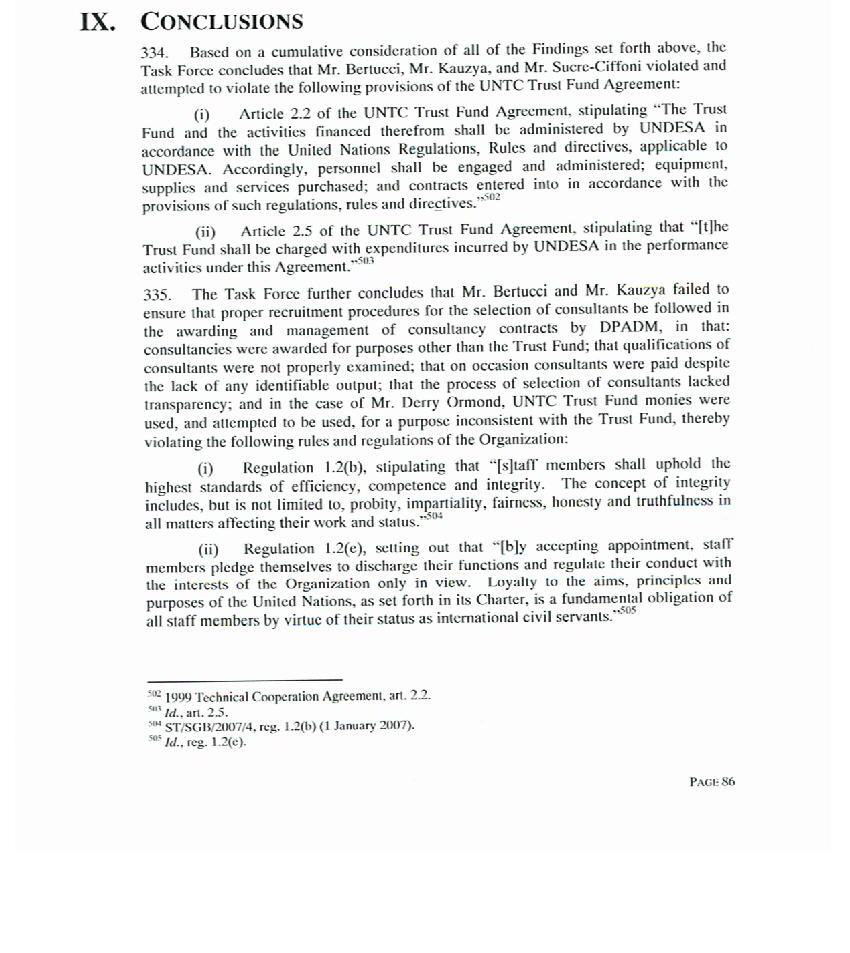
With the UN Development Program confronted by these ethics problems, where did UNDP turn to hire its new in-house Ethics Officer? To another scandal-plagued part of the UN system, Guido Bertucci's Department of Economic and Social Affairs. Bertucci retired on July 31 amid calls for discipline; the conclusion of the UN's confidential investigation of Bertucci, which Inner City Press has obtained and placed online here, is that Bertucci and at least two others, Mr. Kauzya and Mr. Sucre-Ciffoni, violated the terms of the UNTC Trust Fund Agreement and the integrity provisions of the UN Staff Regulations.

This is where UNDP turned for its in-house Ethics Officer, Elia Yi Armstrong. Sources point at that she was previously a pianist and teacher in Vancouver, certainly admirable but of only arguable relevance to fixing the ethical problems at UNDP. Even now that she has tried to beef up her online resume, it is noteworthy that according to the Terms of Reference, "The Ethics Adviser will be appointed for a period of one year, renewable up to a total term of office not to exceed four years." However, according to the Accountability Framework and oversight policy for the Executive Board of UNDP, "The Head of the UNDP Ethics Office serves a term of four-years, and is subsequently ineligible to hold any other post in UNDP after his/her term expires." This is a significant discrepancy that could impact her independence.


UN's outgoing Veness and an officer, accountability by Herfkens not shown

But who will audit these outrages? At the UN's Advisory Committee on Administrative and Advisory Questions, long-time director Mark Gilpin was first moved out of the job, and now will retire. He never returned calls, but still and all, such intrigue at a key committee raises questions.

People are moved around for the sake of it: Communications Director David Morrison, for example, is reportedly resurfacing in charge of the Capital Development Fund, despite a dearth of experience with micro-finance. For the record, UNDP will still not answering long-standing questions about countries in which it accepts currency exchange losses, has stated that Morrison's position at UNCDF

"was posted on the UNDP website, both internally and externally, as well as in the Economist. We received 155 applications and four candidates were interviewed. As for the Ethics Advisor, the post was also advertised internally and externally, with a special emphasis on reaching out ethics centers such as the ones at Natal University, Cornell, the ILO and Fordham. We received 73 applications and interviewed 5 candidates."

Then again, UNDP has refused to answer questions about how much it insures its top two executives for, an issue which has come up in terms of how families of the victims of the bombing of UNDP's Algiers premises in December are being treated. While the promised "Accountability Report" is now substantially late and has not been released, a conference call was held last week about the Brahimi Report. The call was chaired by UNFPA's Thoraya Obaid and included Department of Field Suppport chief Malcorra and outgoing head of security David Veness, who said if anything the UN is in more danger now that it was last December. And where's the Accountability?