Thursday, August 18, 2011

At U.N. everyone in suspense waiting for Australia's Gov to vote on carbon tax. It will be the world's first country to implement carbon tax regime.

United States and Canada are next !


Australian Cabinet to vote on carbon tax

CANBERRA, Australia, Aug. 17 (UPI) -- Australia will introduce a carbon price in Parliament next month and it is expected to become a law by the end of the year, the federal government said Wednesday.

Under the controversial tax, Australia's 500 highest-polluting companies will pay $24 per ton of carbon pollution they emit beginning July 1, 2012. In addition, a market-based carbon trading scheme would be introduced in 2015, allowing major polluters to buy offsetting shares in companies producing emissions less than target levels.

Wednesday's announcement follows a protest by about 2,000 Australians on Tuesday -- the anniversary of a pledge that Australian Prime Minister Julia Gillard made during last year's federal election not to introduce a carbon tax – demanding that the government scrap the plan.

The latest Nielsen poll indicates that 56 percent of Australian voters asked said they are against the tax scheme and an Institute of Public Affairs survey showed that 70 percent of accountants polled said small business would be negatively affected by a carbon tax.

Australian Climate Change Minister Greg Combet said Wednesday the government has ruled out putting off the carbon tax.

"This is a reform that is in our economic interests to make," he told Sky News.

"This will drive investment in new technologies, innovation, it will improve the productivity of our economy over time -- there is no case for delaying it here."

The Institute of Public Affairs, a free market think tank, urged the Gillard administration to scrap the carbon tax in light of the looming economic downturn of China.

The world's largest exporter of coal and iron ore, Australia is China's largest supplier of iron ore.

"The recent stock market roller coaster and the European and U.S. debt crises have shed light on the risks associated with Australia's reliance on China's thirst for our resources," Hugh Tobin, director of the Northern Australia Project at IPA, said in a release.

Tobin said that once global demand drops in the resource sector, commodity prices would fall from the current high levels. The combination of falling commodity prices, along with Australia's introduction of proposed mining and carbon taxes, he warned, would make many Australian projects unprofitable.

"China is deliberately moving to reduce its reliance on Australian minerals in favor of increasingly cheaper markets in parts of West Africa and South America," Tobin said. "Why would we want to add on new taxes and make ourselves uncompetitive at a time like this?"

‘N.K. military receives most aid’ - While United Nations lies on statistics and access to monitoring in the country


North Korean government, administrative, military and related industry officials receive priority in food rations, according to media sources in the country, as a U.N. aid agency claims ordinary citizens are given less than a third of the recommended nutritional diet.

North Koreans were only given 200 grams of daily rations in July, according to the World Food Programme, as quoted by Voice of America.

“The WFP is constantly worried about the insufficient amount of rations given through the North’s distribution system,” said WFP Spokesperson Nanna Skau.

According to the WFP, July’s rations were half that of April, but an increase from the 190 grams given in May and the 150 grams given in June.

According to the U.N. food agency, a healthy adult requires about 700 grams of daily rations for a balanced diet.

“Recently the rations distributed in the North have been supplied by foreign grains,” said Skau.

“We believe that 100,000 tons of grain have been imported from China.”

However according to journalists within the reclusive nation, military, police, party, administrative officials and mine officials and personnel are given priority in rations.

According to the state-run think tank Sejong Institute, chief editor and publisher for the Asia Press Ishimaru Jiro presented information from the North during a policy symposium here.

“Kim Jung-il is pleading the international community for food aid because they lack the food to distribute to the more privileged classes, so if the international community were to deliver aid, the North Korean government would distribute rations to the priority classes first,” said an inside source as quoted by Ishimaru.

The Asia Press publishes the Rimjin-gang, a magazine on internal affairs of North Korea.

Ishimaru analysis suggests that the priority class makes up roughly 20 percent of the entire population.

Wednesday, August 17, 2011

UN investigates theft and sale of Somalia famine food aid

  • guardian.co.uk,
WFP says thousands of sacks stolen and sold in markets but suspending aid programme would cause more deaths (CLICK HERE FOR STORY by AP)

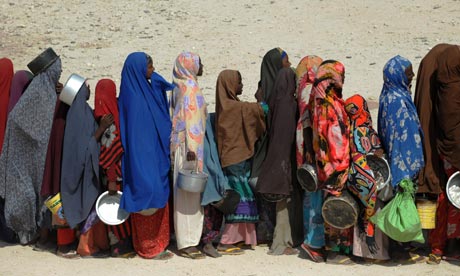
somali refugees queue for food
Somalis at a refugee camp in Mogadishu. There are reports of food aid being stolen and resold in markets nearby. Photograph: Roberto Schmidt/AFP/Getty Images

Thousands of sacks of food aid meant for famine victims are being stolen and sold at markets in neighbourhoods where children in refugee camps do not have enough to eat.

The UN's World Food Programme (WFP) acknowledged it had been investigating food theft in Somalia for two months. WFP officials said the "scale and intensity" of the famine crisis did not allow for a suspension of assistance, which would lead to "many unnecessary deaths".

And the aid is not even safe once it has been distributed to families huddled in the makeshift camps popping up around the capital. Families at the government-run Badbado camp said they were often forced to hand back aid after journalists had taken photos of them with it.

Ali Said Nur said he received two sacks of maize twice, but each time was forced to give one to the camp leader.

"You don't have a choice. You have to simply give without an argument to be able to stay here," he said.

The UN says more than 3.2 million Somalis – nearly half the population – need food aid after a severe drought that has been complicated by Somalia's long-running war. More than 450,000 Somalis live in famine zones controlled by militants linked to al-Qaida, where aid is difficult to deliver. The US says 29,000 Somali children under the age of five have already died.

Officials have expected some of the food aid pouring into Somalia to go missing. But the sheer scale of the theft taking place calls into question aid groups' ability to reach starving people. It also raises concerns about the willingness of aid agencies and the Somali government to fight corruption, and whether diverted aid is fuelling the country's 20-year-civil war.

"While helping starving people, you are also feeding the power groups that make a business out of the disaster," said Joakim Gundel, head of Katuni Consult, a Nairobi-based company that evaluates international aid efforts in Somalia. "You're saving people's lives today so they can die tomorrow."

The WFP Somalia director, Stefano Porretti, said the agency's system of independent, third-party monitors uncovered allegations of possible food diversion. But he underscored how dangerous the work is: WFP has had 14 employees killed in Somalia since 2008.

"Monitoring food assistance in Somalia is a particularly dangerous process." In Mogadishu markets, vast piles of food sacks are for sale with stamps on them from the WFP, the US government aid arm USAID and the Japanese government. AP found eight sites where aid food was being sold in bulk and in numerous smaller stores. Among the items being sold were corn, grain and Plumpy'nut – a specially fortified peanutbutter designed for starving children.

An official in Mogadishu with extensive knowledge of the food trade said he believed a massive amount of aid was being stolen – perhaps up to half of aid deliveries – by unscrupulous businessmen. The percentage had been lower, he said, but the flood of aid into the capital in recent weeks with little or no controls had created a bonanza for businessmen.

At one of the sites for stolen food aid, about a dozen corrugated iron sheds are stacked with sacks. Outside, women sell food from 50kg (110lb) sacks, and traders load the food on to carts or vehicles in full view of local officials.

Helen's mother dead at 87 (may she rest in peace) - but Helen's priority seems to be the saving of NZ Labour (did UNDP paid for this trip?)

Clark is back, campaigning hard for Labour


by WHALEOIL on AUGUST 17, 2011 · 9 COMMENTS

Helen Clark is back in the coun­try and it appears is cam­paign­ing hard for Labour. This ‘inau­gural event’ is being adver­tised and autho­rised by Carol Beaumont.

What do we know about this arrangement?

NOTE: This PO Box resolves to a nat­ural skin care com­pany called Paci­fica Organ­ics… The sole direc­tor of this com­pany is Jenny Agnew who also hap­pens to have a grass­roots Labour web­site.. and is a well known Labour supporter

So this inau­gural lec­ture series is a Labour fundraiser and Helen’s rais­ing the cash. I won­der who is pay­ing Helen Clark’s bills while she’s here fundrais­ing for Labour?

She is back run­ning the campaign!

Has Trevor been given the arse?

Former PM Helen Clark's mother dies

CLICK HERE FOR STORY @ WWW.STUFF.CO.NZ

Margaret Clark
Timaru Herald
PEACEFUL PASSING: Margaret Clark died in Tauranga with her daughter, former prime minister Helen Clark, at her hospital bedside.

Former prime Minister Helen Clark's mum has died.

Irish born Margaret Clark, nee McMurray, 87, died in Tauranga Hospital this morning.

She had been a primary school teacher and is survived by her husband, George, and four daughters.

A spokesman for Ms Clark said she was with her mother when she ''passed away peacefully" early this morning.

Former Labour MP and friend Chris Carter said Ms Clark had been back in New Zealand because her mother had been unwell for several weeks.

He said she had suffered from pneumonia.

Ms Clark had been by her mother's side the entire time she had been back in New Zealand, except for a short trip to Oamaru, he said.

Her funeral will be held in Waihi on Monday but the time was yet to be announced.

Tuesday, August 16, 2011

You have 30 sec to tell Ban Ki Moon about an idea that would change the United Nations

The 2011 World Humanitarian Day campaign in partnership with The United Nations Department of Public Information launches the 3rd annual Citizen Ambassadors video contest from 8 August 2011 to 8 September 2011.

WINNERS WILL WIN A TRIP TO NEW YORK AND THE CHANCE TO PITCH THEIR IDEA IN PERSON TO THE UNITED NATIONS SECRETARY-GENERAL!!

Rules of the Contest:

- Only entries submitted via YouTube will be eligible for consideration. To sign up for an account on YouTube, please visithttp://www.youtube.com/create_account.

- Video entries must not exceed 30 seconds in length.

- The contestant must be at least eighteen (18) years of age on the date he/she enters the contest.

- Video submissions must be original and unpublished work by the contestant and not infringe on any copyright laws.

- The submitted video must begin with the phrase "Excuse me, Mr. Secretary-General..."

- Submitted videos must be recorded in English or French or subtitled in English or French.

- Each entrant must fill out the Entry Form.

- Video submissions may not contain any offensive or inappropriate content, according to United Nations principles and practices, and must comply with YouTube's general terms and conditions.

- Current or former staff members, interns or retirees of the United Nations Organization, its Agencies, Funds or Programmes and any family and/or house-hold members of these staff members are not eligible.

- The contest will end on 8 September 2011 at 11:55 p.m. New York time (EST). Entries submitted after this time or modified past the end of the contest will not be eligible.

- The results will be announced in October 2011 on the official Citizen Ambassadors website http://www.uncitizenambassadors.org/ and on the UN Channel on YouTube.

Legal Disclaimer:
By submitting a video submission to the competition, the entrant accepts the full terms and conditions of the contest. By submitting a video, the entrant grants the United Nations full permission to freely use said video as appropriate, for World Humanitarian Day activities, cross-posting on other YouTube channels, UN websites and by UN partners, or any other use. The United Nations will have the right to freely use the video material. These terms and conditions are subject to change.

For further information, please email us at citizenambassador[at]un.org. Please include the URL of your video submission and your YouTube profile name in your email.

Music: 'If I Could Change' (Instrumental) by Jerry 'Wonda' Duplessis

(Closed Captions in the 6 UN Official languages will be added shortly)

KoreaHerald: Model U.N. creates goodwill ambassadors to Korea

THIS WAS ONE OF THE LATEST U.N. GOODWILL AMBASSADORS

Aicha Gaddafi
Aicha Gaddafi You are Fired !


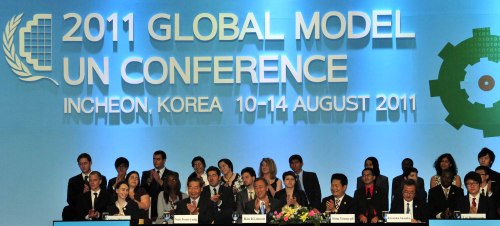
This year’s model U.N. conference, which took place in Incheon from Aug. 10-14, attracted a record number of participants from around the world, largely helped by the attendance of the United Nations chief.

About 1,000 high school, university and graduate students from 60 countries discussed pending global issues, ranging from global warming to a U.S.-led financial market crisis in Songdo, a district of the Incheon Free Economic Zone.

Their five days of impassioned discussion resulted in resolutions on four topics ― nuclear safety and security, world food security, global warming and sustainable development.
Participants of the Global Model U.N. Conference applaud during the opening ceremony of The Global Model United Nations Conference at Songdo, Incheon, on Aug. 11. (Kim Myung-sub/The Korea Herald)

The United Nations ‘Somali Project’ leaves too many queries unanswered

By AHMED JAMA
Posted Monday, August 15 2011

For the past two decades, Somalia has been one of the international community’s most highly-funded, yet, as the current famine has revealed, “Project Somalia” has been unsuccessful as it has failed to improve food security in the war-torn country.

Since the 1990s, Somalia has received significant support from the donor community, notably the United States and the European Union. Most of the support is channelled primarily through United Nations agencies which maintain a large support structure based in Nairobi.

There is also parallel donor support for Somalia through the UN Consolidated Appeal Process and the Emergency Response Funds, managed by the United Nations Office for the Coordination of Humanitarian Affairs.

These funds are accessible to UN agencies and to international and local NGOs under what is known as the cluster framework. Clusters are normally chaired by a UN agency.

Given the lack of an effective national government in Somalia, UN agencies have positioned themselves as the providers of public goods and services in the country.

Very often, UN agencies embark on unilateral resource mobilisation initiatives on behalf of the Somali people. Mobilised resources are then used by the same agencies to implement their own projects and programmes.

In practice, this means that UN agencies raise funds for projects conceived, implemented and managed by themselves, usually without external monitoring and evaluation by a non-UN entity, and quite often without the active participation of government.

This is unethical and raises serious questions about whether UN agencies working in Somalia are accountable, not just to the donors, but to the people of Somalia.

The specific policy framework followed by most international donors for Somalia has been anchored on LRRD (Linking Relief, Rehabilitation and Development), which is adopted when a country is going through a crisis.

In the eyes of the international donors and UN agencies, Somalia represents a classic argument for an LRRD strategy. However, the ‘crisis’ has been on for almost 20 years, and by definition, it can no longer be considered one.

Meanwhile, humanitarian relief continues as in response to crisis, and with a limited view of moving beyond the crisis towards development.

In line with the above policy, the European Union has supported a number of rural development and food security initiatives since 1995 to the tune of 150 million euros.

Over 60 per cent of this amount has been used in South Somalia to fund projects in areas mainly in Lower Shabelle where irrigated agriculture has the most potential.

Lower Shabelle was the bread-basket of Somalia in the 1980s, and has remained so even after the civil war. EU support has gone towards improving data collection, rehabilitation of the irrigation infrastructure, seed testing and multiplication, pest management, capacity building of farmers, creation and/or strengthening of community water users associations, and rehabilitation of the roads.

For rural development and food security, the primary UN implementing agency is the Food and Agricultural Organisation, which receives substantial resources from the EU to implement projects in the agricultural areas of South Somalia.

Given the heavy investment in the Lower Shabelle region in the last 16 years, it is surprising that this is the very region that the UN has now declared a famine area. Did the EU-supported interventions in Lower Shabelle fail or has the UN — for whatever reason — made the Lower Shabelle appear more food insecure than it really is?

I suspect it is the latter, because even as recently as last year, the FAO reported that Lower Shabelle had experienced a bumper harvest.

Clearly, there is a mismatch between the resources made available to UN agencies over the last two decades and the dismal picture emerging from the most productive regions of South Somalia.

Currently, billions of dollars are being raised to help the starving of Somalia. Given the past record of UN relief and development projects, it is likely that the country will find itself in another “crisis” a year from now, and possibly in many subsequent years.

Mr Jama is a Somali agricultural economist based in Nairobi.(edboehe@yahoo.com)

Monday, August 15, 2011

The unholy alliance in Somalia: Media, donors and aid agencies


CLICK HERE TO READ FULL ARTICLE IN WWW.THEEASTAFRICAN.CO.KE


The season of giving has started — and it not even Christmas yet. Leading international aid agencies, including the United Nations, Oxfam, Save the Children and Islamic Relief UK, have launched massive campaigns to save the thousands of Somalis who are facing hunger in their own country and in refugee camps in neighbouring Kenya and Ethiopia.

UN Secretary-General Ban Ki-moon has asked donors for $1.6 billion in aid for Somalia and the World Bank has already pledged more than $500 million towards the relief efforts.

The appeals for food aid have been accompanied by heart-wrenching images: children with swollen, malnourished bellies, emaciated mothers with shrivelled breasts that no longer lactate, campsites bursting at the seams with hordes of skeletal refugees. Almost all the large humanitarian aid agencies are rushing to the Dadaab refugee camp in Kenya to witness, photograph and film the crisis. We have seen these images before — in the mid-1980s when Mohamed Amin filmed the famine in Ethiopia that triggered the trend of rock stars becoming do-gooders. Since then, famine has become the biggest story coming out of Africa — and one of the biggest industries.

Media-savvy aid agencies

Images of starving Africans are part and parcel of fund-raising campaigns, as are journalists. As one leading humanitarian official told the BBC’s Andrew Harding, the UN can produce endless reports, but it is only when the images of starving people are televised or placed on the front page of newspapers that politicians take action.

The problem is that the story that they see or read is not as impartial as they would like to believe. More often than not, it is told by aid agency staff on the ground or independent filmmakers. News organisations that do not have the resources to send reporters to far-flung disaster zones such as the camp in Dadaab, have entered into an unholy alliance with aid agencies, whereby the aid agencies’ spokespeople — wearing T-shirts and caps bearing the logos of their respective organisations — “report” the disaster via satellite to international audiences. Even when journalists are present on the ground, they rely almost exclusively on aid agencies’ version of the disaster. The narrative about the famine in Somalia has, therefore, become both predictable and one-sided.

Dutch journalist Linda Polman believes that the “unhealthy” relationship between journalists and aid agencies does not allow for independent, objective reporting, and is often slanted in favour of the agency doing the “reporting”.

Media-savvy aid workers fully exploit the eagerness with which journalists accept their version of a disaster or crisis. On their part, says Ms Polman, journalists “accept uncritically the humanitarian agencies’ claims to neutrality, elevating the trustworthiness and expertise of aid workers above journalistic scepticism.” This non-nuanced, simplistic story about African disasters has foreign policy implications, says Karen Rothmyer in a discussion paper published by Harvard University’s Joan Shorenstein Centre early this year.

“Top US officials responsible for Africa policy who begin their days with media summaries focusing disproportionately on Africa’s problems are unlikely to see the continent’s potential.”

The cosy relationship between aid workers and journalists has thus distorted the way Africa is reported. Journalists often do not get to the heart of the story or take the time to do the research into the causes of a particular crisis. Africans do not feature much in their stories, except as victims.

“In public affairs discussions the term ‘starving Africans’ (or ‘starving Ethiopians’ or ‘starving Somalis’) rolls from the tongue as easily as ‘blue sky’,” wrote former aid worker Michael Maren in his 1997 book The Road to Hell.

“Charities raise money for starving Africans. What do Africans do? They starve. But mostly they starve in our imaginations. The starving African is a Western cultural archetype like the greedy Jew or the unctuous Arab.”

In a recent phone conversation, Ms Polman told me that the “starving African” story is not just the easiest to tell, especially in a continent that does not generate much international media coverage, but is also the most “politically correct.” After all, who in their right mind would want to be accused of doing nothing for dying people?


UN's Great Leader Ban Ki-moon's childhood kitchen get's immortalized same as North Korea's Kim il-sung (no one wants to say who paid for it?)


HAIL THE GREAT LEADER !

And now the Great Leader of the United Nations, H.E. Ban Ki-moon's childhood kitchen get's renovated and immortalized into a magnificent public museum so new generations to come can see for themselves the humble beginnings of the world's greatest korean (always after Kim Il-sung of North Korea).

Here is the Secretary General's old kitchen (as per UN Information Dept)


For those that would wonder how North Korea's Kim Il-sung's kitchen looks like, don't worry his is still full of food:


Mangyongdae - Kim Il-sung Kitchen in North Korea

Why USUN doesn't hold United Nations Development Programme to the same transparency standards applied by State Department and USAID?

Under the Obama administration and Secretary Hilton leadership the transparency at State Department and USAID has visibly increased. To this effect the USAID has made public its Headquarters and Field Credit Card Holders. (Click here for the link at USAID webpage).

While the above applaudable move is welcomed, seems that at United States Mission to the U.N. not interested to hold the U.N., and especially its operational branches UNDP and UNOPS, to the same standards the US Government has set for its own.

The failure of UNDP/UNOPS to publish the list of all UNDP/OPS Credit Cards holders, seem to be related to the list of individuals who otherwise would not be able to hold a credit card based on financial rules.

An informed source says that few of Credit Card holders are not even staff, they hold various temporary contractual status and thus, as per U.N. Financial Regulation should not be in position to neither authorize nor incur expenditures on behalf of the organization.

Consider that many of these expenses are "small", meaning less than $2,500, most if not all escape the internal controls under the so called "approval authority threshold".


What is the reason behind United Nations continuous denial to these basic transparency requirements which seem every other member states have already endorsed and is conforming to ?

Sunday, August 14, 2011