Tuesday, April 13, 2010

Same Old Divisions Mar Restart of Climate Negotiations

BONN, Germany, April 12, 2010 (ENS) - Government climate negotiators Sunday concluded a three-day round of official talks in Bonn, the first since the Copenhagen summit ended in December with the weak Copenhagen Accord, a political agreement. Many countries and the United Nations had aimed for a legally binding deal to limit global greenhouse gas emissions after the Kyoto Protocol expires at the end of 2012.

Delegates in Bonn bickered over how to proceed this year to draft a text that can approved at the next annual UN climate summit November 29-December 10 in Mexico.

Protesters shovel broken glass outside the Bonn climate talks. (Photo by Simone Ackermann courtesyGermanwatch)

As they entered the hall, delegates passed a four tonne pile of broken pieces of glass dropped by environmental groups to send the message that now is the time to pick up the broken pieces of the international climate accord and get back to work.

TckTckTck partners, Germanwatch, WWF and Oxfam, the groups who dropped the glass outside the conference hall, say four tonnes of glass represents four degrees Celsius, the upper range of temperature increase the world will experience as a result of the failure to come to an agreement at the Copenhagen summit.

Inside the conference hall, Fernando Tudela of Mexico expressed support for efforts to start a new stage in these "complex negotiations." He outlined consultations by the Mexican host group to build confidence in the process.

But the first day of the Bonn talks displayed deep fractures among governments.

The United States and China disagreed over whether to write a new draft negotiating text this year as proposed by South Korea. Chinese delegate Su Wei said a basis for work already exists in a previous text, but the U.S. delegate Jonathan Pershing said that text has over 100 pages of bracketed clauses, which denote disputed text.

The Copenhagen Accord itself was a major point of contention.

The document, drawn up last December by leaders from the United States, China, India, Brazil and South Africa, is not legally binding and it was not voted upon or signed, but simply noted.

While 111 countries and the European Union, out of the world's 194 governments, have indicated their support for the Copenhagen Accord, Venezuela delegate Claudia Salerno told Bonn delegates today that it is not really an "accord," at all.

Although "the urgency we face now is even greater than 2009," Salerno said, the Copenhagen Accord contains only proposals for "voluntary reductions in carbon emissions that according to scientists would lead to increases in temperature of about five degrees Celsius (about nine degrees Fahrenheit).

Most scientists, governments and nongovernmental organizations agree that the global temperature can rise no more than two degrees C (3.6 degrees F) above pre-Industrial Revolution levels to avoid catastrophic climate change.

In Copenhagen, Venezuela and other developing countries said they could not accept the draft Accord because it lacked ambitious targets for reducing carbon emissions.

Developing country delegates in Bonn generally view the Copenhagen Accord as "a secret text put together by a selected few," in the words of Tosi Mpanu Mpanu of the Democratic Republic of Congo, speaking for the Africa Group.

Under the Copenhagen Accord, the UN Framework Convention on Climate Change, UNFCCC, has received national pledges to cut or limit emissions of greenhouse gases by 2020 from 75 Parties, which together account for more than 80 percent of global emissions from energy use.

?"It is clear that while the pledges on the table are an important step towards the objective of limiting growth of emissions, they will not in themselves suffice to limit warming to below two degrees Celsius,"? said UNFCCC Executive Secretary Yvo de Boer, who steps down later this year before the Mexico climate conference.

"The climate conference at the end of this year in Mexico therefore needs to put in place effective cooperative mechanisms capable of bringing about significant acceleration of national, regional and international action both to limit the growth of emissions and to prepare for the inevitable impacts of climate change," de Boer said.

Said Spain's Alicia Montalvo Santamaria, speaking for the European Union, as Spain currently holds the presidency, "The EU recognizes the positive outcomes of the Copenhagen conference that gave important political guidance from the highest levels."

"However, the outcome did not reflect the EU's ambitions," she said. "We remain fully commited to negotiations with all parties in order to conclude a comprehensive global legal framework that allows us to stay below a rise of two degrees Celsius since pre-industrial times."

Leaders of the world's multilateral development banks and the International Monetary Fund, meeting today at the European Investment Bank in Luxembourg, mapped out their plans to support a sustainable global recovery and agreed the Copenhagen Accord is an opportunity for action to finance measures to combat climate change.

The bank leaders said in a joint statement that they welcome the commitment of developed countries as part of the Copenhagen Accord to provide additional fast track financing for developing countries of US$30 billion in the period 2010-12 and the pledge to mobilize US$100 billion by 2020 in order to help developing countries cope with the impacts of climate change and achieve the deep cuts in global emissions needed to hold the increase in global temperatures below two degrees Celsius.

The bank leaders said they "reaffirm their readiness to provide technical support to the UN process and recognize the importance of a legally binding post-2012 international agreement on climate change being concluded as soon as possible."

Taking part in Friday's meeting were: African Development Bank President Donald Kaberuka, Asian Development Bank President Haruhiko Kuroda, European Bank for Reconstruction and Development President Thomas Mirow, European Investment Bank President Philippe Maystadt, Inter-American Development Bank Vice President Roberto Vellutini, International Monetary Fund Deputy Managing Director Murillo Portugal. For the World Bank Group, Lars Thunell, executive vice president and CEO, International Finance Corporation.

After the Bonn talks conclude on Sunday, the next climate negotiating session to open will be the Major Economies Forum on Energy and Climate at the U.S. State Department in Washington April 18 through 19.

Deputy National Security Advisor for International Economic Affairs Michael Froman will serve as chair. U.S. Special Envoy for Climate Change Todd Stern will lead U.S. participation. The meeting will take place at the level of leaders' representatives.

This forum is intended to "facilitate a candid dialogue among major developed and developing economies to make progress in meeting the climate change and clean energy challenge, and advance the exploration of concrete initiatives and joint ventures that increase the supply of clean energy while cutting greenhouse gas emissions," according to the State Department.

The 17 major economies that are members of the Major Economies Forum are: Australia, Brazil, Canada, China, the European Union, France, Germany, India, Indonesia, Italy, Japan, Korea, Mexico, Russia, South Africa, the United Kingdom, and the United States.

The Bolivian government is convening the World People's Conference on Climate Change and the Rights of Mother Earth on April 19 through 22 in Cochabamba. This conference aims to allow civil society and government representatives to coalesce around common, just demands in order to give a new impetus and direction to the UN talks on climate change, organizers say.

The Bolivian conference has 17 working groups which will produce proposals on, for instance, the dangers of carbon markets, the Kyoto protocol, forests, agriculture and food sovereignty.

Another official negotiating round hosted by the UNFCCC in Bonn is scheduled for May.

UN agrees to host two more rounds of climate change talks before summit in Mexico

Climate change talks underway in Bonn, Germany

12 April 2010 – Participants at the United Nations climate change talks in Bonn have agreed to intensify their negotiating schedule in hopes of reaching a strong outcome in Mexico later this year after world leaders were unable to agree on a binding treaty in Copenhagen last December.

“At this meeting in Bonn, I have generally seen a strong desire to make progress,” said Yvo de Boer, Executive Secretary of the UN Framework Convention on Climate Change (UNFCCC), following the talks over the weekend in Germany.

He cautioned, however, that while additional “meeting time is important, it is itself not a recipe for success.”

In addition to the negotiating sessions already scheduled for 2010, governments of the 175 countries that participated decided to hold two additional sessions of at least one week each to intensify the search for ways to limit carbon emissions and provide assistance for developing countries.

Dates have not yet been set, but the additional meetings will take place between 11 June, when the UNFCCC Convention subsidiary bodies wrap up their session, and 29 November when the UN Climate Change Conference will begin in Cancun, Mexico.

“The UN Climate Change Conference in Cancun must do what Copenhagen did not achieve: It must finalize a functioning architecture for implementation that launches global climate action, across the board, especially in developing nations,” said Mr. de Boer.

The end result of the previous climate change conference held in Denmark in December 2009 was the Copenhagen Accord, a non-binding document which has now been signed by at least 117 countries.

Mr. de Boer stressed that negotiations this year need to finalize mitigation targets and action, a package on adaptation, a new technology mechanism, financial agreements, ways to deal with deforestation, and a capacity-building framework.

Pakistan joins bid for position of UN climate chief

United Nations, Apr 13 (PTI) Pakistan has nominated its candidate Tariq Banuri for the position of the head of United Nations Framework on Climate Change (UNFCCC) that will be filled by July when the current UN Climate Chief Yvo de Boer steps down.

The final list of candidates include Christiana Figueres from Costa Rica, Maria Fernanda Espinoza from Ecuador, Vijai Sharma from India, Marthinus van Schalkwyk from South Africa and Janoz Pasztor from Hungary who is also presently heading the Secretary-General's Climate Change Support Team.

A former government official in Pakistan, Banuri is the director of the Asian Centre of the Stockholm Environment Institute and has previously worked with the UN.

The deadline for submission of nominations ended on March 31st.

Bolivia launches World Peoples' Climate Summit at UNFCCC talks in Bonn

Pablo Solon, Bolivia's ambassador to the UN, at a press conference during UNFCCC negotiations in Bonn on April 10, 2010 condemned continued attempts by some developed countries to impose a deeply flawed Copenhagen Accord as the basis for future negotiations: “The only way to get negotiations back on track not just for Bolivia or other countries, but for all of life, biodiversity, our Mother Earth is to put civil society back into the process.”
Solon explained it was this belief that motivated Bolivia to host an historic World Peoples' Summit on Climate Change and Rights of Mother Earth on 19-22 April 2010 to which more than 15,000 people and up to 70 governments are expected to attend.
“The central aim of any climate summit is not to save itself and accept any outcome, but to come to an agreement that will save humanity.”
Solon said that the Copenhagen Accord sadly marked a “backwards step” so could never be acceptable as a basis for further negotiations. Solon pointed out that the European Union's own analysis of the Copenhagen Accord admitted that it would lead to an increase of temperatures of up to four or five degrees.
“This is no kind of solution. Yet at these talks [in Bonn] we never hear developed nations admitting concern over this. Instead the US claims this is the best agreement we have had. Are we really willing to say that allowing temperatures to rise to four or five degrees is a good goal?”
Solon reiterated the demands of many developing nations by calling on industrialized nations to rebuild trust. “You cannot rebuild trust by legalizing the same methods that led to the failure in Copenhagen.” Solon called for talks to be returned to the full UNFCCC process, and to develop on what had been agreed in COP15.
Solon commenting on news that the US and Denmark were withdrawing aid from countries like Bolivia for their opposition to the Copenhagen Accord said, “This in their rights, but unfair and clearly an attempt to punish Bolivia. What kind of negotiation is it where you lose money if you disagree?” Solon said that Bolivia would not back down due to such threats. “We are a country with dignity and sovereignty and will maintain our position.”
BACKGROUND ON CONFERENCE
The Peoples' World Conference on Climate Change and Rights of Mother Earth (http://cmpcc.org) was announced by President Evo Morales of Bolivia in the aftermath of the widely denounced outcomes of the Copenhagen UNFCCC conference in December 2009. The aim of the conference is to advance an agenda led by civil society organizations and in dialogue with proactive governments dedicated to preventing climate change. The conference aims to analyze the structural causes of climate change, and develop specific proposals and actions for addressing it.
Bolivia has invited all 192 governments in the UN to attend the conference and is working closely with the United Nations Development Program to bring representatives from nearly all the 49 Least Developed Countries (LDCs), whose populations will be most vulnerable to climate change.
(Source: http://www.huntingtonnews.net/)

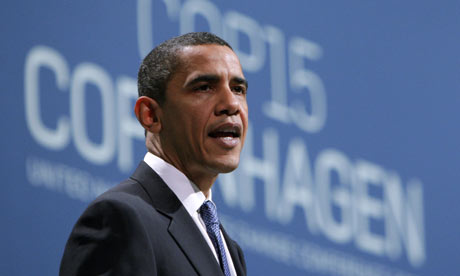
Confidential document reveals Obama's hardline US climate talk strategy

COP15 U.S. President Barack Obama

The document outlines key messages the Obama administration wants to convey in the run-up to UN climate talks in Mexico in November. Photograph: Anja Niedringhaus/AP

A document accidentally left on a European hotel computer and passed to the Guardian reveals the US government's increasingly controversial strategy in the global UN climate talks.

Titled Strategic communications objectives and dated 11 March 2010, it outlines the key messages that the Obama administration wants to convey to its critics and to the world media in the run-up to the vital UN climate talks in Cancun, Mexico in November. (You can read the document text below).

Top of the list of objectives is to: "Reinforce the perception that the US is constructively engaged in UN negotiations in an effort to produce a global regime to combat climate change." It also talks of "managing expectations" of the outcome of the Cancun meeting and bypassing traditional media outlets by using podcasts and "intimate meetings" with the chief US negotiator to disarm the US's harsher critics.

But the key phrase is in paragraph three where the author writes: "Create a clear understanding of the CA's [Copenhagen accord's] standing and the importance of operationalising ALL elements."

This is the clearest signal that the US will refuse to negotiate on separate elements of the controversial accord, but intends to push it through the UN process as a single "take it or leave it" text. The accord is the last-minute agreement reached at the chaotic Copenhagen summit in December. Over 110 countries are now "associated" with the accord but it has not been adopted by the 192-nation UN climate convention. The US has denied aid to some countries that do not support the accord.

The "take it or leave it" approach divided countries in Bonn this weekendand alienated most developing countries including China, India and Brazil who want to take parts of the accord to include in the formal UN negotiations. They say the accord has no legal standing and should not be used as the basis of the final legally binding agreement because it is not ambitious enough. It lacks any specific cuts in greenhouse gas emissions and sets a temperature rise limit of 2C, which critics say is too high to prevent serious harm to Africa and other parts of the world.

Last night Jonathan Pershing, lead US negotiator at the Bonn talks, said he "had no knowledge" of the document. But he endorsed one of its key messages. "We are not prepared to see a process go forward in which certain elements are cherry-picked. That was not the agreement we reached in Copenhagen," he said.

Text of the leaked document:

Strategic communications objectives

1) Reinforce the perception that the US is constructively engaged in UN negotiations in an effort to produce a global regime to combat climate change. This includes support for a symmetrical and legally binding treaty.

2) Manage expectations for Cancun – Without owning the message, advance the narrative that while a symmetrical legally binding treaty in Mexico is unlikely, solid progress can be made on the six or so main elements.

3) Create a clear understanding of the CA's standing and the importance of operationalising ALL elements.

4) Build and maintain outside support for the administration's commitment to meeting the climate and clean energy challenge despite an increasingly difficult political environment to pass legislation.

5) Deepen support and understanding from the developing world that advanced developing countries must be part of any meaningful solution to climate change including taking responsibilities under a legally binding treaty.

Media outreach

• Continue to conduct interviews with print, TV and radio outlets driving the climate change story.

• Increase use of off-the-record conversations.

• Strengthen presence in international media markets during trips abroad. Focus efforts on radio and television markets.

• Take greater advantage of new media opportunities such as podcasts to advance US position in the field bypassing traditional media outlets.

• Consider a series of policy speeches/public forums during trips abroad to make our case directly to the developing world.

Key outreach efforts

• Comprehensive and early outreach to policy makers, key stakeholders and validators is critical to broadening support for our positions in the coming year.

• Prior to the 9-11 April meeting in Bonn it would be good for Todd to meet with leading NGOs. This should come in the form of 1:1s and small group sessions.

• Larger group sessions, similar to the one held at CAP prior to Copenhagen, will be useful down the line, but more intimate meetings in the spring are essential to building the foundation of support. Or at the very least, disarming some of the harsher critics.

U.N. Climate Negotiators Facing Crucial Test

United Nations climate change negotiators agreed Sunday to hold more sessions aimed at bridging differences left unresolved by last December's contentious talks in Copenhagen.

While some developing nations signaled support this week for the accord reached in Copenhagen, others questioned the role of the accord in future talks. EDF’s International Counsel Annie Petsonk, who monitored the talks in Bonn this weekend, said:

The U.N. climate negotiations are facing a crucial test over whether this process can serve as the global guidance system for tackling climate change.

There is still momentum in the U.N. process, but it is fragmenting. In the absence of U.S. legislation, and with the corresponding slow progress in the U.N., there is a new focus on national action as talks continue toward a global agreement.

This fragmentation presents challenges, but it also creates opportunities, as nations that move swiftly to embrace carbon regulation position themselves for economic growth in the 21st century. That competition presents an even greater imperative for the Obama administration to make a serious push for a balanced energy-climate bill in the U.S. Senate.

U.N. program piques global interests

By VANESSA McCRAY
vmccray@record-eagle.com

TRAVERSE CITY -- Participating in Model United Nations while at Traverse City West Senior High School piqued Jamie Schaub's interest in global environmental issues.

The 2008 West graduate now attends Kalamazoo College, where she's majoring in psychology. She lined up a summer internship with a local environmental nonprofit and plans to study abroad in Thailand in the fall.

"I always knew that I was interested in kind of international work, but I wasn't really sure what it would be," Schaub said.

In-depth study of Costa Rica for Model U.N. opened her eyes, led to more research and travel.

"I kind of got some new information about environmental issues globally," she said.

Kerry Fleet, a 2006 West graduate, spent two high school years on Model U.N., learning about countries such as Sudan and the Democratic Republic of the Congo. It was her first intense study of Africa, and when she enrolled at Michigan State University she added an African studies focus to her art education courses. Fleet lived in Pietermaritzburg, South Africa, last year and wants to join the Peace Corps.

Model U.N. seems to attract, or perhaps shape, these globally curious, world-traveling high-achievers. And, Traverse City West's Model U.N. program is among the finest. The high school recently won a Best Prepared School award for the fifth consecutive year at the Mid-American Model United Nations competition in Kalamazoo.

Leading the diplomacy dynasty is teacher and advisor Charles Rennie, who guided a 50-student team this school year.

"They put in a lot of time," Rennie said. "The awards are kind of like an after-glow of just how prepared they are and how well they do."

To ready for competition, the group spends hours researching countries assigned to students and writes hundreds of pages of papers. More than two dozen schools participated at the Kalamazoo contest, where students act as United Nations ambassadors. The role-playing delegates represent their nations' interests during debates about real-life topics that the actual U.N. faces. Students meet in committees, draft resolutions and convince students who represent opposing countries or viewpoints to side with them.

Students said the exercise teaches research and public speaking skills; tests their own political pre-conceptions, powers of persuasion and peace-making abilities; builds teamwork and forces them to listen carefully and think quickly.

"You really improve your social skills. People are not going to listen to the guy who stands in a corner," said Charlie Pacer, a member of the current West team.

Aaron Madison, who won the recent contest's highest individual honor for her work, said Model U.N. gave her a reason to delve into topics she normally wouldn't deal with as "an 18-year-old girl in Traverse City." That's as much a valuable opportunity as it is "a lesson in leadership," she said.

"Model U.N., it's not just good for foreign relations. It's good for everything," said fellow student Chase Wagner.

Many of Rennie's former students, like Schaub and Fleet, remain interested in global issues. Rennie said the experience prepares them for the future -- from succeeding in college, speaking to the city commission, writing a letter to a newspaper editor or furthering their career. Current students said Model U.N. is also great for the short-term.

"The fun you have and the feeling of accomplishment and satisfaction that you get from working with friends is pretty much worth it," said West's Jason Heder Petit-Frere.

Iranian President calls Ban Ki Moon to probe western targets in Iraq and Afghanistan

Tuesday, April 13, 2010 09:33 GMT
Iranian President Mahmoud Ahmadinejad called the UN Secretary General Ban Ki Moon to establish an investigation committee in order to probe the aims of the western military operations in Afghanistan and Iraq. In a letter to the UN Secretary General, the Iranian President said that the manners used by the USA and NATO troops in dealing with terrorism in the region were doomed to fail. Ahmadinejad called the UN Secretary General to launch an investigation the results of which shall be submitted to the UN General Assembly. As a consequence of the western presence in Iraq and Afghanistan millions of people were killed, wounded or became homeless to that the cultivation of poppy plants, from which opium is extracted, increased. To that, people in these regions are still living under threats, Iranian President added.

National Review: The U.N. 'Love Boat'

by BRETT D. SCHAEFER


captain's hat
EnlargeiStockphoto.com

The World Food Program has rented out two passenger ships to accommodate many U.N. staff members off the coast of Haiti. At $112,500 per day, how much of these costs are passed off onto the U.S., the largest contributor to WFP.

text sizeAAA
April 13, 2010

In a story posted last week on Fox News's website, George Russell laid out one of the most outrageous examples of poor judgment and profligacy seen in recent years from a U.N. organization. As Russell reports, two passenger ships (the Ola Esmeralda and the Sea Voyager) have been rented by the World Food Program — a U.N. humanitarian-relief organization — for $112,500 per day for the purposes of "accommodation for many of the U.N.'s international staff" off the coast of Haiti. The ships are also available to NGO workers and dignitaries such as Brazilian president Luiz Inacio da Silva, who recently visited the impoverished and earthquake-ravaged island. The total cost of renting these ships is projected to be over $10 million for the first 90 days. U.N. staff call one of the ships the "Love Boat."

Sensing that the news might not be received well, WFP quickly pulled down its own article (complete with pictures) about the ships. Russell preserved the story, however, and does a wonderful job of exposing the many questions surrounding WFP's decision to rent these ships. Among the highlights:

WFP is being overcharged, because the projected expense is millions of dollars more than what the ships would have been likely to earn through normal operation.

The Ola Esmeralda is owned by a Venezuelan company with close ties to Pres. Hugo Chavez.

Also included in the story is a revealing insight into the U.N. mindset. Russell asked Edmond Mulet, special representative in Haiti of the U.N. secretary general and head of the U.N. peacekeeping mission (MINUSTAH) in the country, about the decision. Mulet's answer, spread through several quotes in the story, was shocking: "It is the least we could do for them. They are working 14, 16 hours a day. The place was pulverized. Living conditions are really appalling. . . . [When] oxygen masks come down in a falling plane, the first thing you do is put them on yourself. You have to be in good shape in order to help the Haitians."

Apparently, a visit to the Lido Deck is just the thing for staying in "good shape."

Russell reports that if the two boats are fully booked, the cost to WFP is $181.81 per passenger per day for the Sea Voyager and $154.25 per passenger per day for the Ola Esmeralda. But U.N. staffers get to stay on the ships for $40 per day, and those participating in the U.N. peacekeeping mission get to stay for $20 per day. So WFP, even if the ship is full, provides each U.N. "passenger" a direct subsidy of up to $161.81 per day. But WFP doesn't really pay for it, of course; the taxpayers in the countries who contribute to WFP do. In 2008, the U.S. gave over $2 billion to WFP — about 40 percent of its total budget.

And as if that weren't enough, American taxpayers pay roughly a quarter of the expense of U.N. operations and staff salaries — expenditures that include a Daily Subsistence Allowance for U.N. staff of $244 dollars. Reasonable people might wonder, given that their daily allowances would more than cover it, why WFP is not charging U.N. staff the full cost of staying on the ships rather than $40 or $20 per day. Such is the regard U.N. agencies have for our hard-earned tax dollars.

This is just the latest in a series of missteps by WFP. For instance, according to a March 2010 report by the U.N. Monitoring Group on Somalia, "up to half of the food aid intended for needy Somalis is routinely diverted," and WFP food-aid delivery was dominated by three individuals (and their families and associates) linked to "arms sales and insurgent connections." A February 2010 story, also by Russell, detailed how WFP's relief effort in Afghanistan was inflated, with some outside experts saying that “some of the costs are more than 100 percent higher than they need to be."

Since the U.S. is by far the largest contributor to the World Food Program, Congress should take a keen interest in its activities in Haiti and elsewhere.

Monday, April 12, 2010

Issue of climate financing far from being resolved

by Xinhua Writers Han Mo, Huan Gongdi

BONN, Germany, April 11 (Xinhua) -- UN climate chief Yvo de Boer on Saturday questioned the will of the developed countries to act to fund climate change.

Climate financing, a issue first mentioned decades ago, has fallen into the category of "far from resolution" in his to-do list, Boer said in Bonn, where negotiators from more than 180 countries gathered for the first round of UN climate change talks since the Copenhagen conference last year.

The outgoing executive secretary of the UN climate change secretariat told Xinhua that he divided climate change issues into three categories: the one near finalization; the one with big difference but perhaps being resolved; and the third, which is "still very far from resolution," that is, the question of climate finance.

The United Nations Framework Convention on Climate Change (UNFCCC), which took effect in 1994 and has been ratified by 194 countries, contains articles of financial support for developing countries to fight climate change.

However, 16 years have elapsed and these pledges are still lying in documents, rather than being converted into actions.

The Copenhagen Accord, put forward at the last minute after marathon talks in late 2009, pledged to offer 10 billion U.S. dollars per year to poor countries in the next three years, and to increase the aid to 100 billion dollars annually by 2020.

UN Climate Talks ‘Fracturing’ as Decision Delayed (Update1)

BusinessWeek Logo

(Adds schedule of meetings in eighth paragraph.)

By Ben Sills

April 12 (Bloomberg) -- Negotiators at United Nations climate talks put off a decision on how to treat a U.S.-brokered agreement on global warming, reducing the chances for a new plan on limiting emissions of greenhouse gasses after 2012.

After three days of discussions, delegates from 175 countries left it up to Margaret Mukahanana-Sangarwe, a diplomat from Zimbabwe chairing the talks, to decide what parts of the accord signed by President Barack Obama in December 2009 in Copenhagen to include in the UN’s official negotiating text.

U.S. delegation chief Jonathan Pershing said he was “upset” by tactics he labeled “completely out of line” when countries that had declared support for the Copenhagen deal joined Sudan and Saudi Arabia in seeking to sideline that accord. The dispute, said the UN diplomat leading the talks, makes it unlikely an agreement will be finished when this year’s global warming discussions conclude in December in Cancun, Mexico.

“The possibility of coming to a legally binding treaty in Cancun has never been on my table,” Yvo de Boer, who is quitting as head of the UN Framework Convention on Climate Change as of July 1, said as the meeting wrapped up last night in Bonn, Germany.

The talks may determine who gets access to $30 billion of climate aid that wealthy nations pledged to the developing world in Copenhagen. This weekend’s fracas damages the UN’s role in the global effort to avert global warming, said Annie Petsonk, international counsel for the Washington-based Environmental Defense Fund.

Process ‘Fracturing’

“The UN process is fracturing,” Petsonk said in an interview in Bonn. “The process is going very slowly, and that means that countries that want greater action will turn to national action.”

The meeting was the first gathering of climate diplomats since the Copenhagen talks ended without a legally-binding agreement that would limit emissions of carbon dioxide, blamed for global warming, after the current pact negotiated in Kyoto, Japan, in 1997 expires in two years.

More Talks

Delegates agreed to add at least two more rounds of talks lasting at least a week to this year’s schedule of climate negotiations, which already includes two sessions each running two weeks from May 31 to June 11 in Bonn and Nov. 29 to Dec. 10 in Cancun. The dates for the new talks haven’t been set.

The discussion this weekend, by junior negotiators, were aimed at laying the groundwork for the meeting in Cancun and rebuilding confidence after Copenhagen, which Sudanese negotiator Bernarditas Muller described as a “trauma.”

Muller and her allies pressed for excluding the deal reached in Copenhagen from future talks, earning a rebuke from the U.S. and other industrial nations that drew up the pact.

The U.S. scrapped about $3 million of aid for Bolivia after it refused to endorse the Copenhagen deal. Other countries that refuse to support the agreement also will be excluded from some aid payments, Pershing, the American representative, said at a press conference.

“The middle ground appears to have been quicksand,” Pershing told the delegates at the talks. In an interview following the decision, he said: “There is an ongoing negotiation about the implementation of the accord, and we will decide on the basis of how countries are moving forward.”

Leftover Disputes

Animosity left over from the Copenhagen talks spilled into the conference’s final session as delegates wrestled about the fate of the deal, which the G-77 representing developing nations said doesn’t do enough to curb climate change.

“Despite continual attempts by the U.S. to make the completely unacceptable Copenhagen Accord the basis for future negotiations, I am glad to say they failed,” Pablo Solon, Bolivia’s ambassador to the UN, said in a statement. “The G-77 group of countries and China remained united. There is no explicit mention of the Copenhagen Accord in the approved resolution.”

Delegates from 70 nations plan to meet next week in Cochabamba, Bolivia, to discuss their position on the UN climate talks.

When Australian climate ambassador Louise Hand suggested a compromise based on a “threesome” of proposals, commenting that it was “quite a cocktail,” Saudi Arabia’s Mohammad Al Sabban shot back: “In G-77 culture, we don’t like cocktails -- or threesomes.”

Diplomatic Fudge

“What is at stake here is the credibility of the UNFCCC,” Christiana Figueres, Costa Rica’s negotiator, told the session. A compromise, she said, would “remind ourselves and send the important message to others outside this venue that this intergovernmental process can deliver.”

Yesterday’s decision to let Mukahanana-Sangarwe decide how to incorporate the Copenhagen deal into the negotiating text is a diplomatic fudge that will allow the talks to continue when negotiators meet next in Bonn in June, said Petsonk, the Environmental Defense Fund counsel.

“They reached the edge of the abyss,” Petsonk said. “And they stepped back.”

--Editors: Reed Landberg, Randall Hackley

To contact the reporter on this story: Ben Sills in Bonn at bsills@bloomberg.net

To contact the editor responsible for this story: Reed Landberg at landberg@bloomberg.net

Obama Warns Pyongyang of Further Isolation Over Nukes


Barack Obama
Kim Young-jin
Staff Reporter

U.S. President Barack Obama warned Thursday that North Korea will face further isolation if it does not cooperate on denuclearization.

The remark came at a joint news conference after Mr. Obama and his Russian counterpart Dimitry Medvedev signed a new Strategic Arms Reduction Treaty (START) in Prague.

"I believe that our ability to move forward already on sanctions with respect to North Korea, the intense discussions that we're having with respect to Iran, will increasingly send a signal to countries that are not abiding by their Nuclear Non-Proliferation Treaty (NPT) obligations, that they will be isolated," Obama said.

The new START treaty, which replaces the 1991 agreement that expired in December, calls for the two largest nuclear powers to each reduce their number of deployed strategic nuclear warheads from 2,200 to 1,550 and place restrictions on missiles and launchers.

"Those nations that refuse to meet their obligations will be isolated, and denied the opportunity that comes with international integration," he said. He added that "those nations that follow the rules will find greater security and opportunity."

The bilateral treaty now requires ratification from both governments.

Obama also mentioned the Nuclear Posture Review report released Tuesday by the Pentagon which significantly narrows the circumstances in which the United States would use nuclear weapons.

"Earlier this week, the United States formally changed our policy to make it clear that those non-nuclear weapons states that are in compliance with the Nuclear Non-proliferation Treaty and their non-proliferation obligations will not be threatened by America's nuclear arsenal," he said.

The report, however, does leave nuclear attacks as an option against those ― including Iran and North Korea -- who don't live up to their international nonproliferation obligations.

Obama's warning came amid preparations for a high-profile nuclear security summit scheduled to be held in Washington next week. The meeting will see some 40 heads of state discuss how to prevent the proliferation of nuclear materials to non-state terrorist organizations.

The North left the NTP in 2002 in response to U.S. allegations that it had started an illegal enriched uranium program and has since conducted two nuclear tests.

Then, in response the U.N. sanctions imposed for its nuclear test last May, it walked away from the six-party nuclear talks on its denuclearization. The talks are hosted by China and also include South Korea, the United States, Russia and Japan.

U.S. State Department spokesman Philip Crowley, in a press briefing in Washington, D.C. Thursday, urged North Korea to rejoin international efforts on denuclearization.

"We want to see North Korea take further steps towards denuclearization," he said. "We would like to see North Korea re-enter the NPT. We will start our efforts, I think, on May 3rd towards strengthening the Non-Proliferation Treaty. And obviously the best route to do that is through the six-party process."

Crowley was referring to NPT review session scheduled to be held in New York in May. The conferences are held every five years.

The May 2005 session failed to reach an agreement and saw major differences between the U.S. and many countries which complained of a lack of serious disarmament efforts by nuclear powers. The meetings are held every five years.

North Korea has said it will not return to the six-party talks until the United States and other involved parties agree to discuss a peace treaty to officially end the Korean War (1950-1953), which ended in an armistice, and has also demanded the lifting of the U.N. sanctions.

Recent speculation that North Korean leader Kim Jong-il will pay a visit to China in the near future for talks with President Hu Jintao has raised hopes the impoverished country could return to the negotiations in return for renewed aid.