A group of US lawmakers in a letter to Congressman Ed Whitfield,
Chairman Subcommittee on Energy and Power and Committee on Energy and
Commerce has said CBO’s conclusions about the costly impacts of climate
change are consistent with recent reports released by the United Nations
Development Programme (UNDP) and the World Economic Forum.
Click here to read more on this @: http://www.firstpost.com/world/us-needs-to-work-with-india-china-on-climate-change-report-826801.html
Tuesday, June 4, 2013


UNDP continues its pilots in China: - while preparing global scale transfer of Chinese knowledge and best practices
UNDP pilot steps up a level to nationwide coverage
Initiative to reduce DDT usage in China scaled-up after creating significant environmental and economic impact
Beijing, 27 May — The
Ministry of Agriculture launched today in Beijing a new national plan
to promote an eco-friendly alternative technology to replace the
agricultural use of the harmful pesticide Dicofol across China by 2015,
based on a pilot project run by the Ministry of Environmental
Protection and United Nations Development Programme (UNDP).
Since 2009, UNDP has been working with partners to
encourage Chinese farmers to stop using Dicofol – a DDT-based harmful
pesticide – and use safer alternative methods, known as the Integrated
Pest Management (IPM), that employ green techniques to ward off
agricultural pests.
“This inspiring project is an outstanding example of
work for sustainable development, as it contributes to China’s efforts
in both poverty reduction and environmental protection,” said
Christophe Bahuet, UNDP China Country Director at the launch event.
Farmers who took part in the pilot found that their
crops not only could survive without being coated in Dicofol, but
actually flourished. Before, apples from one pilot site in Luochuan
County, Shaanxi Province were selling for 2 RMB per kilogramme; now
they fetch three times that amount. 100,000 farmers at Luochan and two
other pilot sites in Hubei and Shandong have already been trained to
use environmentally-friendly IPM techniques such as planting grass at
the base of trees to provide alternative habitats for pests. Many of
these farmers have now become trainers, passing on their knowledge to
others. This was one of the project’s key features – once the knowledge
has been imparted to a community, it spreads itself.
In addition to boosting incomes, the project has
also strived to shut down Dicofol production lines which led to DDT
production in China being cut by 2,800 tons, DDT-related emissions
falling by 350 tons and DDT-contaminated waste reduced by 1,350 tons.
As well as having a positive impact on the environment, these
reductions also mean that China was able to meet its obligations under
the Stockholm Convention, which governs the use of DDT and sets strict
health and safety standards globally.
Based on the successful experiences collected from
the three piloting sites, the National Promotion Plan launched today
maps out concrete steps to roll out IPM techniques in China’s main
plantation areas of oranges, apples and cotton across the country
through a series of activities including training, demonstration,
communication and incentive-making. This 3-year nationwide plan aims to
completely phase out Dicofol use in China by end of 2015.
“In launching this new plan, the whole of China is planting a seed for a chemical free future,” said Bahuet.
This project is one of many initiatives being implemented in China by
UNDP and its partners, as part of a cohesive programme of assistance to
the government of China in meeting its targets under various
international environmental conventions for chemical control and the
Millennium Development Goal to ensure humanity’s environmental
sustainability.
Daily Nation: "UNDP’s shortcomings a reflection of a wider failure within the UN system"
CLICK HERE TO READ THIS ARTICLE IN FULL @ DAILY NATION

by Rasna Warah
Those who have been reading this column will know that I have
for some time been advocating for a more thorough and independent
evaluation of the United Nations and its various programmes and
projects.
The reason I believe this is necessary is because
few UN agencies have actively been monitoring or evaluating the work
they do and its impact, with the result that millions of taxpayer
dollars are simply unaccounted for, pilfered or wasted.
Corruption and mismanagement are often worst in
the poorest and neediest countries, particularly those experiencing
civil strife. In many countries, including Iraq, Rwanda, the DRC and
Haiti, UN failures have had disastrous – and often fatal – results.
Meanwhile, no one is questioning why the UN
Security Council, the “peacemaking” organ of the UN, comprises countries
that are the leading suppliers of arms to the world.
It is, therefore, heartening to see that the
United Nations Development Programme, the UN’s flagship anti-poverty
agency that has offices in 177 countries and territories around the
world, has not only conducted an evaluation of its projects and
activities, but has made the findings public.
The decision to go public is particularly
praiseworthy, considering that the report’s findings do not paint a
pretty picture of its efforts to reduce poverty around the globe.
This could be due to the fact that apart from
UNDP’s own Office of Evaluation, the team that prepared the report
comprised external consultants and an advisory panel of experts.
The use of external experts is in itself quite
unusual, as the UN is prone to evaluating itself using its own staff, a
practice that has seen the worst cases of mismanagement and fraud
conveniently swept under the carpet.
Key donors make assessments about which agencies
to fund based on claims made in these internal evaluations, which are
likely to be flawed.
According to the evaluation report which was
ordered in 2009 by UNDP’s executive board and released to the public
last month, only about half of UNDP’s projects have had significant
outcomes and many have “only remote connections with poverty”.
After spending more than $8.5 billion on
anti-poverty activities between 2004 and 2011, the organisation has only
“limited ability. . . to demonstrate whether its poverty reduction
activities have contributed to any significant change in the lives of
the people it is trying to help”.
The report notes that some UNDP national offices
are pursuing too many dispersed and small-scale projects that not only
have little impact but add to unnecessary costs.
Moreover, many projects are not sustainable as
sustainability is “rarely considered in detail as part of the selection
and design process”. These problems are not unique to UNDP; they reflect
a wider failure within the entire UN system.
Whether a UN agency, or aid agencies in general,
actually reduce poverty, is, of course, debatable. Countless studies
have shown that aid has little impact on poverty reduction, and in many
cases, actually impoverishes people further.
In many African countries, aid substitutes efforts
to improve domestic revenue collection or to grow and improve local
industries.
In Somalia, aid became part and parcel of the war
economy. It is no coincidence that the most aid-dependant countries are
also the poorest.
Aid creates crippling dependency. It saps local
initiative. It often encourages corruption, as governments and
ministries pilfer aid at the expense of their own people. The impact of
aid, as the UNDP report shows, is often not assessed, either by the
donors or the implementing agencies. This leaves a lot of room for
corruption.
Fortunately, an increasing number of donors are
demanding more accountability in the way their aid is disbursed. This is
partly prompted by a shrinking European economy where citizens are
having to bear the burden of harsh austerity measures and are calling
for a halt to overseas assistance.
Donor countries are under pressure from their own populations to
prove that the aid they have allocated to poor countries is worth it.
The UNDP findings will, hopefully, make donors more selective in choosing the agencies they wish to continue supporting.
Wednesday, May 15, 2013
Fox News: UNDP chases CA$$ rather than results
Read this in full at Fox News: http://www.foxnews.com/world/2013/05/15/un-anti-poverty-agency-often-chases-cash-rather-than-long-term-results-study/?test=latestnews#ixzz2TNnPvE4Q
The $5.7 billion United Nations Development Program, the U.N.’s flagship anti-poverty agency, is poor at producing lasting results, sets unrealistic or unfocused priorities and often seems more interested in getting funding than in setting up programs that make the best sense, according to an internal assessment that will be discussed at a top-level meeting next month.
Moreover, in a sweeping examination of some $19.7 billion worth of UNDP programs between 2008 and 2012, the report says that only in “just about half” of the country-by-country efforts was the agency “likely to have made, or make, a significant contribution to the intended outcome.”
Nor is the agency very good at judging where it is going wrong, the report adds, meaning that “strengthening the efficiency of projects and programs is a major challenge.”
The sobering evaluation of UNDP’s usefulness was carried out by UNDP’s own Evaluation Office, whose director is appointed by UNDP’s top official, Helen Clark. So far, only an executive summary of the evaluation is available to members of UNDP’s 36-nation supervisory Executive Board, which holds its semi-annual meeting in New York City starting on June 3. According to a UNDP spokesman, a full version of the report will be made public next week.
George Russell is editor-at-large of Fox News and can be found on Twitter @GeorgeRussell
Thursday, April 25, 2013
United Nations Jew-basher Richard Falk blames Boston Marathon attack on Israel
Click here for this story in full at : http://www.nydailynews.com/opinion/beneath-contempt-article-1.1326653

Read more: http://www.nydailynews.com/opinion/beneath-contempt-article-1.1326653#ixzz2RVCXOA7h
CEM TURKEL/AFP/GETTY IMAGES
United Nations anti-Semite-in-chief Richard Falk has pinned blame for the Boston Marathon bombing on America and, you surely guessed, Israel.
So once more, the call goes out for the UN to fire Falk as the Human Rights Council’s special investigator of conditions in the Palestinian territories, a post he uses to groundlessly bludgeon the Jewish state.
Read more: http://www.nydailynews.com/opinion/beneath-contempt-article-1.1326653#ixzz2RVCXOA7h
Is Satinder Bindra linked to the corruption scandal in Nairobi?
UNEP official accused of diverting money still heads unit tied to Olympic Games
A key United Nations official has been charged with spending hundreds of thousands of dollars donated outside normal channels, gaining financial benefits for his family and friends, contrary to...
Click here for this story in full at Fox News: http://www.foxnews.com/world/2013/04/23/un-official-accused-diverting-money-still-heads-unit-tied-to-olympic-games/
Wednesday, April 17, 2013
Hachim Badji, Senior Coordinator for Disaster Risk Reduction, United Nations Development Program (UNDP)
Click here for this @: http://vimeo.com/63805150

In this video, Hacim Badji speaks about his daily work as Senior Coordinator for Disaster Risk Reduction at the United Nations Development Program, his motivations and his career.
Obama firing 20,000 marines to save 10 billion - while giving more CA$H to United Nations
Click here to read this in full @: http://frontpagemag.com/2013/dgreenfield/obama-cuts-military-boosts-un-spending-to-3-6-billion/

Obama is firing 20,000 Marines to save 10 billion dollars.
Meanwhile the 2014 budget raises the cash giveaway to the United Nations to 3.6 billion dollars… or 7200 Marines.
Obama is firing 20,000 Marines to save 10 billion dollars.
Meanwhile the 2014 budget raises the cash giveaway to the United Nations to 3.6 billion dollars… or 7200 Marines.
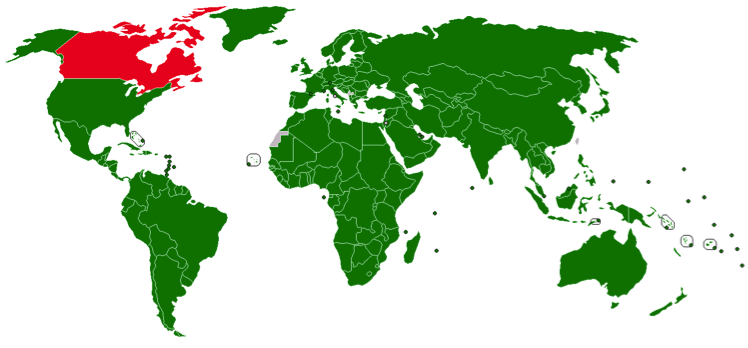
Cold as Ice: Why It Matters that the Canadian Government is Backing Out of UN Climate Change Efforts
Click here for this story in full @: http://gppreview.com/2013/04/15/cold-as-ice-why-it-matters-that-the-canadian-government-is-backing-out-of-un-climate-change-efforts/
by Jacob Patterson-Stein
At the end of March, while answering questions in the House of Commons, Canadian Prime Minister Stephen Harper calmly explained why he was stopping payments to an organization that, in his words, “spends less than 20 percent of the funds that we send […] on programming.” At a time when governments everywhere are feeling the urge to justify spending, it is not surprising that representatives cheered after the PM’s brief statement. What caught many international observers off guard, however, was the organization to which Harper was referring: the United Nations Convention to Combat Desertification (UNCCD). Indeed, even the UN was surprised to learn that Canada was withdrawing from the Convention and reportedly only found out about Ottawa’s decision after being reached for comment by Canadian press.
Subscribe to:
Posts (Atom)
















