So Chris Carter’s look ing for ward to work ing with his old boss in the New York office of the Labour Party.
Pleased to see that on Good Morning yesterday he continued to maintain message discipline.
So Chris Carter’s look ing for ward to work ing with his old boss in the New York office of the Labour Party.
Pleased to see that on Good Morning yesterday he continued to maintain message discipline.

By Elizabeth MacDonald
Published June 07, 2011
| FOXBusiness
On Monday, South Korea's Ban Ki-moon threw his hat into the ring to serve a second five-year term as head of the United Nations. While he is very likely to keep his post, and has the backing of the White House, he continues to face criticism he hasn't done enough to reform the UN's dysfunctional budget operations.
Congress is moving to do it for him. For the first time in years, Congress has moved to aggressively cut the U.S.'s share of the UN's budget due to chronic waste, fraud and abuse, a time when the U.S. is facing record deficit shortfalls.
President Barack Obama today issued a statement on Ban Ki-moon's bid for a second term, in which the president noted that while the UN "is an imperfect, but indispensible institution," the U.S. "strongly supports further efforts for reform to improve effectiveness, streamline bureaucracy, reduce costs, and update business practices to improve the United Nation's ability to meet its mandate," including peace-keeping worldwide.
America has been the largest contributor to the UN’s budget ever since its founding in 1945. The U.S. is currently funding 22% of the regular UN budget and more than 27% of its peacekeeping budget. The U.S. paid in about $6.4 billion out of the UN’s $22.3 billion budget. In fiscal 2001, the U.S. gave $3.2 billion.
In that same time span, the UN’s regular budget has more than doubled and its peacekeeping budget has more than tripled. Those growth rates are faster than the growth rates of the economies of its 192 member nations, including the U.S., says Citizens Against Government Waste.The U.S. budget grew by 97% between 2000 and 2010 in nominal terms “because of an enormous increase in expenditures, including costs associated with the war on terrorism, two major military operations, and the unprecedented government expenditures to address the financial crisis and stimulate the economy,” say experts at the Heritage Foundation, a conservative think tank.
Reducing the U.S. contribution to the UN by 25% would save taxpayers $7.9 billion over five years, according to estimates from Citizens Against Government Waste (CAGW).
“As the U.S. attempts to grapple with mounting deficits and debt, organizations like the UN should not be spared the knife when it comes to trimming budget fat,” said CAGW President Tom Schatz in a statement. “The United States is still the world’s largest economy, but its share of UN funding is entirely out of proportion. The ramping up of other members’ contributions is long overdue.”
Schatz added: “After all, former UN Secretary General Boutros Boutros-Ghali once estimated that ‘perhaps half of the UN work force does nothing useful.’”
For the first time in years, Congress moved aggressively to cut the U.S.’s funding of the U.N. by $377 million in the continuing resolution that funded the government for the remainder of fiscal 2011. But that’s just about a 6% cut in overall U.S. funding.
Because the UN has ramped up its spending “so dramatically, it makes sense to enact larger cuts,” Schatz adds.
The U.S. voted against the U.N. 2008-2009 budget in December 2007 because of out of control costs, non- transparency, and apathetic reforms to stop waste, mismanagement and corruption. But over a U.S. objection, for the first time the other U.N. member states broke with a 20-year consensus tradition and voted to approve the budget.
That the U.N.’s budget has veered out of control over this past decade has been easy to see compared to its growth in prior years. It had “relatively flat budgets from the mid-1980s until 2000,” says Heritage. “For instance, the U.N. regular budget grew only 45% in nominal terms--less than 5% in real terms measured in constant 2000 U.S. dollars--from the 1986-1987 biennium through the 2000-2001 biennium.”
Watch this new video from the Make Aid Transparent campaign. It explains why aid should be transparent and who can benefit from it.
Posted at 03:25 on 03 June, 2011 UTC
A New Zealand academic says while this country is now allocating more half a billion dollars in foreign aid it’s harder than ever to get information on where that money’s going.
Changes were made two years ago, bringing the semi-autonomous aid agency, NZAID, back into the ministry of foreign affairs to cut costs and improve accountability and transparency.
But under the new set-up it’s difficult to get information on the spending - information that development issues professor John Overton says was readily available under the previous arrangement.
He says this lack of clarity comes when donors demand greater transparency and accountability from recipient governments.
“So donors are imposing, as I say, quite rightly, all these standards about the tracking of aid money. The irony is that we are part of an aid regime that insists on these for recipients, but we don’t seem to applying these same standards to ourselves.”
“”
After suspicion of misuse of funds in certain countries, the Global Fund to Fight Aids, Tuberculosis and Malaria decided in early 2011 to have the situation investigated by a group of international experts. The group’s report, which was expected in May, will most likely only be available in September.
In addition, the European Commission has not only rescinded its financial support to the Fund, but has also started investigations in various countries. The results of these will be communicated to the group of experts appointed by the Fund.
“If the results of the investigations by the European Commission are positive, then Belgium is prepared to deposit its €21 million contribution for 2011,” stated Minister for Development Cooperation, Olivier Chastel.
Belgium has made substantial contributions to the Global Fund: €12 million in 2008, €16 million in 2009, and €21 million in 2010, which was deposited during the fourth quarter. An amount of €21 million has been planned for 2011. However, Belgium remains active in the fight against AIDS, and Prime Minister Yves Leterme will take part in the 2011 High Level Meeting on HIV-AIDS in New York on 8 June.
“We must get sufficient guarantees that the money allocated to the Global Fund to Fight AIDS, Tuberculosis and Malaria is being used correctly. This is a matter of good management,” says Olivier Chastel. “The Global Fund is a legitimate institution and I am therefore happy with the decision made in February regarding the establishment of measures to strengthen financial protection and the opportunities to combat fraud.”

Senior UNDP official points way ahead for Egypt out of transition
In an interview with Ahram Online, Geraldine Fraser details how a collective leadership is essential for Egypt at this point
Sharing experiences of transition and soliciting electoral management assistance are important for the management of the current phase between the January 25 uprising and the launch of a new democratic state in Egypt. Even more important at this point, is collective leadership to help move the country forward. That is the opinion of Geraldine Fraser, director of the Democratic Governance Group at the UN Development Programme (UNDP).
Speaking to Ahram Online ahead of the launch, earlier today, of a two-day conference in Cairo on the alternative pathways towards democracy, Fraser, who is also a leading ANC activist in South Africa, argued that the capacity of the political parties to work on the ground and the capacity of people to participate and engage would increase significantly under a collective leadership. By bringing the country together in this way, Egyptian society would be spared from falling victim to divisions at this moment of clear political volatility.
Summing up the potential for moving forward and succumbing to dangers, Fraser stated that "Egypt is in a very fluid situation."
And for Fraser, who served in the South African government for 14 years after years of activism to end apartheid, collective leadership has to be inclusive of all political groups, faiths, and both men and women.
"Inclusivity is essential for participation," Fraser insisted.
For Fraser, Egypt seems to have most of the ingredients necessary to move towards a democracy: there is the will of the people and the commitment of the international community to lend support "upon the request of the Egyptian government." But, she argued, "what appears to be absent is the leader, or rather the collective leadership."
The essential task for this collective leadership, as perceived by Fraser, is to help with the "transition of the current political movement from street politics to political parties."
In the South Africa example, Fraser noted, "we had a leadership collective; there was of course [Nelson] Mandela but there was also the National Executive Committee."
Under a collective leadership, adds Fraser, South Africans managed to bypass disagreements over the drafting of a constitution and worked on the basis of an interim constitution, pending the first election of the two houses of parliament to allow for a permanent constitution to be written.
Moreover, says Fraser, collective leadership is capable of promoting a true national dialogue that can build sufficient consensus towards agreeing on the compromises necessary to formulate a national agenda that reflects the voices of all groups.
Collective leadership, Fraser insisted, has the capacity to integrate the voices coming out of mosques, churches, women groups and community centres to reflect their views so that "everybody would have been represented around the table."

I am sure the excellent UNDP watch blog will have some things to say about Uncle Helen’s latest recruitment.
It seems she has got her old buddy Chris Carter a job at the UN in New York.
Now, I am sure Carter can say he is eminently qualified for whatever role it may be, and he will point to aid work and the like, but it will make you wonder what strings Uncle Helen pulled to get one of her closest confidantes a plum job with the UN.
What exactly is this job that Carter will be doing? What will it pay? Was the post advertised? Who else was in the running? What special talents and abilities did Chris Carter have that others lacked.
I am sure a trip down memory lane would prove useful for those of us who might question Carter’s abilities. And I am sure those watchdogs at the UNDPWatch andUNwatch blogs will find a good google trawl of Chris Carter MPmost informative.
Forget about the tittle tattle about his colourful personal life, I will leave that for other bloggers. All I will say on that is that I always found it amusing to find a gay MP going to the mosques to promote Islam Awareness Week.
Instead, I will recall Carter’s misuse of taxpayer funded credit cards which caused him to be demoted last year, he went running back to Mummy Clark to take advice following his expenses scandal, and was branded a liar by party leader Fail Gaffe. He was later dumped from the party after threatening to dish the dirt on the party, which also followed his involvement in a failed coup against Gaffe. And Carter did enjoy his taxpayer-funded holidays.
What, with his troughing, his support for Islam despite his homosexuality, his double dealings, disloyalty, etc, etc, maybe Uncle Helen hasn’t been pulling strings for her hold mate. He could well be eminently qualified for the UN after all!
Just one final thought. If Darren Hughes didn’t have certain allegations before the police, might he have got the job instead??
Popularity: 1% [?]
CLICK HERE FOR STORY ON STUFF.CO.NZ

UN BOUND: Expelled MP Chris Carter is set
to take up a job with former NZ Prime Minister
Helen Clark at the UN.
--
Axed Labour MP Chris Carter looks set to take up a job with his old boss, Helen Clark, at the United Nations before the end of the year.
The independent MP has just returned from a three-week trip to New York where he said he had positive meetings over working at the UN. "I had some very interesting and productive interviews, so we'll see."
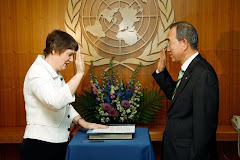
If Carter does take up a job at the UN, he will join former PM Clark, who is the administrator of the UN's Development Programme.
Carter said nothing was confirmed. "Until it's in the hand, it's not in the bag."
If the role is confirmed, Carter said it was likely he would leave to take up the job before the November 26 election.
However his departure would not cause a by-election as it is within the six-month threshold.
Carter said he "had no intention" of causing a by-election anyway.
"As tempted as I was to stick it to Mr Goff, I care more about Labour than that."
Carter said the role would not be working in Clark's team but it would be at the UN.
Carter was expelled from the Labour Party in October last year. The Labour Party council ruled that Carter had brought the party into disrepute by acting in a misleading manner that was likely to foment internal discontent and encourage external ridicule.
He was expelled from the Labour caucus in June after he sent an anonymous letter to members of the media saying a coup was being planned against party leader Phil Goff. But when he was named as the source of the letter he took two months' stress leave.
He was the first MP expelled by the party since John A Lee in March 1940.
At the time of his expulsion Carter, who represented the Auckland seat of Te Atatu, said he would remain in parliament until the next election as an independent MP.

Speaking today on TV3’s “The Nation”, he said Ms Clark had phoned him yesterday “to discuss the book and we talked about resources and the way I'd do the book.”
“She's not going to help me write it, but she’ll no doubt be a critic of it, but I'd expect no less from her,” he said.
Mr Carter goes before Labour’s New Zealand Council on Monday to face possible expulsion from the party over his comments earlier .this year about leader, Phil Goff.
He said he planned to fight the expulsion.
“I'm going to make a strong case about yes I stuffed up,” he said.
“Yes I did an inappropriate thing, but hey Richard Prebble called David Lange mentally unbalanced, you know Phil Goff and Annette King tried to roll Helen Clark, none of them were kicked out.
“I don’t want to have my membership taken off me.
“I’ve spent 20 years in the Labour Party, I've worked very hard to fight it, I'm absolutely fighting it, I'm fronting up, and you know I've never been a person afraid to front up
Mr Carter said he wants his lawyer Deborah Manning to replace him as Te Atatu MP when he resigns at the next election.
He described her as a “young Helen Clark.”
But he denied her claims made in a series of calls to news media that he had been on suicide watch after he was expelled from Labour’s caucus.
“The suggestion that I was mentally sick is not true.
“The statement that I was exhausted and stressed is certainly true and my actions reflected that, they were irrational, they were ridiculous and stupid.”
But he maintains that Mr Goff cannot win the next election for Labour.
He accused him of continuing to fudge on issues like GST and Paul Henry and of being a figure form the 80s.
Mr Carter also talked about his close relationship to Helen Clark.
“I think that Helen was a person that was quite well known to the public, but there are aspects of her personality, her humanness and her humanity which I think a lot of people didn’t see,” he said.
“When Gottlieb (Braun-Elwert) her mountain climbing guide died in the hut (near Lake Tekapo) with her you know that had such a profound effect on her, and she wept, she was profoundly affected by that for weeks and months afterwards.”