WHAT DOES GLOBAL FUND HAS TO HIDE ?
GLOBAL FUND RUNNING SCARED FROM QUESTIONS ABOUT ITS OPERATIONS
DELETES COMMENTS ON ITS FACEBOOK'S PAGE AFTER BILL O'REILLY FACTOR INTERVIEW


CLICK HERE TO VIEW THIS STORY ON VALLEYNEWSLIVE.COM
By JOHN HEILPRIN
Associated Press
GENEVA (AP) - A $21.7 billion health fund championed by the rich and famous has come under harsh scrutiny amid revelations it's bleeding money to corruption. But fund officials and outside experts in the field have a stark message for global development: other aid agencies are in much worse shape.
"The others should follow our lead," the fund's inspector general, John Parsons, told a press conference Monday organized by the fund's top officials to discuss an Associated Press story about $34 million in losses in several African nations.
Investigations led by Robert Appleton, a veteran former U.S. federal prosecutor whom Parsons hired last fall to root out corruption, are showing that up to two-thirds of some grants provided by the Global Fund to Fight AIDS, Tuberculosis and Malaria are lost to graft, with much of the money accounted for by forged documents or improper bookkeeping.
The fund rocketed to prominence with the backing of celebrity campaigners like Bono, who see it as an alternative to the bureaucracy of the United Nations.
On Monday, the organization defended its record. Only a tiny fraction of grants have been examined so far, but fund officials say the vast majority of the money is going to where it should, based on the results they are seeing in terms of saved lives.
Fund officials and several outside anti-corruption experts said that while the Global Fund's new investigative unit is aggressively tackling corruption, many of the world's biggest development agencies, including the United Nations, don't even look for major corruption in their midst for fear that would turn away donors.
An AP investigation last year found the United Nations cut back severely on investigations into corruption and fraud within its ranks, shelving cases involving the possible theft or misuse of millions of dollars. That happened after the U.N. dismantled its anti-corruption Procurement Task Force at the end of 2008.
It's been much the same story at many of the major heavyweight organizations and others that were expected to hand out some $130 billion in aid globally in 2010, according to Transparency International, the Berlin-based anti-corruption advocacy group.
Though many began taking corruption more seriously in the mid-1990s, Transparency International said in a recent report that "accountability in development aid has been low" at many aid agencies, non-governmental organizations, the World Bank, the U.N. and other development banks and international bodies.
"All aid agencies need to practice greater transparency," said Robin Hodess, TI's director of policy and research.
"There's the need in the developing aid agencies to be accountable," she told AP. "Sometimes there hasn't been enough attention to preventing corruption."
The Government Accountability Project, a Washington-based nonprofit law firm, says its defense of whistleblowers at the World Bank, the Inter-American Development Bank and the United Nations shows those institutions are failing to take on corruption.
"The investigative function at these institutions has broken down," said Bea Edwards, the firm's international program director. "There's very little accountability at these institutions because the departments that should enforce it are comprised themselves."
In 2009, an independent unit within the World Bank faulted another arm of the bank, the International Development Agency, with failing to protect some $10 billion in loans to poor nations from theft and other fraud. That agency had handed out almost $200 billion in loans since 1960.
Research largely funded by the Bill and Melinda Gates Foundation also has revealed some U.N. health programs have been useless or riddled with corruption.
When officials studied the effectiveness of a major U.N. child health strategy used in more than 100 countries, they found no difference between the health of kids who were included in the strategy and those who weren't.
A similar study found that a $27 million UNICEF program designed to save children in West Africa also failed, as children who weren't included actually had a better chance of survival than those enrolled in U.N. programs.
And in 2008, Gates-funded research showed dozens of countries exaggerated figures on how many children were vaccinated against deadly diseases, which allowed them to get more money from U.N.-sponsored programs. After the research was published, the agency involved and its donors scrambled to cut off all payments until countries could explain what happened.
Bill Gates, a staunch supporter of the Global Fund, criticized the AP story reporting losses to corruption, saying it gave an incomplete picture and would breed reluctance to give to good causes.
"People will reduce their generosity and that causes deaths," Gates told the AP in a telephone interview.
The Global Fund has $21.7 million in pledges, and gives out $3 billion annually. Fund officials provided new figures Monday that it has dispersed $13 billion since the fund was created in 2002, with the U.N. Development Program responsible for managing $3.88 billion of that - $369 million this year - in dozens of the most strife-torn and difficult nations.
Parsons said that money - roughly a fifth of the fund's portfolio - is effectively off-limits to investigators because UNDP won't share their internal audit reports. As a result, the fund's investigators can't look more closely at some of the fund's biggest multimillion-dollar losses.
In Mauritania, where UNDP manages the grant money, for example, the fund's investigators say as much as 67 percent of an anti-HIV grant was lost due to faked documents and other fraud. They say 67 percent of the TB and malaria grant money they examined in that country was eaten up by faked invoices and other requests for payment.
UNDP, the U.N.'s main anti-poverty program, told AP it is reviewing its policy of keeping those audit reports to itself but "takes its responsibility towards our donors and the beneficiaries very seriously."
The Global Fund's choice of Appleton as its investigations director points to a contrast with the U.N. approach to corruption: From 2006 to 2008 he chaired the U.N.'s former Procurement Task Force. And unlike the U.N.'s secrecy with its investigative reports, the fraud that Appleton's team is finding can be found on reports on its website along with the efforts the fund has made to recoup some of the losses.
The fund's board of directors also have authorized a big budget increase for Parsons' office because investigators can't keep up with the volume of grant programs it needs to monitor. Appleton already has more than 100 cases, including 63 yet to be assigned because there are not enough people to pursue them.
"We are vigilantly seeking to protect funds that are earmarked to save lives," Appleton told AP. "The Global Fund should be lauded, not criticized, for promoting transparency, having a strong inspector general and publicly identifying the issues and trying to get the fund's money back."
___
AP Medical Writer Maria Cheng contributed to this report from London.
Copyright 2011 The Associated Press. All rights reserved. This material may not be published, broadcast, rewritten or redistributed.
 click here to view this on FoxNews
Published January 25, 2011
| FoxNews.com

AP
FILE: In this photo taken Nov. 9, 2010, Rep. Ileana Ros-Lehtinen, R-Fla., talks to a reporter in Miami Beach, Fla.
Once again, the United Nations is in the cross-hairs of a U.S. congressional committee today, and the themes from its critics are all too familiar: wastage of U.S. taxpayer dollars, institutionalized corruption, a “culture of impunity,” covert assistance to America’s enemies and a bias on human rights issues in favor of dictatorships and autocracy, and against Israel.
On the other side, equally familiar themes, as supporters of the world organization argued, in the words of one, that the U.N. “is not a perfect institution, but it serves a near-perfect purpose”: to bolster U.S. interests abroad and “allow our nation to share the burden of promoting international peace and stability.”
As Washington awaited President Obama’s State of the Union speech, the House Foreign Affairs Committee, chaired by Florida Republican Ileana Ros-Lehtinen, was clearly making a bid to add the U.N.—and what the U.S. should do about it—to the crowded domestic political agenda. The title of the full-committee session—dubbed a “briefing” rather than a full-fledged hearing—said it all: “The United Nations: Urgent Problems that Need Congressional Action"
The meeting gives a strong stamp to Ros-Lehtinen’s own priorities: it is her first full meeting since the Foreign Affairs Committee was reorganized under the new Republican majority little more than two weeks ago. (At the last moment, however, Ros Lehtinen herself was unable to preside, as she left Washington on an urgent family matter.)
There is little doubt that meeting’s ultimate aim is to build support for withholding U.S. financial contributions from the U.N. as leverage to help bring reform to the world organization’s myriad ingrained problems, which even many of its most loyal supporters acknowledge—and which some of them think have worsened under Secretary General Ban Ki-moon.
That strategy, however, is unlikely to get much help from the Obama Administration, which has loudly and often proclaimed its support for the United Nations—and even backed that up by joining the U.N.’s notoriously authoritarian-friendly Human Rights Council.
Nonetheless, “if the U.S. does not press this issue, no other nation is likely to step forward,” warned Brett Schaefer, an expert on U.N. financial affairs at the conservative Heritage Foundation. “The failure to reform the U.N. has resulted in a system that remains bureaucratic, costly, cumbersome, lacking in oversight and often incapable of fulfilling the responsibilities placed on it.”
One of the biggest reasons for the morass is also one of the most obvious. As Schaefer put it, “the bulk of the U.N. member states simply do not pay enough to the U.N. for waste, or corruption to trouble them.” The combined payments levied on 128 of 192 U.N. members “totals less than 1 percent of the regular budget and less than one-third of 1 percent of the peacekeeping budget,” he told the committee, even though they have enough votes to approve the budget and block U.S. attempts at reform.
So Byzantine has the U.N. become, in fact, that Schaefer says no-one in Washington really knows how much the U.S. spends on it. The U.N.’s biennial “regular” budget has more than doubled in the past decade from $2.49 billion to$$5.16 billion, Schaefer said, and the U.S. pays 22 percent of that.
But the peacekeeping budget has jumped higher and faster, from $1.7 billion in 2000-2001 to $7.2 billion in 2010-2011, and the U.S. pays 27 percent of that. Moreover, new missions could yet be added in Cote d’Ivoire or Somalia.
Then there are so-called “voluntary” funds where the U.S. contributions to a variety of sprawling U.N. funds, programs and agencies have also risen fast: according to sources cited by Schaefer, reaching $3.5 billion last year. (There are also independent funds, in such areas as climate change, that U.N. agencies also spend and manage.)
To combat the wasteful sprawl, Schaefer suggested that “Congress should not be shy in suggesting budget cuts.” Among other things, he proposed reinstating a long abandoned U.S. policy of pushing for “zero growth” for the U.N. regular budget, but also suggested pruning a variety of U.N. organizations, like a flock of U.N. regional economic commissions, that could be financed by their regional members.
Seemingly eternal U.N. mandated activities—there are more than 9,000 mandates in all—should also be chopped, he said.
Just how badly the U.N.’s ability to police internal corruption had already weakened was underscored by Robert Appleton, for three years head of a special investigations unit within the U.N., created five years ago in the wake of major U.N. procurement scandals (exposed, in part, by Fox News).
At the end of 2008, the special unit was shut down, its funding cut off, Appleton reported—after “we identified at least 20 major fraud schemes, hundreds of millions in losses and waste, and more than $1 billion in tainted UN contracts.”
Even in its final month of operation, he added, "we completed five major corruption reports, including a report on fraud in Iraq, elections, roads and rebuilding in Afghanistan, fraud and corruption in the Economic Commission of Africa in Addis Ababa, and in several matters involving high value contracts for transportation in Africa.”
When his unit disbanded, Appleton told the committee, it left behind eight more draft corruption reports, and “175 cases we could not reach because of time constraints.”
“As I understand, more than two years later, these cases have largely not been advanced.”
Moreover, Appleton testified, staffers from his procurement task force were subsequently passed over for jobs in a new U.N. financial crimes unit that was supposed to replace it, or were“forced out of the U.N.” As one result, he said, in public reports for 2009 and 2010 of the U.N.’s watchdog Office for Internal Oversight Services (OIOS), which houses the anti-fraud investigations unit, “no significant fraud or corruption investigation is reported.”
“In short,” he concluded, “the incentives in the UN are perverted, the support for true investigations and oversight is lacking, and the philosophy of the leadership is to reward inaction rather than action, suppression rather than exposure, and punishment of whistle-blowers and investigators, rather than protection.”
The same see-no-evil philosophy applies to the U.N.’s 47-member Human Rights Council, according to Hillel Neuer, head of a Geneva-based non-governmental watchdog, Human Rights Watch. With a handful of exceptions, he told the committee, “the council has systematically turned a blind eye to the world’s worst human rights violations. The council has failed the victims who are most in need of international attention.”
There have been no Human Rights Council resolutions against China, Cuba, Saudi Arabia orZimbabwe, he declared, Nor has there been any against Iran “even as it massacred its own citizens while the council was in session.” Moreover, he testified, “no resolution has even been proposed regarding these gross violators.”
Israel, on the other hand, gets plenty of attention. In all, Neuer testified, the council has adopted 35 resolutions condemning alleged human rights abuses in Israel, and “a little over a dozen against the rest of the world combined.”
Some of the council’s special sessions have even been used to legitimize violations, he said. One example Neuer cited: a special session on Sri Lanka, after the alleged government massacre of 20,000 people, ended, he said, in a draft resolution that praised the Sri Lanka government for “promotion and protection of all human rights.”
The Human Rights Council’s favored experts also came in for scorn. One of them, Richard Falk, who has a permanent mandate to report on Israel’s alleged transgressions, is known as a 9/11 “denier” who has called for investigations of the U.S. governments role in the terrorist attacks. On the eve of the Foreign Affairs Committee hearing, Secretary General Ban Ki-moon suddenly declared that Falk’s 9/11 remarks were “preposterous,” and “an affront to the memory” of the victims.
The Human Rights Council’s record is supposed to be reviewed by U.N. members this year, on the fifth anniversary of its founding. Neuer’s judgment is already in. He told the committee, “according to the U.N.’s own standards, the promises of the council’s founding resolution—improved membership, action for victims, an end to politicization and selectivity—have not been kept.”
At the same time, Neuer had kind words for the Obama Administration, and its Ambassador to the U.N. Susan Rice, for their efforts to push back against the council extremists—even though the same Administration made the controversial decision to end a U.S. boycott of the institution from its inception. And at no point in his prepared testimony did he push for a new U.S. walkout.
The U.N. institutions that had been so roundly flayed by the majority of committee “briefers” could hardly be recognized, in the testimony of Peter Yao, a sometime senior State Departmentofficial who now heads the Better World Campaign of the U.N. Foundation, the not-for-profit champion of the world organization originally founded by billionaire Ted Turner.
After dubbing the U.N. “not a perfect organization” but with a “perfect purpose,” he told the committee that the world organization had, in fact, “greatly improved its ability to identify and correct waste, fraud, and abuse.” It has “made procurement investigations a permanent feature,” and has “moved aggressively to strengthen the ethical culture of the institution.”
Over the past two years, he added, “the U.N. has taken important steps to ensure that it has the most productive and effective work force possible,” and has taken “numerous initiatives to strengthen peacekeeping operations.”
The U.S. decision to join the U.N. Human Rights Council, he said, “had already produced tangible results,” starting with a successful campaign to keep Iran from winning a council seat.
Nevertheless, he admitted, “some of the most serious and challenging human rights violations continue to go unaddressed, and the council itself places undue focus on Israel.” The five-year review of the council’s performance, he added, “is an opportunity for the U.S. and other countries to improve the work of the council.”
When it comes to international action, Yao argued, the U.N. has been a vital U.S. partner. It has crafted its “toughest-ever” sanctions on Iran, “partnered with America” to battle the Iranian nuclear threat, “joined American forces to promote security” in Afghanistan, and “battles mightily to stabilize and reconstruct earthquake-shattered Haiti” (where more than 1 million people are still homeless). U.N. institutions like the World Health Organization and UNICEF “have worked hand-in-hand with the U.S. government and American service organizations to save and improve the lives of millions of children.”
The U.N., Yao argued, is even an important job creator. “For every $1 invested by the United States into the United Nations,” he argued, “American firms receive approximately $1.50 in contracts.” One example he cited: “almost every contract associated with the ongoing renovation of the U.N. headquarters in New York has gone to an American firm, creating jobs here at home.”
(The master contract for that renovation—a $1.8 billion project whose costs virtually trebled before the contract was awarded—was, in fact, bestowed on the U.S. subsidiary of a Swedish-based firm.)
Yao’s dollars-and-cents argument soon reached its main point: “we must pay our U.N. dues on time, in full, and without threats of withholding our contribution. When we act otherwise, we send a strong and provocative signal that we are more interested in tearing down the U.N. than making it better, in going it alone rather than working with others.”
Moreover, he argued, such a stand was also popular, citing a Pew research poll from September, 2009 that said 61 percent of Americans viewed the U.N. favorably, and that his own lobbying group’s research showed that 63 percent of Americans favored his “in-full, on-time” dues-paying advice.
Those Americans with similar views may not make up 63 percent of Ros-Lehtinen’s Foreign Affairs Committee—but they are very well represented indeed in the Obama Administration. Where the opinion-taking really matters—in the back-rooms and lobbying corridors of Washington—the struggle over which views of the U.N. will prevail has just begun.
As Ros-Lehtinen put it in an opening statement to the hearing, delivered in her absence: “This is one of the first true U.N. reform hearings held by this committee in almost four years, but it won’t be the last.”
George Russell is executive editor of Fox News
By Matthew Russell Lee, Exclusive
UNITED NATIONS, January 25 -- In the run up to UN corruption hearings in the US House of Representatives today, Secretary General Ban Ki-moon angrily answered questions about lack of transparency by claiming that 99% of his officials publicly disclose their finances. This is not true, as Inner City Press has said and now documents.
On the UN's website for such disclosures, numerous Ban officials simply state “I have chosen to maintain the confidentiality of the information disclosed by me in order to comply with the Financial Disclosure Program.” This is not public disclosure of finances: it is its opposite.
Those Ban officials refusing make even the most basic disclosure -- as simple as in what country they own property, such as the one line disclosure by top UN lawyer Patricia O'Brien that she owns “farmland, Ireland” -- ranging from both of Ban's envoys in Sudan, Ibrahim Gambari and Haile Menkerios to UN officials with outside jobs that might conflict, such as Terje Roed-Larsen (Lebanon and IPI), Peter Sutherland (migration and BP) andRay Chambers (malaria and hedge funds).
When Chambers took the job, Inner City Press asked him about his outside interests. Now Chambers simply states, “I have chosen to maintain the confidentiality of the information disclosed by me in order to comply with the Financial Disclosure Program.”
There are other ways to not disclosure. Philippe Douste-Blazy, whom Inner City Press has exposed as wasting millions of dollars through the “MassiveGood” scheme, discloses no finances, only service for the Millennium Foundation.
Alexander Downer, Ban's man on Cyprus, makes no financial disclosure although he lists he works at the business consultancy Bespoke Approach. And do its clients, in Turkey for example, raise conflicts? There is no way to know.
Ban's close ally and Cote d'Ivoire envoy Choi Young-jin states that “I have chosen to maintain the confidentiality of the information disclosed by me in order to comply with the Financial Disclosure Program,” as does Ban's UN Security chief Gregory Starr.
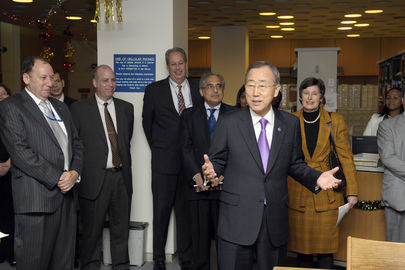
UN's Ban & chief of staff Nambiar in Dept of Management: empty forms not shown
These refusals are noteworthy given how superficial even the “public disclosures” are. Peacekeeping logistics deputy Anthony Banbury, who famously said that “only” three rapes in a Haitian IDP camp “elated” him, lists “Nil” for both assets and liabilities, as does General Assembly Affairs chiefShaaban Shaaban.
Some officials are listed, but there is no link to any form, even one refusing to disclose. These include Achim Steiner of UNEP and former UN lawyer, still listed as adviser Nicolas Michel, who took money from the Swiss government for his housing while serving as the UN's lawyer. Since that scandal, there are issues about Ban officials receiving housing subsidies through their spouses, not disclosed on the “public” disclosure forms.
Other Ban officials stating “I have chosen to maintain the confidentiality of the information disclosed by me in order to comply with the Financial Disclosure Program” include West Africa envoy Said Djinnit, Middle East and Lebanon specialist Michael Williams, UNDP Asia boss Ajay Chhibber(in charge, another other places, of Myanmar), Jan Mattsson of UNOPS, where Ban's son in law got a contested promotion, and Cheick Sidi Diarra, whose brother has been Microsoft's Ambassador to Africa, allowed to use a UN dining room for this purpose.
In another display of non - transparency, Ban's spokesman Martin Nesirky on January 21 told Inner City Press he would not answer any more questions until Inner City Press acted “appropriately.” This outburst came after Inner City Press asked for the second day in a row how UN Staff Regulation 1.2 applies to UN official's outside political activity.
Ban named Jack Lang as his adviser on piracy, reporting to the Security Council today. But Lang continues to write letters as an official of a political party in France, for example regarding Ivory Coast (where, again, Ban's envoy Choi Young-jin refuses to disclose his finances). The UN has refused to apply its Regulation 1.2 to this or other case, or to even answer questions about it.
One wonders how this will be dealt with at today's US House of Representative hearings and afterward. Click here for footage of Ban's claims from a recent piece on Swedish TV including Inner City Press and a hearing witness.
Ban's main claim to transparency, the 99% of his officials make public financial disclosure, is simply not true, and his spokesman refuses to answer any questions. Watch this space.

















