Showing posts with label nairobi. Show all posts

Friday, July 22, 2011

USAID overpays ($25) for solar lanterns via UNDP Kenya - beter quality lanterns sold on Amazon for only $19


“The solar lights have a huge impact on health, education, productivity and overall improve the quality of people’s lives,” said Joseph Nganga from Solanterns, an initiative of Renewable Energy Ventures.

Its lanterns cost around $25 and are powered via a solar panel, which charges a lithium ion battery. Solanterns says it has reached over 1,500 households. This was partly helped by USAID which bought and distributed 500 lanterns around Nairobi. CLICK HERE FOR THIS

undpwatch
you paid $25 (overpriced) while you can buy a better one 4 only 19$

Friday, January 7, 2011

A Bloated U.N. Bureaucracy Causes Bewilderment

click here for story

GENEVA — When Bolivia wanted a list of standards drawn up for the trade in llama and alpaca meat, it turned to an unlikely source: the U.N. Economic Commission for Europe.

This little-known body, based in Geneva, published a 44-page report in 2008 offering global norms for the fat thickness and trimming of llama cuts, and the means of avoiding “ragged edges” and ensuring that “cross-sectional surfaces” form approximate right angles with the skin surface.

It also offered a color gauge for in-shell walnuts and walnut kernels, and recently a glossy 75-page brochure on red and green peppers, highlighting product characteristics for food traders to avoid, like mold or discoloration.

The United Nations is widely known for functions like peacekeeping, health programs, refugee support and the International Court of Justice. But those are just a part of its bureaucracy, whose size and structure still bewilder many of its own employees.

There are five big centers — New York, Geneva, Rome, Vienna and Nairobi — and numerous smaller ones. In Geneva alone, the United Nations held 10,000 meetings in 2009, offered 632 training workshops and translated 220,000 pages of documents for its yearbooks, reports, and working papers.

But in these difficult economic times, as many countries reduce their own services, critics are asking whether there is a case for putting this army of civil servants to work in a smarter, more streamlined manner.

“There’s huge redundancy and lack of efficiency,” said Mark Malloch Brown, deputy in 2006 to the secretary general at the time, Kofi Annan, “but it’s entirely the making of the member states, who want to pass certain resolutions and demand certain papers.”

There appears little prospect of genuine overhaul soon, given its size, the competing interests of its 192 member states, and the fact that the worst of the financial crisis may be over.

The frustration is often most pointed among those with exposure to the private sector, like Jean-Pierre Lehmann, professor of international political economy at the I.M.D. business school in Lausanne, Switzerland.

“Generally, the U.N. has been a terrible disappointment compared to the ideals with which it was established” after World War II, he said. “It serves as a gravy train for a very bloated employment system, and, yes, there is huge overlap between the agencies.”

In food standards, for example, the U.N. Economic Commission for Europe is far from alone, often examining the same issues as other U.N. bodies like the World Health Organization and the Food and Agriculture Organization. Its mandate also overlaps with national or regional agencies like the U.S. Food and Drug Administration and the European Food Safety Authority.

The United Nations itself is broadly divided into six parts, the best known of which are the secretariat, headed by the secretary general, Ban Ki-moon; the General Assembly; the Security Council; and the International Court of Justice. The other two are the Economic and Social Council and a Trusteeship Council.

Latest U.N. figures show it employs about 75,000 people, including those in related agencies, under a $5 billion annual budget. This excludes its 16 peacekeeping operations and the cost of several agencies financed by voluntary contributions from member states. Mr. Malloch Brown, chairman of global affairs at F.T.I. Consulting in London, estimates the real annual budget is about $20 billion when all funds and programs are included. That budget is “utterly opaque, untransparent and completely in the shadow” and would benefit from being consolidated and audited from the outside, he said.

The secretariat and related agencies comprise 16 specialized bodies, including theInternational Monetary Fund; four related organizations, including the World Trade Organization and the International Atomic Energy Agency; two trust funds; and three convention secretariats, including the one on climate change.

Under the General Assembly, there are eight committees and a plethora of boards, councils, working groups and panels. There are also 11 “programs,” including Unicefand the U.N. High Commissioner for Refugees.

Below the Security Council sit a dozen “subsidiary bodies,” including peacekeeping operations.

The Economic and Social Council has five regional commissions, including the Economic Commission for Europe; nine functional commissions; three standing committees; and expert, ad-hoc and related bodies.

“We need to reform the institutions rather than abolish them, en principe,” Mr. Lehmann said, “but it is a Herculean task and so far, I think, all attempts have failed.”

During the late 1990s, Mr. Annan initiated what he called a “quiet revolution” by reducing staff, cutting the administrative budget and trying to weed out patronage. Staff numbers are down.

Mr. Malloch Brown said Mr. Annan was “fairly” successful, mainly because he had previously held a number of top positions inside the United Nations and had “understood the levers.” But political constraints make change almost impossible at the central secretariat, he said.

Jan Kubis of Slovakia, executive secretary of the U.N. Economic Commission for Europe, defended his organization’s role during an interview at his office overlooking the lake in Geneva.

“We do our standard setting, we do our norm setting, we do our reports and it is so technical and so diverse and so apolitical that we are below the line of visibility,” said Mr. Kubis, a respected veteran of European diplomacy and bureaucracy. “Very often you hear about this or that development, but rarely are we mentioned.”

The commission has 220 employees, and its 2010 budget, most of which went on staff, was almost $50 million. Mr. Kubis said the squeeze is on. “We are asked to do more but the resources are basically the same,” he said.

For some, certain issues have become even more acute under the current leadership. Inga-Britt Ahlenius, the former under secretary general for the United Nations internal oversight office, submitted a damning end-of assignment report in July to the secretary general, which was subsequently leaked.

It described a pervasive culture of secrecy, notably surrounding Mr. Ban. She said that he appeared more concerned with preventing news leaks than with releasing possible criminal evidence to prosecutors. She also said Mr. Ban’s office had blocked attempts to improve transparency despite commitments to the contrary.

At the time, the U.N. said that it regretted the leak but that the memo’s “frank thinking and advice” would be reviewed as an important tool for improving management. Farhan Haq, a spokesman for the United Nations in New York, declined to comment on the accusations, saying the issues were “raised long ago and were responded to in detail then.”

More broadly, he said that Mr. Ban “feels he has made progress in internal reforms,” notably revamping the internal justice system to handle disputes more transparently; by encouraging senior officials to comply with financial disclosure rules; by strengthening whistle-blower protection; and by expanding the role of the U.N. Ethics Office.

Back in Geneva, Mr. Kubis argues that reform can occur only “step by step.”

“You are surprised what is coming from New York sometimes,” he said. “It’s simply sometimes impossible.”

The work of the U.N. Economic Commission for Europe is “a never ending story,” he said. A current priority is developing standards to allow people with impaired vision to detect electric cars. “We’re working on it,” he said. “We are unique.”

Thursday, March 4, 2010

UN Eco-Commissars on Bali – Again

by Claudia Rosett at PajamasMedia.com

For folks terrified of warmer weather, the UN climate commissars sure do have a strange affinity for the balmy climes of Bali.

Recall that in December, 2007, as the common folk shivered in the wintry vicinity of the UN’s well-appointed offices in New York, Bonn and Geneva, a horde of UN climateers decamped to the far side of the globe for a fortnight of conferencing by the Indonesian beaches of Bali’s ritzy Nusa Dua resort (and convention center). There, up close and personal, they braved the preview of a world beset by warm temperatures and ocean waters, as you can see in this virtual tour of the adjacent beach resort — complete with its freshwater pool, beachside cocoons, seafood buffets and winding paths beneath the palm trees.

Now they’re at it again. The UN Environment Program, which is based in Nairobi, is convening a set of meetings this week – not in Nairobi, or New York, but at the same Bali beach resort (and convention center) where they sacrificed all that time for the greater good in 2007. Never mind the UN’s continuing campaign — in the face of its crumbling “climate science” — to restrict and control carbon emissions. Yet again, we are asked to believe the UN deserves special exemptions from its own preachings. Its conferees are jetting to Bali for the greater good of all the little folk, whose job is merely to pay the bills for such pleasures, and live with any resulting rationing and regulation. According to the Jakarta Post, some 1,500 people from 192 countries are expected to attend this shindig — where UNEP claims that envoys of some 140 governments will be present. The pre-session events (the UN goes in for a lot of those on Bali) have already begun.

This gathering is on a somewhat different theme from the grand “global warming” jamboree of 2007 (or the UN anti-corruption convention at thesame Bali beach resort in 2008). The main topic of discussion this time is supposed to be the “sound management of hazardous chemicals and wastes.” Unlike carbon dioxide, that actually is worth worrying about. But do you trust this crowd to handle it? These folks are the from the same UNEP (launched and initially run by Maurice Strong, who went on to godfather the Kyoto Treaty) that has been one of the big purveyors of UN climate alarmism. This is the same UNEP which, together with the UN’s Geneva-based WMO (World Meteorological Organization) established the IPCC (Intergovernmental Panel on Climate Change (IPCC), which under the leadership of UN climate guru Rajendra Pachauri is now embattled over one revelation after another of missing data, faulty data and cooked results in its politicized findings of climate “consensus.”

And in the UNEP press announcement of this conference, there is already a strong flavor of yet more alarmism, calculated to bring in yet more funding for these folks, as — I’m not making these names up — the United Nations Body Burden Forum gets ready to sound alarms about “the toxic chemical burden increasingly borne by the life of the planet.” Again — it’s a great idea to actually clean up toxic chemicals. But do you trust this UN crowd to decide what those are? Or to find a reasonable way to do it?

Part of this UN bash will be a special session of the UNEP governing council. That council includes not only such members as the U.S., Canada and Japan, but also Russia, China, Cuba, and Iran – Iranian government officials being free to join in overseeing and attending such shindigs, despite Iran’s being under UN sanctions for its continuing pursuit of nuclear weapons (which, in Iran’s hands, would be terrible for a lot of things, including the environment).

There’s lots here that bears watching, but I’ll round this off with a note that at this plush pow-wow the UN’s propaganda engines will be roaring full steam ahead. On Feb. 22-23, this Monday and Tuesday, UNEP will put together a media workshop, on “Reporting Green — The Environment as News.” What fun for the media! A two-day workshop on Bali, by the beach. Will this workshop be teaching the media how to ask hardball questions about things like IPCC findings, UNEP conflicts of interest, or, for that matter, repeat UN mega-eco-conferences on Bali? I’d say, don’t hold your breath.

Thursday, December 3, 2009

UN official calls for funds for climate change

TO READ STORY ON MIAMIHERALD.COM CLICK HERE

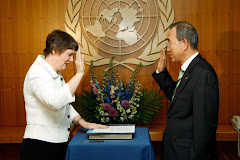
   In this photo taken on Tuesday, Dec. 1, 2009, U.N. Development Program Administrator Helen Clark speaks during an interview with The Associated Press in Nairobi, Kenya. The chief of the U.N.'s global development network says proposals to put up billions of dollars to help poor nations deal with the effects of climate change are only a start.
In this photo taken on Tuesday, Dec. 1, 2009, U.N. Development Program Administrator Helen Clark speaks during an interview with The Associated Press in Nairobi, Kenya. The chief of the U.N.'s global development network says proposals to put up billions of dollars to help poor nations deal with the effects of climate change are only a start.
KHALIL SENOSI / AP PHOTO

ASSOCIATED PRESS WRITER

Developing countries will need tens of billions of dollars each year to cope with the effects of climate change such as floods and drought, the global head of the U.N.'s development arm said.

About 100 world leaders will be in Copenhagen next week for a summit on global warming, and the U.N. climate chief, Yvo de Boer, has told reporters that rich countries "must put at least $10 billion a year on the table."

Helen Clark, the administrator of the U.N. Development Program, said though that scientists and others believe that between $75 billion and $100 billion a year is needed to help poor nations cope with climate change.

"Developing countries are bearing the brunt of climate change now. It's not something that might happen in 10, 20, 30 years time," Clark told The Associated Press late Tuesday.

More than two years ago, a panel of hundreds of scientists commissioned by the world's governments released a report that said the poorest parts of the world, especially Africa and Asia, would be hit hardest by climate change.

The Intergovernmental Panel on Climate Change says temperature rises will result in increased droughts and flooding in poor nations. Subsistence farmers in Africa and Asia are expected to be particularly hard hit.

In a report earlier this year, the International Food Policy Research Institute predicted 25 million more hungry children over the next four decades because of climate change's impact on crop production.

Negotiators in Copenhagen will seek a new agreement to curb emissions of climate-warming greenhouse gases. The key question is how to divide the responsibility for reducing emissions globally, with developing countries saying they should not be forced to commit to binding targets.

The conference had originally been intended to produce a final global warming treaty, but that now seems out of reach. Most leaders now hope the conference can produce a framework agreement, leaving only details, technical arrangements and legal language to be concluded over the next six to 12 months.

Clark, however, said that climate change also should be related to other issues, such as improving the living standards of billions of people in the world.

She said one way this can happen is by providing financial and technical support to poor nations, allowing them to meet their energy needs while producing little or no greenhouse gases.

With such support, "we will have the ability to bring energy to the huge numbers of people in our world, up to 2 billion people, who do not access have energy at the moment, who don't have electricity," Clark said.

Last month, the U.N. Development Program and World Health Organization released a report that described 2 billion people as lacking natural gas, propane or other modern fuels used for cooking or heating their homes. The report also said 1.2 billion more people live entirely without electricity.