Monday, May 16, 2011

IMF Head Held on Sexual Assault Charge

Global Dashboard – Blog covering International affairs and global risks

CLICK HERE FOR STORY

David Steven

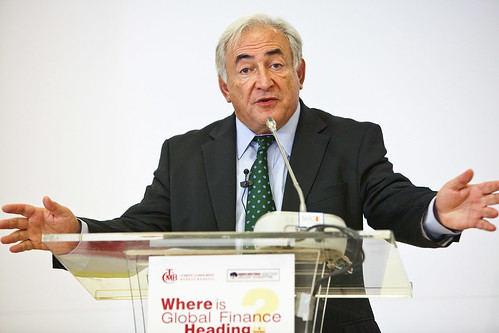
Extraordinary news here in New York where the IMF’s Dominique Strauss-Kahn was this afternoon hauled out of the first class cabin of an Air France plane at JFK airport to be arrested for – allegedly – sexually assaulting the chambermaid in his room at the Sofitel Hotel.

According to the New York Times, Strauss-Kahn fled to the airport after the attack, leaving his mobile phone in his room, but was apprehended just 10 minutes before the plane was due to depart.

Strauss-Kahn, who had been expected to run for French President, was embroiled in asex scandal back in 2008, when he slept with an IMF employee at Davos, and was then accused of ushering her into a new job outside the Fund. Unlike the World Bank’s Paul Wolfowitz, who was forced out for giving preferential treatment to his partner, Strauss-Kahn kept his job.

Ironically, it was only on Friday that the Guardian ran an article by French journalist,Melissa Bounoua, lauding the open-mindedness of the French voter, who she claimed would happily have Strauss-Kahn as President, even if he were a serial shagger for whom consent wasn’t that big a deal.

Is Dominique Strauss-Kahn, current head of the International Monetary Fund, a “queutard” – literally, a man who makes extensive use of his intimate parts?[...] Strauss-Kahn (widely known as DSK) had an affair with Piroska Nagy, a Hungarian economist, while working at the IMF in 2008…

That wasn’t the only scandal. There was a fuss last year when a young French author, Tristane Banon, described her encounter with him. She explained that she had interviewed him for a book about public figures and their missteps, and claimed she had to fight him off physically…

“Personally, I doubt this side of DSK’s life would have any influence on how he would run the country,” Ms Bounoua claims in an article that makes all the usual excuses for the sexual proclivities of the powerful and is hailed, rather breathlessly, by the Guardian’s Jessica Reed as giving readers “sex, power, politics AND… a new French word: queutard.”

One wonders how Ms Bounoua and the Guardian will react to this new ‘fuss’…

Update: It’s worth remembering that ugly, if unproven, rumours have swirled round Strauss-Kahn for many years. Here’s Felix Salmon – now with Reuters, and one of the best financial journalists around – discussing the Frenchman’s ‘lower half problem’ in 2007 before he took over at the IMF.

Salmon quoted French journalist Chris Masse’s account of a previous Strauss-Kahn ‘fuss’:

A cable TV show (“93 Faubourg Saint Honoré”, on Paris Premiere, hosted by Thierry Ardisson) invited a young (and unknown to me) French actress. I don’t remember her name. She said that she had a bad encounter with Dominique Strauss-Kahn. Here’s what happened. She was asked to come in a little apartment he had in Paris, and then the next thing, Strauss-Kahn jumped on her and tried to undress her and more. She yelled, and told him that that was a rape, but the word “rape” (“viol” in French) didn’t seem to perturb him. She said that he was like “a gorille en rut” (a gorilla in rut).

The Dharmic Method to Save the Planet

CLICK HERE TO VIEW THIS STORY ON HUFFPOST

An eminent scholar recently came to our university campus and spoke about the role of diverse religious communities of the world and their attitudes toward the environment. He showed examples from several indigenous communities from the North America, South America, Africa and Asia. However, when he referred to the traditions of India, he used these words: "India has the most bizarre culture in the world where even a cobra is worshipped. This is a bit of an overshoot." What amazed me was that even in this supposedly globalized world that we live in, India continues to mystify scholars. While most Americans are familiar with the terms such as "yoga" and "Bollywood," Indian perspectives toward the ecology seem to be largely unknown.

It is true that cobras are worshipped by many Hindus, especially on a specific festival dedicated to them (just as there are specific festivals for mountains, rivers, cows, trees and hundreds of other gods and goddesses throughout India). What is not commonly known is that Mahatma Gandhi had a brief encounter with a cobra at his ashram (retreat) once and he too did not want it to be killed by his colleagues. This is one of the shining examples of Indian environmentalism, not an "overshoot" as called by our scholar friend mentioned above. Several scientific studies have pointed out that every being in nature is intrinsically valuable because every other being is directly or indirectly dependent on each other's survival. This is the fundamental motivation of scientists and environmentalists to save the biodiversity in every part of our planet. Therefore, even a cobra has the right to survive. Moreover, other beings have an intrinsic duty to protect it as long as it is not a threat to them.

More than 2,500 years ago in India, Mahavira and Buddha taught the same concept, although in a different framework of philosophy, spirituality and ethics. Mahavira, the last great teacher of Jainism, even proclaimed that ahimsa (nonviolence) is the greatest dharma. (Dharma's meanings include religion, ethics, duty, virtue, righteousness and cosmic law.) Several Hindu and Buddhist texts also propound the same principle in different languages. According to most of these texts, ahimsa improves one's karma. For observant Hindus, Jains and Buddhists, hurting or harming another being damages one's karma and obstructs advancement toward moksha (liberation). To prevent the further accrual of bad karma, they are instructed to avoid activities associated with violence and to follow a vegetarian diet (meat consumption in India has historically been very less compared to elsewhere). They also oppose the institutionalized breeding and killing of animals, birds and fish for human consumption. Just this month, my book is published based on my research with three communities in India and the diaspora with several ecological practices inspired by the Indic traditions.

Although yoga is widely known in the West, what is not so widely known is that yoga is a system of eight "limbs" or components. The very first step of the first limb of yoga is ahimsa. Unless one is firmly rooted in ahimsa in one's thoughts, speech and actions, true practice of yoga cannot begin. In addition, since Gandhi was a dedicated practitioner of ahimsa (and other yogic principles), he can be called a great yogi even though he might not have practiced all the stretching exercises that we commonly refer to as yoga. It is this practice of yoga that develops one's harmony with and reverence for nature in which even a cobra is not to be killed.

When I first mentioned this to my own students recently, one immediately questioned me and asked if Indians in India are not following the principles of Gandhi, how can we expect the same from others? I partially agreed with her. India (and many other emerging nations in the world) is enthusiastically aping the West with its ever-expanding economy and ever-shrinking natural resources. I was also asked recently at a conference on world religions and ecology, what do the non-Western countries expect of the Western countries? If the rest of the world is eager to make the same mistakes as the West did, what route should the West now take to ensure the planet's survival? Perhaps, one answer could be to embrace Gandhi and his ecological practices. If the West is to remain the intellectual leader of the world, the quicker it reforms and transforms itself, the better for our planet. While the West continues to crave more natural resources without changing its lifestyle, it will continue to lack the moral authority to preach to other cultures. It was the West that led the world with its modern scientific and technological innovations for the last several centuries. It will have to be the West that emerges as a new ecological leader, with Gandhi as the foundation of its lifestyle. All voices to save the planet's ecology are hollow rhetoric until that happens.

There cannot be and should not be separate "war on terrorism," "war on climate change," "war on drugs," "war on corruption," "war on obesity" and so on. Our physical, mental and spiritual health, the environment, the global security, international peace and social justice -- it seems like everything will get a great boost if we first become nonviolent in our most basic activity: eating and surviving. "We are what we eat." It is such a simple statement and yet is so widely ignored all over the world. This is the way Gandhi lived everyday and his protest against the imperial power was influential because it was based on his own great life, unlike many contemporary activists whose own lives are nowhere close to the Gandhi's.

Gandhi's entire life can be seen as an ecological treatise. This is one life in which every minute act, emotion or thought functioned much like an ecosystem: his small meals of nuts and fruits, his morning ablutions and everyday bodily practices, his periodic observances of silence, his morning walks, his cultivation of the small as much as of the big, his spinning wheel, his abhorrence of waste, his resorting to basic Hindu and Jain values of truth, nonviolence, celibacy and fasting. The moralists, nonviolent activists, feminists, journalists, social reformers, trade union leaders, peasants, prohibitionists, nature-cure lovers, renouncers and environmentalists all take their inspirations from Gandhi's life and other dharmic teachings.

As an alternative perspective on contemporary India, despite all the recent advances in India's economy and consumerism, Gandhi's inspiration still thrives in modern India. Here are contemporary environmental activists and dharmic leaders who have modeled their lives taking their inspirations from dharmic teachings of India or have resisted the global consumerist pressure in various other ways: Sunderlal Bahuguna, now in his 80s, leader of the famous Chipko Movement in North India; Medha Patkar, astrong voice against big dams in Central India; Dr. Vandana Shiva, fierce critic of Western style globalism and capitalism; Anna Hazare, in headlines recently for his major protest against political corruption and also famous for ecological experiments in his village in Central India; Pandurang Hedge, who is leading Chipko style movement in South India; late Pandurang Shastri Athavale (I have written about his global Swadhyaya Parivar in my book); late Anil Agarwal, founder of Center for Science and Environment; Dr. Ramachandra Guha, another fierce critic of Western-style consumerism, capitalism and environmentalism, including deep ecology; and hundreds of smaller voices spread all over India making India the land of biggest environmental movement on the planet (as noted by Dr. Christopher Chapple in his volume on Hinduism and ecology published by Harvard University). There are also dozens of institutions in several Indian towns founded by Gandhi himself that are still flourishing with their own small-scale production of textiles and agriculture. In addition, almost every Indian political party must use at least the rhetoric based on Gandhi's values whenever there is a discussion on taking technology or any kind of help from the U.S., U.K., France or other major Western power. They all immediately attack their political opponents as if somebody just was "sold out to the West." Finally, there are several recent major Bollywood blockbusters with several Gandhi-like figures reminding the audience of the message of Gandhi (nonviolence and civil disobedience).

Yes, Gandhi's immortal soul and other dharmic traditions of India are still vibrant even in the 21st-century globalized consumerist society. Several decades ago, in his nonviolent movement for civil rights, Dr. Martin Luther King said, "Christ furnished the spirit and motivation, while Gandhi furnished the method." It is time again to go back to these cherished values propounded by Christ, Gandhi and Dr. King: nonviolence not just toward other human beings but also toward the entire earth. All three also practiced and preached an absolute simple lifestyle and it is time again to practice the same lifestyle.

Please join me on a free Webinar on May 19 to discuss these topics further. Click here to register online.

Dr. Pankaj Jain is an Assistant Professor of Indian Religions and Ecology at the University of North Texas. He has taught Indian Films, Sanskrit, Hindi/Urdu languages, and literatures at North Carolina State University, Rutgers, Kean University, Jersey City University and the University of Iowa. In his scholarship, he connects the ancient Indic traditions of Hinduism and Jainism with contemporary issues -- particularly the environment. He is the author of Dharma and Ecology of Hindu Communities: Sustenance and Sustainability..

Follow Pankaj Jain, Ph.D. on Twitter: www.twitter.com/pankajaindia

Manhattan Rooftop Dining Attracts UN Insiders


By Irwin Arieff | May 10, 2011

The German mission to the UN offers a fashionable lunch with the right views.

Let's face it, the United Nations cafeteria is looking a bit forlorn these days.

With a years-long renovation of UN headquarters under way, the cafeteria, which is located on the ground floor of the Secretariat complex at the south end of the UN compound, is pretty thoroughly boxed in by construction that includes asbestos removal.

The once-mobbed and highly popular cafeteria must also be feeling somewhat unloved, with many Secretariat workers temporarily assigned to commercial Manhattan office buildings blocks away. Most UN staffers seem to be checking out the corner cafe in their new neighborhoods, rather than walking the half-mile to the mother ship, to sip a cappuccino, toss off a salad or choke down a sandwich.

How lucky, then, that in-the-know UN aides and V.I.P.s can stroll uptown to 49th Street to German House, inside the German mission to the UN and the German Consulate, for a stylish lunch at its top-floor restaurant.

The German House dining room, on the 23rd floor, is comfortable and casual, offering striking views of northern Manhattan and the East River through the oversize windows lining two sides of the room. The food ranges from generic to Germanic, from fulfilling to frilly, from straightforward to quite ambitious. Accompaniments include Bitburger beer and wine, a pastry of the day and a very decent espresso.

Recent daily menu items, mostly $10 to $12, included a hearty soup, panini with soup and salad, beef goulash with spätzle, gnocchi with julienne vegetables, wiener schnitzel with potato salad and mixed greens and grilled fish with fusilli pasta and pumpkin sauce. The servings are ample.


Irwin Arieff
At Germany's mission to the UN, the top floor is the setting for German House, a luncheon restaurant catering to diners with a UN pass.

Because of its diplomatic roots, there is no sales tax, and because it is mostly self-service, tipping is not in evidence. The dress ranges from T-shirt and jeans to diplomatically dark business suit. The entire establishment can accommodate only about 70 diners, and the seating is widely spaced, so you are unlikely to overhear the highly classified conversation that might be going on at the next table.

You order at the bar, pay up front, and walk your own drinks, water glass and silverware to the table of your choice. In short order, a server delivers your food and cleans up the table after you eat. The main drawback, as with many UN-related sites, is security. Just as it is difficult for tourists to go beyond the UN gift shop, visitors to German House must run a gauntlet of identity testing.

First, at least one member of your party must have a UN photo ID. If you plan to lunch there regularly, you must go to German House ahead and pick up a form in the lobby applying for a restaurant pass. Once you fill out and turn in the form, it can take two to three months to get the pass, according to a German UN mission administrator.

In a pinch, you can call the restaurant and ask if they can accommodate you by sending an escort to the lobby to usher you past the security barriers and up the elevator. If the staff agrees to let you in, you must leave behind your UN badge at the front desk as a safeguard.


Irwin Arieff
Outside the German mission to the UN.

The restaurant is run by Elderberry Catering, a New York City firm whose classically trained executive chefs, Wolfgang Ban, Eduard Frauneder and Werner Tschiedel, actually hail from Austria. Their specialty, the firm boasts, is "European cuisine with a modern flair." Elderberry also runs two other restaurants in Manhattan, Edi & the Wolf and Seasonal Restaurant and Weinbar.

German House is located at 871 United Nations Plaza, on the west side of First Avenue between 48th and 49th Streets. The rooftop restaurant is on the 23rd floor and is open from about 12:30 p.m. to 2:30 p.m. For information or to arrange for an escort, call 212-610-9552.

Paul: IMF Implicated After Chief Arrested on Attempted Rape Charge

click here for story

The leader of the International Monetary Fund now embroiled in a criminal assault case in New York City was cleared in 2008 of harassment charges after an affair with an IMF economist.

But it's that kind of behavior that should make the world wonder about trusting the IMF, Rep. Ron Paul said Sunday.

The 2008 Republican presidential candidate told "Fox News Sunday" that Dominique Strauss-Kahn, who was pulled off an Air France flight moments before take-off from New York Saturday and arrested on charges of a criminal sex act, attempted rape and unlawful imprisonment, said the whole course of events "is a bit ironic."

Paul, who makes no secret about his disgust of IMF policies, said Strauss-Kahn demonstrates why the Fund has problems.

"These are the kind of people that are running the IMF and we want to turn the world finances and the control of the money supply to them," Paul said. "That should awaken everybody to the fact that they ought to look into the IMF and find out why we shouldn't be sacrificing more sovereignty to an organization like that and an individual like he was."

Strauss-Kahn, 62, is scheduled for arraignment Sunday after being accused by a 32-year-old maid at the luxury Sofitel hotel near Times Square of an attack on her in his suite on Saturday afternoon.

The IMF chief, who is considered a frontrunner in challenging Nicolas Sarkozy for the French presidency, "denies all the charges against him," his attorney, Benjamin Brafman, said Sunday.

A State Department press officer said she had no comment on last night's arrest. Though a New York City police spokesman said Strauss-Kahn does not have diplomatic immunity, the officer could not say with certainty whether that's accurate, but said the department is reviewing his status.

The IMF also said it's not commenting on the arrest but issued a statement saying, "The IMF remains fully functioning and operational." The Wall Street Journal reported that John Lipsky, Strauss-Kahn's first deputy, has been in the acting managing director role since Strauss-Kahn left D.C. for New York.

It's not the first time that the thrice-married Strauss-Kahn has been in trouble for his relationships. In 2008, an outside lawyer hired by the IMF to investigate three complaints made about Strauss-Kahn's behavior concluded that he did not force an ex-lover to accept a payout from the IMF and move to another organization.

The executive board at the IMF took no action against Strauss-Kahn but warned him about behavior toward female staff. Strauss-Kahn reportedly offered an apology to the board. His wife, French newswoman Anne Sinclair, wrote it off as a "one night stand."

At the time, French commentators claimed the investigation's timing was suspicious since it coincided with the IMF push toward a global currency.

"It's very odd that it comes just at the moment when people are talking about the IMF and its head taking a lead role in creating a new global financial order which will not necessarily be to the advantage of wealthy, right-wing Americans," a French economist and government adviser told Britain's Observer newspaper.

But Paul said the IMF's moves toward a world currency are "a threat to us."

"I would like to go to a sound American currency, but others want to go to a world currency. They want to use the IMF," he said.

U.N. Gets in Bed with “Mother Earth”

click here for this story

The Barr Code by Bob Barr

The United Nations has long been an institution of little true value; serving largely to spread statist ideals around the world, and which purports to act as the arbitrator of legitimacy in international affairs, despite its many scandals and failures. It is hard to foresee a scenario that would increase the worthlessness of this organization, but a recent proposal may do just that.

Bolivia, led by leftist President Evo Morales, and other socialist nations are pushing a treaty that would afford “Mother Earth” the same rights as humans. This proposal actually will be seriously considered by the UN; which two years ago encouraged such nonsense by passing a resolution establishing April 22nd as “International Mother Earth Day.”

According to an article at Canada.com, the treaty would give the Earth “a series of specific rights that include rights to life, water and clean air; the right to repair livelihoods affected by human activities; and the right to be free from pollution.”

Morales’ obsession with “Mother Earth” apparently stems also from a belief held by the Aymara, a native ethnic group in Bolivia – a heritage he claims. In fact, the South American country is currently pushing through a domestic law, called the “Law of the Rights of Mother Earth,” which gives those rights to insects and trees. Ecuador has joined this bizarre movement by enacting a similar law and incorporating it in its Constitution.

The US-based Pachamama Alliance, which boasts controversial former Obama Administration official Van Jones on its board and is headquartered in San Francisco, is one of the organizations responsible for pushing this initiative through the Global Alliance for the Right of Nature (GARN). According to its website, the movement behind this treaty is, “about balancing what is good for human beings against what is good for other species, what is good for the planet as a world. It is the holistic recognition that all life, all ecosystems on our planet are deeply intertwined.” The movement, in true collectivist fashion, denigrates the basis of economic liberty by claiming that laws recognizing property rights “actually legalize environmental harm.”

“Green” proposals such as this one frequently are offered in the context of harmless, feel-good rhetoric; stressing that well-meaning individuals or countries are simply trying to encourage conservation and bring recognition to global warming. But as Christopher Horner, author of The Politically Incorrect Guide to Global Warming and Environmentalism, notes, proposals such as this may sound well-intentioned and appear “green on the outside,” but in reality are “red to the core.” Morales has closely aligned himself with dictators like Fidel Castro and Hugo Chavez. Castro even penned a letter encouraging Morales to be awarded the Nobel Peace Prize for enacting socialist policies. The Bolivian leader’s true agenda was made clear when he stated that the “central enemy of Mother Earth is capitalism.”

Of course, this is just the latest in the outright bizarre views that have become common fodder for many environmentalists; including some who call for extreme population control measures, such as a worldwide one-child policy. These are the same people who admire dictators and mass murderers like Che Guevara and Castro. However, as Michael Prell notes in The Hill, “[t]hese anti-human humans make an important distinction: they do not think that all life should be reduced on Planet Earth, just the lives of Earth’s most powerful creatures—human beings. Why? So that less powerful life forms, like plants, animals and even ‘killer viruses’ might thrive.”

There is no question we need to protect our environment and guard against pollution. However, this can be accomplished through reasonable measures consistent with free-market principles; and without enacting downright silly treaties or costly, job-killing legislation.

If the UN proceeds with this “Mother Earth” absurdity, it will be simply another notch on its all too familiar, anti-capitalist and anti-American agenda.

by Bob Barr — The Barr Code

U.N. Agency Prepares to Resume Aid to Libya Even if Qaddafi Remains in Power

click here for story


By George Russell

While the U.S. and NATO demand that Libyan despot Muammar al-Qaddafi relinquish control and stop slaughtering his own people, the United NationsDevelopment Program is secretively planning for a quick return to action in the country, even if Libya’s rebels fail to drive him from power.

UNDP, the U.N.’s flagship anti-poverty agency, abandoned its previously close embrace of the Qaddafi family as the anti-regime protests turned into widespread armed rebellion and NATO air forces began supporting the often-beleaguered rebels. The agency’s non-Libyan staffers left the country, along with other U.N. personnel, and now work out of Cairo.

But now, UNDP bureaucrats are planning to return with a “forward looking framework of likely recovery policies,” even if the rebels are not successful, according to a planning document obtained by Fox News. The proposed price tag: $25.3 million, though the document also says the numbers are “no more than estimates of what would be required to kick-start program initiatives.”

Evidence of the detailed contingency planning was hastily scrubbed from a UNDP website the day after Fox News raised questions about the activity, and sensitive wording was rephrased in the text that remained. A Fox News request for the specific six-page document that summed up UNDP’s thinking was denied, on the grounds that the document “is in draft form and is still under discussion.”

CLICK HERE FOR THE UNDP WEB PAGE AS IT FIRST APPEARED

CLICK HERE FOR THE UNDP WEB PAGE AS LATER MODIFIED

Now, “in anticipation of the possibility of a ceasefire/political agreement or a victory by the opposition, UNDP is already preparing to adjust and scale up its programming inside Libya,” according to the internal document on “recovery and transition in post-crisis Libya,” obtained by Fox News despite UNDP’’s refusal to provide it.

Even if rebel control is limited to the eastern half of the country, where the rebellion is strongest, the “recovery policies” can be used by the U.N. agency to “support early recovery activities, including capacity development support for local government and civil society.”

And if Qaddafi falls, as NATO leaders and European government leaders are demanding, UNDP intends to be quickly in place to provide “advisory support to the new government on transitional arrangements and processes” (including a new constitution and elections) as well as a strategy for “public administration reform,” and “support for national dialogue and reconciliation,” according to the contingency document.

“UNDP has a critical role to play,” the paper declares, “given its expertise in such areas as transitional governance, national dialogue and reconciliation; youth and civil society; strengthening national and local governance institutions and restoring public service delivery; and (re-)establishing the rule of law and community safety.”

CLICK HERE FOR THE ‘POST-CRISIS’ DOCUMENT

There is considerable irony to UNDP’s claims of expertise, as the agency has been responsible for many similarly-named policies in the previous decade, all carried out with the full support, and very often the full financing, of the Qaddafi regime itself.

UNDP, which has operated inside Libya in close cooperation with the government since 1974-- put its $19.7 million local program for 2011-2014 on hold when the fighting became heavy.

That program was developed entirely in cooperation with the Qaddafi government, using Libyan money, and called for programs under such headings as “Strengthening national institutions toward public service delivery; and strengthening national data management systems,” and “Strengthening Government efforts on economic diversification through increased focus on small and medium enterprises, youth capacity development, and economic empowerment of women.”

The programs were to be carried out in close cooperation with a variety of Qaddafi government ministries, as well as non-governmental organizations and civil society organizations—all of which, in pre-upheaval Libya, were closely controlled by the Qaddafi government or members of the despot’s family.

CLICK HERE FOR THE 2011-2014 PROGRAM

UNDP’s previous Libyan program, for 2006-2009 (later extended through 2010), was also developed in close cooperation with the regime, and had such headings as “Improved governance at local and central levels.”

Under the governance rubric, it included the promise to “continue to support national capacity building efforts in the area of good governance, including human rights,” and conduct “a comprehensive technical review of the legal system in Libya, in support of the country's efforts to promote the rule of law, and to modernize the judicial system at the national and local levels.”

The projected cost of that program was initially estimated at $16 million, with all of the money likewise coming from the Qaddafi regime.

CLICK HERE FOR THE 2006-2009 PROGRAM

The program, along with its successor, was carried out under an arrangement known as “national execution,” or NEX, which is, according to a UNDP handbook, “a cooperative operational arrangement entailing...overall responsibility and assumption of accountability for the formulation and management of the program country of UNDP-supported programs and projects.”

Translation: the programs were run by the Qaddafi government itself, with UNDP providing technical advice and its seal of approval. For its role, UNDP takes a management fee of about 3 percent of total program spending.

(The NEX “modality” is used by UNDP in many if not most of the 167 countries where it operates, including some of the world’s worst despotisms—Zimbabwe, for example.)

In its latest, confidential “post-crisis” planning paper, however, UNDP admits that ordinary Libyans do not think highly of some of the institutions the U.N. agency “supported” in its previous multi-year development plans in Libya.

“Rule of law institutions, including the justice sector and police, have suffered a severe erosion of trust among the Libyan people,” the document declares. “Reforming these institutions to regain that trust is indispensible to ensure security and stability during the recovery process.”

Among other things, as a medium-term priority, it suggests “Increase access to justice for vulnerable communities by establishing legal advice services, raising awareness of rule of law and human rights, and training for traditional justice providers.”

Those solutions seem pallid alongside the description of the failings of the Libyan justice system in the U.S. State Department’s latest human rights examination of the country. There, the system is described as essentially a sham. As the report puts it: “At his discretion Qaddafi and his close associates may interfere in the administration of justice by altering court judgments, replacing judges, or manipulating the appeal system. The judiciary failed to incorporate international standards for fair trials, detention, and imprisonment.”

Libyan local government institutions, the UNDP document says, were also not very commendable; they “were weak and had limited planning and implementation capacities.” The paper noted that “immediate and longer-term support to local authorities and development institutions would be critical.”

The paper also suggests “scaled-up support” for a campaign to rid Libya of land mines, noting that “the use of landmines and the proliferation of small arms during the conflict are creating new risks to community security.” (Over the past seven years, the paper notes, the regime had imported $1.7 billion worth of small arms “from European countries.”)

As it happens, a similar anti-land-mine campaign was previously carried out under UNDP auspices in Libya, in cooperation with a local non-government organization that was supervised by the Qaddafi Charity and Development Foundation.

The foundation was run by Muammar al-Qaddafi’s son Saif al-Islam, considered before the latest rebellion as Libya’s most likely benign reformer. (In those not-so-long-ago days, UNDP hailed its relationship with the Qaddafi Foundation as a “long and healthy partnership.”

Since the situation in Libya remains highly fluid, the latest post-crisis paper says, “needs and options will obviously vary depending on what happens.”

But whatever direction comes next, the document makes clear, UNDP intends to remain as close to the center of things as possible—just as it did in the Qaddafi-dominated past.

George Russell is executive editor of Fox News and can be found on Twitter@GeorgeRussell.