@APThe Associated Press
Wis. schools eye teacher layoffs as impasse continues over Walker bill yanking union rights:http://apne.ws/fyXiZB -RAS

by Claudia Rosett @ PajamasMedia.Com
When President Obama made Susan Rice his ambassador to the United Nations, in 2009, he thought the job was so vital that he gave her cabinet rank. Now, here we are, with the Arab world in tumult, two dictators gone in the past two months, and the UN aflutter over scenes of Libyans dying this past week by the hundreds, or thousands, in outright rebellion against a raving Moammar Gaddafi — who has been vowing to “fight to the last drop of blood.” Gaddafi’s atrocities are so visibly horrific that the UN Security Council has been meeting on Libya in emergency session. In Geneva, the Human Rights Council interrupted its usual anti-Israel programming to hold its own emergency session on Friday, and engage in the novel activity of demanding the suspension of Libya from its ranks and a probe into Gaddafi’s abuses in Libya. Even Secretary-General Ban Ki-Moon cut short a UN public relations recruiting trip to Hollywood early this week, in order to phone Gaddafi and dash back to New York.
Where’s Susan Rice, the cabinet rank ambassador of the free world’s superpower? On the day Hosni Mubarak stepped down as dictator of Egypt, Feb. 11, she was visiting Oregon to give a talk on “Why America Needs the United Nations.” This week, as Libyans escalated their uprising against more than 41 years of Gaddafi’s totalitarian, terror-based reign, Rice sent her deputy to an emergency Security Council meeting on Libya on Tuesday, and took off for a two-day meeting in Cape Town, South Africa.
What was so urgent about this this meeting in Cape Town? Did it have anything to do with the droves of Libyan diplomats, from New York to Geneva to Cairo, now renouncing the Gaddafi regime? Did it have anything to do with the warning of Libya’s deputy ambassador to the UN that Gaddafi, with his threats of house-to-house assaults, was launching a genocide against Libyans who defied him? Did it have anything to do with mass rebellion roiling North Africa and the Middle East, and sending tremors as far as China and North Korea?
Nope. This was a two-day meeting of — what else? — the UN Secretary-General’s High Level Panel on Global Sustainability. As a press release from the U.S. Mission to the UN explains it — (please take a deep breath and try to stay awake for this) — the mission of this 21-member panel, formed last summer by Ban Ki-Moon, is to “provide the Secretary-General with a final report by 2012 that will focus on practical solutions for putting countries on a sustainable path toward long-term growth and development.” Panelists include the president of the World Meteorological Organization, Russia’s Alexander Bedritsky; Switzerland’s Ahmadinejad-lovin’ foreign minister, Micheline Calmy-Rey; and the woman who is perhaps the most sustained retread of every UN meeting on “sustainability” going back to the early 1980s, former Norwegian Prime Minister Gro Harlem Brundtland. This is precisely the kind of crowd that’s been telling us all to cut back on jet travel in order to reduce carbon emissions, and one might suppose they’d have applauded a decision by Rice to videoconference in from New York and spend the rest of her time on Libya. Apparently there were other priorities.
Last Sunday, before embarking on her trip to South Africa, Ambassador Rice turned up on Meet the Press to note that the U.S. administration had condemned attacks on civilians in Libya, and comment, before she took off, that despite the murder of protesters in Libya’s second-largest city of Benghazi, “There has been less violence, very little so far in Tripoli.” Before the returning Rice outdoes clueless Director of National Intelligence Eric Clapper, maybe someone should brief her that for both the UN and Libya — where Tripoli, the redoubt of a fist-waving Gaddafi, has become a place of gunfire and slaughter — it’s been a busy week. Maybe someone should also brief President Obama that it’s time for a new ambassador to the UN.


• AJE: US Sanctions will freeze Gadaffi assets,32 billlion dollars in US banks.
• AJE: United Nations Security Council due to vote for santions against Libya gov’t.
• Reuter: Rebels are in control of nearly all oil fields east of the Libyan town of Ras Lanuf
• Heute News: Gaddafi’s personal pilot has fled--Google translate it.
• Twitter is over capacity. again. damn you.


Click here to view this on HRW.ORG
Government security forces opened fire on peaceful anti-government protesters in several areas of the Yemeni port city of Aden on February 25, 2011, killing one demonstrator and wounding at least a dozen others, Human Rights Watch today.
The security forces opened fire in the afternoon in the al-Mu’alla district as more than 1,000 protesters chanting “peaceful, peaceful,” and carrying posters reading “peaceful” stopped about 100 meters from a line of approximately 100 military, police, and other security forces, the witness said. President Ali Abdullah Saleh had two days earlier promised to prevent clashes at anti-government demonstrations and protect the rights of protesters to assemble peacefully.
“Two days after President Saleh promised to halt all attacks on peaceful protesters, there is more bloodshed,” said Joe Stork, deputy Middle East and North Africa director at Human Rights Watch. “Other countries, including The United States, the United Kingdom, and Saudi Arabia, need to press Yemen to stop these senseless and illegal attacks.”
At least one security officer stepped out and opened fire with a military assault weapon without giving a warning, the witness told Human Rights Watch. He said the gunman wore the gray uniform of the National Security Bureau. Police then immediately opened fire, shooting both into the air and straight at the crowd, and also fired teargas at the protesters, the witness said.
“Suddenly I heard screams, turned around, and saw two men on the ground,” the witness said. “One of them was shot in the head – he was lying on the ground face down, blood streaming from his head. He didn’t move. The other guy was screaming, ‘My arm! My arm!’ – he got two bullets in his shoulder.”
Security forces also opened fire without warning on another peaceful demonstration in the al-’Arish area of Aden, a human rights activist at the scene told Human Rights Watch. The activist said he saw at least five people fall to the ground after being hit by bullets, mostly in the legs.
Another witness told Human Rights Watch that at about 7 p.m., security forces shot randomly and fired teargas at several hundred people who began protesting in the Crater Area after police dispersed a crowd near the Aden Hotel. Protesters there set a police station on fire.
A doctor in one of the hospitals in Aden said that 11 people with bullet wounds were delivered to his hospital after the protests. Two others were taken to a second hospital, one of whom died from a head wound, while the other had a chest wound and was in critical condition. The protester who died at the hospital was Muhammad Ahmad Salih, media reports and local human rights activists said.
As of 10 p.m., shooting continued in several areas of Aden where uniformed security forces and men in civilian clothes carrying AK-47 assault rifles had deployed, a local activist at the scene said. He said that he saw police shooting at protesters in al-Mu’alla, the site of the fatal shooting earlier in the day.

CLICK HERE TO VIEW THIS ON REUTERS AFRICA
CARACAS Feb 25 (Reuters) - Revolts in Libya and elsewhere in the Arab world are politically awkward for Venezuela's President Hugo Chavez due to his friendships in the region and opposition accusations that he too is a strongman.
His relationship with Libyan leader Muammar Gaddafi has been particularly warm, the pair showering each other with gifts and awards over the last few years.
Here are some details of their friendship:
* Chavez and Gaddafi have enjoyed a long-standing alliance based on shared military backgrounds, left-wing economic ideas, antagonistic relations with the United States, and membership for both their nations of the OPEC oil producer group.
* In 2004, Libya awarded its annual Gaddafi International Human Rights Prize to Chavez for resisting "imperialism" and being a champion of the poor. A citation with the award praised the Venezuelan leader's "brave heart, intelligent mind, eloquent oratory and firm hand."
* Chavez first visited Tripoli a year after taking office in 1999, and has been back five times since.
* In 2006, Libya named a new 11,000-seater soccer stadium after Chavez near the Mediterranean city of Benghazi. The Libyan soccer federation said Chavez was being honored for his "brave humanitarian positions, especially in support of the people of Gaza in the recent Israeli aggression."
* Making a rare visit to the Americas, Gaddafi attended a Chavez-hosted summit of Latin American and African leaders in 2009. Together, they called for a new world order countering Western economic dominance.
* After the meeting on Venezuela's Caribbean resort island of Margarita, Chavez presented Gaddafi with a replica of a sword of South American independence hero Simon Bolivar.
* Last year, Chavez said he planned to govern from a Bedouin-style tent given to him by Gaddafi, to make space for homeless Venezuelans he invited to live at his palace.
* At the height of recent protests in Egypt, Chavez said he had spoken to Gaddafi and Syrian President Bashar al-Assad for briefings on the situation.
* When the demonstrations and violence reached Tripoli, British Foreign Secretary William Hague said he had seen information to suggest Gaddafi had fled and was on his way to Venezuela. Libya and Venezuela's governments denied it, and Gaddafi later appeared on TV to refute the rumors. (Reporting by Caracas newsroom, Writing by Daniel Wallis;Editing by Kieran Murray)
click here for story on enduringamerica
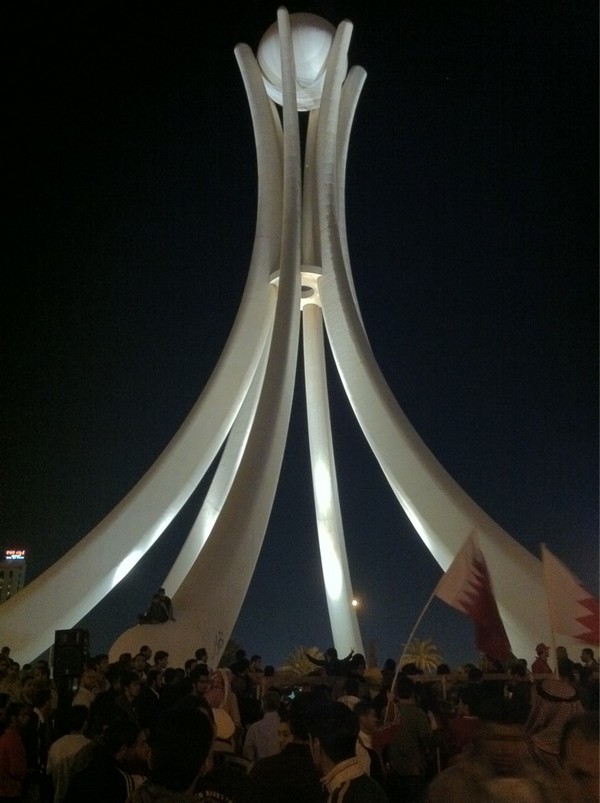
Cortni Kerr and Toby C. Jones write for Middle East Report Online:An uncertain calm has settled over the small island kingdom of Bahrain. The wave of peaceful pro-democracy protests from February 14-17 culminated in bloodshed, including the brutal murder of seven activists, some of whom were asleep in tents, by the armed forces. On orders from above, the army withdrew from the roundabout on the outskirts of the capital of Manama where the protests have been centered, and since shortly after the seven deaths it has observed calls for restraint. Thousands of jubilant protesters seized the moment to reoccupy the roundabout, the now infamous Pearl Circle. In commemoration of the dead, the demonstrators have renamed it Martyrs’ Circle.
The mood in the circle is buoyant, even carnivalesque. It is also dead serious, for the thousands of encamped demonstrators demand nothing short of fundamental change to the kingdom’s autocratic political order. The crown prince, Salman bin Hamad Al Khalifa, has issued a bland call for healing and national dialogue. The country’s formal opposition may be tempted by the prospect of realizing at least some of its long-established demands for reform. But the wounds from the direct assault at dawn on February 17 are deep. Several prominent banners in Martyrs’ Circle display the pledge, “No dialogue with those who killed us in cold blood.” Chants echo: “We will sit here until the fall of the regime!” The fault lines that have long divided rulers and subjects in Bahrain have widened due to the carnage.
On February 21, meanwhile, the regime summoned tens of thousands of supporters (state television wildly claimed 300,000) to rally behind it outside a large Sunni mosque, al-Fatih, in Manama. The choice of a Sunni mosque was deliberate; the Al Khalifa, themselves Sunni, have a history of playing sectarian politics to divide and rule the population, which has a Shi‘i majority. The pro-democracy protesters, for their part, have maintained from the start that their cause is national. Their slogans have explicitly appealed to cross-sectarian solidarity. On February 22, the largest crowd to date streamed into the streets, answering a call from the opposition groups, and marched nearly two miles from a mall to the roundabout. State TV ignored them, re-running footage of the previous day’s pro-monarchy gathering.
The killing is done for now, but it is too early to tell if the cold peace between the regime and the dissidents will last and, if so, how long. Bahrain’s revolution is not over, but its outcome is far from decided.
Toward Defiance
At the heart of the uncertainty is the question of whether the royal family can muster the political will to see through substantive political reform at long last. On February 20, the crown prince acknowledged the “clear messages from the Bahraini people...about the need for reforms,” though what the changes might be, he did not say. The majority of Bahrainis greeted his vague words with pronounced cynicism, and with good reason, for they know the country has been down the road of false promises before. In 2000 and 2001 then Emir Hamad (he has since declared himself king) promised sweeping liberal reforms that would, in essence, transform Bahrain from an absolute into a constitutional monarchy. The promises proved illusory. Instead, Hamad and his cronies set up a sham bicameral parliamentary system, decreed a constitution that consolidated power in the hands of the elites and institutionalized discrimination against the island’s majority Shi‘i population. The king appoints a consultative council that can block the elected lower house’s legislation. Electoral districts are hopelessly gerrymandered to minimize Shi‘i representation.
Popular hostility to the political status quo has simmered ever since. Although the Shi‘a have suffered the most from the regime’s intransigence, frustrations cut across sectarian lines. For ten years, an organized opposition, consisting of a handful of formal political societies (actual parties are illegal), has struggled to generate enough pressure on the regime to correct its course. The two most prominent societies, the Shi‘i Islamist grouping al-Wifaq and the left-leaning, non-sectarian Wa‘ad, led the charge, boycotting the 2002 elections and generally refusing to give the system a stamp of legitimacy. But something changed in 2006. The opposition ended its boycott, ran for Parliament and vowed to change the system from within. By all accounts, the opposition deputies agitated repeatedly for structural changes, but their incorporation into the system rendered them wholly ineffective.
The opposition’s decision to end the boycott, meanwhile, split its social and political base. Alternative centers of dissent emerged in 2005 and 2006, notably the Haqq Movement for Liberty and Democracy. Led by charismatic figures like Hasan Mushayma‘, ‘Isa al-Jawdar and ‘Abd al-Jalil Singace, Haqq rejected participation in elections and called for increased grassroots organizing, up to and including civil disobedience, and reached out to Western governments. With this bold program, Haqq siphoned off a considerable amount of supporters from al-Wifaq and Wa‘ad, eventually boasting a significant following in both the Shi‘i and Sunni communities. Equally important was the intensification of efforts by a network of young, energetic and devoted human rights activists, who drew attention to the grievances of the Shi‘a, in particular. At the heart of this network was the Bahrain Center for Human Rights, headed by ‘Abd al-Hadi al-Khawaja and Nabeel Rajab. Using the language of human rights, al-Khawaja and Rajab carved out influential political roles as well, inspiring younger Bahrainis to get involved in civic affairs and instructing them in how to build potent grassroots organizations.
Haqq and the human rights activists also assumed a decidedly more defiant stance against the regime and its excesses than the established opposition. In doing so they distinguished but also separated themselves from the safety of numbers. Beginning in earnest in 2005 and 2006, the organizations began to mount regular peaceful demonstrations, in which knots of young activists would take to the streets demanding the amelioration of various complaints, from poor housing to under-employment among Shi‘i youth to the torture that is credibly reported in the kingdom’s jails. The new opposition leaders also became increasingly provocative in their public statements, regularly offering direct criticism of the Al Khalifa. They paid a heavy price. Al-Khawaja and Mushayma‘ have been arrested multiple times. Singace was abducted by the security services in August 2010, imprisoned, tortured and is now facing charges of terrorism and plotting to overthrow the government. The same accusations are leveled at Mushayma‘, who went into exile in London.
The rise of the new Bahraini opposition was met with a surge of regime brutality. From 2005 to 2010, the security forces routinely used tear gas and rubber bullets in their attacks to disperse demonstrations. To preempt refusal of orders by the police, the regime stepped up its long-standing practice of recruiting foreigners as officers, including non-Bahraini Arabs and Pakistanis. Not coincidentally, the opposition says, the recruits tended to be Sunni. A cycle of state violence and opposition recrimination was firmly entrenched by 2010. Their increasingly vicious treatment by the state garnered the younger activist generation considerable credibility with the population. Where al-Wifaq and Wa‘ad pliantly sought influence in the corrupt halls of power, Haqq and the human rights groups were resilient in their insubordination. It became increasingly clear that the country’s political future would be decided in the streets.