Friday, August 14, 2009

Does Baroncini have moral claim on nepotism?

Nicola Baroncini, walk up one morning to face for himself the cruelty of the United Nations System and the unethical behavior of his supervisor (Elizondo). Well what's new to this?

I was reading the other day his story in the media and it stroke me the following passage:
"Shortly, my wife joined me (she works elsewhere in UNDP)"

Well anyone outside the United Nations reading the above, would definitely have hard time to understand Baroncini's claim for nepotism towards Rebecca Doss. Now all this can be explained with, well they might have got married after both were employed at UNDP.

Could be true or.... not.

But one thing is troubling in his claim - if wife and husband can work together in same place, why should be such a bigger deal for father and daughter not to ?

Also why is Baroncini trying to tell now stories of corruption at RBAP involving Jovita Domingo and Ligia Elizondo ?

Why didn't he come forward before the "accident" ?

Anyhow the above does not exclude and condone Elizondo's and Domingo's behavior, and many of us are aware of both unethical behavior and mismanagement. But it seem that Baroncini have some explaining to do himself, either he comes all clean or he really have no claim.


The real Helen Clark

Sunday Star Times


She went from 'sex bomb' trade unionist to 'very dour' Labour leader in her quest for credibility. In this exclusive extract from his unauthorised biography of Helen Clark, Denis Welch reveals the person behind the politician.

If I had $10 for every time someone who's met Helen Clark has said to me, "Oh, but she's so different in person!" I'd be a rich man now. In her years in public office it became commonplace to say that close up and personal she seemed softer, lighter, smaller even; more feminine; more inclined to laugh and joke.

And with such a lovely complexion. Stated or unstated, the corollary of these observations was that the Clark you saw on TV, in parliament, or at media conferences was bigger, harder, heavier, more mannish. People would often go on to lament that we didn't see more of the private Clark in public.

The implication tended to be that with male leaders like, say, Muldoon, Lange and Bolger, what you got in private was generally what you got in public - and that Clark must therefore be adopting a pose.

Well, wouldn't you? If you wanted to succeed as a woman in politics? Allowing yourself to come across as even a tiny bit "feminine", in the usual sense of the word, is fatal to such a career.

"What do women politicians fear most? They fear not being taken seriously. The fear of being trivialised." That's Clark herself in a 1994 interview with Bill Ralston.

"So from the time I came in," she went on, "I approached the job rather overseriously and that left its public impression. Very dour, very sour, very dry. All these sorts of things. Shaking that off as you become more secure in what you're doing is not so easy."

Eugenie Sage was Clark's press secretary when she was Minister of Housing 1987-89. "Helen was perceived in the media as a bit cold and aloof," says Sage, "but when she spoke at state house openings there would be so many tenants taking her by the arm and wanting to show her their places it would be hard to get away. There was a huge personal warmth and empathy here and in dealing with constituent queries that the media somehow didn't pick up on."

Sage attributes much of the misperception to male-dominated media, some of whom were "quite misogynist".

From the outset, Clark also had to put up with cracks about lesbianism - both of her personally and of her friends, colleagues and staff. The phrase "lesbian mafia" - a common taunt during her years at the top - conveyed an image of power-hungry dykes conspiring against the public good for their own perverted ends. Yet, quite apart from the irrelevance of the criticism, it's fair to note that male leaders since time began have surrounded themselves with male cronies - and that has been taken to be "normal", so natural as to be part of the political wallpaper.

In 2007, for instance, Michael Bassett wrote that Clark had very successfully ridden the "international wave of female empowerment that has dominated the last 30 years".

Now there's nothing sinister in that, though critics like Bassett often contrive to make it seem so. But how often do we hear it said that Robert Muldoon, say, rode the international wave of male empowerment that had dominated the previous 30 centuries?

In today's terms, Clark's most illustrious predecessor, the revered Michael Joseph Savage, had a very curious home life, never marrying, never even having a serious relationship with a woman, and living as a boarder with an elderly couple throughout his premiership.

It was scarcely considered an issue at the time, nor is it now, and it didn't stop Savage from becoming the best-loved leader this country has ever had. Yet Clark has had to put up with a more or less ceaseless stream of innuendo aimed not just at her but at her husband too, not to mention comment by the yard on every little shift in her appearance.

It seems typical of the very persona adopted by Clark the politician that she herself has discouraged the idea that women are especially targeted. For someone in her position to do that would, of course, be to invite the sneering male response "Diddums!".

So we should not be surprised that she once expressed sympathy for Bolger and Lange over the hammering they got from the media, and at the same time asseverated: "I don't think it's very different for women. There is a difference in the kind of criticism.

Once they decide to go for you they go in ways they wouldn't go for men. So they'll go for your clothes and your haircut and that sort of silly stuff. But in the end I'm not sure it's more poisonous, it's just a different kind of poison from what would be applied to male politicians."

Actually, leaving aside the coiffure, the clothes and the closet gay carry-on, Helen Clark has probably been the most culturally sophisticated and physically active prime minister New Zealand has ever had.

She went to the opera house and to the mountaintop.

She knew her Brahms from her Beethoven and her pitons from her crampons.

She played the piano and went cross-country skiing - though not, mercifully, at the same time. Her outdoor pursuits did attract some media attention, but one has the feeling they'd have got a lot more had she been a man.

As a young woman, Clark, by her own admission, was not much interested in clothes. Ralston, who was at university with her, recalls that "her hair was quite long, usually tied back, along with a woolly sweater, a plaid skirt, sensible shoes".

In the late 70s, as a career in politics beckoned, her friend Cath Tizard encouraged her to make herself more presentable.

In the early 1980s she favoured a vaguely safarical look, appearing in photos in almost military-style shirts, with buttoned breast pocket and sleeve flaps, and scarves knotted cravat-style at the neck.

A certain likeness to the country's first woman MP, Elizabeth McCombs, was commented on. Clark professed to be flattered, saying that she probably did have "slightly Edwardian looks".

The number of people who remember her by her boots is extraordinary. Trade unionist Matt McCarten's first memory of Clark is when she came to the old Hotel Workers Union building in Auckland in the early 80s and ran a seminar.

"She was dressed all in black," he says, "and had big black boots."

Fellow unionist Laila Harre, in turn, recalls a 1985 party where young men were "salivating over Helen Clark and her boots".

McCarten: "She was a sex bomb!"

Harre: "She was, actually - from a left-wing point of view. We don't have very high standards!"

It was after the 1990 election that Clark decided to get at least the semblance of a life outside politics.

"In the early years," she acknowledged several years later, "I probably put too much time into the job, but I rectified that in the 1990s and I've done a lot of things I really wanted to do, got involved in a lot of my personal interests and haven't let the job crowd that out."

She'd often gone tramping in her student days, and one year joined the university ski club, but by the time she became a cabinet minister in 1987 she was listing her personal interests as badminton, tennis, films, theatre and concerts.

Clearly she felt less than fully physically challenged, because it was after 1990 that she seriously took up cross-country skiing and began working out regularly at the gym.

She also set herself to learn Spanish, polishing up her pronunciation one summer with a holiday in Madrid.

Every year she tried to spend a month out of the country: Europe (particularly Switzerland and Sweden) and Central and South America were favourite destinations. She and husband Peter Davis invariably saw his parents in England during these trips.

Not instinctively, one feels, a team-sport person, she nonetheless made a point of keeping up with rugby league in Auckland; and if New Zealand pride was at stake in any sport, she'd be right there: remember how she flew to Dublin to (successfully) make New Zealand's case for hosting the 2011 Rugby World Cup?

When New Zealand was trying to win the America's Cup, she would text skipper Grant Dalton during the rounds off the coast of Spain.

"I always found that quite amazing, that she would find time in her busy schedule to do that," says Dalton, who avers that without her "fantastic and unwavering" support, Team New Zealand would never have survived to fight another day.

"I found her, and still do to this day, accessible, friendly, incredibly smart and immensely knowledgeable . . . and I really, really mean that sincerely - I'm not just saying that."

He never felt, Dalton says, that he was dealing with someone who had no affinity with the sport of yachting. When he got back to New Zealand from Spain he had dinner with Clark at Bellamy's, seeking some government funding for the next cup campaign.

He was nervous too. "I got about halfway through the pitch and she said, 'Whatever - but what I want to know is, why did you go around the right mark instead of the left in the third race on the second run?"'

Not that she neglects the head stuff. She usually went on holiday with "10 copies of the Guardian Weekly and four novels in a bag".

She likes Latin American writers like Gabriel Garcia Marquez and Mario Vargas Llosa, has read most of John le Carre's spy novels, and also used to make a point of reading the Booker Prize winner each year.

Despite her long involvement in the arts, however, in 2000 she admitted with some embarrassment that she'd read hardly any New Zealand literature.

She blamed it partly on her education: "Through all my years at school - and I did English 1 at university - I can't remember ever studying a New Zealand novel. Not even Man Alone.

Not even at Stage One! It was W. H. Auden and Robert Graves and the war poets and Sassoon." She read Dostoyevsky, though, and if memory doesn't deceive I once came across her working her way through War and Peace, possibly as research for a speech criticising National's defence policy.

As Leader of the Opposition she spent an entire summer holiday reading Vikram Seth's mega-novel A Suitable Boy. Being well-read herself, she encouraged others to write well and was notorious among her staff for correcting punctuation in letters, even going so far as to instruct officials not to start sentences with "however".

Clark never wanted a child. "It's inconceivable that I would become pregnant," she said perceptively in 1986.

By then she had been taking the Pill for years. Her definitive statement on the subject came in Making Policy Not Tea, the 1993 book about women MPs, in which she said bluntly: "Having children has never been something I've wanted to do because I value my personal space and privacy too highly. I cannot think of the sort of life I would want to have where I would want to give up those things for children.

"I've observed many friends and relatives with children over many years, and nothing that I've seen has led me to change my mind. I don't think it's just this job. I think that anything I did I would have been very busy, and when I wasn't putting a lot into it I would have wanted personal space for myself.

"The other thing is, I spend my whole life working with and on behalf of people. I can't go to work and just shut the door on people and their concerns: that is the job. I take my hat off to people who can add families and family concerns on top of that, but I just don't think I could happily do it."

That she remained (understandably) sensitive about allusions to the subject was evident in 1998, when Maori Affairs Minister Tau Henare responded to a question she asked in the House about why he hadn't attended the launch of a group home-building scheme.

Henare said that he'd promised long ago to spend three days with his children at that time - and "I'm not going to break a promise to my family and my children. It's something that the Leader of the Opposition wouldn't have any idea what that means".

Clark asked for his apology and withdrawal; Speaker Doug Kidd said the comments were not out of order but that members shouldn't bring family affairs into debate.

A few months later, she said she found political opponent's references to her childlessness "a bit pathetic really".

As indeed they were.

Even other women were not immune to taunting her about it. Though she'd appeared with National's Jenny Shipley on an episode of Shortland Street in 1996, the relationship appeared to deteriorate once Shipley became Prime Minister, thus beating Clark to the coveted title of "New Zealand's first woman prime minister".

After Shipley called her "the spinster of New Zealand politics", Clark hit back with this: "From the time she became leader of the National Party I have been subjected to constant attack by her and the National Party in coded terms for not having children." By contrast, she said, "[Jim] Bolger, as we know, had a large family, was proud of them, never sought to use it for personal advantage in any way and never ever cast a personal aspersion on me, ever."

As to the low voice - if you must know - she once confided to an interviewer, presumably in a low voice, that she'd had a lot of allergies "and to have something constantly dripping on your vocal cords makes the voice low".

In UN Bite-Gate, UNDP's Toothless Investigation of Nepotism and Irregularities in Asia and Africa, Attempts to Moot Out Scandal

UNITED NATIONS, August 13 -- With the UN hoping to put behind it the nepotism and biting scandal brought to light by UN Congo envoy Alan Doss' email to the UN Development Program asking for "leeway" in hiring his daughter Rebecca being published by Inner City Press, spokesperson Marie Okabe on August 12 replied that "all queries should be addressed to the New York County District Attorney’s office." Video here.

But from within UNDP, sources tell Inner City Press of a multi part strategy to try to moot out the scandal. UNDP's investigation, they say, involves one Francois Dubois and long-time associates of Alan Doss. Beyond and reflecting what they call this conflict of interest, they say that the supposed investigation has become an attempt to justify, post facto, the violation of the spirit and letter of UNDP and UN rules by focusing on leave time that Alan Doss had accumulated.

Despite Doss himself having told Inner City Press in writing that he tranferred from UNDP to the Department of Peacekeeping Operations on July 1, 2009, after his daughter was short listed for and offered the UNDP job, an attempt is afoot to claim that before his July 1 "arrival" at DPKO, Doss was already not at UNDP at least technically. Doss may have asked in an unseemly way for "leeway," the theory goes, but he didn't need it.

As first reported by Inner City Press, on April 20, 2009 Alan Doss wrote to UNDP's deputy director of the Regional Bureau for Asia and the Pacific:

"Dear Ligia,

This is just to inform that I have advised UNDP in writing that I will transfer to DPKO effective 1 July 2009. I have also spoken to Martin and advised him that I cannot transfer before that date because the new DPKO contractual arrangements only come into effect on the 1 July. He informed me that the ‘deadline’ for the ALD contracts is 15 May so the period of overlap would only be 6 weeks (assuming Rebecca’s ALD would come into force on the 14th May at the latest). I have asked for some flexibility, which would allow a very long serving and faithful UNDP staff member a little lee-way before he rides off into the sunset.

Becky is very excited about the prospect of going to work for you so I hope that it will work out. With my warm regards and thanks,

Alan.

Alan Doss
Special Representative of the Secretary-General United Nations Mission in the Democratic Republic of the Congo"

Beyond the open request for the bending or breaking of rules, for a UN official as high placed as Alan Doss to write in this way about giving a job to his daughter is inappropriate. Many in the UN express amazement that there have as of yet been no repurcussions.

On August 13, Inner City Press directly asked UNDP's spokesman Stephane Dujarric -- as well as Messrs. Doss and Dubois, and Adminstrator Helen Clark's chief of staff -- to respond to what these UNDP sources are saying, and to confirm or deny Dubois' role in the investigation as well as the matters below. Ignoring the pointed questions, Dujarric twice repeated boilerplate that the investigation is serious, and that Ms. Clark routinely speaks with the press.

Why then has she still not done a press conference after 100 days in office, while UNDP reaches out to particular reporters they think will give her uncritical coverage?

The UNDP sources, disgusted by what they call a cover up, assert that UNDP seeks to moot out the controversy by moving Rebecca Doss from the contested position in New York within the Regional Bureau for Asia and the Pacific to a job in Copenhagen. The sources say that the vacancy announcement for this post, like the one the Dosses took a P-2 position, has mysteriously been taken offline by UNDP, to be used to "solve the problem." Relatedly, to quell the other side of the controversy, some point to a just withdrawn vacancy announcement for a post within the Regional Bureau for Europe and the CIS States in Bratislava. "This is how things are done in the UN," a source tells Inner City Press. "Especially at UNDP where there is additional dirt not yet revealed."


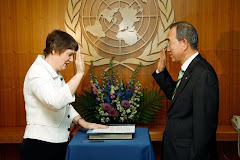
UNDP's Clark and UN's Ban, nepotism and scandal(s) not shown

While each Regional Bureau within UNDP has skeletons in its closet, RBAP has covered and covered up programs in totalitarian countries like Myanmar and North Korea, and war crime sites like Bangladesh and Sri Lanka. In Myanmar, for example, sources describe to Inner City Press how UNDP paid inflated prices to the government of General Than Shwe for telephones and license plates, "essentially propping up the regime," the sources say. Inner City Press has asked UNDP directly, how much has it paid in Myanmar for phones and license plates; UNDP's answer will be reported when provided.

In Bangladesh, where UNDP has said it would help set up and advise on an inquiry into actions by Pakistan in the early 1970s, such efforts have reportedly slowed since Helen Clark took the top job earlier this year. She met with representatives of Pakistan, and now progress in setting up the inquiry into alleged Pakistani war crimes has become less clear. Inner City Press has asked UNDP and Ms. Clark's chief of staff to respond to UNDP sources statement that "Ms. Clark met with Pakistan representative(s) and UNDP's commitment to assisting in the investigating possible Pakistani war crimes has since changed." The response, if and when received, will be published on this site.

Perhaps most explosively, RBEP oversaw the closing and now reopening of UNDP's program in North Korea. Sources say that under the name of programs on the books of UNDP in China, actions in North Korea continued even during a supposed lull. One Napoleon Navarro was shifted from covering North Korea to becoming one of four UNDP deputies in China. The UNDP's top man in China, Khalid Malik, is reportedly seeking to shift to the top post at the UN World Tourism Organization based in Spain. Local UNDP staff in China have been complaining about Malik's reign in Beijing.

Regarding Alan Doss himself, questions have arisen about his attempted use of UN Volunteers posts for relatives while he was in Liberia, and about the use of UN Mission resources while in the Congo. At the Augst 12 noon briefing, Inner City Press asked Ms. Okabe to clarify whether the Congo, including its capital Kinshasa, is or is not a "family post" for UN purposes. Twenty eight hours later, no answer has arrived. Watch this site.

Inner City Press asked UNDP:

"please confirm that investigation involved Francois Dubois, and that he is an acquaintance and more of Mr. Alan Doss. I am cc-ing both gentlemen. Also, I'm told a move is afoot to recalculate / use Mr. Doss' leave time as a solution to the irregularity that has surfaced. On Bangladesh, I am asking about the status of UNDP's previous projection that it would help set up a war crimes inquiry. To help you respond, I have been told by a UNDP source that Ms. Clark met with Pakistan representative(s) and UNDP's commitment to assisting in the investigating possible Pakistani war crimes has since changed. Please comment on this [and] confirm or deny: Rebecca Doss is being considered for a job in Copenhagen.. please state UNDP's jurisdiction over the acts of Alan Doss, no longer with UNDP, and whether his acts are being investigated by UNDP and could be acted on by UNDP."

UNDP's spokesman, for the second time refusing to confirm or deny this and other matters, responded with boiler plate:

"Regarding questions about Miss Doss and the investigation, I can tell you that the allegations suggesting irregularities in the recruitment procedures are serious and are being fully investigated by UNDP’s Office of Audit and Investigations, in conjunction with OIOS. The matter is being given top priority. On Bangladesh, I will revert. On Miss Clark’s appearance, she speaks to journalists regularly and looks forward to engaging with journalists in the UN press corps. On Myanmar, I’m trying to see what can be found."

We're still waiting. Watch this site.

Thursday, August 13, 2009

JOIN US IN FACEBOOK: United Against Corruption and Mismanagement at United Nations


All of those who believe in United Nations should join us in our FACEBOOK GROUP:

http://www.facebook.com/group.php?gid=56375287768

Invite all your friends, and let call for Helen Clark to stop the corruption, nepotism and mismanagement inside the United Nations Development Programme.

Thank you all,


The real Helen clark: Bullying Quote

KIWIBLOG

Over at The Standard, Paul Buchanan made this comment:

I hate to say it, but I think bullying crosses the aisle and is endemic not only in NZ politics but the society at large, be it in academia, government, unions or corporations. Helen Clark openly called for my dismissal from Auckland University when I raised questions about the Zaoui case. She also vilified Deborah Manning, who is one of the more courageous Kiwis I have met. After it was all over and Zaoui won his appeal, Deborah moved on to an international job and Helen got her wish with regards to me.

I’d forgotten about that. So much to remember – Kit Richards, Erin Leigh, Peter Doone also.

"JOAN OF ARC IS HERE - CAN SHE CLEAN MASSIVE CORRUPTION AT UNDP?"


Liberty Scott has been lamenting the sychophancy of Tracy Wartskins and her New York jaunt to see Uncle Helen.
Naturally, we heard about the vindictiveness of National, and that New York was Helen's kind of town, but we never saw any tough questions, like what does the UNDP do?, does it do it well? And what does Clark intend doing?
Now there has been some commentary elsewhere that she will shake things up, she has an agenda and climate change and carbon trading schemes will be part of it.
New York could well become New Helengrad!!
Remember how she said New Zealand was now "too small" for her.
Well, we've save such speculation for another day, but some rigorous analysis of Uncle's motives at the UN would have been welcome instead of the fluff we saw.
But if the UNDP is to gain a bigger role in the governance of the affairs of the planet, we may want to question its record so far.
Now, there has been much criticism of the United Nations in general and there are blogsites like UNWatch. The NGO is based in Geneva and aims to monitor the UN in accordance with its principles.
The US has been a longstanding critic of the UN and you don't have to be an avid viewer of Fox News to realise the UN has problems with issues of corruption or even a leftist agenda.
The UNDP is central to the UN and Uncle Helen has a prime spot. Wasn't she declared number 3 or something in the entire organisation? So she is a big fish in this very large pond.
Any journo worth their salt could have had an easy trawl for info. There is even a UNDP Watch blogsite, apparantly run by UNDP staffers who want more openness in the 'secretive' organisation.
The UNDP Watch blog presents here an illuminating piece on the organisation's problems noting a shift in power from the assembly to bereaucrats and the UNDP becoming a 'cesspool'' of failed and discredited politicians.
A quick glance through this blog reveals a few interesting things, and certainly presents a good basis for any journo hoping to give a new global leader, for that is what Clark is, or intends to be, a good grilling on the issues facing her new role.
Helen Clark and New Zealand politics have featured on the blog already.
And I had to laugh that prior to her first speech, the blog mentioned Ian Wishart's book Absolute Power, noting a link to Amazon . Let's get to know better our Dear Leader' was an adjoining comment.
"Joan of Arc is here - will she be able to stand in front of a 6 billion dollar dirty machine?
Can she clean massive corruption at UNDP?"
was also posted below concerning her arrival.
Anyway, barely 100 days into her new job, Uncle has her first scandal, something to do with overpayments to consultants in Panama.
Obviously, as Liarbour leader for so long, Clark should be used to the swirl of scandal.
Perhaps this was valuable experience for her new role that helped her get it!
Either way, since this is Clark's first big test, it will be interesting to see how she gets along.
It will also be of interest to see if or how the New Zealand public will be told.

UN Chief’s warning – the end of the world is nigh!

TELEGRAPH.CO.UK

By Nile Gardiner

UN Secretary General Ban Ki-moon has such a low profile on the world stage that he’s referred to as “the invisible man”. Perhaps in an effort to boost his press coverage he’s given a speech in Incheon, South Korea (hat tip: Drudge), that can only be described as a bizarre PR stunt, with the sort of cataclysmic environmental statements doled out in scientifically dodgy disaster movies like The Day After Tomorrow or the forthcoming 2012.

In his address to the Global Environment Forum this week (read talking shop for unelected, overpaid bureaucrats), Ban warned of impending “droughts, floods and other natural disasters”, as well as mass social unrest and violence – “the human suffering will be incalculable” - if the world’s leaders did not “seal a deal” on climate change at a summit in Copenhagen in December. In the Secretary General’s ominous words:

“We have just four months. Four months to secure the future of our planet.”

In reality, the United Nations can’t even maintain its own headquarters, manage its own books and keep its tens of thousands of peacekeepers under control, let alone save the world. The UN is an extraordinarily badly run institution, rife with corruption and mismanagement, that shields some of the most odious tyrants on the face of the earth. Surely it should be focusing on implementing some much-needed management reform, cracking down on rampant corruption within its ranks, and preventing its peacekeeping troops from raping refugees in war-torn places like the Democratic Republic of the Congo and southern Sudan.

If Ban Ki-moon really wants to make a bigger impact on the world stage he should condemn North Korea’s barbaric enslavement of millions of its own people in forced labour camps, speak out against Iran’s nuclear weapons program, fraudulent elections and mass violations of human rights, and stand up to tyrannical regimes from Pyongyang to Khartoum. He should also call for reform of the UN’s ludicrous human rights organization, the Human Rights Council, which is no improvement at all over its disastrous predecessor the UN Commission on Human Rights.

The main threat to humanity at present is posed not by climate change but by dangerous madmen like Kim Jong Il and Mahmoud Ahmadinejad, heading rogue regimes hell-bent on wiping their neighbours off the map. Not to mention the rise of militant Islam and a global terrorist network that seeks the destruction of the free world. As long as UN officials stick their head in the sand and ignore the world’s real problems the body will remain an irrelevance.

Helen Clark - "the sex bomb"


Sunday, July 19th, 2009 at 3:52 pm

The SST report:

THE YOUNG Helen Clark was once described as “a sex bomb” in black boots, according to a new unauthorised biography of the former Labour prime minister.

Helen Clark, by Wellington journalist Denis Welch, says trade union leader Matt McCarten’s first memory of her was from the early 80s. “She was dressed all in black and had big black boots,” McCarten said.

Fellow unionist Laila Harre, later an Alliance Party cabinet minister in Clark’s first cabinet, recalled a 1985 party where young men were “salivating over Helen Clark and her boots”.

“McCarten: `She was a sex bomb!”‘

“Harre: `She was, actually from a left-wing point of view. We don’t have very high standards!”‘

Funnily enough more people would say Laila used to be the left’s “sex bomb”. Many a Nat staffer used to gaze longingly at her.

However Laila had these steely eyes that looked like they could freeze you at 100 metres, so I don’t think any of the young admirers ever shared their adoration with her :-)

The SST also has a largish extract from the upcoming Welch book on Clark.

Tuesday, August 11, 2009

"Io, pestato dalla sicurezza" Trascina l'Onu in tribunale

Brutta avventura per un consulente italiano che, escluso da un concorso al Palazzo di vetro, aveva denunciato scelte clientelari. "Sono stato preso a calci, assalito e mi hanno messo anche le manette", racconta dall'inviato Giampaolo Pioli

"Sono stato preso a calci e assalito da tre guardie dell’Onu in un ufficio, mi hanno spruzzato in faccia due volte il pepper spray e messo le manette come un delinquente. Per disperazione col bruciore negli occhi ho reagito addentando la mano di uno dei poliziotti e domani dovrò presentarmi in tribunale a difendermi dalle accuse di essere stato io l’assalitore degli agenti. E’ incredibile. Ho lavorato per quasi 6 anni per le Nazioni Unite come consulente con diversi contratti a termine. Sono un idealista, credo nel Palazzo di Vetro e nella sua funzione, ma le cose che accadono al suo interno possono anche essere raccapriccianti…Voglio che ritirino la loro denuncia e se non lo fanno ne presenterò io una contro di loro".


Nicola Baroncini, 35 anni è un giovane valtellinese di Delebio, laureato in economia, sposato con una dipendente dell’United Nations Development Program e padre di un bambino di 2 anni. Il rocambolesco episodio del suo arresto dentro uno dei palazzi dell’Onu, da parte della polizia di New York che lo ha portato anche in carcere a Manhattan per una notte, risale al 22 giugno, ma adesso, con l’udienza, rischia di far esplodere un nuovo caso di nepotismo nella gestione del segretario generale Ban Ki Moon. Senza quel clamoroso arresto tutto sarebbe finito probabilmente nel nulla.

Baroncini sostiene di essere vittima di una rappresaglia interna e che il concorso in programma il 9 giugno per il posto di "special assistant" (60/70 mila dollari l’anno esentasse) del vice direttore dell’ufficio Asia e Pacifico dell’UNDP Ligia Elisondo, al quale ha partecipato classificandosi 4°, potrebbe non essersi svolto nel rispetto delle regole. Dopo il trattamento subito vuole andare fino in fondo.


Il giovane italiano, ora disoccupato, si è rivolto prima ai responsabili delle risorse umane dell’Onu mostrando una e-mail nella quale quasi 2 mesi prima, il 20 aprile l’inglese Alan Doss sottosegretario generale dell’Onu e inviato speciale di Ban Ki Moon per il Congo ringrazia la stessa Elisondo per la posizione che verrà assegnata alla figlia Rebecca prima ancora dell’uscita del bando.


Alla fine dell’esame il 9 giugno una bella ragazza russa Violeta Maximova prima classificata rinuncerà al posto per andare nella fondazione di Bill Clinton e Rebecca Doss seconda in lista ottiene la posizione.


Il 22 giugno per Baroncini arrivano i guai, le manette e crolla il mito dell’Onu. Quando si presenta alla scrivania, il capo dell’ufficio la signora Elisondo gli dice di tornare a casa ma che verrà pagato comunque fino alla fine del mese quando scadrà il contratto. Lui va dal diretto superiore che solo due giorni prima gli aveva promesso di aiutarlo a trovare un altro posto a termine, ma questa volta trova un muro. Baroncini sventola di nuovo l’e-mail di Doss e grida nel corridoio "vergogna… se questo è il modo con cui reclutate la gente".

Un uomo della sicurezza gli chiede di restituire il pass e di lasciare l’edificio.Baroncini obbedisce e comincia a raccogliere le carte e a spegenere il computer. Arriva anche la moglie che lavora poche stanze più avanti e insieme a lei due guardie dell’Onu che lo piantonano obbligandolo(secondo il suo lungo racconto) a rimanere per ore in attesa in un ufficio vuoto.

"A quel punto non capivo più cosa stava succedendo - ci dice - Ho chiesto di parlare col consolato italiano e con un avvocato. Non mi è stato permesso. E’ arrivato anche un altro agente Onu e hanno invitato mia moglie ad andare in un’altra stanza dove le hanno chiesto se a casa ero violento e la picchiavo. C’è tutto nel mio rapporto che ho già presentato alle autorità dell’Onu e che presenterò in tribunale. Ma l’aggressione è avvenuta quando è entrato nella stanza un ufficiale delle Nazioni Unite con la divisa bianca. Una delle guardie mi si è buttata addosso tirandomi per terra e le altre mi hanno preso a calci e spruzzato lo spray. Non ci vedevo gridavo dal dolore volevo un avvocato e mi hanno spruzzato ancora prima di mettermi le manette mi erano addosso in tre. La polizia di New York è arrivata molto dopo con un’ambulanza. Mi hanno portato all’ospedale Bellevue. Non al pronto soccorso ma al reparto psichiatrico. Il medico mi ha visitato e si è messo a ridere giudicandomi sano di mente. Da li sono finito al distretto di polizia per le impronte digitali perché nel frattempo un agente dell’Onu aveva sporto denuncia nei miei confronti dicendo che ero stato io ad assalirlo e da qui sono finito in tribunale alle dieci di sera. Siccome il giudice era già andato a casa ho dovuto trascorrere la notte seduto in una cella on altre 20 persone fino alle nove del mattino quando il magistrato ha fissato per agosto la data dell’udienza".

Avete provato a discutere con l’Onu?
"Il mio avvocato ha cercato diverse volte di mettersi in contatto ma è sempre stato rinviato da un interlocutore all’altro".


E’ probabile che nel frattempo in corte le venga offerto un 'patteggiamento' per chiudere l’incidente?
"E’ quello che mi è stato detto, ma non intendo accettare. Se l’agente dell’Onu non ritira la denuncia ne faccio una contro di loro per le violenze subite e voglio un processo per dimostrare chi è stato l’aggressore e l’aggredito. Chiameremo anche i funzionari dell’Onu a testimoniare. E’ una vicenda assurda e sconcertante. Voglio che venga fuori la verità. Rivoglio la mia dignità…Io non ho nulla da perdere…..ma solo un figlio da mantenere e un mutuo da pagare".

L’ufficio del portavoce delle Nazioni Unite è avaro di dettagli su questo episodio. Ammette che è accaduto , conferma che è stato usato il 'pepper spray' e aggiunge che la guardia coinvolta è stata medicata in ospedale ed è dovuta rimanere a casa una settimana dal lavoro. Sul concorso contestato dell’UNDP dichiarano laconici che "il processo di selezione si è svolto regolarmente". Non parlano del potenziale conflitto d’interesse di Alan Doss che raccomanda la figlia, ma potrebbero essere costretti a farlo com’è del resto già accaduto anche con vecchi scandali Onu del passato.

dall'inviato Giampaolo Pioli

Servicing the poor people has its benefits - Elizondo can afford a 800 Thousand Condominium ..

With Nicola Baroncini's scandal on UNDP's Regional Bureau for Asia Pacific nepotism and favoritism of high UN officials, it seem that many more information regarding Elizondo's (Deputy Director of RBAP) are now coming out.

It looks like we should expect many more internal confidential informations from the deals UNDP has had with dictators the likes of North Korea and Myanmar.

Questions are being raised as to how Ligia Elizondo:

1. an international public servant;
2. working for UNDP to eradicate poverty in Asia Pacific Region;
3. paid by Tax-Payers public donations to United Nations for the poor;

CAN AFFORD A 800 THOUSAND DOLLARS CONDO ??


Maybe the Donor countries and their tax-payers should review the salaries of these individuals who are "servicing the poor" from New York.


DEVELOPING NEWS: Baroncini might have copy of all Elizondo's mailbox and ATLAS Profile

Sources inside UNDP's Investigative Division indicate that Baroncini might have had enough time to download all Elizondo's mailbox including all her ATLAS Profile Transactions.

Should the above be true and the content of Elizondo's drive ends up in the hands of New York Prosecutors and/or South District Attorney (or US Mission to the UN) - UNDP might be in for serious troubles. Especially since Elizondo was directly involved in particular confidential deals with Myanmar, North Korea and Afghanistan, where she was ultimately last "Approver" inside complicated financial transactions.

UNDP's Investigators have allegedly found evidence of Elizondo's mailbox including her ATLAS profile in Baroncini's desktop.

Same sources say that Helen Clark's Office has allegedly indicated that a deal be offered immediately to Baroncini and transfer Doss's daughter to another duty station (maybe in Brussels or Copenhagen).

One thing is for sure - UNDP's reputation is yet again at stake and inaction this time might cost a lot to the organization.

U.N.D.P. Biting Incident Sparks Probe Of Daughter's Hire

The New York Times


NEW YORK (Reuters) - A former U.N. employee charged with biting a security officer rejected a plea deal on Monday saying he wanted to go to trial instead so he could expose nepotism at the United Nations.

Nicola Baroncini, 35, is charged with third-degree assault in the June 22 incident. His lawyer told a New York judge he would not plead guilty to a lesser charge of harassment.

"I want the case to go to trial so I can have my say and show how people are hired at the U.N.," Baroncini told Reuters later, adding that it was "blatant nepotism."

Baroncini is accused of biting a U.N. security officer who tried to escort him out of an office where he had gone to complain about being passed over for a position in favour of the daughter of a high-level U.N. official.

The Italian says he was defending himself from three U.N. guards who used pepper spray on him and beat him.

Baroncini said he had been complaining about nepotism involving Alan Doss, a U.N. under-secretary-general and special envoy to the Democratic Republic of the Congo. He said he was showing another U.N. official an e-mail from Doss in which he used his influence to smooth the employment of his daughter.

U.N. Development Program spokesman Stephane Dujarric said the hiring of Doss' daughter was being investigated.

Doss was a long-time UNDP employee but has been on loan to the department of peacekeeping, a separate U.N. division, since 2001. He was transferred out of the UNDP to the peacekeeping department on July 1, the day his daughter, Rebecca, took up her new post as a special assistant at UNDP.

Baroncini, who worked at UNDP and had access to his boss' e-mails, saw one from Doss referring to Rebecca's application to work at that agency, which does not normally employ members of the same family.

"I have asked for some flexibility, which would allow a very long serving and faithful UNDP staff member a little lee-way before he rides off into the sunset," Doss wrote in the e-mail, a copy of which was seen by Reuters.

Doss said he had no comment pending the UNDP review.

(Editing by Patrick Worsnip and Doina Chiacu)