Showing posts with label European Union. Show all posts

Sunday, August 4, 2013

Climate innovation debate: What’s the future for carbon trading systems, around the world?

Click here for this in full @: http://bulletin.sciencebusiness.net/news/76233/Climate-innovation-debate-What’s-the-future-for-carbon-trading-systems,-around-the-world


A focused panel of experts from business, academia and politics will consider how different regional carbon trading systems should be modified in order to enable them to effectively combat climate change. The debate, to be held on 24 September, is organised by Climate-KIC, which is part of the European Institute of Innovation and Technology (EIT).

The European Commission and Parliament have been struggling to find a solution to plunging carbon prices, with a compromise deal being struck only as recently as June and many publicly questioning the future of the system.
Advocates, however, have called for the success of carbon trading to be determined based on the level of carbon reduction, rather than the price of carbon. Research has been published to suggest that the market-based approach of Europe’s carbon trading system is still delivering results.

Meanwhile, international policy makers are looking to adopt local versions of Europe’s carbon trading system. Climate-KIC will now bring together a panel of experts to discuss the future of carbon trading, and its effect on long term climate change mitigation and adaption.

Wednesday, July 3, 2013

EU Contributes €2.4M for Preservation of Palestinian Heritage in Jerusalem

EU Contributes €2.4M for Preservation of Palestinian Heritage in Jerusalem
International Middle East Media Center
The European Union (EU) and the United Nations Development Program (UNDP) signed on Tuesday a €2.4 million agreement with Al-Quds University aimed at the preservation of Palestinian cultural heritage in Jerusalem's Old City, an EU press release said ...

Monday, November 26, 2012

Who are the main players in global climate negotiations


Click here for this story in full at philStar.com: http://www.philstar.com/breaking-news/2012/11/25/873333/main-players-global-climate-negotiations

DOHA (Xinhua) - A new round of UN climate change conference slated for Nov. 26-Dec. 7 will be held in Doha, Qatar where negotiators are expected to push ahead what was achieved in Durban last year and work out the details of the second commitment period of the Kyoto protocol.
In climate change talks, parties to the UN Framework Convention on Climate Change (UNFCCC) mainly group under three contending forces, namely the Umbrella Group, the European Union(EU) and the G77 and China.
UMBRELLA GROUP
The umbrella group mainly consists of the United States, Japan, Canada, Australia, New Zealand and Russia, whose stance regarding climate change is less enthusiastic than most of the developed signatories to the Kyoto Protocol. Particularly, in 2001, the United States withdrew from the Protocol, and in 2011, Canada followed its step.
The Umbrella Group insists that developing countries should undertake quantified emission reduction commitments along with the developed countries, regardless of the fact that rich nations are responsible for 80 percent of the existing greenhouse gas in the atmosphere due to their unsustainable way of industrialization in the past.
EU
The EU is more active in fighting climate change than the Umbrella Group and supports a second commitment period of the Kyoto Protocol being negotiated.
Nevertheless, the EU sees the second commitment period only as a transition phase, following which a new treaty should be implemented in its stead to assign all major economies mandatory emission cut targets.
These economies that the EU has in mind include the United States, who has so far showed no interest in the second commitment period, as well as the emerging economies, mainly include China and India.
Again, the EU is aiming to discard the core principle of the UNFCCC, "common but differentiated responsibilities," and tries to blur the distinction between the duties of developed and developing countries.
G77 AND CHINA
The G77 and China represent the interests of the developing countries in the climate negotiations.
An important player under this bloc is the BASIC nations, which encompass China, India, Brazil and South Africa. The BASIC group often meets to coordinate their positions ahead of major climate talks.
The G77 and China advocate respecting the UNFCCC and the Bali Roadmap, which set a double-track process for climate negotiations and differentiates the duties of the rich and poor countries.
They argue that the developed countries should make greater commitment to cutting carbon emissions, citing their historical discharge, while the developing countries, aided by financial and technical support, should also make efforts to cut their emissions on a voluntary basis.

Click here for this story in full at philStar.com: http://www.philstar.com/breaking-news/2012/11/25/873333/main-players-global-climate-negotiations

Tuesday, November 13, 2012

Is UNDP/UNFCCC ruinning the carbon trading business? - The European Union thinks so !


Click here for this story @ FOCUS INFO: http://www.focus-fen.net/index.php?id=n292071

  Picture: AFP
Brussels moots pollution credit cut to up carbon price
12 November 2012 | 23:00 | FOCUS News Agency
Home / European Union
Brussels. The European Commission proposed Monday cutting the pollution credits auctioned to firms in 2013-2015 in order to raise the price of carbon and make investment in clean technology worthwhile, AFP informs.
The proposal, published on the Commission's website, has been submitted to EU member states, according to the Commission's climate commissioner Connie Hedegaard.
The EU's Emissions Trading System (EU ETS) is a so-called cap-and-trade system that seeks to fight climate change by gradually tightening the amount of greenhouse gases that can be emitted by companies.
Companies receive annual carbon emissions targets. They are allotted some carbon emission credits but then must purchase allowances that have been auctioned or earned by other companies.
However the price of carbon allowances under the EU's ETS has fallen so low that companies do not have a major incentive to invest in reducing their emissions.
Hedegaard has proposed cutting by 900 million tonnes the amount of carbon credits auctioned to firms in 2013-2015, with the allowances increased in 2018-2019.
The EU plans to auction credits worth some 8,500 million tonnes of carbon emissions in 2013-2019.
Hedegaard also considered a cut of 400 million tonnes and 1,400 million tonnes.
The European Parliament had backed a cut of 1,400 million tonnes, which would cause the price of a tonne of carbon emissions to double from the current price of seven euros, according to estimates.
Experts believe that the price should be between 24 and 30 euros in order to make investment in clean technologies worthwhile.

Wednesday, November 7, 2012

UN climate talks: EU must prevent this decade from becoming a period of climate inaction!


Click here to read this in full @ Stop Climate Change: http://www.stopclimatechange.net/index.php?id=25&tx_ttnews[tt_news]=1883&tx_ttnews[backPid]=2&cHash=28f2be60f13b6322755412b3b0ce28ba

From 26 November - 7 December 2012, the 18th Conference of the Parties (COP 18) to the UN Framework Convention on Climate Change (UNFCCC) will be held in Doha, Qatar. The Environment Committee has prepared a draft motion for a resolution, which will be voted in this morning...

From 26 November - 7 December 2012, the 18th Conference of the Parties (COP 18) to the UN Framework Convention on Climate Change (UNFCCC) will be held in Doha, Qatar. The Environment Committee has prepared a draft motion for a resolution, which will be voted in this morning.
As with the climate talks in general, and due to persistent opposition from Poland against more ambitious attempts to curb atmospheric pollution, the EU hasn't been able to move forward with its position in the negotiations since last year. At the last Environment council in October, Ministers once again failed to find an agreement on the excess of allowances - officially named Assigned Amount Units (AAUs) and referred to disparagingly as "hot air" accumulated by the Eastern Europe Member States. This lack of progress could have serious implications for the credibility of the EU and its partnership with the developing countries but also the overall UN efforts to tackle climate change in general as it could seriously endanger the second commitment period of the Kyoto protocol, whose first phase expires at the end of this year. 

Sunday, October 28, 2012

Does UNDP assistance in Cyprus makes sense? Academics from UK say : " NO" !

Academics question point of EU funding for peace

Click here for this in full @ Cyprus Mail:  http://www.cyprus-mail.com/features/academics-question-point-eu-funding-peace/20121028


Most Cypriots have crossed the buffer zone no more than once or twice if at all
 
IN THE midst of the financial squeeze, is the EU getting its money’s worth for the host of Cyprus reconciliation and development programmes it is funding?

The findings of a project titled ‘Reconciliation and Peace Economics in Cyprus’, funded by EuropeAid,  would suggest not.

The project’s aim was to promote “a conducive environment for the further development of trust, dialogue, cooperation and closer relationship between the Turkish Cypriot and Greek Cypriot communities...”

But “From the start of the project, it was apparent that there was little hope for a settlement and the project concluded as the UN-sponsored talks again failed,” concluded British-based academics, Dr Kate Flynn and Dr Tony King.

They had been contracted by the EU’s EuropeAid organisation to run a two-year project exploring “reconciliation and peace economics” on Cyprus.

After extensive study, the researchers found that given fundamental disagreements between the two communities on the root cause of the Cyprus problem, it is “highly problematic from the outset to effectively apply reconciliation initiatives”.

Their findings were out-and-out depressing. Some highlights: “The two communities do not agree on what the Cyprus problem is and there is little agreement about arrangements for a post-solution state.  There is marked reluctance to recognise the other side, as well as interact even with the checkpoints open. Most Cypriots do not cross the Green Line or have only done so once or twice, so bi-communal contact is limited to a small percentage of the population. There is notable societal mistrust both within as well as between communities. There is suspicion about political leadership and the direction of the talks.”

No doubt the report stands out for it no-nonsense take on efforts to bring the two communities closer in a bid to help reunification efforts.

Click here for this in full @ Cyprus Mail:  http://www.cyprus-mail.com/features/academics-question-point-eu-funding-peace/20121028


Wednesday, October 10, 2012

European Union: EU/CEE: Carbon Trading Post-2012 - A Battle For Transitional Free Allocation Of Emission Allowances

Click here to read this in full @ Utility Products: http://www.utilityproducts.com/news/2012/10/09/european-union-eu-cee-carbon-trading-post-2012-a-battle-for-transitional-free-allocation-of-emission.html

The EU Climate Change Package provides for a revision and strengthening of the Emissions Trading System (ETS). A single EU-wide cap on emission allowances will apply from 2013 and will be cut annually, reducing the number of allowances available to businesses to 21% below the 2005 level in 2020. Further, the free allocation of allowances will be progressively replaced by auctioning. In July 2011 the EU member states agreed to the EC proposal to auction 120 million emission allowances for phase 3 of the ETS in 2012, the year before phase 3 starts. These so-called "early auctions" are required in view of the widespread commercial practice in the electricity sector of selling power on a forward basis and purchasing the required inputs (including emission allowances) when they sell their output...

Wednesday, October 3, 2012

While George Soros certifies UNDP as top-10 most transparent in the world - @InnerCityPress's Matthew Lee publishes more audits on LOTFA - Afganistan

Click here to read this at InnerCityPress:  http://www.innercitypress.com/auditpad1undp100212.html

Afghan UN Audits Find Contracts on Blank Paper, Musical Mispayments 

By Matthew Russell Lee, Exclusive

UNITED NATIONS, October 2 -- Since June Inner City Press has published a series of internal audits of irregularities in the UN Development Program's Law and Order Trust Fund for Afghanistan. The UN's outgoing Afghanistan deputy Michael Keating told Inner City Press,"we need to be more explicit in acknowledging... the risks that are inevitably there with a program of this size and complexity and not try to hide those risks." Video here, from Minute 11:07.
 
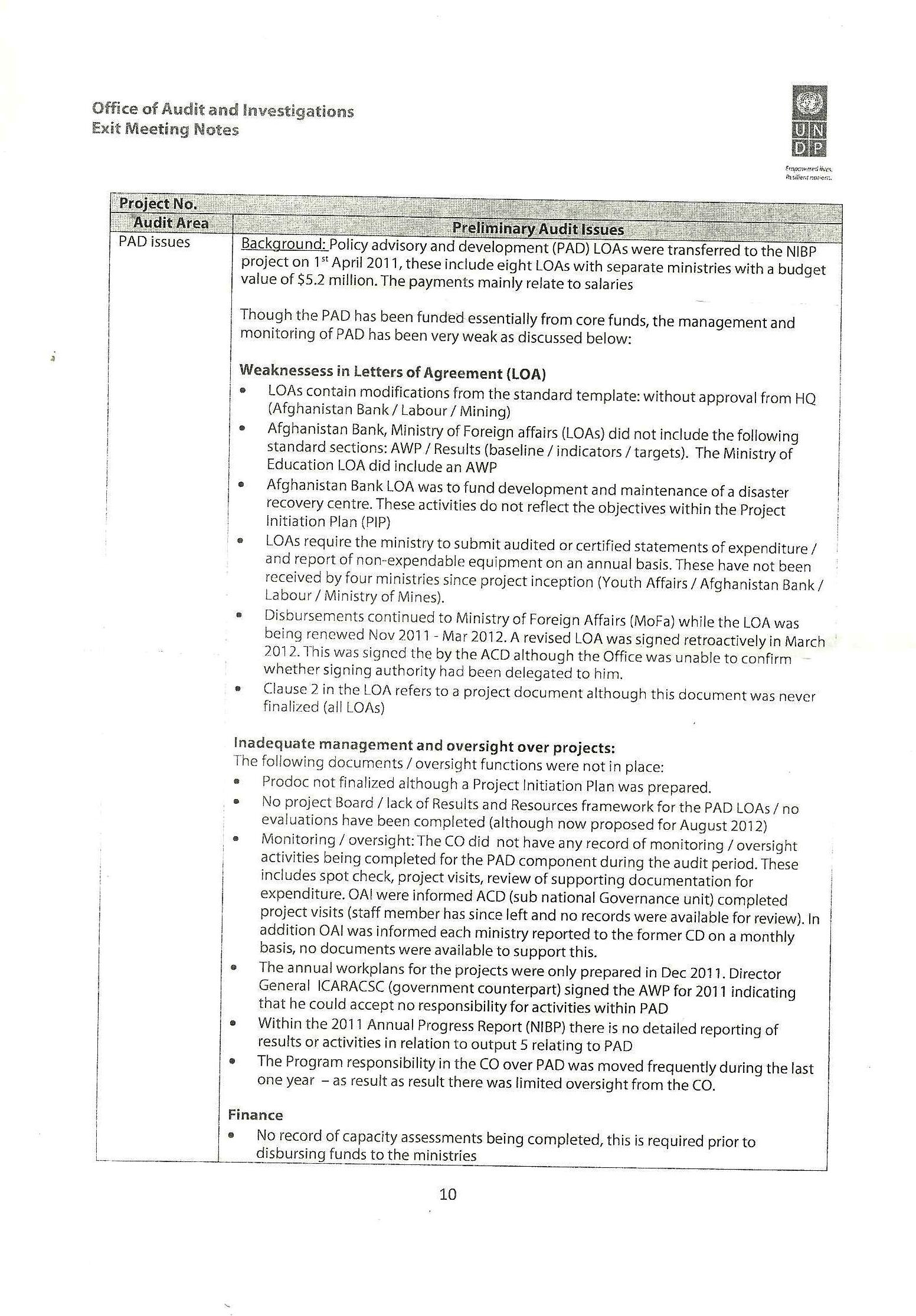
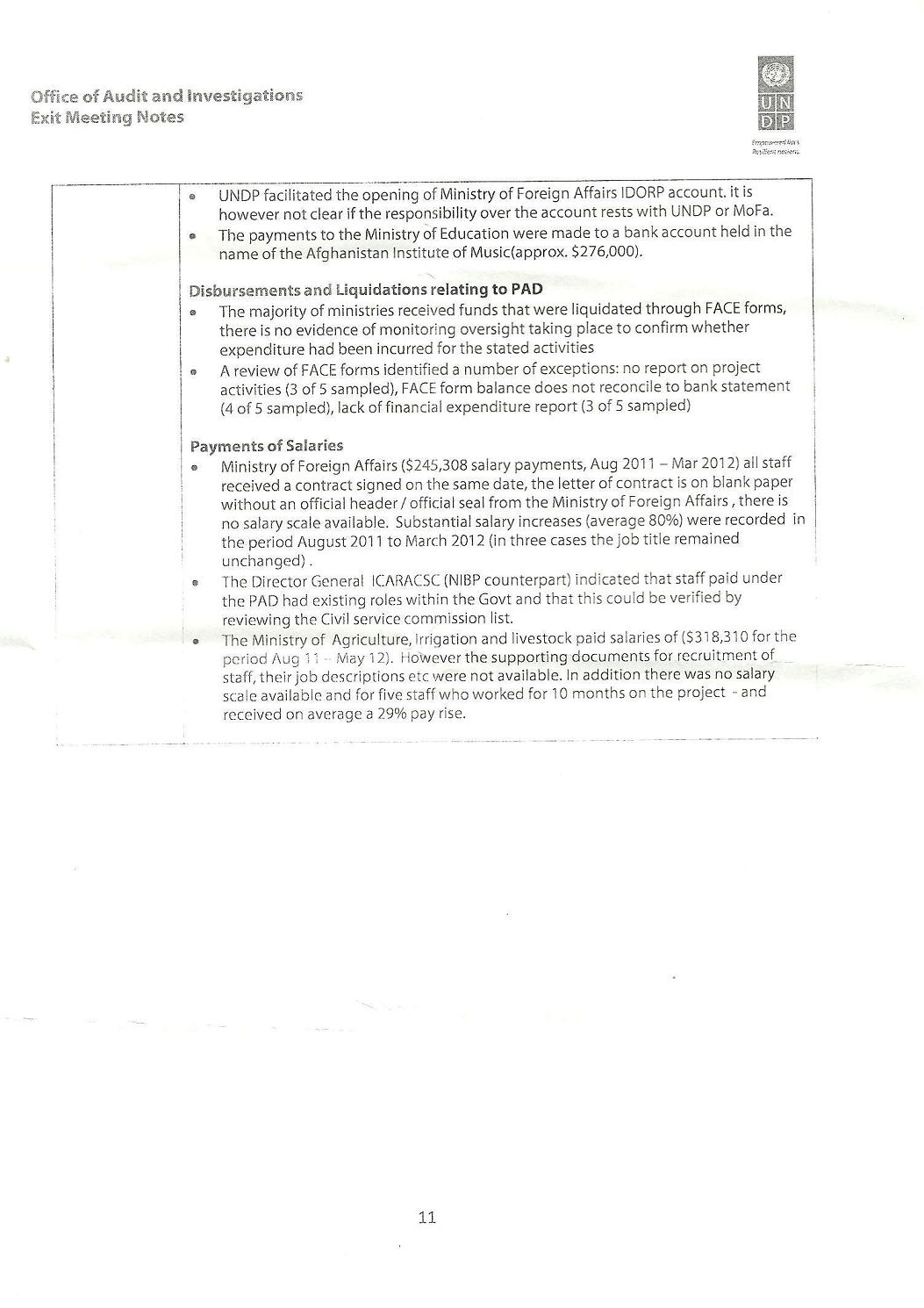
   But now another troubling audit has come in from sources to Inner City Press, of UNDP's policy and advisory development Letters of Agreement in Afghanistan; two pages are being exclusively published today by Inner City Press. 

   The problems are myriad: money paid to the wrong Afghan ministry (in one case, to the Institute of Music instead of to the Ministry of Education); contracts on blank paper without letterhead at the Ministry of Foreign Affairs; no oversight, no required audits. Click here for Page 1 of this audit; click here for Page 2.

  Back on September 20, Inner City Press asked the UN system's top envoy to Afghanistan Jan Kubis about the series of audits of the Law & Order Trust Fund for Afghanistan published by Inner City Press over the past three months; he said there will be a public accounting. Video here, from Minute 3:37.

   This is more than Inner City Press has received from UNDP, which has sent a few responses but no direct comment on the exclusively published leaked audits. 

   Inner City Press asked Kubis about a letter the European Union sent to Kubis about the scandal, which Inner City Press put online here.

  Kubis said that the EU states are more and more convinced that the necessary steps are being taken by UNDP. He said the auditing of LOTFA is going on, but a midterm review will give rise to general public information.  But when?

    Inner City Press exclusively published three more audits. In LOTFA "Observation 19," the auditors drily note:

"During the course of our physical verification of assets, we noted that some of the assets, which were appearing in Statement of Assets, were not physically present."

  This diplomatic "not physically present" phrase, if accepted, would have a good future on all manner of criminal defense. 
 
In Observation 18, the auditors state that "during the course of our audit we noted certain instances where purchase orders were not raised in respect of procurement of goods," including over $300,000 for the purchase of Toyota vehicles.

   Observation 17 "note[s] instances where evidences of required approvals by Special Procurement Commission were not available with the contracts" and "recommends that the provisions of the Afghanistan Procurement Law should be complied" with. Ya don't say.

  Beyond this UN system corruption, there is a more serious debate about the proposed spending on constructing a new electoral roll -- would it be done fairly for all groups and how much would it cost. This question could not be asked - Kubis had a flight to catch.
 On his way out he told Inner City Press that the electoral issue, and how the 19% budget cut to UNAMA is being (mis?) implemented, would still be issues when he comes to the UN next time. We aim to be here, and to ask. And now the UN Security Council is considering traveling to Afghanistan. Watch this site.

Click here to read this at InnerCityPress:  http://www.innercitypress.com/auditpad1undp100212.html

Tuesday, June 5, 2012

Euroepan Union doesn't trust Helen Clark's UNDP anymore. EU pulls the plug$$$ from Projects in Afghanistan (Calls it a corrupt structure)

Wall Street Journal: - EU Freezes Cash for U.N.'s Afghan Police Fund

KABUL—The European Union is blocking the release of €30 million ($37 million) to a United Nations-run fund that finances Afghanistan's police force amid an investigation into alleged mismanagement and corruption at the U.N. program, Western officials in Kabul said.

The EU had previously put the funds on hold pending a determination that the Afghan police force had made certain improvements, the officials said.

European leaders, adding a new condition, decided to keep the funds frozen until they are also satisfied that the U.N. has addressed allegations, reported by The Wall Street Journal on May 10, that officials running the program ...

CLICK HERE TO READ THIS ON WALL STREET JOURNAL 

Wednesday, March 14, 2012

CanadaFreePress: UN is Fleecing US and the EU Carbon Tax

CLICK HERE TO VIEW THIS ON CANADA FREE PRESS

Politicians in America and the current administration are fleecing the American public with their Green Environmentalist Agenda 21 driven by the United Nations and its bureaucrats


Author
- Dr. Ileana Johnson Paugh

The EU charges a carbon emissions fee, an “extra terrestrial tax.” This is viewed by non-European governments as an attack on sovereignty. China’s airlines have refused to comply. “Some non-European airlines may have to choose whether to obey the law of their land or that of Europe.” Companies refusing to comply would be fined and denied the right to land in the 27 countries that are members of EU.

The European Court of Justice has already rejected the legal basis of a challenge raised in London by North American airlines. Carriers have until April 30 to calculate their damaging annual emissions and to buy polluting rights for 2012. Delta Airlines has already added a surcharge to passenger tickets. The scalping of the developing world continues. Each flight will cost us an additional $32 of a round-trip long-distance ticket. The financial gains are substantial for the bureaucrats since 655 million people flew to Europe last year.

The United Nations is pushing for a global deal through its International Civil Aviation Organization (ICAO). It does not matter that global warming has been debunked, the EU and UN coffers must be replenished by hapless developed world citizens and the wealth must be spread to developing nations in the name of “social justice.”

The media did not report on the temperature rise in the U.S. during the time period when no airplanes flew after the 9/11 attack, proving that pollution from airplanes does not increase temperatures, on the contrary, it provides a level of cooling protection. (Lord Monckton)

Never mind that the United Nations no longer lives up to its charter of world peace and is indoctrinating children and the population into the green sustainability hoax. UN wants more than the $516.3 requested from the United States for its regular budget and more than the $2.182 billion requested for the peacekeeping budget.

In 2009, U.S. contribution to the UN octopus was $6.347 billion. US have provided aid to UN since 1945, currently giving 22 percent of UN’s operating budget and 27 percent of its peacekeeping budget. (OMB)

Aaron Cantor, USAF (retired) perfectly encapsulated the peacekeeping mission of the United Nations “Ready, Aim, Flee.”

The Congressional Research Service revealed that we are giving hundreds of millions of dollars of foreign aid to some of the world’s richest countries while borrowing billions from them. More specifically, we gave $1.4 billion to 16 foreign countries that hold at least $10 billion in Treasury securities. China received $27.2 million, India $126.6 million, Brazil $25 million, and Russia $71.5 million.

Palestinians receive $400.4 million in economic aid, $100 million to support the Palestinian Authority police training, $61.5 million in emergency humanitarian aid after Israel’s “assault on Gaza,” an actual retaliation for all the rockets fired randomly from Gaza into Israel.

Fritz Vahrenhold and his geologist colleague, Sebastian Luning, work for the German utility company RWE. They published a book last month, “Die Kalte Sonne” (“The Cold Sun”) in which they claim that important research about climate change was hidden and “cries of an impending catastrophe are misleading.” “The world is not facing a climate catastrophe.” The authors are dismissing the “CO2 lie” – it is not greenhouse gases that cause problems, it is the sun that determines climate change.

The most relied upon source of information on the topic is the climate report produced by the United Nations, more specifically the Intergovernmental Panel for Climate Change (IPCC). The report, produced by civil servants and not researchers, is full of misinformation and doubts. Yet countries around the world are basing their policies and fundamental changes of their citizens’ lives on a bogus report produced by bureaucrats.

Many climate researchers question the quality of computer models used to forecast climate change. “Knowledge of the effect of particle from industry, heating, and auto emissions as well as from oceans, volcanoes and from the soil is very low, according to the IPCC report. These particles serve as seeds for clouds, and some estimates suggest that an increase in the cloud cover by just one percent could offset a doubling of the CO2 in the air.”

Making matters worse, a trading scheme is now part of European Union laws. The EU is trading on emissions that would limit the release of “harmful greenhouse gases.” Prices for CO2 certificates have dropped constantly to about half, around $10.60 per metric ton, in spite of the closure of eight German nuclear power plants in 2011 and the increase in demand for coal power. The CO2 trading system is not working and is producing nothing but deceptive hot air because politicians decide the amount of CO2 that industries in the EU may emit way into the future.

Why are CO2 certificates so cheap? Other than the obvious that people understand it is a fleecing scheme, Germany for one spends billions on renewable energy. “With CO2 certificates so cheap, generating power from environmentally harmful fuels becomes even more than a good deal - which explains why brown coal consumption increased by nearly 4 percent in 2011, bucking the general trend.” Emissions trading is not stopping climate change, but actually speeding it up. (Alexander Jung)

Politicians in America and the current administration are fleecing the American public with their Green Environmentalist Agenda 21 driven by the United Nations and its bureaucrats. Do we want to become subservient to the laws of the European Union and United Nations or follow the supreme law of the land, the U.S. Constitution?

Monday, October 10, 2011

U.S. and Europe fight over cuts in peacekeeping

undpwatch
of and Europe fight over cuts in How can US afford to pay

By Colum Lynch @ Turtlebay.ForeignPolicy.com

Is austerity making the world a more dangerous place? Republican hawks are making the case that the Obama administration's planned Pentagon cuts are making the world safe for bad guys, and now European governments are looking at their defense expenditures as well -- and they're targeting the blue helmets budget line, particularly in peacekeeping missions favored by the United States.

Susan Rice, the U.S. ambassador to the United Nations, fended off a push last month by European governments to press to consider cuts next year in U.N.-backed peacekeeping mission in Liberia, which costs upwards of $525 million a year, more than Liberia's $459 million annual national budget. Rice has also resisted calls from other European governments, like Britain and France, to consider deeper cuts in U.N. peacekeeping missions in Haiti and in Sudan.

France and Britain are required to pay, respectively, 7.5 percent and 8.16 percent of all U.N. peacekeeping costs.

U.S. officials say that peacekeeping missions must be adequately funded to ensure their success, and that European governments, who each pay a far smaller share of the U.N. peacekeeping budget, are in some instances motivated by a desire to shift funding to their own "pet" missions, not the commitment to fiscal discipline that they claim.

"There is no country that has a greater interest in the economies, effectiveness, and efficiencies of U.N. peacekeeping missions [than the United States]. We pay 27 percent of the bill while the Europeans pay a smaller percentage," Rice said in an interview with Turtle Bay. "For them to be holier than thou is a bit rich, to say the least."

"We want missions to succeed at maximum efficiency and minimum cost," she said, noting that the United States has already agreed to send thousands of U.N. peacekeepers from Haiti and Liberia back home. "We are all feeling the strain.... But we are not going to sacrifice the effectiveness and success of missions by prematurely closing them or prematurely cutting them down beyond what the security situation on the ground will allow."

But while Rice is backing a prominent contribution to peacekeeping, the Obama administration is seeking cuts elsewhere at the United Nations, delivering a series of sharply critical statements about the organization's failure to tighten its belt and cut waste in these hard times.

The debate is unfolding at a time when the United States and other major donors are facing major financial crises at home, prompting their envoys to press for deeper cuts while securing support for operations of critical national interest. The U.N.'s administrative and peacekeeping budget, however, has been expanded over the past decade, and shows little sign of contracting.

"We meet at a time of severe -- and worldwide economic challenge.... Member states around the world are under financial strain," said Joseph M. Torsella, the U.S. representative for U.N. Management and Reform, in a Sept. 29 speech calling for more belt-tightening before the U.N.'s main budget committee. "That is the simple reality we face, all of us: in a time of scarce resources, the United Nations cannot afford business as usual. But that unfortunately, is exactly what is represented in this budget."

The United Nations currently has about 120,000 peacekeepers serving around the world at a cost of more than $8 billion, with about 27 percent of that amount paid by the United States. Indeed, those costs don't even include a series of expensive "special political missions" in Afghanistan($200 million), Iraq ($200 million) and now in Libya ($10 million in start-up costs) that are favored by the United States. (The U.S. pays only about 22 percent of the costs for these missions.)

The missions in Afghanistan and Iraq are unpopular, however, among developing nations, who say the United States, Britain, and France get a discount because the operations are funded through the U.N.' regular budget. (Under a highly complex set of U.N. budget rules, the five permanent members of the Security Council -- the United States, China, Russia, France, and Britain -- have to pay a premium on peacekeeping missions, because of their special role in establishing them.) But now budget strains are bringing the United States and its allies at the U.N. into conflict, as competition for scarce resources increases. And even more draconian budget cuts may be coming.

"We're gearing up for a big -- cross-the-system-wide -- fight over the budget, and the peacekeeping stuff will be part of that," said Bruce Jones, the director of NYU's Center on International Cooperation. "There will be a decreasing budget one way or another [because of the] financial crisis. Nobody has any money left."

France, which oversees the U.N. mission in Ivory Coast, has been engaged in a running competition with the United States over resources.

In a cost-cutting effort, the U.N. Security Council decided six years ago to pass a resolution requiring the United Nations to share peacekeeping personnel and equipment among the three West African missions in Liberia, Sierra Leone, and Ivory Coast. The deal has led to enormous friction between the United States and France, which has sought periodically to borrow for use in the Ivory Coast three Ukrainian-piloted attack helicopters, which are based in Liberia.

The arrangement has not always gone smoothly.

In 2006, the United Nations made a request for a battalion of Liberia-based peacekeepers, plus a team of 140 police officers, to assist the U.N. mission in Ivory Coast, which had come under attack by forces close to then President Laurent Gbagbo. They only secured the support of a much smaller company of peacekeepers.

The United States allowed the Liberian-based helicopters to be used in a French-led military offensive that toppled Gbagbo's government earlier this year, after he refused to accept defeat in U.N-certified elections. But U.N. diplomats say the United States still dragged its feet. "This time took a couple of weeks longer than it should have," said a council diplomat.

A senior U.S. official said that French complaints about American stinginess are a "bit galling," given that the United States has allowed the French to use the helicopters for the better part of a year, and only demanded them backas Liberia headed towards a landmark second presidential election. "We have been very flexible," the official said. "The French took the view that these were their helicopters.

The United States has long historical links to Liberia, which was settled by freed American slaves. And Washington has resisted a European push for further U.N. troop reductions in the U.N. mission in Liberia, which stands at more than 7,000 international blue helmets, down from more than 15,000 in 2006. In September, Rice blocked an amendment by the Security Council's four European governments -- Britain, France, Germany and Portugal -- to consider carrying out a review of the costly U.N. peacekeeping mission in Liberia, with a view to trimming costs.

"We are not ready to predetermine Security Council actions on so important a matter as UNMIL's drawdown, given uncertainties surrounding the election and tensions in the region," Rice told the council after the vote, expressing hope she could consider cuts next year. "Now is not the moment to impose rigid timelines on UNMIL."

The U.S. refusal to wait for a review of the mission's mandate infuriated European delegations, who took a veiled swipe at the Americans in their explanations of the vote. "We are disappointed that Resolution 2008 did not take up amendments that a number of Security Council members put forward" to review the authorized military and troop strength in Liberia by May 30, 2012," said Britain's U.N. ambassador Mark Lyall Grant, "We do not expect any peacekeeping mission to be exempt from regular review by this council."

The tone has been sharp. Earlier this year, Lyall Grant also raised concerns about a decision to authorize and fund the deployment of 4,500 Ethiopian peacekeepers to Abyei, disputed territory that straddles the borders of Sudan and South Sudan.

"Why do we need so many troops?" Lyall Grant asked in a closed-door session of the Security Council, according to two diplomats who were in the room. It only required 10,000 British colonial soldiers, he quipped, to administer India. An Indian envoy responded that Britain had not been engaged in a state building effort.

British officials maintain that their concern is not limited to costs, but to the wisdom of maintaining large foreign peacekeeping missions in countries that are no longer at war, and no longer need foreign military assistance. Haiti, for example may be economically distressed and still recovering from the devastating 2010 earthquake, but it is not at war and still hosts some 12,000 U.N. peacekeepers. Britain believes its time to bring the blue helmets home.

"There are worrying reports that many ordinary Haitians increasingly see MINUSTAH as an occupying force," said Philip Parham, Britain's deputy U.N. ambassador. "We believe the continued presence of large number of troops is counter-productive and police officers, whether from UNPOL, or ideally the Haitian National Police, would be seen as a more sensitive and low-key presence on Haiti's streets."

The United Nations, backed by the United States, plans to reduce the size of the force in Haiti to about 8,000 troops, but will maintain a robust peacekeeping force to fill the vacuum left by a national police force that is incapable of taking full responsibility for security. Jeffrey DeLaurentis, the U.S. ambassador for special political affairs at the United Nations, insisted that the peacekeepers remain with "strong rules of engagement...to deal with a stable but fragile security situation in Haiti. The United Sates believes that any determination of the future size of MINUSTAH forces must be based on security conditions on the ground."

The United States has long had interests in the fate of Haiti, an island nation located some 700 miles southeast of the coast of Florida. The country has sent large numbers of immigrants to the United States, particularly during periods of violence and political instability. Britain, on the other hand, has few vital national security interests in Haiti.

Rice was even blunter. If the British don't think a peacekeeping force is appropriate for Haiti, they "shouldn't have voted to authorize it in the first place, because the nature of it hasn't changed. The Haitian people and the Haitian government are not asking for it to leave now."

Follow me on Twitter @columlynch