click here for this story on FOXNEWS
By George Russell
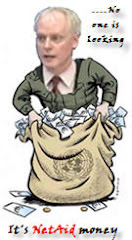
EXCLUSIVE: Four of the United Nations’ biggest development and aid agencies quietly piled up at least $12.2 billion in unspent cash by the end of 2009, according to a confidential draft report prepared for the government of Norway.
The four agencies with bulging bank accounts are the U.N. Development Program (UNDP), World Food Program (WFP), UNICEF, and the U.N. Population Program (UNFPA). Taken together, their cash position was the equivalent of 84 percent of the money that the four agencies would pull in for all of 2009, according to the study, which was examined by Fox News.
“UNFPA, UNICEF, UNDP and WFP are building up considerable reserves and/or [are] unable to spend a growing share of resources,” the draft report declares.
It adds that “the buildup of reserves implies that substantial donor funding is not being used for development purposes,” and warns that “it may also result in a situation where donors may not fund the U.N. system as much as before, until these reserves are utilized and brought down to an appropriate level.”
The report offers no similar opinion on a fifth agency included in the study, the United Nations High Commission for Refugees (UNHCR), which now refers to itself on its website as “the U.N. Refugee Agency.”
According to the Norwegian study, UNDP had $5 billion of unspent funds at the end of 2009.
According to the UNDP spokesman, the agency’s “balance of resources” at the end of 2010 was $4.8 billion, all of it “earmarked for specific programmatic activities to be undertaken in 2011 and beyond.”
The other agencies mentioned had cash positions of lesser amounts. At WFP, for example, the unspent funds “exceeded $4 billion” at the end of 2009. According to a WFP spokesman, the exact total was $4.0581 billion in 2009 and $4.0941 billion in 2010. For UNICEF, the tally at the end of its 2008-2009 fiscal year was $2.7 billion, and the 2010 year-end total was $2.2 billion. For the much smaller UNFPA, the tally of reserves and unspent funds was $500 million, according to the report, and $484.3 million in 2010.
None of the agencies analyzed in the Norwegian study would comment on the document when queried by Fox News, on the grounds that the document was still in draft form.
All of the agencies, however, objected to the notion that the unspent money in their treasuries was a reserve, in the sense of free cash that could be used for any purpose. All four said instead that the money represented funds for the future years of programs that had already been approved.
“These funds are committed, they are not fungible and do not represent an accumulated reserve,” underlined a spokesman for the United Nations Development Program, the U.N.’s flagship anti-poverty agency. (Budgets for all of the organizations for 2012 are still in various stages of preparation.)
The two-volume study, prepared for Norway last month by the private consulting firm IDC, has the intimidating title of “Activity Based Financial Flows in U.N. system: a Study of Select U.N. Organizations.” Its intention, the report says, is not to produce an overall evaluation of U.N. aid, but instead to “contribute to the understanding of financing flows and current financial planning and budgeting processes,” at the selected U.N. agencies, including “how are resources allocated” and “where does the money go.”
Those questions are a matter of increasing concern “partly in response to the need to accelerate growth and poverty reduction and partly in response to demands from governments facing fiscal constraints and taxpayers,” the study says.
Norway’s is hardly the only government concerned with the way the U.N. gathers and spends funds, and how well it uses the proceeds. In March, a hard-nosed British government study threatened to pull the financial plug on four relatively minor U.N. agencies for their lack of effectiveness, even as it gave good marks to most of the agencies mentioned in the more recent Norwegian study.
Click here to read more on that story.
One reason for the increasing government interest is the sheer difficulty in determining how the sprawling but dramatically fragmented U.N. system, taken as a whole, does virtually anything.
A total of 28 different funds, agencies, programs and other organizations make up the main outlines of the system, each with their own financing and accounting procedures, governing bodies and planning systems, and even their own nomenclatures. (Just last month, for example, the World Food Program’s executive board decided to switch from a two-year planning cycle, aligned with a two-year, budget appropriation, to a three-year planning cycle and single-year budget appropriations.) Many of their important financial tools, such as internal audits, may not even be available to the countries that ultimately pay their bills.
Norway is a major donor to all five of the U.N. agencies in the study, forking over $909 million in 2010, according to the study, though it lags far behind the U.S., which contributed $2.58 billion last year to the same U.N. grouping.
Yet, as the study indicates, even if the money is accounted for, it still raises questions about how the U.N. agencies are raising and spending their funds, a view underlined further by Brett Schaefer, a specialist on U.N. budgets at the conservative Heritage Foundation in Washington.
“First and foremost, why do these organizations keep increasing their budgets when they apparently cannot effectively spend the resources that they requested previously?” Schaefer told Fox News.
“Whenever Congress considers reducing U.S. contributions to them, they and their supporters plead poverty and warn of dire consequences that would result. Instead, the evidence indicates that they have routinely requested more resources than they require.”
Whether Schaefer’s conclusion is justified or not, the U.N. agencies in question have undoubtedly been receiving and spending money at an increasingly torrid clip. As the study notes, they have taken in nearly $100 billion in the past decade, and in the process doubled or even nearly trebled (in the case of UNDP) their spending rates.
Their collective average growth rate from 2001 to 2009 was 11.2 percent, a “very significant” number, the study notes, while also observing that during the same period there was a “very modest increase in disposable per capita income in most donor countries.”
Moreover, the five agencies also get the major share of money donated to U.N. aid agencies (excluding the U.N. Secretariat and peace-keeping operations): according to the study, which cites U.N. official sources to set the amount at about 70.5 percent of a development funding in 2008.
Most of the cost burden for the five studied agencies is born disproportionately by the top ten donor countries on the U.N. roster, led by the U.S.
Yet paradoxically, the study suggests, one reason for the huge piles of cash outstanding at the agencies may be the fact that neither the agencies themselves, nor their governing executive boards, have as much control over their spending as they used to.
That is because an increasing percentage of the donor money is earmarked for specific projects by the country or government agency that gives the funds, meaning it cannot be diverted to other uses, or spent as the agency itself may see fit.
Such earmarked funds, as the agencies themselves told Fox News, can often require spending over several years, leading to the pileup of unspent cash.
The study also notes that “earmarked contributions come with restrictions, reducing flexibility in the use of funds.” Translation: the money can only go where the donor wants it spent, which can clog the aid pipeline and also mean that help is not going where it is most desperately needed.
At UNICEF, for example, the study notes that “As a result of the increasing share of earmarked contributions,” the agency’s medium-term strategic plan “today sets priorities for only one-third of total expenditures.”In the case of the UNHCR, the study notes, “detailed accounts confirm that no significant funding goes to countries and programs that have not received substantial earmarked contributions.”
It’s also possible, according to the study, that U.N. agencies are biting off more in the way of funding than they can chew. At the end of 2009, for example, the study notes that roughly one-fifth of the staff positions at UNICEF were vacant, and “in many field offices and headquarters divisions, the vacancy rates were more than 30%.”
“These high vacancy rates,” the study said, “adversely affect the capacity of UNICEF to implement the planned activities.”
George Russell is executive editor of Fox News and can be found on Twitter @GeorgeRussell.