Wednesday, July 18, 2012
The Real Agenda Behind UN “Sustainability” Unmasked
Read full story at the New American
RIO DE JANEIRO — During the United Nations Rio+20 Conference on Sustainable Development in late June, Christ the Redeemer — the city’s most famous landmark, a massive statue of Jesus Christ on top of Corcovado mountain overlooking Rio — was illuminated using bright green lights. It was a fitting symbol for the controversial summit in more ways than one.
Shortly before the conference began, green legend James Lovelock — the scientist and environmentalist who first came up with the whole “Gaia” concept — warned that the “green religion” was now “taking over from the Christian religion.” While it may sound absurd to most Americans, for many Rio+20 summit participants, the stunt with green lights shining on the statue of Christ no doubt had a special meaning.
UN critics and many Christians, at least, were outraged. Lord Christopher Monckton, a policy advisor to former U.K. Prime Minister Margaret Thatcher and one of the most well-known opponents of the UN’s supposed environmental agenda, called it “a kind of childish message that the environmental religion is now replacing Christianity.” According to Lord Monckton, those who have lost the “true faith” nevertheless felt the need for religion and a common bond between themselves — and thought they had found it “in the spurious nostrums of Marxist environmentalism.”
Read full story at the New American


Tuesday, July 17, 2012

Fox News: United Nations says "NO" again to US State Department on North Korea and Iran
UN agency slammed after refusing US request for probe into Iran, N. Korea shipments
Read full story on Fox News: http://www.foxnews.com/politics/2012/07/17/un-agency-slammed-after-refusing-us-request-for-probe-into-iran-n-korea/#ixzz20tGnCvFu
A United Nations agency under fire for shipments of computers and other sophisticated equipment to North Korea and Iran has apparently rejected a request by the U.S. State Department to conduct an independent probe into the controversy, drawing a pointed bipartisan rebuke from top lawmakers on Capitol Hill.
In a letter being released Tuesday, the leaders of the House Foreign Affairs Committee complained to World Intellectual Property Organization Director General Francis Gurry about his agency's refusal to cooperate. They accused the agency of locking down key documents while trying to root out the whistle-blowers who alerted others to the scandal -- and then rebuffing the State Department's request for an outside investigation.
"We are outraged by your recent refusal on the basis of 'confidentiality,' of a request by the U.S. Department of State to conduct an independent, external investigation into how and why these transactions happened," wrote Reps. Ileana Ros-Lehtinen, R-Fla., and Howard Berman, D-Calif., chairwoman and ranking member of the committee, respectively. "There is no rational basis for this refusal. ... On the face of it, the documentary record, coupled with your public statements, shows a shocking and intolerable lack of judgment, together with an inclination to disregard the legitimate concerns of Member States and to retaliate against staff who are simply trying to tell the truth.
"However, if you truly believe that your actions have been entirely proper, then surely you would have nothing to hide and no reason to block the requested independent investigation," they wrote.
The lawmakers continued to call for an independent probe. And they described an agency pledge to have future shipments to Iran and North Korea reviewed by the U.N. Sanctions Committee "not sufficient."
Read full story on Fox News : http://www.foxnews.com/politics/2012/07/17/un-agency-slammed-after-refusing-us-request-for-probe-into-iran-n-korea/#ixzz20tGTGN7M
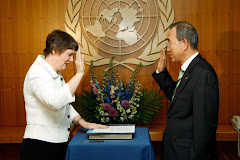
The 37th and 38th PMs of New Zealand
Click here to view this on Kiwiblog
Thursday, January 5th, 2012 at 7:00 am

Sent to me by e-mail. Very well done.
TVNZ: Helen Clark tobacco company award a 'travesty'
Click here to read this on TVNZ.CO.NZ
Former Prime Minister Helen Clark has been criticised for her role in granting a business award to India's biggest tobacco company.
Clark, who is now head of the United Nations Development Agency, presented India's largest cigarette maker, ITC (formerly Indian Tobacco Company) with the World Business Council for Sustainable Development's (WBCSD) highest prize for improving the environment and removing poverty.
"The award is possibly the biggest travesty of justice even by the UN and the World Bank's weak ethical standards," Pranay Lal of Union Southeast Asia, a lobby group fighting tuberculosis and lung disease.
Writing on India's Daily News and Analysis website, he said ITC was primarily a cigarette maker and tobacco trader although it now claims to be a diversified company selling soap, biscuits and hospitality.
He asked why the UN, the World Bank or even the World Health Organisation continue to partner and recognise perverse industries like tobacco companies.
"The answer is simply - money. Starved of public financing, the UN agencies rely upon 'voluntary' contributions like donors, private philanthropies and companies."
He said ITC and Brazil's largest tobacco producer, Souza Cruz, were close to UN policy because of their funding.
"What is tragic is that Helen Clark, a responsible prime minister and wife of a respected public health expert could not have given this award in New Zealand or any other developed country," Lal said.
Clark is married to Auckland University public health specialist Peter Davis.
"WBCSD is a curious club of organisations ranging from the most wanted corporate criminals (Dow Chemicals) to good Samaritans (Infosys), Lal said.
Dow is reviled in India in the wake of the Bhopal gas disaster in 1984 in which up to 12,000 people may have died. A number of corporate officials have been convicted over the disaster in India, but Dow internationally does not accept liability.
ITC's chairman, Y C Deveshwar, accepted the award from Clark.
"I receive this award with humility and pride, on behalf of the hundreds of thousands of tribals and poor farmers whose lives have been transformed by ITC's Social and Farm Forestry initiative," he said.
Monday, July 16, 2012
Douglas Keh of UNDP Sri Lanka says: "Obama didn't come to Rio+20 because of upcoming US elections -- but US communities are being organized around the main themes of Rio and UN leadership"
Is UNDP organizing communities in United States territories ?
How Agenda 21 and Sustainable Development is being mainstreamed in USA ?

Friday, July 13, 2012
Forbes: Why United Nations Reform can't wait
Click here to read full article on Forbes
It’s no secret that the United Nations hasn’t lived up to its billing as a champion of human rights and democratic values since its establishment in 1945. All too often, the UN system has aided and abetted some of the world’s most odious regimes—and served as a political weapon for those countries against the West. Yet even by these standards, this summer has seen an unprecedented level of rot in the world’s most powerful international forum.
Iran, under mounting pressure from the international community for its persistent nuclear ambitions, was elected to a top post at the UN Arms Trade Treaty conference in Geneva in early July. To add insult to injury, the news came just days after the Islamic Republic was found to be flouting UN restrictions by shipping arms to the regime of Syrian dictator Bashar al-Assad—arms that Assad has subsequently used against his own people.
Click here to read full article on Forbes
National Review: - Tilting at the U.N. Windmill. Not everything the U.N. does is evil. Some of it is just incompetent.
Click here to read this on National Review
By Jonah Goldberg
Those of us who believe the United States would be best served by pulling out of the United Nations and starting up a more morally and politically serious clubhouse for morally and politically serious nations are often accused of tilting at windmills.
The phrase “tilting at windmills” was inspired by Cervantes’ novel Don Quixote, and it means to fight something that doesn’t really deserve to be fought. Quixote mistook the windmills of the Spanish countryside for ravenous giants and set out to vanquish them. (“Tilting” is a jousting expression, in case you didn’t know.)
Well, let’s review some recent evidence.
The U.N. has been working hand-in-glove with the Chinese government to make the Chinese one-child policy as efficient and ruthless as possible. “Our conclusion is that the [United Nations Population Fund (UNFPA)] is directly responsible for forced abortions and forced sterilizations in China,” Steven Mosher, president of the Population Research Institute, recently told Congress in prepared testimony.
Of course, not everyone dislikes the one-child policy. Vice President Biden has supported it, and President Obama restored UNFPA’s funding when he took office. So let’s move on.
Lots of people like the Internet, right? Well, good news! The U.N. wants to take it over. The International Telecommunications Union, a U.N. organization, is secretly debating proposals to claim jurisdiction over the Web and take it out of America’s hands. The major forces behind this push: authoritarian regimes eager to censor their domestic Internet and monitor their citizens. Russia and some Arab countries, reports the Wall Street Journal’s Gordon Crovitz, want the power to read private e-mail. Others want to tax cross-border Web traffic. And countries like China are working hard to bribe, bully, or barter votes in favor of the U.N. takeover.
You see, that’s what dictatorships do at the U.N.: work to make the world safe for dictatorships. The most brutal regimes on the planet are constantly trying to get on or game the Human Rights Council so they can spend all of their time condemning Israel and blocking any attempts to censure their own regimes.
Not everything the U.N. does is evil. Some of it is just incompetent. The whole of what passes for the “international community” has been trying to enforce sanctions on Iran and North Korea. But nobody told the U.N.’s intellectual-property agency, it was revealed earlier this month, so they went ahead and gave North Korea and Iran computers and IT equipment.
A few days later, the invaluable human-rights group U.N. Watch reported that Iran was elected to the U.N. Conference on the Arms Trade Treaty, despite having just been declared guilty — in a U.N. Security Council report! — of illegally shipping guns and bombs to Syria.
Speaking of Syria, which is currently violating agreements to not murder its own people, it recently had a big victory at the Human Rights Council. Syria co-sponsored and passed a resolution pushed by Cuba (and supported by the usual Legion of Doom nations) to establish a “Right to Peace.” The document is a lot of boilerplate until you get to the part where it says “all peoples and individuals have the right to resist and oppose oppressive colonial, foreign occupation.” This is Middle East–speak for “It’s okay to blow up Israelis.”
Now these are all just recent news items. But you can play this game any time you want because the U.N. always provides fresh hells for us to marvel and laugh at.
For example, the United Nations website tells us that there is something called the Open-ended Ad Hoc Working Group of the General Assembly on the Integrated and Coordinated Implementation of and Follow-up to the Major United Nations Conferences and Summits in the Economic and Social Fields. Who among us doesn’t sleep better knowing the OAHWGGAICIFMUNCSESF is working for us?
Alas, the U.N. website notes, “The Ad Hoc Working Group was last active during the 57th session of the General Assembly in 2003.” In other words, the ad hoc open-ended working group is so open-ended it hasn’t met in nearly a decade.
But that’s the great thing about the U.N.: It never fails to surprise us with its predictability.
I’m beginning to think the U.N.’s defenders are the Don Quixotes, only in reverse. Where the critics see the reality of the ravenous giant, the U.N.’s defenders can only see a harmless windmill converting hot air for the good of all mankind.
— Jonah Goldberg is editor-at-large of National Review Online, a visiting fellow at the American Enterprise Institute, and the author of The Tyranny of Clichés. You can write to him by e-mail at JonahsColumn@aol.com, or via Twitter @JonahNRO. © 2012 Tribune Media Services, Inc.
Click here to read this on National Review
Thursday, July 12, 2012
Commentary Magazine: Time for Ban Ki-moon to resign - he is incapable of managing the UN
CLICK HERE TO READ THIS ARTICLE ON COMMENTARY MAGAZINE

Several years ago, I took the opportunity to hear UN Secretary-General Ban Ki-moon speak at a Johns Hopkins University School of Advanced International Studies graduation. The Secretary-General is not the most dynamic speaker and, if memory serves, his speech was basically pabulum, talking a great deal about meetings he had had; if there was a focus, it was probably on global warming. To be fair, while his predecessor Kofi Annan is a better public speaker, there is little substance to Annan’s speeches as well.
The problem with many of the UN Secretaries-General is that they have redefined their position to be that of the world’s diplomat, and have assumed a bully pulpit for which they have no right. When the UN was created, the purpose of the secretary-general, first and foremost, was to be the UN’s administrator. He was meant to make the organization’s bureaucracy function in a clear and efficient way.
By this standard, both Ban Ki-moon and Kofi Annan have been abject failures. Take the most recent scandal at the United Nations: The World Intellectual Property Organization (WIPO) shipped hi-tech computers to Iran and North Korea in contravention of UN sanctions. That is a failure of administration at the highest level. In any normal organization, it would lead to the resignation not only of WIPO’s director, but also that of the UN administration, because it was the failure of the secretary-general’s oversight that allowed this transaction to occur.
The same is true with Kofi Annan. There has seldom been a statesman who enjoys such a reputation as an elder statesman but whose record rests on failure. As director of the UN’s peacekeeping operation, Annan’s indecisiveness enabled the Rwanda genocide to develop and cost the lives of hundreds of thousands, a casualty count for which Annan has apologized. As director of peacekeeping operations, Annan also presided over the failure to protect the safe haven in Srebrenica in 1995, in which 7,000 men and boys were slaughtered by Serbian fighters. It was as secretary-general, however, where Annan truly failed. He ignored his primary responsibility as administrator-in-chief in order to traipse around the globe at donor expense, giving speeches and collecting laurels. By doing so, he presided over the worst corruption scandal to hit the United Nations, one for which he has never truly paid the price.
The United Nations has an important role. Having a place to convene enemies and combatants is a valuable enabler of diplomacy. If the UN secretary-general is unable or incapable of managing UN affairs, however, then either it is time for the UN secretary-general to resign or it is time to shrink the UN and its myriad agencies back to a manageable size. Rather than sweep the WIPO scandal under the rug, perhaps it’s time to erase this notion of a world diplomat and instead return the secretary-general to his original purpose as an administrator and facilitator.
CLICK HERE TO READ THIS ARTICLE ON COMMENTARY MAGAZINE
What is the UN Secretary-General’s Job?
Michael Rubin | @mrubin1971 Several years ago, I took the opportunity to hear UN Secretary-General Ban Ki-moon speak at a Johns Hopkins University School of Advanced International Studies graduation. The Secretary-General is not the most dynamic speaker and, if memory serves, his speech was basically pabulum, talking a great deal about meetings he had had; if there was a focus, it was probably on global warming. To be fair, while his predecessor Kofi Annan is a better public speaker, there is little substance to Annan’s speeches as well.
The problem with many of the UN Secretaries-General is that they have redefined their position to be that of the world’s diplomat, and have assumed a bully pulpit for which they have no right. When the UN was created, the purpose of the secretary-general, first and foremost, was to be the UN’s administrator. He was meant to make the organization’s bureaucracy function in a clear and efficient way.
By this standard, both Ban Ki-moon and Kofi Annan have been abject failures. Take the most recent scandal at the United Nations: The World Intellectual Property Organization (WIPO) shipped hi-tech computers to Iran and North Korea in contravention of UN sanctions. That is a failure of administration at the highest level. In any normal organization, it would lead to the resignation not only of WIPO’s director, but also that of the UN administration, because it was the failure of the secretary-general’s oversight that allowed this transaction to occur.
The same is true with Kofi Annan. There has seldom been a statesman who enjoys such a reputation as an elder statesman but whose record rests on failure. As director of the UN’s peacekeeping operation, Annan’s indecisiveness enabled the Rwanda genocide to develop and cost the lives of hundreds of thousands, a casualty count for which Annan has apologized. As director of peacekeeping operations, Annan also presided over the failure to protect the safe haven in Srebrenica in 1995, in which 7,000 men and boys were slaughtered by Serbian fighters. It was as secretary-general, however, where Annan truly failed. He ignored his primary responsibility as administrator-in-chief in order to traipse around the globe at donor expense, giving speeches and collecting laurels. By doing so, he presided over the worst corruption scandal to hit the United Nations, one for which he has never truly paid the price.
The United Nations has an important role. Having a place to convene enemies and combatants is a valuable enabler of diplomacy. If the UN secretary-general is unable or incapable of managing UN affairs, however, then either it is time for the UN secretary-general to resign or it is time to shrink the UN and its myriad agencies back to a manageable size. Rather than sweep the WIPO scandal under the rug, perhaps it’s time to erase this notion of a world diplomat and instead return the secretary-general to his original purpose as an administrator and facilitator.
CLICK HERE TO READ THIS ARTICLE ON COMMENTARY MAGAZINE
Wednesday, July 11, 2012
U.S. Should Hold WIPO Accountable and Dissuade Future Violations of U.N. Sanctions
By Brett Schaefer
July 9, 2012
July 9, 2012
It is becoming increasingly clear that the World Intellectual Property Organization (WIPO) has transferred technology to North Korea and Iran that are prohibited by United Nations Security Council sanctions and U.S. law. These violations have spurred a State Department investigation and were raised at a House of Representatives Judiciary Committee hearing on June 27. The U.S. should hold the leadership at WIPO accountable and prevent repetition at WIPO or any other U.N. organization.
WIPO’s Mission
WIPO is a U.N. specialized agency with 185 member states focused on establishing international standards for protecting and facilitating access to intellectual property. WIPO administers 24 treaties establishing standards for patent, copyright, and trademark matters. The U.S. rightly supports most, if not all, of these treaties and efforts that strengthen protections for the intellectual property of American companies and citizens.
WIPO has been charged by its member states with providing developing countries with technical assistance, technology transfer, and policy advice. Broadly speaking, this effort is targeted at improving developing country adherence to legal norms and obligations embedded in WIPO-administered agreements on intellectual property, enhancing domestic governance and law enforcement for intellectual property, providing appropriate access to intellectual property, and implementing policies to bolster opportunities for their citizens to register and benefit from their intellectual property.
WIPO, North Korea, and Iran
Both Iran and North Korea are members of WIPO and are among the developing countries targeted by WIPO under the organization’s development agenda. These interactions are sensitive because Iran and North Korea are subject to significant sanctions enacted by the U.N. Security Council—which are binding on all U.N. member states and all U.N. organizations, including WIPO—barring sale, transfer, or other provision of equipment or material that could be used to advance their nuclear or ballistic missile programs.[1] Nonetheless, WIPO has conducted 48 specific technical assistance programs for Iran and 16 for North Korea.[2]
In April 2012, Fox News reported that WIPO (with Chinese cooperation) had shipped “computers and sophisticated computer servers to the government of North Korea” in a manner designed to “bypass safeguards specifically created by U.N. authorities to prevent a repeat of previous U.N. scandals involving shipments to North Korea.”[3]
The purpose of the computers was reportedly to allow North Korea to set up a modern patent office and allow it to more easily access WIPO’s database of more than 2 million patents. The transfer of the computers and equipment was approved and completed by WIPO in November 2011.
WIPO member states reportedly learned of the North Korean transfer only after the fact. Bank of America and the U.S. Office of Foreign Assets Control blocked the payment for the computers out of concern that it was in violation of U.S. law banning certain exports to North Korea. A letter from Moncef Kateb, president of the WIPO Staff Association, to the U.N. Joint Inspection Unit confirms that WIPO member states were kept in the dark:
Member States have not been consulted and have no knowledge of the project. Thus, they were not given an opportunity to review or object to it. The project was allegedly approved directly by the Director General.The Staff Council is extremely concerned by the fact that WIPO staff may be implementing a project in violation of two UN Security Resolutions related to Sanctions against the DPRK and possibly in violation of staff’s own international obligations, and their national laws.[4]
The letter reportedly led to a direct meeting with Director General Francis Gurry by representatives from the U.S. and other countries. The U.S. State Department also initiated an investigation of the issue.
WIPO legal counsel Edward Kwakwa wrote a legal memo to Gurry stating that “WIPO, as an international organization, is not bound by the US national law in this matter.”[5] However, the computer manufacturer, Hewlett-Packard, is subject to U.S. law, and by transferring the computers to North Korea, WIPO is in violation of its contractual obligations.
Kwakwa repeatedly asserted that it is “unlikely” that U.N. sanctions “restrict the computer transfer” but never indicated that WIPO actually consulted the sanctions committee to determine this fact. Moreover, while the memo asserts that there is “no provision excluding general computer technology” in the sanctions, the analysis neglects to address the possibility that the computers could be prohibited as a dual-use item.
The U.S. has indicated that it is also investigating WIPO shipments of sensitive technologies to Iran, including 20 Hewlett-Packard computers.[6]
Victor Cormas, a member of the U.N. Panel of Experts assessing the Security Council sanctions on North Korea from 2009 to 2010, strongly criticized WIPO’s actions: “They are walking through the cracks and loopholes of the sanctions regulations. There should be some recognition that international organizations themselves are obliged to follow the rules.”[7]
Next Steps
Congress and the Administration are right to be concerned about alleged acts by WIPO to circumvent sanctions on North Korea and Iran. However, direct action against WIPO is likely to be ineffective. WIPO’s funding structure—which relies principally on private payments and fees for service from businesses rather than member state contributions (in 2011, the U.S. provided only $1.2 million to WIPO)—is unusual in the U.N. system and undermines the ability of the U.S. government to impose financial penalties and incentives on the organization. The U.S. could withdraw from WIPO,[8] but for the minimal cost of WIPO dues, it is better for the U.S. to retain the oversight privileges of membership.
Thus, the U.S. should exploit less direct steps to address the current situation and prevent repetition:
- The State Department should complete the independent investigation of all WIPO activities in countries under Security Council sanction, and Congress should hold a hearing on the report’s conclusions;
- The U.S. representative to WIPO should call for the immediate dismissal of Gurry and Kwakwa for failing to alert the member states about the Iranian and North Korean transfers, failing to alert the Security Council sanctions committees about the transfers, and facilitating WIPO’s violation of its contractual obligations with Hewlett-Packard;
- The U.S. should call on the Security Council to issue a statement reminding all U.N. specialized agencies, funds, programs and other bodies that they are bound by Security Council sanctions and that the sanctions committees must receive advance notice of any transfer of goods, equipment, technology, or individuals to sanctioned countries;
- The U.S. should also draft a Security Council resolution requiring complete and immediate cooperation and transparency by all U.N. organizations in investigations into alleged violations of Security Council sanctions;
- The U.S. should demand that the Secretary-General adopt a policy that U.N. immunity from domestic prosecution will be immediately waived when credible evidence is presented of U.N. staff violating or assisting in the violation of Security Council sanctions; and
- The U.S. should also explore the possibility of giving the Chief Executives Board for Coordination (CEB)—which is made up of the heads of all major U.N. funds, programs, and agencies under the chairmanship of the Secretary General—institutional responsibility for transmission of sanctions information to U.N. bodies and require that they report any and all contacts with sanctioned member states to the CEB, which, in addition to the U.N. organization, would be charged with alerting the Security Council of these activities.
Cause for Concern
The evidence indicates that WIPO transferred technology to North Korea and Iran that could be used by those regimes to advance their nuclear and missile programs. These actions may violate U.N. sanctions, and the U.S. is right to investigate these actions.
Regardless of the outcome, however, the leadership at WIPO has demonstrated grave lapses in judgment in failing to alert the member states and the sanctions committees of these transfers and should be held accountable.
Moreover, the U.S. should take steps to forestall similar incidents by WIPO or other U.N. organizations through the Security Council and urge changes in U.N. policy to enhance transparency and accountability.
Brett D. Schaefer is Jay Kingham Fellow in International Regulatory Affairs in the Margaret Thatcher Center for Freedom, a division of the Kathryn and Shelby Cullom Davis Institute for International Studies, at The Heritage Foundation.
Tuesday, July 10, 2012
UNDP's concept on Governance of Sustainable development ( paying top dollars for brains like this??)
This is the concept of Governance of Sustainable Development and the
Governance of the Governance of Sustainable Development

@UNDP pays top dollars for such brain washing, while none of these would even be able to find a job at a 7-eleven. Listen to the level of the presentation, and just think that this is remunerated at a level close to 9000 (nine thousand) a month.
Subscribe to:
Posts (Atom)