Saturday, August 28, 2010

The accidental NGO and USAID transparency test

Aid Watch: just asking that aid benefit the poor

By Guest Blogger |

The following post was written by Till Bruckner, PhD candidate at the University of Bristol and former Transparency International Georgia aid monitoring coordinator. An op-ed from Bill in Monday’s Wall Street Journal mentioned Till’s struggles with USAID; here Till provides the details.

The aid industry routinely pushes institutions in developing countries to become more transparent and accountable. But a slow and almost comically incomplete donor response to a request to see some specific project budgets sheds light on exactly how willing donors are to apply such “best practices” to themselves.

As I described in a previous Aid Watch blog post, I filed a Freedom of Information request with USAID after ten international NGOs working in the Republic of Georgia refused to publish their project budgets. After a painful, 14-month struggle, including failing to respond at all to my first three communications, USAID finally released a set of documents covering project budgets of 19 UN bodies, NGOs and private contractors.

A portion of World Vision project budget provided by USAID

The documents are disappointingly full of blacked-out non-information. The level of disclosure varies drastically from one document to the next. Some budgets are provided in full, while others appear as blacked-out row upon row. In three cases, USAID even withheld the identity of the contractor itself. USAID explained this inconsistency saying that it was legally required to contact each grantee to give it “the opportunity to address how the disclosure of their information could reasonably be expected to cause substantial competitive harm.”

I wondered why USAID is legally bound to follow its grantees’ wishes in deciding which information to withhold. Can the grantees of a US federal agency really compel that agency to keep the total amount disbursed, or even their very identities, secret? Why doesn’t USAID specify full disclosure as a grant condition? I have filed an appeal with USAID to address these questions, and will keep the readers of this blog updated.

Since according to USAID every piece of blacked-out information was withheld on request of the grantee, the budgets provide a fascinating glimpse into aid agencies’ willingness to open their books. If USAID blackouts do NOT correspond to NGO requests, I would be happy to correct the record.

Perhaps surprisingly, the United Nations showed the highest consistent commitment to transparency. The budgets of the two UN agencies funded by USAID are both reproduced in full.

UMCOR, Mercy Corps, and AIHA emerge as the most transparent NGOs. These charities apparently felt that they had nothing to hide, and did not request USAID to black out any of the information contained in their budgets.

In contrast, Save the Children apparently asked USAID to withhold all information related to salaries. As even the aggregate subtotals for international and national staff have been blacked out, concerns about the privacy of individual staff members cannot have been the sole concern driving the organization’s response. Still, the fact that all non-salary related budget lines remain visible put Save the Children in the middle ground in terms of NGO transparency.

CARE’s response is harder to interpret as USAID inexplicably sent only an aggregated “summary budget” that leaves little to conceal. What information exists shows that CARE did not object to the release of unit prices for supplementary food items, or of aggregated staff and operational support costs. In contrast, CARE appears to regard its “indirect cost rate” and “cost share” as confidential. To hide this information, USAID also had to black out the budget’s bottom line, thus leaving unclear how many taxpayer dollars were handed over in total.

Portion of CNFA project budget provided by USAID

The least transparent NGOs in this test are CNFA, World Vision, and Counterpart International. They apparently requested that USAID black out all information in their budgets except for the grand total. Apparently, these NGOs consider budget items such as “office furniture” (CNFA), “visibility items (t-shirts, caps, publications)” (World Vision) and “forklift expenses” (Counterpart) as confidential information whose release could cause them substantial competitive harm.

What does this transparency test tell us? First, USAID’s mechanism for responding to Freedom of Information requests desperately needs an overhaul. It took USAID 14 months to respond to a simple information request. Ironically, in terms of FOIA responsiveness, USAID is less transparent than public institutions in the Republic of Georgia, as recently assessed by a local watchdog organization. And we are still waiting to hear why USAID allows its own contractors to operate in secrecy whenever they wish. All of this places USAID in an awkward position as it recommends greater transparency and accountability to Georgia.

Second, NGOs have publicly committed themselves to transparency and accountability, but their actions show that their interpretations of what this entails in practice differ widely. For example, World Vision is a full member of theHumanitarian Accountability Partnership, but still asked USAID to hide all of its budget information apart from the bottom line. The Georgian country office of Mercy Corps had earlier refused to release its project budgets, but its headquarters apparently has no such reservations. Save the Children is willing to release indirect cost rates but refuses to divulge even aggregate salary information, while CARE appears more relaxed regarding human resource expenses even as it fiercely guards information on its indirect costs rates. Both USAID and the NGOs have too often violated the elementary principles of transparency.

Why Does UNDP Continue to Aid Repressive Regimes?

Brett SchaeferAUTHOR:Brett Schaefer

A recent story by Fox News provides yet another example of the United Nations Development Program’s refusal to accede to an unfortunate reality: that the organization’s efforts to work with, and through, the world’s most despotic regimes are regularly twisted to serve the goals of the regime rather than the people suffering under their rule. According to the story:

An independent assessment of a $100 million United Nations Development Program aid effort in Burma calls it ‘disappointing,’ and ‘unsatisfactory,’ and suggests that major portions of the program be discontinued next year. Nonetheless, the director of UNDP intends to keep it alive with as-yet unspecified fixes.

The assessment of the UNDP’s Human Development Initiative suggested there were ‘modest or only limited differences’ between the Burmese villages that got UNDP support and those that didn’t.

Among the areas of negligible impact: health care, education and ‘food security,’ meaning the vital business of whether the poorest were producing and saving enough food to eat in the military-controlled country also known as Myanmar….

Even while admitting that Burma is a ‘difficult and unpredictable’ environment for HDI, however, the assessors state firmly that UNDP’s own problems with community development programs are the most significant. Among them: lack of clear focus; inability to show that it has accomplished much beyond the delivery of tangible goods, such as fertilizer; lack of staff training; and perhaps most importantly of all, lack of any clear strategy to wean the people they are helping off continued outside assistance.

Aid to Burma—whose government has been accused of war crimes and crimes against humanity by the Obama Administration, is suspected of pursuing a clandestine nuclear program, and has imprisoned opposition politician and Nobel Peace Prize winner Aung San Suu Kyi 15 out of the last 21 years—has come under increasing scrutiny.

As reported in the FoxNews story, UNDP is under instructions from its Executive Board to ensure that its funds stay out of government hands. However, a 2007 report by a Burmese human rights group asserted that U.N. funding, including UNDP funding, supports state-controlled programs that employ extortion and forced recruitment to “expand military control over the population while divesting itself of the cost of operating programmes and simultaneously legitimizing its policies in the name of development.” In 2008, news storiesrevealed that the “United Nations discovered ‘very serious losses’ of at least $10 million on foreign exchange transactions involving relief money sent to cyclone-battered Burma.”

This is hardly surprising. A number of allegations have been made in recent years concerning improper activities funded by, or linked to, UNDP staff or projects in authoritarian states, including North Korea,Venezuela, and Zimbabwe. In some repressive states, the U.N. and NGOs can work around the government to help the people directly. In these cases, there is some justification for continuing U.N. humanitarian activities. In cases like Burma and North Korea, however, government interference and assertion of authority over humanitarian activities in country is so extensive that humanitarian efforts are crippled. Despite the best efforts of the U.N. and other providers of humanitarian assistance, aid is permitted only if it benefits the regime. In such cases, UNDP programs—and those of other U.N. agencies like WFP and UNICEF—end up inadvertently rewarding the government.

Many argue that the U.N.’s humanitarian work should continue regardless of whether the government benefits because some portion will aid the suffering population. There is little doubt about the suffering in places like North Korean and Burma. However, it is the repressive policies of the government that have most directly contributed to that suffering. Aiding the government, even inadvertently, perpetuates that suffering.

The Fox News story reports that internal assessments have assured the Executive Board that UNDP has not allowed its funds to be used by the government. At the very least, however, considering the “difficult and unpredictable” environment in Burma, UNDP assistance merits closer scrutiny to see if it is inadvertently benefiting the regime.

At August 30 meeting of the UNDP Executive Board—of which the U.S. is a member—the U.S. Mission to the United Nations should closely question all UNDP activities in repressive regimes like Burma, North Korea, Iran, Venezuela, and others countries and demand full and complete access to all UNDP documents and assessments to inform their examination. At a bare minimum, the U.S. should call for all such programs to be suspended unless the governments: (1) allow the U.N. and NGOs to hire and use local and international staff without government interference; (2) grant complete and free access to projects, distribution centers, and aid recipients to ensure that aid is not being diverted by the government; and (3) not impede non-governmental organizations helping to deliver aid and assess need.

Friday, August 27, 2010

UNDP's Assistant to Palestinians Beat Rohr Lists Ph.D from Diploma Mill, Helen Clark Through Spokesman Dodges Questions

By Matthew Russell Lee

UNITED NATIONS, August 26 -- To head UNDP's Program of Assistance to the Palestinian People, UNDP's Administrator Helen Clark recently named Mr. Beat Rohr of Switzerland, listing in her announcement his qualification that “Beat has.. a Ph.D in Management from the Pacific Western University in Los Angeles.”

There is a problem: a simple Internet search shows that Pacific Western University in Los Angeles is a discredited diploma mill that changed its name to try to put the scandal behind it.

"Pacific Western University, prior to an ownership change, changing its name and becoming accredited, was the subject of criticism concerning its unaccredited nature and quality of its programs. In May 2004 the USGovernment Accountability Office presented the results of an eight-month examination titled "Diploma Mills: Federal Employees Have Obtained Degrees from Diploma Mills and Other Unaccredited Schools, Some at Government Expense" to the U.S. Senate Committee on Governmental Affairs"

Inner City Press on August 25 asked UNDP spokesman Stephane Dujarric

please confirm that this Ph.D [is] from the then- Brentwood-based (and since re-name, after scandal)http://en.wikipedia.org/wiki/California_Miramar_University;

please provide UNDP's and Ms. Clark's comment on the information in the above link, that the institution was an unaccredited diploma mill; and

What due diligence does UNDP do, and did it do in this case?”

Dujarric asked for a day to produce an answer, and Inner City Press agreed and held off publication. But then Dujarric responded to the specific questions above with this statement:

Subject: Press questions re Beat Rohr and Pacific Western University, on deadline, thanks in advance
From: Stephane Dujarric [at] undp.org
To: Matthew Lee [at] InnerCityPress.com
Date: Thu, Aug 26, 2010

Matthew, Below is my answer to your question. Please print in full.

Beat Rohr’s academic credentials and years of professional service with UNDP and other organizations including UNHCR and CARE go above and beyond the requirements for the post of head of UNDP’s Programme of Assistance to the Palestinian People.”

Before publishing this non-responsive answer, Inner City Press asked again, adding “what do you say about the public reports about that university? What does Beat Rohr say? On what basis did he list this university, and what weight did UNDP give it?”

If and when UNDP, the UN, Ms. Clark or Mr. Rohr provide answers, they will be published.


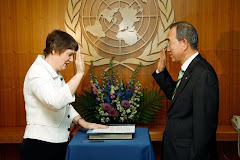
Helen Clark & UN's Ban, PAPP & Beat Rohr' discredited Ph.D not shown

For now, the public record shows that Ms. Clark's Special Representative to the Program of Assistance to the Palestinian People is listing a Ph.D from http://en.wikipedia.org/wiki/California_Miramar_University

Pacific Western University, prior to an ownership change, changing its name and becoming accredited, was the subject of criticism concerning its unaccredited nature and quality of its programs.

In May 2004 the US Government Accountability Office presented the results of an eight-month examination titled "Diploma Mills: Federal Employees Have Obtained Degrees from Diploma Mills and Other Unaccredited Schools, Some at Government Expense" to the U.S. Senate Committee on Governmental Affairs.[10] According to the report the investigation was conducted to determine whether the federal government had paid for, or governmental officials possessed, degrees from unaccredited schools. After the passage of the Homeland Security Act, Section 4107 of tile 5, U.S. Code was amended. After this act became law in 2002, the federal government could pay for the cost of academic degree training for federal employees only if the college or university providing that training was accredited by a nationally recognized accrediting body. As the basis of the report, the GAO searched the Internet for nontraditional, unaccredited post-secondary schools that offered degrees that met their search criteria. Pacific Western University in Los Angeles was one of the unaccredited schools on which the GAO found online and mentioned in the report. Of these schools mentioned in the report, California Coast University and Pacific Western University - California, were California State Approved institutions[11][12] at the time this report was presented. Although unaccredited at the time, both of these Universities have gone on to gain national accreditation[13] since the report was originally submitted.

Later that year, investigative reporters from television station KVOA ofTucson, Arizona, stated that PWU was one of seven schools identified as diploma mills by the GAO report.[14][15] The station reported that Pima Community College in Tucson had reduced the salaries of two faculty members who previously had been paid at the Ph.D level based on their degrees from PWU.[14] In a subsequent clarification of the original articleKVOA reported that one of the two professors contacted the station and disagreed that PWU was a diploma mill. The professor did not feel misled by Pacific Western, as the station reported, because the professor said it was approved by the California Department of Education to be an educational institution and to award degrees.[15]

Internationally, the media responded similarly to Pacific Western University and the GAO Report.[10][16][17] It was reported in the Irish Independent on 9 October 2005 that the Chief Science Advisor to the government ofIreland, Barry McSweeney, had been found to have advanced his career using a degree obtained from Pacific Western University.[18][19] The newspaper report stated that McSweeney had obtained his Ph.D. inbiotechnology and biochemistry from PWU in 1994 after just 12 months of study. The article went on to say "There is no question that Mr McSweeney has anything other than a distinguished track record in business. He has a degree in biochemistry from UCC and a Masters degree in clinical biochemistry from TCD. He was also in charge of the Marie Curie Fellowships, an EU-wide programme which has been credited with helping more than 35,000 scientists develop their careers. Mr McSweeney has been widely praised for his role in expanding this programme." It further described PWU as having "no merit or standing in the academic world" and having been "the subject of numerous official investigations, state bans and media exposés" during its 28 years of operation.[18] McSweeney was forced to resign his position as a result although the article stated that McSweeney had made no attempt to conceal the details of his education and that he was "proud" of his doctorate and "stood over it" and that he considered PWU California to be a "respected" and recognized body." Mr McSweeny's spokesperson went on to add: "Barry stands over his doctorate.....He has a degree from UCC, significant life experience, and was the director-general of the Joint Research Institute. I can't believe you're writing this." [20] In Australia, a lecturer at the University of Southern Queensland was banned from using the title of "Doctor" after it was discovered that his Ph.D. had been obtained from Pacific Western University.

And UNDP? Watch this site.

* * *

On Sri Lanka, UN's Holmes Speaks of Gov't Shelling, Casualties, 2 Sides' Propaganda

By Matthew Russell Lee

UNITED NATIONS, August 26 -- Asked about Sri Lanka on his final day as UN Humanitarian Coordinator, John Holmes offered a defense of his department's funding of the government's internment camps while admitting the government may have “deliberately shelled” civilians and hospitals. Video here, from Minute 17:29.

Inner City Press asked Holmes about criticism of his and the UN's actions in Sri Lanka, for example pulling out of Kilinochchi, funding the internment camps and failing even now to get to the bottom of the murder of the Action Contre La Faim humanitarian workers. Video here, from Minute 14:30.

Holmes called this the “ACF massacre,” and said it has still not been explained or even investigated. He did not explain the Kilinochchi pull out, which has been criticized including the International Crisis Group.

He said there's a need to know how many civilians were killed, when it was his OCHA unit which stopped reporting on civilians casualties when one of their reports was leaked to and published by Inner City Press.

Holmes began his answer by referring to the “heavy propaganda claims on both sides.” It was not clear if, beyond side of the the government and “Sinhalese extremists” -- to use Singapore's Lee Kwan Yew's description of Mahinda Rajapaksa -- Holmes meant the LTTE Tamil Tigers, or the Tamil diaspora.

As Inner City Press reported at the time, during Ban Ki-moon's trip to Sri Lanka in May 2009, Holmes during an on the record briefing on the UN plane said that he got lots of email from the Tamil diaspora alleging for example bias by Ban's chief of staff Vijay Nambiar. I just delete it, Holmes said of the e-mail.


John Holmes in the UN auditorium, accountability not shown

Later after complaints, Inner City Press tried to soften the story. But that is what he said. And since he said it, information has emerged about Nambair's still unexplained role in telling LTTE leaders who wanted to surrender to come out with white flags. They were killed, and the leader of the unit which did the killing is now reportedly coming to the UN as Sri Lanka's Deputy Permanent Representative.

Holmes is headed to a think tank of sorts, Ditchley Hall. Perhaps he will write a book -- and perhaps it will address these issues. We'll be watching.

On Congo Rapes, DPKO Faces Council Questions, New Element

By Matthew Russell Lee

UNITED NATIONS, August 26 -- On the Congo rape scandal, the UN Department of Peacekeeping Operations faced a rare barrage of questions from some Security Council members on Thursday morning. Inner City Press is told that DPKO has been asked for a copy of the July 30 e-mail noting the incursion of rebels into the area the 154 rapes would take place, and telling humanitarian workers to stay away.

The forthcoming Council press statement, the initial four elements of which Inner City Press exclusively published before the meeting, is being expanded with a fifth paragraph. Ambassador Susan Rice, it is said, will speak to the Press after the meeting and the Statement, to be read by Russia's Vitaly Churkin, the Council president for August.

Other members concerned with protection of civilians include Mexico, whose Permanent Representative Claude Heller said, even in this week's Council meeting on piracy, that “Mexico condemns and rejects these acts of sexual violence which cannot remain unpunished and deserve a categorical condemnation from the international community,” and “the Security Council should address in the appropriate time this serious issue.”

So if this is not the appropriate time, when is? Watch this site.

On Congo Rapes, Email About Rebels Exposes UN Lies, Security Council's Buzzword “Elements” Must Extend to Probe of UN

By Matthew Russell Lee

UNITED NATIONS, August 26 -- Amid the growingscandal of the mass rapes on Congo, 30 kilometers from the UN peacekeepers of MONUSCO, the UN Security Council is belated set to meet on August 26. In advance of the meeting, Inner City Press, which was the first to report the scheduling of the meeting, exclusively obtained the elements of the planned Council press statement that were circulated to members on August 25:

1) Condemnation in the strongest terms and expression of deep concern for these attacks;

2) Demand for complete cessation of all acts of sexual violence;

3) Call on the Government to fight impunity and investigate the matter; and

4) Welcome the dispatching of Assistant Secretary General Atul Khare.

This collection of buzzwords of the UN Security Council was circulated before the leaking, late of August 25, of news of

an e-mail alert from the United Nations Department of Safety and Security [which] was sent to United Nations staff members on July 30, the day the rapes began. The message warned them to stay away from the area — part of Walikale, in the North Kivu Province of Congo — because it had been taken over by rebels. 'Everyone got that e-mail,' said an officer from a humanitarian organization in the area, who spoke on the condition of anonymity on strict instructions from the organization. 'That rebel elements were active in those specific villages, and humanitarian workers should not go there.'”

Numerous participants in the August 25 video link up of MONUSCO chief Roger Meece with correspondents at UN headquarters immediately concluded that Meece had “lied through his teeth,” as more than one of them put it. Others said that the UN lying went beyond Meece, to nearly all communications on the rape scandal.

On August 23 and 24, after Inner City Press first asked about the rapes at that day's UN noon briefing, Spokesman Martin Nesirky claimed that the first MONUSCO and the UN knew of the rebels' incursion and the rapes was on August 12. He repeated this date again and again: “August 12, Matthew, August 12.”

On August 25, Meece carefully moved away from this account, acknowledging that there was some knowledge -- vague, as he put it -- of rebels in the area. But, according to Meece, when the MONUSCO peacekeepers went out on patrol on August 7, they went the other way, away from the site of the rapes.

With news that they “all” got the e-mail on July 30 saying that rebels were in the specific villages and that humanitarian workers should stay away, both accounts appear in a different light, as does the UN peacekeepers' inaction from July 30 on, and decision to head away from the village with their patrol.

Maybe humanitarian workers should run the other way from rebels intent on rape,” one correspondent told Inner City Press. “But if the UN peacekeepers, charged with protecting civilians, won't do so, and lie about what they knew and when, somebody has to get fired. Don't they?”

This is the UN, so one never knows. Secretary General Ban Ki-moon has said, through Nesirky and not in person, that he is outraged by the rapes. But will he be outraged by his own officials' lying? What will he do about it?

While NGO representative William Cragin of the International Medical Corps was initially quoted that the UN and aid workers knew about the rebels' presence from July 30 on, when IMC in California was called on August 25, the group's Margaret Aguirre said we work with the UN agencies and want to continue to work with them.

Suddenly, IMC's Ms. Aguirre said, Cragin was traveling and unavailable to speak, for the foreseeable future. As Inner City Press asked Meece in revealing this communication, this smacks of explicit or implicit retaliation and cover up which must going forward be acted on.

Ban belated dispatched ASG Khare and his Sexual Violence and Conflict envoy Margot Wallstrom to the Congo. Khare, previously the UN's top official in Timor Leste, dodged the Press on August 23.

Earlier this summer, in a rare media availability beside top UN peacekeeper Alain Le Roy -- not heard from yet on this DPKO scandal -- Khare answered Inner City Press' question about the displacement of tens of thousands of people by fighting in the Congo by insisting the UN had not offered logistical support to the Congolese Army in that case. But isn't the UN supposed to be concerned about the plight of civilians? Or do they run the other way?

Margot Wallstrom, when asked what she has actually done about the Congo and the issue of rape as a tool of war since assuming her position, offered little more than platitudes. Her lack of action on this incidence of mass rape, since July 30, or August 4, or August 7, or August 12, calls into question the seriousness of the office and mandate, necessitating a full review and changes.

More pressingly on August 26, how the Security Council members deal with this new information?


UN's Ban and US' Rice, action on MONUSCO's misdeeds and UN misstatements not yet shown

While some members may argue that the information is too new, and try to stick to the earlier circulated elements, that would be nearly complicity in MONUSCO's and the presenters' misdeeds.

The Council nearly always mechanically offers unqualified support to the UN peacekeeping operations it has sent out into the field. When, for example, UN peacekeepers are found to be involved in sexual abuse or exploitation, the Council rarely takes it up, preferring to refer obliquely to this in some future statement.

Here, any credible meeting or Statement purporting to address the mass rapes must address the role of MONUSCO's inaction. One or more elements would have to be added to the above, such as an independent outside investigation of MONUSCO's action and failures to act, and UN officials' statements since July 30.

As Inner City Press asked Meece about on August 25, Belgium's foreign minister has already called for an investigation. But now the Council, which has only recently ordered investigations into the Gaza flotilla assault, the shoot out between Israel and Lebanon and the violence in Darfur's Kalma Camp, seems required to set in motion an investigation of the UN's own actions. We'll see -- watch this site.

Footnotes: as Inner City Press has repeatedly been told since it began asking about the Congo rapes on August 24, France is the Security Council “lead” on all things DRCongo. Questions to the French charge d'affaires have not, to put it mildly, resulted in response of the seriously seemingly required.

US Secretary of State Hillary Clinton, as pointed out by tworecent Madame Secretary blogs, traveled to Goma in the DRC to show the Obama administration's seriously about the issue of rape as a tool of war.

While US Permanent Representative to the UN Susan Rice has been at the Security Council this week, she has not take any Press questions on the unfolding scandal. Earlier this year, when she declined to go on and skipped both the planned and rescheduled and shortened Council trip to the DR Congo, she did not explain.

Her office issued a written statement on the night of August 24, followed by tweets from her personal AmbassadorRice Twitter account about a US Mission's basketball win and shout-out to Jason Lang, team MVP.

While it has been argued to Inner City Press that such sports tweets are humanizing, and Inner City Press does not disagree, now that misdeeds and misspeaking by the UN itself have been revealed, what will Susan Rice, Hillary Clinton and the Obama administration do about it? Each Council member state faces a similar moment of decision. This is a test: watch this site.

At UN, Sri Lanka Move to Place Alleged War Criminal As Ambassador Questioned

By Matthew Russell Lee

UNITED NATIONS, August 25 -- Sri Lanka's Deputy Permanent Representative to the UN post, vacant following Bandula Jayasekera's department triggered by a sexual harassment scandal, is now reportedly slated to be filled byMajor General Shavendra Silva, who “was allegedly among those mentioned by MP Sarath Fonseka in a media interview where he had said that the former 58 Division Commander had received orders to shoot at sight LTTE suspects who came with white flags to surrender to the army during the final stage of war.”

At the UN on Wednesday, Inner City Press asked Martin Nesirky, the spokesman for Secretary General Ban Ki-moon, about this reported appointment and that of General G.A. Chandrasiri to replace Palitha Kohona as Permanent Representative. Video here, from Minute 53:36.

While Nesirky said he wouldn't comment on hypotheticals, when Inner City Press asked if Ban would have some discretion to not accept credentials when presented, Nesirky said he would look into it.

Shavendra Silva is clearly a witness to the war crime events about which Ban has appointed a (stalled) three member panel to advise him. Would appointing him an ambassador give him de facto or de jure diplomatic immunity?


UN's Ban takes credentials from Kohona- is acceptance automatic?

Inner City Press also asked Nesirky if the four month “clock” of Ban's panel of experts had finally begun. No, Nesirky said, the clock has not started but it is being wound. But why so slowly? Watch this site.

Later on Wednesday Inner City Press asked a Sri Lankan diplomat about the reported new Deputy Perm Rep and Perm Rep. “It's not yet confirmed,” he answered, adding that the entire staff of the mission in New York might be replaced.

Amid Calls to Probe UN Inaction on Congo Rapes, UNSC to Meet Aug 26, NGO Goes Silent

By Matthew Russell Lee

UNITED NATIONS, August 25 -- Two days after the UN belatedly disclosed some of its knowledge of the mass rape of at least 154 women in Eastern Congo less than 20 miles from the UN MONUNSCO Peacekeepers' base, Roger Meece of MONUSCO took questions from the Press. Meanwhile, sources tell Inner City Press that the Security Council will hold emergency consultations on the rape on August 26.

While the UN on August 24 had denied that MONUSCO had been aware of the presence in the area of the FDLR rebels, Meece admitted that they became aware on July 31, before four days of mass rape. He said that MONUSCO's patrol on August 4 went away from the village of rape, and that the International Medical Corps only told the UN about the rape on August 12.

Inner City Press asked Meece to respond to a call by the foreign minister of Belgium, the former colonial power in the Congo, for an investigation including of MONUSCO failure to protect civilians. Meece said he was not aware of the call. Video here.

Inquiries with the International Medical Corps' 'California office found Margaret Aguirre saying that “We work closely with the UN agencies and we want to continue working with them.”

William Cragin, who has said the UN knew of the rebels' presence still at least July 31, is now traveling and unavailable. Inner City Press asked about this, and Meece said if the implication was retaliation or cover up, he rejects it. We'll see.

Inner City Press asked Meece about his Mission's failure to protect civilians from the Lord's Resistance Army, which the UN has blamed on the withdrawal of nine Indian helicopters. (India tells Inner City Press they gave the UN fore-notice, and still have other copters in the Congo.)

Meece referred to the loss of copters, and said that the remaining ones had many uses and weren't suited for patrolling “densely wooded” area.

How, Inner City Press asked for the second day in a row, is the UN going to communicate with the civilians it is charged with protecting?


Meece and UN's Ban, investigation of MONUSCO inaction not yet shown


Meece said there's cell phone service in only one of the villages. Here's a suggestion: with the UN spending a billion dollars on MONUSCO, maybe it could leave better communication in place? In the interim, flares or satellite phones?

The Security Council still has not issued any statement. Multiple Council sources, however, told Inner City Press that there will be consultations on August 26 at 10 am with an eye toward issue elements to the press. Later, after Number Two Peacekeeper Atul Khare and Sexual Violence and Conflict envoy Margot Wallstrom have assessed the situation, the Council may issue a more formal statement.

As UN's Inaction on Congo Rapes Triggers Belated Trips, Why No Flares or Sat Phones?

By Matthew Russell Lee

UNITED NATIONS, August 24 -- The UN's belated response to the mass gang rape of at least 154 women in Eastern Congo became more surreal on Tuesday. Following up on questions it posed the previous day, Inner City Press asked UN spokesman Martin Nesirky to respond to an NGO's statement that the UN knew of the location of the FDLR rebels on July 31, before the four days of mass rape began. Video here, from Minute 8:50.

Nesirky responded by reading out a timeline, that the UN Mission MONUSCO's North Kivu office only learned of the rapes on August 12. But the rapes took place less than 20 miles from the peacekeepers' base, and the international medical NGO was able to access the village from August 4 on.

Nesirky said repeatedly that the UN peacekeepers conduct “routine patrols.” But how could these patrols leave them unaware of these mass rapes 20 miles away, from August 4 to August 12? Nesirky on Monday called the area “densely wooded.” On Tuesday he called it “vast.”

The UN's supposedly lack of knowledge -- other accounts say that the peacekeepers were aware but did nothing until the rebels left -- is attributed to the rebels blocking their victims access to the road.

Inner City Press asked what the UN does to ensure that the civilians it is charged with protection can in fact reach the peacekeepers -- flares? Satellite phones? Video here, from Minute 12:15.

Nesirky said, “the suggestions you've made [are] the kind of things people will look at.” But why only now, after the 154 rapes?


UN in Congo: equipment but protection of civilians, flares or sat phones, not shown

Now, 12 days after the UN says it became aware of the mass rapes, Secretary General Ban Ki-moon is sending the Number Two Peacekeeper Atul Khare to the Congo, and charging his expert on Sexual Violence and Conflict Margot Wallstrom with belatedly coordinating the UN's response.

But while the UN should clearly investigate its own peacekeepers' inaction, Nesirky on Tuesday insisted that “it's for the government of the DRC to investigate.”

The UN apparently does not accept the results of DRC Government investigations: the government has charged two members of the Pareco militia with killing three Indian peacekeepers in the Congo, but when Inner City Press asked Nesirky for the UN's comments, he declined. Video here, from Minute 30:59.

Nesirky dodged several questions by saying that on Wednesday by audio or video link up a UN official will brief the Press about the incident. The allegations that

(1) the UN knew as early as July 31,

(2) could have intervened at latest on August 4, as the unarmed NGO did, and

(3) delayed at least from August 12 onward in going public with the facts of the mass rape, all have to be answered. Watch this site.