Saturday, October 17, 2009

UNDP Reports on Clark's Kiwi Concerns, Doss Probe In Limbo, Ryan on Sri Lanka

By Matthew Russell Lee

UNITED NATIONS, October 15 -- The no longer so new Administrator of the UN Development Program, Helen Clark of New Zealand, has still not done a UN press conference. On Thursday one of her duputies, Jordan Ryan of the Bureau for Crisis Prevention and Recovery, was announced as the guest at the noon briefing, with no topic listed. [Inner City Press previously covered Ryan's work in Vietnam, click here.]

Once Ryan arrived on Thursday, the scope of the briefing was limited to UNDP's work in Tonga and Samoa. Inner City Press asked if this had anything to do with the interest ofHelen Clark's native New Zealand in these two. Why not a briefing on the Philippines and Indonesia? Mr. Ryan did not directly answer. He described three big waves.

Since UNDP never comes to the UN briefing room anymore, Inner City Press asked Mr. Ryan a few outstanding UNDP questions. Is it true that UNDP was the agency charged with relocating the World Food Program in Islamabad to a common premises in the diplomatic zone, before the recent bombing? When will UNDP's internal investigation of Alan Doss' written request that he be shown "leeway" -- that rules be broken -- and a UNDP job given to his daughter? Ryan said there is an investigation. But it's been months.

As the moderator tried to cut off questions, Inner City Press returned Tonga and Samoa -- how much notice was given? half an hour -- then Guinea and Sri Lanka. Ryan, who has visited Sri Lanka, talked about building housing. Inner City Press asked about the view of some Tamils that the rehousing may involve changing the ethnic make up in Northern Sri Lanka. Video here.


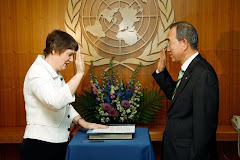
Helen Clark and New Zealand PM and press, Tonga and 226 briefing not shown

Ryan said that not what he saw during his visit, but acknowledged that in some cases in Sri Lanka, people are moved to places other than where they came from. This could be done in the name of safety. But it could having intentions and / or effects.

Afterwards, several other UN correspondents marveled that Helen Clark, the UN system's third highest officials, has yet to come do a press conference at the UN. Watch this site.

* * *

Is Ban Ki-moon responsible for "Crimes Against Humanity" committed by Kim Jong-il and North Korean Regime ?


Currently North Korea runs six prison camps with almost 154,000 political prisoners. These data come from a recent South Korean government report.

Last week for the first time - a representative of the GNP ruling party in South Korea said that: - "These 154,000 - who are held in separate prisons from common criminals - are forced to work more than 10 hours a day on only 200g (7oz) of food, and are denied medical care".

Mr. Yooo Sang-hyun of the Grand National Party was quoted saying that: - "North Korea perpetrates various crimes against humanity, including public executions, tortures or rapes, against those who try to escape".

Many experts now are saying that previous governments, when Ban Ki-Moon was Minister of Foreign Affairs, have failed to highlight the evidence of the human rights abuses in North Korea, and that somehow with the Sunshine policy and CASH support from Ministry of Reunification for Kim Jong-il might have been an supportive element for the perpetration of these Crimes Against Humanity committed in the North by the Communist Regime.

Ban Ki-moon has continued to remain silent about North Korean human rights abuses not only throughout his tenure as Minister of Foreign Affairs of South Korea but also when he came to the helm of the United Nations since January 2007. Although the UN keeps an official presence in Pyongyang, with UNDP (United Nations Development Programme), Ban Ki-moon seem to intentionally fail to address these issues and affront the Regime on the matter.


Thursday, October 8, 2009

Helen Clark and UNDP sycophancy


If there is one thing that keeps me in the UK and which frustrates and angers me the most about the idea of returning to New Zealand (or even to Australia), it is how journalism almost does not exist in the mainstream media. At least with the Times, the Observer, the Telegraph, FT or even (cough) the Guardian, there are journalists – people not afraid to research a topic and ask hard questions, to be a devil’s advocate for the opposing point of view. Sadly, it appears that metaphorically sticking your tongue up the arse of your subject is de rigueur among New Zealand reporters

The most recent example is the sycophancy dressed as journalism being trotted out by Tracy Watkins in the Dominion Post, who has written two articles profiling how Helen Clark is getting on leading the UN Development Programme. Watkins could just as well have been working for the Labour Party to produce such inane twaddle. The first article would be better seen in the NZ Woman's Weekly or the like. I do love how the talk of scandals was brushed to one side though, "disgruntled staff" you see. Because, presumably, you only listen to disgruntled staff when they work for the private sector, not the altruistic people loving United Nations.

You can of course read the latest instalment here, which goes on about five crisis that have ravaged the world in the past year (food, financial, fuel, swine flu and climate change), though you might ask some hard questions about how many of these are real and how many still exist (food and fuel disappeared as financial came).

Watkins could have asked what have been the achievements of the UNDP, how many countries it has weaned off of aid since it was formed in 1965? The answer of course is none.

Watkins could have talked to critics of aid, especially UN based aid operations. Funnily enough she didn’t.

Watkins could have asked how much of the NZ$5 billion budget of the UNDP goes on administration, how much the average UNDP employee receives in income (tax free) and the UNDP’s travel budget? In other words she could have discussed why UN employees are some of the best paid (and least hard working) “public sector” workers in the world.

So the article is essentially an interview with Clark. Nice for Watkins to get her jaunt to New York of course, but that could have been done over the phone. Watkins could instead have used her trip to meet with different groups who have differing views of the UNDP or the UN, but that might have upset Clark – and you can’t do that can you?

She finishes with a so-called “factbox”, which says precious little.

It talks about New Zealand’s aid, ignoring aid raised through private charities and distributed through such charities, like World Vision (who I do NOT endorse). For example, talk about the aid given by the US ignores that around 80% again is given and distributed privately. In short, aid doesn’t have to involve force.

So what could Watkins have done? Well maybe she could have looked at the long list of scandals involving the UNDP and asked Clark what she’d be doing about it on her NZ$500,000 tax free salary. Scandals? You mean the New Zealand MSM hasn’t been doing its job to find out what the UNDP is about? You betcha! Watch this space.

Helen sends UNDP back into North Korea


Despite a major report outlining questionable UNDP practices in North Korea before (such as hiring North Korean staff selected by the regime for sensitive job positions), the UNDP is back.

UNDP Watch notes:

The regime employees filled such critical jobs as UNDP finance officer; program officer slots that helped to design and oversee UNDP projects in the country; technology officer, who maintained all of UNDP’s internal and external communications and servers; and even the assistant to the head of the UNDP office, who presumably was in a position to see much, if not all, of the boss’ paperwork.

The staff were paid in US$, and the capacity for fraud and diversion of aid for political purposes was enormous. $9.13 million was paid directly from UNDP to North Korean government agencies for projects approved by UNDP.

Who says the UNDP is back? Well the Korean Central News Agency. All other reports rely on that coverage. So who knows how true it is.

The Heritage Foundation is outraged for a very good reason. In a totalitarian state, any aid given is approved by the regime and benefits it. The regime's top priorities are:
- The tightly knit senior leadership surrounding Kim Jong Il and his non-estranged family;
- The military and secret police; and
- High ranking party members.

By NO means can money or aid going to North Korea that is used by its own government agencies ever be verified as having delivered assistance to those in need. It would be like funding Concentration Camp commanders to assist their captives.

So how is Helen Clark justifying this? Or is it just plus ça change... ?

I'm sure the New Zealand mainstream media are working hard to investigate this one, like they did before entered the role.

Thursday, October 1, 2009

Helen Clark/UNDP: -We're back in North Korea because they are changing and is a change we can believe in

Heritage Foundation: - The UN Development Program Rewards North Korea

Brett Schaeffer

The era of engaging the world’s worst actors continues apace with the recent announcement that the United Nations Development Program has formally returned to North Korea and restarted its program there on Wednesday September 30, 2009. For those who don’t know the history, information provided by whistleblowers to the U.S. Mission to the United Nations led the U.S. to question UNDP about its practices and activities in North Korea. Based on the information it received, the U.S. initiated an investigation that revealed numerous UNDP violations of U.N. rules and regulations and led the UNDP executive board to suspend its activities in North Korea in March 2007. According to a FoxNews summary of an independent audit commissioned by UNDP and released in May 2008, UNDP “routinely, and systematically… disregarded U.N. regulations on how it conducted itself in Kim Jong-Il’s brutal dictatorship, passing on millions of dollars to the regime in the process.”

In light of North Korea’s actions over the past year and its disdain for the U.N. Security Council’s resolutions regarding its nuclear-weapons and ballistic-missiles programs, the decision to return is baffling. The barbaric indifference of the North Korean government to the suffering of its own people should lead the U.N. to pull out of North Korea all together. In other repressive regimes, the U.N. and NGOs can sometimes work around the government to help the people directly. In these cases, there is some justification for continuing U.N. humanitarian activities. There is little basis for this approach in North Korea. The regime controls virtually all international humanitarian activities. Despite the best efforts of the U.N. and other providers of humanitarian assistance, aid to North Korea is only permitted if it benefits the regime. UNDP’s return to North Korea — and the continued present of other U.N. agencies like WFP and UNICEF — rewards the reprehensible government of Kim Jong-Il.

ANALYSIS: Ethics and Accountability at the United Nations

By George Russell

FC1

Does the United Nations accept the rule of law?

That question has been hanging over the world organization for nearly a year, ever since the U.N.’s first ethics commissioner, Robert Benson, tried to take up the case of a whistleblower who drew attention to the rule-breaking practices of the United Nations Development Program.

Among other things, the whistleblower charged that UNDP had funneled millions in hard-currency to the regime of North Korean dictator Kim Jong Il and allowed North Korean government employees to run key aspects of its development program there. Then, he claimed, UNDP retaliated by firing him.

Now the same issue confronts the U.N. again. This time, the question is whether UNDP would pay restitution for the harm done to the same whistleblower who brought the organization’s misbehavior to light, and whose reputation was blackened by UNDP’s hand-picked investigators when they issued a weighty report earlier this month that confirmed most of the whistleblower accusations, and added a few more.

Judging from events of the past week, the answer to the question is still very far from clear. UNDP’s top managers have told FOX News through a spokesman that “no decision has been made” on the restitution issue.

Restitution for character-blackening is the initiative of chief U.N. ethics officer Benson, the man who is supposed to foster a “culture of ethics, transparency and accountability” across the entire U.N. system, and give the world — and thousands of U.N. employees worldwide — confidence that the organization is following its own rules. Benson had been mandated by UNDP itself to review the investigative report on North Korea for violations of whistleblower protection. Benson’s role was a compromise engineered in part by diplomatic pressure from the Bush Administration.

Click here to read Benson's Review.

A refusal to follow the recommendation would be a direct slap at the U.N.’s top ethics official — and it would again expose the world organization to charges of double standards that were exposed — in part by FOX News — in the multi-billion-dollar Oil for Food scandal and a broad swath of procurement corruption cases.

Moreover, it would be a highly public blow to Benson’s boss, Secretary General Ban Ki-moon, who is standing behind his ethics chief. Ban’s spokesman told reporters yesterday that “the report of Mr. Benson stands as the position of the Secretariat.”

At the same time, the spokesman said the Secretary General was going to wait and see how UNDP reacted to the recommendation and would offer no other opinion on it.

The latest crisis point marks a second lease on life for Benson in the whistleblower case, which involves revelations brought forward by a former UNDP employee in North Korea, Artjon Shkurtaj. It is also a second chance for Ban, whose failure to back Benson strongly in the past sapped the unity of the U.N. system.

The case of the whistleblower, a former UNDP operations manager, was Benson’s initial major test in the ethics job last August — a job created in the wake of the Oil for Food and procurement scandals as a cornerstone of the U.N.’s ability to police itself and protect employees who brought wrong-doing to the attention of their superiors.

But Benson was slapped down by UNDP, which said the matter lay outside his jurisdiction and refused to let him investigate what Benson called a “prima facie case” of retaliation.

Suddenly, to the dismay of the Bush Administration and other governments,the sprawling U.N. system of some two dozen independent funds, programs and agencies around the world seemed to have the legal right to design on their own how they treated the disclosure of improper or illegal activity.

In UNDP’s case, a vivid insight into the potential for abuse was provided by the North Korean investigative report, which was made public in early June. UNDP immediately hailed the 353-page report as vindication — even though the document reiterated at great length that UNDP had systematically violated its own rules in hiring North Korean government employees to fill key UNDP jobs in the country, illegally handed over millions in hard currency to the government of Kim Jong Il, and ignored the laws of the U.S. and other countries in handing on sensitive “dual use” civilian-military technology to the Kim regime, even as North Korea was building and testing a nuclear weapon.

The report, however, took great care to avoid assigning any blame for the lapses to any specific individuals in UNDP, and blamed many of them on vague “lack of communication.”

So far as whistleblower Shkurtaj went, however, the report declared that there had been no retaliation against him, even as it offered evidence that the North Korean regime had pressured UNDP to get rid of him. (Initially offered a full-time position, Shkurtaj, a contract employee, had the offer rescinded a month later on procedural grounds, including a preference that a woman should get the job; another man was later hired instead.)

The panel report also lengthily attacked Shkurtaj’s character and credibility, without offering him the opportunity to respond.

In reviewing those results, Benson still insisted that Shkurtaj had whistleblower status — an important designation, since it offers protection for employees who bring U.N. wrongdoing to light.

But he offered UNDP a victory when he agreed that no retaliation had taken place. As the investigators did, Benson based his reasoning largely on the fact that the UNDP human resources officer who withdrew Shkurtaj’s job offer offered “unequivocal” testimony that she was unaware of any North Korean pressure to get rid of the nettlesome employee. (Neither Benson nor the investigating panel found contradictory the fact that the job was ostensibly earmarked for a woman, but later filled by a man.)

Then Benson threw a curve ball: the neglect of the panelists to let Shkurtaj respond to their concerns about his credibility was, in Benson’s nuanced phrase, a “due process failure,” which violated a U.N. employees right to respond to such findings in an investigation.

The right to such a response is deeply embedded in customary U.N. procedure for internal investigations. Benson, however, cited as the basis for his own conclusion about the lack of due process the example set by the U.N.’s $35 million investigation of the Oil for Food scandal, presumably because it was also carried out by outside investigators.

The “failure,” Benson noted, was on the part of the investigative panel, and not UNDP itself — a fact also underlined by UNDP spokesmen. But since the damage was done, Benson noted “there is no means by which to address this matter other than by means of restitution,” and recommended UNDP pay Shkurtaj 14 months’ salary to salve the damage.

Benson’s effort was clearly a compromise aimed at preserving unified standards of fairness across the U.N. system to employees who dare to testify to their organization’s lapses. And Ban’s current support for his ethics chief — though still equivocal — showed a desire to undo some of the damage done by his earlier flinching at UNDP intransigence. (Ban first signaled his new resolve to unify ethical standards at a confidential meeting of U.N. top managers in May, in Switzerland; copies of his talking points at the session were obtained by FOX News.)

But if UNDP does not accept the ethics officer’s ruling, what then? Neither Ban, nor anyone else, seemed inclined to answer — at least not yet.

George Russell is executive editor of FOX News.

Report Shows U.N. Development Program Violated U.N. Law, Routinely Passed on Millions to North Korean Regime

By George Russell

FC1


After more than two years of accusations and probes into the operations of the United Nations Development Program in North Korea, a weighty report finally reveals how routinely, and systematically, the agency disregarded U.N. regulations on how it conducted itself in Kim Jong-Il’s brutal dictatorship, passing on millions of dollars to the regime in the process.

The 353-page report, by a three-member “External Independent Investigative Review Panel” appointed by UNDP to investigate itself, was published with much fanfare last week after nine months of political maneuvering and research.

Click here to read the full report (pdf).

The report depicts an organization that for years apparently considered itself immune from its own rules of procedure as well as the laws and regulations of countries that were trying to keep weapons of mass destruction out of Kim’s hands.

It also shows that UNDP apparently considered itself above the decisions of the United Nations Security Council itself when that organization tried — as it is still trying — to bar Kim from gaining the means to create more weapons of mass destruction.

That is the same Security Council whose decisions, U.N. officials argue, have the weight of international law when applied to the United States and the rest of the world.

Yet despite those rules, and in the midst of a growing international storm of concern over Kim’s behavior, UNDP’s North Korea office, as well as other UNDP offices, continued to hand over millions in hard currency to the Kim regime and to transfer sensitive equipment with potential for terrorist use or for use in creating weapons of mass destruction.

“What this report shows is that UNDP has operated lawlessly for far too long,” said Mark Wallace, the former U.S. ambassador to the United Nations who brought many of the original accusations against the U.N. anti-poverty agency to light in January 2007 after examining confidential UNDP internal audits of its North Korean operation.

“U.N. Secretary-General Ban Ki-moon has indicated that integrity is a high U.N. priority," Wallace said. "It is now up to UNDP to follow that direction.”

The latest panel report initially was passed on to reporters on June 2 by UNDP boss Kemal Dervis at an unusual press conference where he hailed the report’s conclusions, saying that “we finally have some closure on the allegations made against UNDP.”

The actual authors of the report were not available for questioning or comment, Dervis said, until they presented the document to a meeting of UNDP’s supervisory executive board in Geneva. The meeting begins June 16.

But a close reading of the long and dense document, replete with mind-numbing footnotes, shows that Dervis is wrong.

Among other things, the report confirms that UNDP hired North Korean government employees to fill sensitive core staff posts, in violation of its own regulations, and that the Kim regime picked the staffers.

Previously this had been revealed by a report done by the United Nations Board of Auditors in May 2007 in the wake of Wallace’s concern. The 2007 report noted that the same violations had been reported in internal UNDP audits going back to 2001.

The UNDP office in North Korea paid the salaries of these staff directly to the government in hard currency — another forbidden practice. The report dryly notes, in a footnote on page 96, “It was not clear how much of these amounts were paid to the National Staff, if any.”

In an effort that may have been aimed at keeping at least some staffers from starving, UNDP gave them all hard-currency supplements in cash — another violation of its own rules.

The regime employees filled such critical jobs as UNDP finance officer; program officer slots that helped to design and oversee UNDP projects in the country; technology officer, who maintained all of UNDP’s internal and external communications and servers; and even the assistant to the head of the UNDP office, who presumably was in a position to see much, if not all, of the boss’ paperwork.

Click here to see who was staffing UNDP's office in North Korea.

Those violations already were known, although only in the barest detail. But the latest report reveals a fact that makes matters much worse: The regime-appointed finance officer — the person who wrote UNDP’s checks for 10 years — also was responsible for reconciling UNDP’s bank statements with the checkbook.

These two functions are supposed to be separated as protection against fraud. The importance of that separation is strongly underlined in UNDP’s basic guidelines called the “Internal Control Framework for UNDP Offices.”

The potential for fraud by a North Korean government employee, however, is discussed in the report only in dry bureaucratic language.

Despite that the review panel brought documents showing millions of UNDP financial transactions out of North Korea, the report shows — in a footnote buried on page 53 — that the panelists never saw any of some roughly $16.6 million worth of cancelled checks that were signed by UNDP. The reason: Kim’s bankers won’t release the originals or copies.

Without the checks, it is impossible to see if the finance officer made them out to cash or if the names on them match UNDP payment records and bank statements.

The North Korean regime also refused to let the panelists interview the finance officer.

The potential fraud risks are huge. The report notes that in 78 percent of a transaction sample of UNDP payment records that they reviewed, the signature on payment receipts could not be verified. For all the rest there was no sign of a receipt at all.

The report declares, with great understatement, that “it is difficult to determine the ultimate beneficiaries of payments made by UNDP-DPRK on behalf of itself.”

The panel sharply hikes — by millions of dollars — the amount of hard currency that previous probes indicated UNDP had passed on to the nuclear-arming Kim regime from 1997 to 2007, as Kim was ramping up his nuclear weapons program and ultimately setting off a nuclear explosion.

Hard currency transfers to Kim of any kind supposedly were forbidden, but the 2007 investigation already had shown that the rule was violated not only by UNDP but other U.N. agencies in the country.

The latest report says that UNDP spent $23.8 million on behalf of itself and other U.N. entities in North Korea, almost all in hard currency that never was supposed to reach Kim. The panel estimates that 38 percent of this, or $9.12 million, went directly to the North Korean government.

But that is not all. The report also notes for the first time that other UNDP offices and agencies outside the country chipped in anywhere from $9.5 million to $27.4 million more in hard currency to the Kim regime over the same period, on behalf of the North Korean office.

Using the 38 percent yardstick that the panel applied to in-country spending, anywhere from $3.6 million to $10.4 million of those totals might have been directly passed on to the government.

In addition, the report makes passing mention of an even bigger flood of cash: $381 million that flowed into North Korea from non-U.N. donors through an arrangement called the Agriculture Recovery and Environmental Protection, or AREP, Cooperation Framework. UNDP projects in North Korea formed part of that framework and, more importantly, helped to support the entire arrangement. But the report goes no further in tracing those funds.

Unauthorized hard currency by no means was the only support UNDP was offering Kim. The report greatly raises the number of sensitive “dual use” items — good for civilian use and for terrorist purposes or helping to create weapons of mass destruction — that UNDP handed over to North Korea. These included computers, software, satellite-receiving equipment, spectrometers and other sensitive measuring devices: 95 items in all.

The policy of unquestioned transfer of dual use items continued even as the Kim regime in 2006 conducted ballistic missile tests and exploded a low-yield nuclear device to the outrage and dismay of the rest of the world; moreover, UNDP acquired at least some of the items in misleading fashion.

The report notes that when some items were purchased, “it was not explicitly stated … that the equipment would be utilized by DPRK nationals working under the auspices of UNDP projects in DPRK.”

In at least one instance, the report says, an employee with a UNDP sister agency even supplied false information to a Dutch manufacturer nervous about end-users in North Korea, telling him that the equipment would be used by the UNDP office in Pyongyang when it really was intended for a faraway rural location.

The report also shows that UNDP itself rarely asked its suppliers about any possible limits on the use of sensitive export goods and, even when it was explicitly informed, made little, if any, effort to keep records of dual use limitations on equipment.

(The report does not say so, but with North Korean government employees operating as program officers, the lack of conscientious record keeping might not come as much of a surprise.)

The report then dismisses any notion of holding anyone at UNDP accountable for these spectacular lapses by invoking a concept of blanket immunity.

UNDP and its officials, the report notes, are immune from the enforcement of U.S. and other national export control laws imposed for anti-terrorist or national security reasons, under an international U.N. Convention on Privileges and Immunities.

The document notes that despite that free pass, a U.N. legal opinion has held that the world organization can be bound by at least some export license limitations when it is retransferring those sensitive goods.

But the people really exposed to penalties for most of the transfers are UNDP vendors who supplied the goods, because they lack U.N. immunity. The panel notes that in many cases, lack of knowledge of the true use of the equipment is not considered a legal defense by many nations, including the U.S.

Having said that, the report tries to sweep under the rug the explosive topic of UNDP’s obligations to the U.N. itself when the U.N.’s chief executive body, the Security Council, calls — as it did twice in 2006 — for bans of sensitive technologies to Kim. Those bans are known as U.N. Resolution 1695, passed on April 15, 2006, after Kim sent test ballistic missiles in the direction of Japan; and Resolution 1718, passed on Oct. 14, 2006, five days after Kim’s low-yield nuclear blast.

Resolution 1695 applied to equipment that might be used in Kim’s ballistic missile program. Resolution 1718, however, was much more sweeping and called for bans on any equipment that might be used in any kind of weapons of mass destruction, as well as travel bans for officials associated with the weapons program.

The panel report tries to take as little note of these sanctions as possible. Resolution 1718, for example, is mentioned in a footnote on page 195 of the report. The footnote calls its applicability to UNDP programs “relatively minimal,” and adds, “a significant majority of the equipment bought in connection with the UNDP-DPRK program was purchased before the passage of this resolution such that [it] was inapplicable.”

Since the report also notes that the records were badly kept or non-existent, this is a hard assertion to contradict. But it is a highly questionable assumption, at best. The report earlier notes that any UNDP-purchased equipment in North Korea belonged to UNDP until it was officially transferred to a host government. That happened to all the items of dual use equipment in North Korea at the same time — in March 2007.

At that time, UNDP shut down its programs after the hue and cry over UNDP practices in North Korea caused the agency to amend some of its practices — changes that the regime refused to accept.

UNDP officials have argued, and the report tacitly echoes their view, that the transfer of equipment when agency projects are closed down is normal practice.

Hardly normal are Security Council calls for the world, presumably including the U.N. itself, to stop transfers of exactly the kinds of equipment UNDP gave to Kim. There is no sign, for example, that the agency gave any thought to finding another method of asserting its property rights until the sanctions were lifted or of asking other U.N. agencies in North Korea to try to keep tabs on the gear.

UNDP “normal practice” apparently trumped world peace and security. The report passes over that complication, involving a rogue regime that had conducted illegal atomic blasts, and that the U.N. itself had declared an outlaw, without comment.

With the same effect of sheltering UNDP from charges that it aided in endangering the peace and security of the world, the panel report declares that any charges that UNDP inadequately supervised the projects in North Korea under its care are untenable.

It based that conclusion on voluminous paperwork provided by UNDP that proved, the panelists said, that site visits to the project took place frequently and were unimpeded.

But the report fails to put those inspections in the context of the fact that four of UNDP’s program and liaison officers, who manage and help to create programs and perform liaison with institutions and vendors involved in the projects — also were North Korean government employees.

(The report is equally silent on the role of the Kim regime employee who served as UNDP technology officer, who was in charge of all of the UNDP offices' internal and external communications and its computer servers. UNDP communications and computers are supposed to be sacrosanct in terms of host country snooping. Instead, in North Korea, the potential snoops were in charge of the equipment. The potential implications of that fact are completely unexplored.)

Overall, one of the most striking aspects of the report is its lack of curiosity about whether individual members of the UNDP staff should be held accountable for egregious, longstanding and dangerous violations of UNDP rules and international law, not to mention common sense.

This applied notably to the presence in UNDP’s North Korean safe for more than a decade of $3,500 in defaced U.S. counterfeit $100 bills — “Super-Note” fakes that the Kim regime famously passed around the world. Possession of counterfeit U.S. bills is a crime. Even given U.N. legal immunities, it might seem an important matter to bring to the attention of one of the organization's biggest donors.

Yet no-one informed U.S. authorities and senior UNDP officials claimed no knowledge of the fake funds, even though the bogus money was listed on annual reports of the safe contents for years.

The report’s assessment: “There is no evidence that anyone acted in bad faith or in a fraudulent or deceptive manner. Instead, the Panel finds that there was a clear lack of attentiveness at the [office] and Headquarters levels and that communications between the Country Office and UNDP headquarters were inadequate.

“Inadequate communications” is the explanation often given in the report for failures that allowed rule-breaking to continue, even as Kim openly brandished his nuclear weapon. The report notes that in August 2006 — four months after the passage of U.N. sanctions Resolution 1695 — the UNDP office in North Korea asked headquarters for guidance on dual use equipment transmissions to North Korea. It never got any. The project, which was based in part on receiving satellite imagery, had equipment that the report says already had been purchased.

Then, on Oct. 11, 2006 — two days after the Korean nuclear blast — a UNDP regional supervisor in Thailand answered the guidance request. He ordered UNDP not to purchase any equipment and “to close down the project immediately.” In the same message, according to the panel, the supervisor, Romulo Garcia, said he had received clearance from his bosses to close down the project in late 2005.

As it happens, U.N. Resolution 1718, imposing more drastic sanctions on North Korea, went into effect three days after Garcia’s sudden desire to follow up on a two-month-old guidance request.

The panel report’s conclusion? The 2005 decision to shut down the project “does not seem to have been communicated to the UNDP-DPRK office, as equipment purchases continued throughout 2006, including some dual use items.”

That Garcia apparently did not double-check on whether this highly sensitive order was carried out until a nuclear device exploded and another U.N. sanctions resolution loomed is never discussed in the report.

But the lack of discussion speaks volumes, both about UNDP bureaucratic efficiency and about the apparent level of UNDP concern and internal discussion of Kim’s dangerous nuclear plans.

There is one prominent exception to the report’s attitude of sympathetic understanding toward UNDP lapses: the whistleblower who brought most of them to outside attention and inspired U.S. diplomats to call for multiple investigations, including the panel report.

The report concludes that the whistleblower, a former UNDP-DPRK operations manager named Artjon Shkurtaj did, in fact, perform a service when he brought the situation in the UNDP’s North Korea office to light. But the report emphatically denied there was any retaliation against Shkurtaj when a promotion he already had been given was withdrawn and other short-term contracts he held expired.

Such claims, the panel concluded, were “without merit,” as it also made attacks on Shkurtaj’s personal integrity.

At the same time, the report offers evidence that the North Korean regime may have been pressuring UNDP to keep Shkurtaj out of the job and reveals the alarming fact that the regime apparently had veto power over UNDP’s ability to fund the position.

For his part, Shkurtaj has declared that the authors of the report violated customary U.N. practice when they failed to show their conclusions to him prior to publication. He has appealed to the U.N. chief ethics officer, Robert Benson, to investigate.

So it may well be that the ultimate message of the report is that passing on potentially dangerous equipment to a ruthless dictator who threatened his neighbors and defied the U.N. itself apparently was regrettable but otherwise a lapse in communication. Talking about such things outside UNDP apparently was something else.

Rather than bringing “closure on the allegations against UNDP,” as the organization’s boss, Dervis, hopes, the North Korean investigative report ought to raise bigger and more urgent questions about UNDP operations around the world.

If Kim Jong Il’s despotic government was able to twist UNDP’s rules and its adherence to international law with such ease, what is going on in UNDP offices in dictatorships such as Zimbabwe and Syria?

Most urgently of all, as the U.N. wobbles toward further sanctions on the nuclear-ambitious Islamic regime in Iran, what is going on in UNDP offices in Tehran?

George Russell is executive editor of FOX News.

UNDP Accused of Cover-Up in North Korea Cash Funneling Scandal

By George Russell

FC1

What’s happened to the trove of documents that the United Nations Development Programme (UNDP) promised to hand over to prove—or disprove— its innocence in funneling millions of dollars in hard currency to the North Korean dictatorship of Kim Jong Il?

Are they under UNDP safekeeping in North Korea? Or are they being picked over in a UNDP safe house in Beijing, before a sanitized version is offered up for inspection? And is that just part of a wider destruction of evidence?

[Editor's note: See correction at the bottom of this article.]

Those questions became the subject of a storm of Internet accusations over the past week, as an anonymous blog associated with UNDP dissidents charged coverup, and then offered up photos of UNDP documents that it claimed were proof.

To see the accusations, go to undpwatch.blogspot.com.

For its part, UNDP has flatly denied the accusations.

The documents lie at the heart of a controversy that has reached boiling point several times since last January, when a U.S. Ambassador to the U.N., Mark Wallace, used the conclusions of a series of UNDP audits to charge that the U.N.’s flagship development agency had funneled the hard currency to Kim regime officials in March in violation of its own rules, along with a variety of other major infractions. UNDP subsequently announced it had closed its office in March. A preliminary audit by the U.N. panel, without benefit of the documents, validated many of the U.S. charges last June.

The U.N. auditors were ordered at the end of June to make another attempt to investigate—and are still stymied. On Sept. 28, the chairman of the auditing board formally advised the U.N. that the Kim government had refused visas for his inspectors to examine the papers. He declared that the panel of auditors had been disbanded and returned to other duties.

To see the Board of Auditor’s letter, click here.

In response to Fox News questions a month later, UNDP spokesman David Morrison declared that his organization was "initiating steps" to bring the documents out of Pyongyang—something UNDP had long promised.

After that came silence—until the anonymous bloggers began posting their accusations. The first charge came on Nov. 21, when they claimed that Beijing staffers of UNDP said boxes of Pyongyang papers were "now located in the private residence of the UNDP Resident Representative in Beijing." (The Resident Representative is the highest-ranking U.N. official in a nation’s capital.)

The blog also claimed that a team of UNDP officials, as well as officials from the South Korean government, were on their way to vet the trove before any auditors saw it.

All of those charges were forcefully denied by UNDP spokesman Morrison in response to Fox News queries.

"No documents have arrived in Beijing or anywhere else," he declared. "We expect to be in a position to be in a position shortly to make all documentation available outside [North Korea]."

Over the weekend, however, the bloggers struck again, this time offering up cell-phone photos that claimed to show the contents of a small fraction of 59 boxes of UNDP papers in Beijing.

Only two photos were displayed. In one is a fragment labeled "Files Packing List Control Sheet," which carries a summary of monthly accounts from April 1999 to October, 2000. The control sheet carries the acronym for UNDP’s Regional Bureau for Asia and the Pacific, and is dated April 13, 2007.

The other snapshot shows the edges of a variety of files, and pieces of paper showing various stamps, signatures and an address label for the Resident Representative in North Korea, along with letterhead of what appears to be a Korean trading company.

Nothing in the photographs, however, directly linked them to a location in China.

But in the meantime, hints at an even broader UNDP coverup appeared on Sunday in the blog of respected independent journalist (and Fox News consultant) Claudia Rosett. She offered up internal UNDP documents dating from Sept. 24 that recommended the disposal of 11 email and other servers, for reasons of obsolescence or wear and tear. Purchase of two of the "obsolete" servers dated from 1998 and 1999, but all of the others were undated.

To see the documents, go to http://pajamasmedia.com/xpress/claudiarosett

"We don’t know what’s on these 11 servers," Rosett declared. "But surely it’s worth finding out?"

UNDP spokesman Morrison issued yet another rebuttal. The equipment, he said in a written response to Fox News followup questions, had been used to host "UNDP’s virtual directory (phone book). They contained no sensitive information and nothing to do with UNDP’s operations in DPRK [the acronym for Democratic People’s Republic of Korea]."

In any case, he added, "All data is backed up before the hardware is destroyed."

A spokesman for the U.S. mission to the U.N. said officials there would look into the issue.

George Russell is executive editor of FOX News.

___

Correction: UNDP gave incorrect information to Fox News regarding the contents of 11 computer servers that critics have said are being disposed of as part of the alleged coverup. UNDP spokesman David Morrison told FOX News that the servers, which UNDP has declared obsolete, had been used to host the organizations’s “virtual directory" (phone book) and “contained no sensitive information.”

After follow-up questions from FOX News, Morrison said that only one of the 11 servers hosted the directory. The others “were a combination of file/print servers and UNDP’s old intranet.” All information contained in the servers, he declared, “was migrated to other equipment to ensure that no information was lost.” The incorrect information, he told FOX News, had been provided inadvertently.

U.N. Workers Call on Ban Ki-Moon to Reinstate Whistleblower

By George Russell

FC1

The United Nations' five staff associations sent a stinging message to Secretary-General Ban Ki-moon Wednesday, demanding reinstatement of a whistleblower who lost his job after reporting financial and other irregularities in the program of the United Nations Development Program (UNDP) in North Korea.

The resolution also condemned a “culture of impunity permeating the higher levels of the organization, complemented by a dysfunctional internal justice system.”

Click here to read the staff resolution (pdf).

It called on Ban to implement justice system reforms that have already been presented by an independent panel, and, most dramatically, asked the secretary-general to order the head of UNDP, Kemal Dervis, to submit his organization to the jurisdiction of the U.N.’s recently established ethics office. That office has already declared that it found “prima facie” evidence of retaliation against the whistleblower, a 13-year U.N. veteran named Artjon Shkurtaj.

The staff resolution was the latest step in a bizarre standoff that has developed at the U.N. over the Shkurtaj case, in which the UNDP has declared that the ethics office, created by the General Assembly to establish system-wide standards of employee protection and conduct, does not have jurisdiction because UNDP is not part of the U.N. Secretariat.

For its part, the U.S. mission to the U.N. has declared that the ethics office, the capstone of efforts so far to reform the U.N., already has the jurisdiction it requires. Even while holding that position, U.S. diplomats have been fighting to make sure that an ostensibly independent inquiry into the matter, ordered up by UNDP as a substitute for an ethics office investigation, is more than a whitewash.

But the staff resolution is also a reflection of the deep unrest among ordinary U.N. employees at the lack of legal protection and other rights for them at the U.N., which enjoys immunity from the laws of nations including the host United States.

Staffers complain — always anonymously — about retaliation by their superiors when they report abuses and the powerlessness of quasi-judicial tribunals set up on their behalf. Their complaints were confirmed by a special panel set up by Ban’s predecessor, Kofi Annan, that called for a complete overhaul of the U.N. justice system. That overhaul so far has not taken place.

The Shkurtaj case has thrown the same issue into a much more explosive arena. The operations manager of UNDP in North Korea from 2004 to 2006, Shkurtaj told his superiors about a variety of unauthorized activities there, including the funneling of hard currency to the regime of dictator Kim Jong-Il, the presence of many North Korean government employees in staff UNDP positions, and the presence of $3,500 in counterfeit U.S. currency in a UNDP office safe.

Shkurtaj says he was told to keep quiet about his findings, and was fired after he took the information to the U.S. mission at the U.N. UNDP says that he was merely a temporary UNDP employee whose contract was not renewed, and press leaks that could only have come from UNDP sources have hinted that Shkurtaj may have falsified documents.

The entire issue, which has been brewing since Shkurtaj left UNDP several months ago, hit a new level of tension with the ethics office finding in his favor and the subsequent assertion — including by the secretary-general himself — that his own office lacks jurisdiction in the case. At a press conference last week, Ban declared he would go to the General Assembly to get clearer guidelines for the office, but that is viewed in staff association circles as a ploy to further bury the issue in bureaucratic procedure.

As the resolution makes clear, the staff associations feel that Ban already has the authority to order UNDP and other U.N. agencies like UNICEF and the World Food Program to submit to the ethics office. Ban currently has the power to hire and fire the heads of the agencies.

In an e-mail interview after the staff association vote, Shkurtaj declared the result to be further vindication of his view that the U.N. has violated his rights.

As for Secretary-General Ban, he has left New York for Turin, Italy, to take part in a three-day retreat with top U.N. officials in advance of the next session of the U.N. General Assembly in mid-September. Among those also attending the retreat is UNDP chief Dervis.

U.N. Secretary-General Ban Ki-Moon Faces Major Test in Ethics Case

By George Russell

FC1

Faced with crises in the Middle East, Korea and Sudan, U.N. Secretary-General Ban Ki-moon now has another urgent fire to put out — in his own organization.

How he faces that challenge could well determine the tone of his five-year term of office — and whether the head of the United Nations truly controls the sprawling, decentralized and rapidly expanding multibillion-dollar bureaucracy that he is supposed to lead.

“This is a time of choosing” for Ban, declared a Western diplomat familiar with the internal crisis.

The choice: Whether Ban will support Robert Benson, newly appointed chief of the United Nations Ethics Office — itself only a year old — in the first major test case of the office’s mission of “fostering a culture of ethics, transparency and accountability” at the world organization.

Or, if not, whether the ethics office, deemed the high-water mark of U.N. reform, will become no more than a curiosity demonstrating the hollow nature of the secretary-general’s authority, after he included the setting of “the highest standards of ethics, professionalism and accountability” among his core tasks.

The test was set by Benson himself, who declared in a confidential letter dated last Friday that he had established a “prima facie case” of retaliation against an employee by the $5 billion United Nations Development Program, the flagship of UNDP aid schemes.

Click here to view Benson's confidential letter (pdf).

Protecting U.N. employees against bureaucratic retaliation for reporting wrongdoing was one of the main reasons for creating the ethics office, after the U.N. was buffeted by the multibillion-dollar Oil-for-Food scandal and the discovery of millions of dollars' worth of fraud in the U.N.’s procurement department and elsewhere.

The UNDP employee whom Benson referred to — but did not name — is Artjon Shkurtaj, a 13-year U.N. veteran who was head of UNDP’s North Korean operations in 2005-2006, and who blew the whistle on UNDP’s unauthorized funneling of perhaps tens of millions of dollars in hard currency to the North Korean dictatorship of Kim Jong-Il — quickly dubbed the Cash for Kim scandal.

Shkurtaj also disclosed that, in violation of UNDP rules, well over half of the organization’s staff in North Korea was selected and employed by the North Korean regime, and that there was no guarantee that UNDP’s aid projects in North Korea were even taking place as planned.

News of the unauthorized funding was first reported by FOX News and the Wall Street Journal last January, and confirmed in a preliminary investigation at Secretary-General Ban’s request by the U.N.’s own Board of Auditors, released in early June. A further probe by the Board of Auditors was confirmed in late June, but has not gotten off the ground.

Once the scandal erupted, with the disclosure of a series of confidential letters on the topic between U.S. Ambassador to the U.N. Mark Wallace and the UNDP’s No. 2 man, Ad Melkert, Shkurtaj lost his U.N. job and was briefly — and illegally — banned from entering U.N. headquarters grounds.

Since then, UNDP has been at pains to cast doubt on Shkurtaj’s credentials and his credibility.

A spokesman for the agency declared that Shkurtaj was not a staff member, but merely a short-term “consultant” — even though he ordered the disbursement of UNDP funds (a purely staff function under the organization's rules and regulations) and chaired multi-agency U.N. committee meetings in Pyongyang. In a letter to Shkurtaj in June, the UNDP’s own staff association declared that he was “performing the same functions as a regular UNDP staff member, and you should be entitled to the same rights, privileges and expectations of continuous employment.”

An anonymous leaker subsequently charged in the New York Times that documents provided to the U.S. by the whistleblower had been judged by UNDP to be tampered with — though the Times provided no evidence to support that charge.

“I alerted my chain of command to violations of U.N. rules, but they did nothing,” Shkurtaj told FOX News in an e-mail interview from Europe. “UNDP retaliated against me for being a whistleblower; the U.N. Ethics Office has confirmed this. UNDP must be held accountable for retaliation against me, because in accordance with the U.N. whistleblower policy, retaliation is itself misconduct.”

The challenge for Ban begins with the fact that UNDP also declared quickly that the secretary-general’s ethics office has no authority to investigate the alleged retaliation at the agency, which has its own governing executive board and is funded by international donations that are separate from general U.N. dues. (The U.S. has donated roughly $1 billion to UNDP over the past decade, one of the largest single contributions.)

In the same letter, in which he said he found evidence of illicit UNDP retaliation against Shkurtaj, Benson in effect agreed. In a remarkable plea, he urged Kemal Dervis, the head of UNDP, to allow him to continue the ethics investigation on a one-time basis, saying it would be “in the best interest of the United Nations and UNDP to do so.”

So far, UNDP has refused, saying that it will carry on an independent external review of the circumstances surrounding North Korea. But that deliberately sidesteps the retaliation issue.

Moreover, UNDP has no ethics office of its own, nor any policy similar to that creating the protections afforded to whistleblowers under that office. UNDP has pointedly refused to discuss Shkurtaj’s future status with the organization.

(Efforts by FOX News to gain interviews with Benson and Dervis so far have received no reply.)

That is where Ban’s decision comes in. He was pointedly copied by Benson on his letter to Dervis — and at a regular press briefing Monday, Ban’s spokeswoman, Michele Montas, confirmed that Ban had received the copy “and was studying it.” Ban, she added, “is concerned by the issue.”

As well he might be.

The question of whether Ban’s authority extends to ordering UNDP to allow the ethics office to continue its work was apparently not an issue last January, when the secretary-general quickly, and preemptively, announced that the U.N.’s Board of Auditors would examine the allegations of UNDP misbehavior in North Korea.

Ban’s energetic intervention was quickly watered down, however, when North Korea refused to cooperate with the auditors’ probe — and when documents that UNDP first claimed were speeding on their way to New York for audit inspection remained stuck in Asia, where the auditors complained they could not look at them. Those documents, which include check stubs for payments to North Korean staffers, have still not been inspected.

At Monday’s press briefing, Montas took a much more cautious line about Ban’s next move. She declared that the impasse between the U.N. Ethics Office and UNDP involved “intricate legal issues,” then added that Ban’s style was to “use quiet diplomacy to deal with disputes, and [he] has shown that he can obtain results that way.”

However effective Ban’s quiet diplomacy might be elsewhere, the ethics office crisis is the most important, but not the first, time that UNDP has rejected ethics-related investigations outright by Ban’s Secretariat.

In late June, investigators from the United Nations’ watchdog Office of Internal Oversight Services, or OIOS, began probing the central financial management unit of UNDP for evidence of hiring irregularities and violations of UNDP financial rules.

FOX News subsequently reported that a number of personnel in the section were actually employees of a temporary financial employment service, and several had access to functions that are only supposed to be handled by full-time UNDP staffers. There was no evidence of a competitive bid for the contract for those services.

UNDP explained that the employees had been hired under rules that allowed for no-compete contracts, but FOX News also discovered that those rules were promulgated long after UNDP began hiring such temporary help.

The OIOS investigation was abruptly ended, however, when UNDP argued that the watchdog organization had no jurisdiction and that its own investigators would do the job. There has been no subsequent announcement of whether any UNDP investigation is taking place.

Though Dervis and his deputy, Melkert, claim to support the principle of transparency, UNDP has also resisted efforts by members of its own executive board — led by the U.S. — even to obtain copies of internal UNDP audits and financial statements. Top UNDP officials declare these to be “management tools” and therefore immune to scrutiny, even by the nations that provide UNDP with its funding. The United Nations Secretariat began making its own internal audits available to member states more than a year ago.

When Ambassador Wallace obtained limited access to such UNDP internal audits — he was allowed to look at them but not take them away — he discovered that UNDP’s own auditors had long warned of the same practices that Shkurtaj finally brought to broader attention.

This apparently arcane debate over jurisdiction has many long-term effects on the U.N.’s future. At the same time that it has resisted inspection of its practices by the U.N. Secretariat and even by its governing member states, UNDP has been working energetically to expand its sway within the widely diverse array of U.N. agencies and programs that actually deliver services — and money — in the rest of the world.

It has taken the lead in an initiative to increase coordination — in many if not most cases under UNDP’s auspices — of the delivery of all U.N. funds and services in the world’s developing countries. The move, which was first endorsed in a U.N. report issued last November, called for consolidation of such agencies as UNICEFand the World Food Program at the country level, and the elimination of “unnecessary duplication and competition.”

UNDP chief Dervis, heading what is called the United Nations Development Group, speedily announced creation of an eight-country pilot project to test the idea. If the pilot project succeeds, an increasing amount of the U.N.'s discretionary spending on development, famine relief and humanitarian spending — which vastly outstrips the core U.N. budget of some $2 billion — may be further shielded from oversight of the “reformed” portions of the U.N.

Ironically enough, the initiative is known in organizational parlance as “One U.N.” — exactly the concept that Dervis and UNDP oppose when it comes to Ban’s Secretariat investigating wrong-doing on their own turf.

It now remains to be seen whether Ban will be able to invoke “One U.N.” when it comes to the high ideals of ethics and accountability that he swore to bring back to the badly tarnished organization.

George Russell is executive editor of FOX News.

Outsiders Have Access to U.N. Development Program's Financial Management System

By George Russell

FC1

The United Nations Development Program, already mired in controversy for its dealings with North Korea, now faces another scandal involving the people who spend its $5.2 billion annual budget — and shut down its computerized financial management system yesterday when confronted by FOX News about their activities.

The new scandal involves UNDP’s headquarters financial unit, where checks are signed and purchase orders are approved for its sprawling operations world-wide.

Since the last week of June, FOX News has learned, investigators from the United Nations’ watchdogOffice of Internal Oversight Services, or OIOS, have been probing the financial unit for evidence of hiring irregularities and violations of UNDP financial rules.

And already there are some themes similar to the six-month battle over UNDP operations in North Korea: evidence of unauthorized personnel working in sensitive positions that — according to its own regulations — should only be held by UNDP staff; payments with puzzling authorizations that total nearly $2 million; service providers whose employees may violate important UNDP rules and regulations.

FOX News has also learned from UNDP insiders that critical files may have disappeared out of reach of investigators.

This was coupled with dramatic, sudden, and secretive shut-downs of UNDP’s computers in the wake of FOX News email queries Tuesday about the situation.

Indeed, something like a covert scramble began within UNDP on Tuesday in the wake of the arrival of the FOX News questions.

At first, a UNDP press spokesman declared that there had been a delay in receiving the questions, directed to the top echelon of UNDP officials, due to a computer shutdown.

But by that time FOX News had already received telephone confirmation of receipt of the emails from the office of UNDP administrator Kemal Dervis, the organization’s CEO. Those emails included copies of the questions sent to the three top UNDP officials under Dervis.

Just two hours later, however, at 3:37 p.m. on Tuesday, UNDP employees told FOX News that there was a sudden shutdown of UNDP’s computerized financial management system —which coincided with an emergency senior staff meeting that took place in the 21st floor office of UNDP’s No. 2 official, Ad Melkert. (Melkert himself was traveling outside the country; the meeting was chaired by Melkert’s chief of staff, Tegegnework Gettu.)

FOX News was unable to learn what took place in the emergency meeting, or how long it lasted. But at 6:22 p.m., much — but not all — of UNDP’s computer systems came back on line.

With one significant exception. The portions of UNDP’s proprietary financial software system that deal with personnel assignments, personnel records, and access to financial tasks, remained blocked to almost everyone who normally uses those parts of the system, until at least 2 a.m.

The sudden cloak of secrecy was significant, because the new internal investigation centers precisely on the central financial bureau at the heart of UNDP where that financial software is used — a bureau that is directly under the supervision of the agency’s top-most officials.
It is known as the UNDP’s Office of Finance and Administration (OFA), which is headed by UNDP’s No. 4 official, Comptroller Darshak Shah, a 10-year UNDP veteran. OFA, with 84 employees, is responsible for managing the cash flow of the entire UNDP — an organization with more than 8,000 employees whose budget grew from $4 billion to $5 billion between 2000 and 2004, and is expected to grow by another 40% by 2015.

Whatever money UNDP has flows out of OFA to its operations in 190 countries world wide — and to a network of suppliers who provide everything from consultants to foodstuffs to train locomotives for development projects around the world.

Financial controls at OFA are supposedly tight — under UNDP rules, only full-time staff members are supposed to have access to the UNDP’s proprietary financial accounting and disbursement system, known as ATLAS. But that is the rule that is now being violated.

All of which deepens the drama now surrounding UNDP and its relationship with a job placement agency known as Professional Financial Temporaries, Inc.—or PRO-FIT, as it calls itself on its website,www.accountancyatprofit.com.

According to UNDP payment records obtained by FOX News, PRO-FIT has received more than $1.9 million in payments from UNDP since January 2005 alone. Those payments cover the salaries, benefits and other expenses — plus, of course, profit — for PRO-FIT for a variety of employees who are working at UNDP in the Office of Finance and Administration. Those employees’ salaries are not paid by UNDP, but by PRO-FIT itself, which also hires and fires the personnel.

The full number of PRO-FIT employees in the department is not known, though some UNDP insiders place it as high as 31 — or more than a third of the staff. Most are in lower-level clerical or accountancy jobs, but at least several perform functions such as financial disbursement which are supposedly performed only by regular U.N. staffers.

At least seven of the 31 outsiders have log-ins that allow them to operate within the agency’s ATLAS financial system as the equivalent of regular UNDP personnel, in violation of UNDP regulations.

FOX News has obtained ATLAS user IDs for the PRO-FIT employees that confirm their presence in the financial software system, and their roles, which include the ability to approve certain types of financial transactions and move financial deposits within the UNDP’s worldwide system. Along with the IDs, FOX News has obtained copies of PRO-FIT hourly time-sheets filled out by OFA workers and transmitted to PRO-FIT’s Manhattan fax number.

Moreover, FOX News has obtained OFA data recording scores of UNDP payments to PRO-FIT since January 2005. Significantly, none of the payments hit the threshold of $100,000 that is a benchmark for oversight by higher levels of UNDP management. But in a significant number of cases, the monthly totals for the payments easily exceed the $100,000 threshold. And the totals for 2005, 2006, and so far in 2007 all exceed that mark handily.

(Among the items paid there is a particularly unusual one: an invoice numbered 00040679, and dated April 26, 2006. It notes “placement fees” totaling $12,715 for an individual named Fatima Ba — a name almost identical to that of Administrator Dervis personal assistant, Fatimata Ba. Questioned by FOX News about her possible relationship with PRO-FIT, Fatimata Ba would only say that she “did not know” if such a relationship existed, and referred FOX News to the UNDP press office.)

PRO-FIT founder and president Alvin Galland declined to answer any questions from Fox News. (An associate who answered PRO-FIT’s telephone said that Galland “was about to go on vacation.”)

There is an even deeper mystery involving PRO-FIT — how it came to provide such sensitive, and possibly forbidden, services to UNDP that insiders say stretch back more than a decade, without any competitive rebidding of the contract for those services. (PRO-FIT itself, according to its website, was founded in 1996.)

Under UNDP regulations, all competitive contracts must be put up for rebidding every 36 months, but according to UNDP insiders, there are no records of the rebidding of the PRO-FIT contract within at least the past 48 months.

Moreover, insider sources have told FOX News that there is no sign at all of a PRO-FIT contract in UNDP’s legal files dating back for the past four years.

There is at least one piece of evidence that the PRO-FIT relationship stretches back beyond 2004. It’s date of registration in the ATLAS system is January 1, 1901; UNDP insiders explain that ATLAS was created in 2004 and any contracts preceding that time were given the same 1/1/1901 date.

Who authorized the deal with PRO-FIT, and who has been aware of it since that time?

Spending on the order of UNDP’s payments to PRO-FIT usually requires approval at the highest levels of the organization. For purchases of more than $100,000, only UNDP officials with the rank of Director and Assistant Secretary General and above are allowed to grant approval, with the required agreement of a special contract approval committee, known as the Advisory Committee on Procurement, or ACP.

Major purchases are also supposed to be open automatically for competitive bidding, with a rare number of exceptions.

There are at least some theoretical possibilities that the PRO-FIT contract escapes some of the regular UNDP rules. Some UNDP contracts, for example, are considered long-term, and exempt from the rebidding rule. But an examination by FOX News of records of the UNDP’s long term contracts, which are kept on the agency’s internal website, does not include the PRO-FIT deal among them. (FOX News obtained a duplicate image of the website at the time of examination in the event of subsequent tampering.)

UNDP financial rules also allow considerable authority to the organization’s Chief Procurement Officer to create contracts at his or her own discretion, without competitive bidding, so long as the reason is recorded in writing. But that discretion does not extend to granting outsiders access to the UNDP financial control system, ATLAS, which is expressly forbidden under UNDP rules.

UNDP’s Chief Procurement Officer is Akiko Yuge, the agency’s Deputy Assistant Administrator, and No. 3 official. FOX News queries to Yuge regarding the use of any discretionary authority in regard to PRO-FIT have so far gone unanswered.

Similar email questions were put by FOX News to Darshak Shah, head of OFA, along with questions about his awareness of outsiders having access to his office’s most sensitive financial record system. Shah acknowledged receipt of the questions, but said only that “UNDP will revert back to you soon.”

Additional questions sent to Ad Melkert and Kemal Dervis received no reply, beyond an advisory that Melkert was traveling until July 11.

But even without competitive bidding, UNDP purchases must observe safeguards. Any contract of $100,000 or more that is approved without bidding in a unit such as the Office of Financial Administration requires the specific approval of the Chief Procurement Officer — in this case, Deputy Associate Administrator Yuge — and it also requires review and endorsement by the Advisory Committee on Procurement, which Yuge chairs.

Questions to Yuge about whether the procurement committee was ever involved in reviewing PRO-FIT’s contract went unanswered.

The fact that outsiders have privileged access to UNDP’s sacrosanct financial software is not merely a breach of its most important financial rules. It raises the possibility that outsiders whose presence is known to UNDP’s senior management can enter, alter and delete data from the ATLAS record system — precisely the circumstance that the staffers-only access to ATLAS is intended to prevent.

That possibility is particularly sensitive at a time when UNDP has been locked in a bitter dispute with the U.S. government over the transfer of hard currency to the dictatorial government of Kim Jong Il, and, according to the U.S. mission to the United Nations transfers of sums totaling millions to North Korean entities that have a relationship to the country’s illicit nuclear weapons program.

Some of the U.S. accusations have been based on data obtained from the UNDP’s proprietary financial systems, samples of which were revealed to UNDP officials in closed door sessions. UNDP officials have in turn leaked stories claiming that the U.S. data samples differ from entries in those systems, with the clear implication that the U.S. information has been altered or otherwise falsified. The presence of outsiders with privileged and theoretically forbidden access to ATLAS, however, raises the possibility that UNDP itself could be altering data.

The sudden shutdown of UNDP computer access in the areas involving personnel records, duties and ATLAS access IDs further underlines that possibility.

If so, the issues surrounding UNDP may no longer involve just the violation of vital rules and procedures. In light of the investigations underway into the Office of Finance and Management, the issues may include obstruction of the United Nations’ own system of justice.

UPDATE

After publication of FOX News’ story, various U.N. officials have responded to some of the questions posed to them concerning OFA and PRO-FIT. Among other things, the officials state that OFA currently has 117 employees, of whom 101 are staff and 16 contracted workers. Of the 16, 10 are said to be employees of PRO-FIT, while "the other six come from three other external companies."

According to U.N. Chief Procurement Officer Akiko Yuge, the contract for PRO-FIT was approved after a "competitive bidding process" in 1998. The contract was approved under an arrangement known as a Reimbursable Loan Agreement, which allows UNDP to pay outside companies for the services of temporary employees, and does not, Yuge says, require further competitive bidding. "UNDP believes that to date it has received value for money from PRO-FIT," she added.

Even so, Yuge said, OFA has already changed its ways. After deciding "some time ago" to undertake a "new competitive process" for the kind of services PRO-FIT offers, she said, "the bidding process took place three months ago and is currently under review."

FOX News has examined the UNDP procurement Web site where competitive bidding exercises are announced and posted. There is no record on the site of any posting for the services offered by PRO-FIT during the time period Yuge mentions.

Yuge’s claim about the date of UNDP’s relationship with PRO-FIT is contradicted to some degree by answers provided to FOX News by OFA head Darshak Shah. He declared that "PRO-FIT has provided services to UNDP since the mid 1990s." He did agree with Yuge that the deal was finalized under a Reimbursable Loan Agreement, or RLA, "under the authority delegated in accordance with UNDP financial regulations and rules."

FOX News has obtained a copy of the UNDP circular that initially announced the introduction of RLAs. Issued by the UNDP Office of Human Resources, it is dated July 27, 1999 — long after both officials say it was used in the case of PRO-FIT.

Both UNDP officials claim that outside employees at OFA — including those from PRO-FIT — are not forbidden access to the ATLAS financial management system, but are restricted only to data-entry functions.

"PRO-FIT employees in OFA have not been delegated certification and approval functions in ATLAS," Shah asserted.

But UNDP guidelines for hiring short-term help and contractors, which FOX News has examined, explicitly cite ATLAS "access" as a form of "approving or signing authority" that must not be granted to the employee. The same guidelines cover employees under RLAs.

Moreover, UNDP documents, computer log-ins and other information in FOX News’ possession confirm that PRO-FIT employees perform financial approval and other tasks that are supposedly done only by UNDP staffers, as previously reported.

Alvin Galland, the president of PRO-FIT, who initially declined to speak to FOX News, also responded by telephone after the originally story was published. According to Galland, his firm has had a "relationship with UNDP for 13 or 14 years," which would date it to the early 1990s. "We do have contracts, they were competitive, and they were bid," he declared. "I have had nothing but fully professional relations with UNDP."

Galland declined, however, to discuss any specific details of his relationship of his contractual relations with UNDP, suggesting that any such information should come from the international agency.

George Russell is Executive Editor of FOX News.